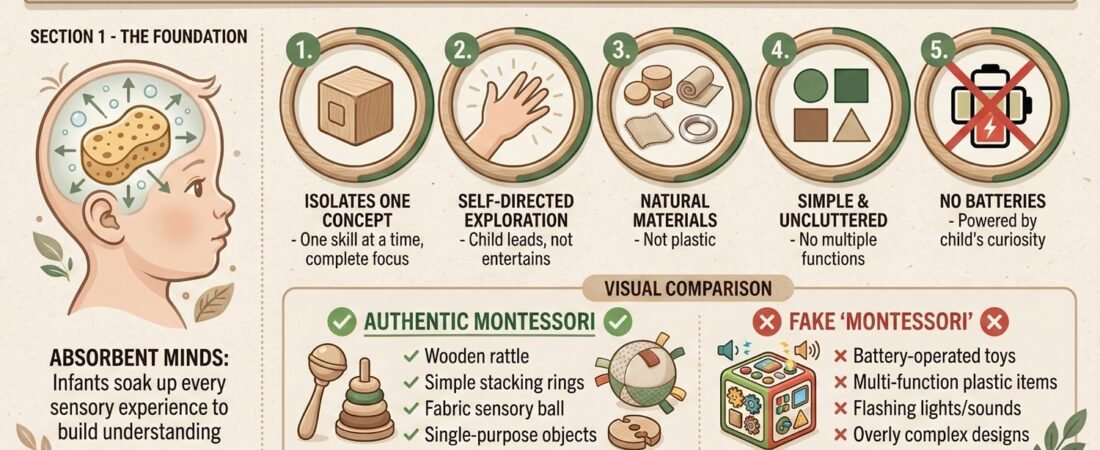
When I first uncovered Montessori principles for my own child, I felt completely overwhelmed by the sheer volume of products marketed as “Montessori.” The reality is that most of what you’ll find online has nothing to do with authentic Montessori philosophy. Manufacturers slap the word on anything made of wood or painted in neutral colors, regardless of whether it actually aligns with Montessori principles.
I spent weeks researching, reading Maria Montessori’s original work, and consulting with AMI-trained educators before I finally understood what truly qualifies as a Montessori material. The difference between authentic Montessori toys and mass-produced items labeled as such is actually profound, and it completely changes how your baby interacts with their environment and develops crucial skills during those critical early months.
Understanding What Makes a Toy Authentically Montessori
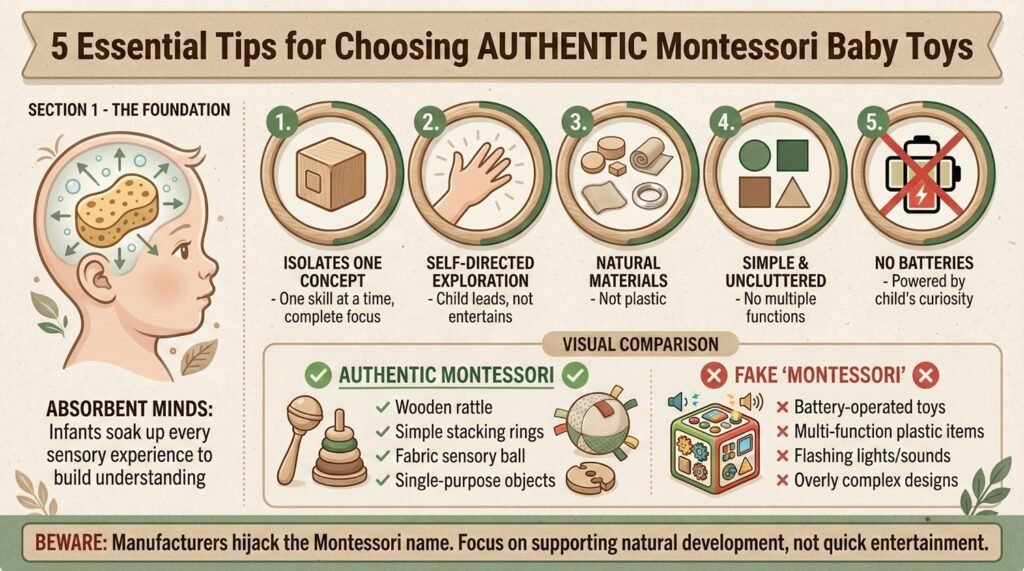
Before we get into the specific tips, you really need to understand the theoretical foundation behind Montessori materials. Maria Montessori didn’t just create educational toys, she developed scientifically designed learning materials based on extensive observation of how children naturally develop.
The Montessori method recognizes that infants and toddlers have absorbent minds, meaning they’re literally soaking up every sensory experience and using it to construct their understanding of the world. Authentic Montessori materials serve very specific developmental purposes.
They’re designed to facilitate natural development through self-directed exploration, not to entertain your baby or keep them busy while you make dinner.
Each material isolates one particular concept or skill, allowing your baby to focus their attention completely on mastering that one thing without distraction. This singular focus stands in stark contrast to how modern toy manufacturers approach design.
The challenge you’ll face is that modern toy manufacturers have essentially hijacked the Montessori name. I’ve seen battery-operated toys, plastic items with dozens of functions, and overly complex materials all marketed as Montessori.
This basic misunderstanding of the philosophy leads parents to purchase items that actually work against their child’s natural development rather than supporting it.
1. Natural Materials Over Synthetic
The first essential tip for choosing authentic Montessori baby toys is prioritizing natural materials, particularly wood, metal, fabric, and other elements found in nature. This comes directly from how babies develop sensory awareness and understanding of their physical world.
When your baby grasps a wooden rattle, they’re experiencing authentic weight, temperature, and texture. Wood feels different in warm hands versus cold.
It has natural variations in grain and color.
It makes a distinct sound when it contacts different surfaces. These sensory experiences are genuinely educational because they reflect how objects actually exist in the real world.
Your baby is building accurate mental constructs about physical properties through direct sensory experience.
Contrast this with plastic toys. Plastic always feels the same temperature regardless of environment.
It has uniform texture and appearance.
The sensory feedback is limited and artificial. Worse yet, many plastic toys are designed to provide the stimulation through external means, lights, sounds, movements, rather than allowing your baby to be the active agent in their exploration.
I uncovered this distinction really clearly when I gave my daughter both a plastic ring stacker and a wooden one. With the plastic version, she’d stack a few rings, get distracted by the bright colors, and move on within minutes.
The wooden stacker held her attention for significantly longer periods because she was actually problem-solving, figuring out weight distribution, practicing precision in her hand movements, and experiencing authentic cause and effect.
Natural materials also connect your baby to the real world in meaningful ways. Montessori philosophy emphasizes reality over fantasy, especially in the first three years.
Your baby is working incredibly hard to understand how the actual world functions.
Natural materials support this work by providing genuine sensory information rather than synthetic approximations.
When selecting toys, examine the materials carefully. Authentic Montessori toys use untreated or naturally finished wood rather than painted surfaces when possible.
If paint or stain is used, it should be non-toxic and applied sparingly.
Metal components should be actual metal, not plastic painted to look metallic. Fabric elements should be natural fibers like cotton, wool, or silk rather than synthetic materials.
The practical challenge here is that natural materials cost more to source and manufacture. This is why authentic Montessori materials typically have higher price points than mass-produced plastic choices.
You’re investing in quality materials that will last through multiple children and provide genuinely educational sensory experiences.
2. Purposeful Simplicity in Design
The second essential tip is choosing toys with purposeful simplicity rather than multiple functions or excessive complexity. This concept challenges everything modern toy marketing tells you.
We’ve been conditioned to think that toys offering more features, sounds, and activities provide better value and keep children entertained longer.
The opposite is actually true from a developmental perspective.
Authentic Montessori materials isolate one skill or concept. An object permanence box, for example, has exactly one function, your baby places a ball through a hole, and it disappears and reappears. There are no lights, no songs, no extra features.
This singular focus allows your baby to concentrate completely on understanding that one concept: objects continue to exist even when you can’t see them.
I remember watching my son work with a simple object permanence box for nearly twenty minutes when he was around eight months old. He would carefully place the ball through the hole, watch intently as it rolled out, retrieve it, and repeat the cycle over and over.
He was building concentration, refining his pincer grasp, understanding cause and effect, and developing object permanence all through this beautifully simple interaction.
A complex toy with multiple functions would have fragmented his attention and prevented this deep, focused work.
The theoretical foundation here relates to how the developing brain processes information. Young babies can’t filter sensory input the way adults can.
When a toy has multiple colors, textures, sounds, and functions, the experience becomes overwhelming rather than stimulating.
Your baby’s brain is trying to process everything simultaneously, which prevents them from truly understanding any one aspect deeply.
Simplicity also supports the development of creativity and imagination. When a toy has only one clear purpose, your baby must engage their own cognitive resources to explore it fully.
They become the active agent in their learning rather than a passive recipient of external stimulation.
This active engagement is absolutely critical for healthy cognitive development and builds the foundation for later creative thinking and problem-solving skills.
When evaluating toys, ask yourself: What is the specific purpose of this material? If you can’t identify one clear developmental goal, the toy probably fails the authenticity test.
Look for materials that do one thing exceptionally well rather than many things superficially.
A simple wooden ball in a cup, a basic shape sorter with just three shapes, or a single rattle with one type of sound, these focused materials support genuine learning far more effectively than complex multi-function toys.
The challenge many parents face is that simple toys seem boring or not enough. We worry our babies will lose interest quickly without constant novelty and stimulation.
But what I’ve observed consistently is that babies return to simple, well-designed materials repeatedly over extended periods.
My daughter used the same wooden egg in a cup from six months through eighteen months, each time exploring different aspects as her skills developed. A complex electronic toy from the same period was abandoned within weeks.
3. Real-World Functionality and Movement
The third essential tip involves choosing toys that function like real objects and move in authentic, physics-based ways. This principle distinguishes genuine Montessori materials from fantastical or mechanically altered toys that don’t reflect how the actual world operates.
Maria Montessori observed that children are naturally oriented toward reality. Babies are engaged in serious intellectual work, constructing mental models of how the physical world functions.
They need accurate information to build these models correctly.
Toys that behave in unrealistic ways actually interfere with this developmental process by providing false information about physical properties and relationships.
Consider the difference between a simple wooden car that rolls when pushed versus a battery-operated vehicle that moves on its own with flashing lights. When your baby pushes the wooden car, they directly experience cause and effect.
They learn about force, momentum, friction, and control.
They’re developing both their understanding of physics and their motor planning skills. The battery-operated car removes them from the equation entirely, they press a button, and something happens, but they’re not the agent of action, and they’re not learning about authentic movement.
I’ll never forget watching my son’s fascination with a simple wooden ball tracker. He would place a ball at the top and watch with intense concentration as gravity pulled it down through the levels.
He experimented with releasing the ball from different heights, placing multiple balls in sequence, and even trying to catch the ball partway down.
Every interaction taught him something real about how objects move through space. A mechanical toy with bells and whistles might have entertained him momentarily, but it wouldn’t have provided these genuine physics lessons.
Real-world functionality extends beyond movement to include how objects look and function. Authentic Montessori materials often use realistic representations rather than cartoonish approximations.
A wooden puzzle with realistic animal shapes helps your baby form accurate mental images of what animals actually look like.
Realistic play foods help them recognize actual fruits and vegetables. This commitment to reality supports language development, classification skills, and connection to their real environment.
The practical application here is carefully examining how toys move and function. Do they rely on batteries or mechanical systems that produce unrealistic movement?
Do they make electronic sounds rather than natural acoustic sounds?
Are they stylized and fantastical or realistic and grounded? Authentic Montessori toys let your baby be the source of action and provide feedback that accurately reflects physical reality.
This principle also extends to avoiding fantasy elements in toys for babies and young toddlers. Characters from media, anthropomorphized animals, or imaginary creatures don’t support your baby’s work of understanding reality.
There’s absolutely a place for imagination and creativity in childhood, but the Montessori approach suggests waiting until children have firmly established their understanding of what’s real before introducing fantasy elements, typically around age three or four.
The challenge is that realistic, physics-based toys require your baby to do more work. They don’t provide instant gratification or constant stimulation.
Parents sometimes interpret this as their baby being bored or the toy being inadequate.
But what’s actually happening is that your baby is thinking, planning, and learning. The periods of quiet observation or seemingly repetitive action represent intense cognitive work.
Trust the process and resist the urge to provide more stimulation.
4. Age-Appropriate Skill Isolation
The fourth essential tip is selecting toys that precisely match your baby’s current developmental stage and isolate specific skills they’re working to master. This needs really understanding developmental sequences and carefully observing your person child rather than relying solely on age labels on packaging.
Authentic Montessori education is based on following the child’s natural developmental trajectory. Maria Montessori identified sensitive periods, windows of time when children are particularly primed to develop certain skills.
During these periods, children are intensely focused on specific types of activities.
A toy that aligns with a sensitive period will absolutely captivate your child’s attention. One that doesn’t will be ignored regardless of how objectively “good” it is.
For young babies, the initial sensitive periods involve developing visual tracking, grasping reflexes, and beginning to understand object permanence. Materials that support these developing skills include high-contrast images for visual tracking, simple grasping toys like wooden rings or silk scarves, and basic object permanence materials.
As your baby develops, they move into sensitive periods for language, order, movement refinement, and small object manipulation.
I learned this principle through trial and error with my first child. I purchased a beautiful wooden shape sorter when she was seven months old because it looked perfect and was labeled for 6+ months.
She completely ignored it.
I put it away, and when I brought it out again at fourteen months, she worked with it daily for weeks. The toy hadn’t changed, her developmental readiness had.
I had jumped ahead of where she actually was developmentally rather than meeting her at her current stage.
Skill isolation means that each material focuses on developing one specific ability. A toy designed to build pincer grip shouldn’t also be working on color sorting and counting.
That combination might seem like better value, but it actually dilutes the developmental benefit.
Your baby can only focus on mastering one skill at a time. When a material combines multiple skills, they end up not truly mastering any of them.
The practical application needs observation. Watch what your baby is actually working on.
Are they refining their ability to transfer objects from one hand to another?
Are they interested in putting objects into containers? Are they working on pulling themselves up?
Once you identify the skill they’re developing, you can choose materials that specifically support that work.
This approach also means rotating toys based on developmental readiness rather than trying to provide everything at once. I keep most toys in storage and have only a small selection available at any given time.
When I observe my daughter mastering a skill or losing interest in a material, I rotate it out and introduce something aligned with her next developmental stage.
This prevents overwhelm and maintains her engagement with the materials that are actually useful to her current development.
The challenge here is that it needs patience and observation. Developmental timelines vary significantly between person children.
Your baby might be ready for certain materials earlier or later than average.
Authentic Montessori practice means following your specific child’s unique developmental path rather than imposing external expectations.
Another aspect of age-appropriate selection is ensuring materials are safe and manageable for your baby’s current physical abilities. A toy that needs precision beyond your baby’s current motor control will lead to frustration rather than engagement.
Conversely, toys that are too easy for their current skill level won’t capture their attention because there’s no challenge to overcome.
You’re looking for that sweet spot where the material is just slightly beyond their current ability, challenging enough to be interesting but achievable with effort and practice.
5. Passive Toys That Require Active Engagement
The fifth essential tip is choosing passive toys that require your baby to be the active agent rather than active toys that do the work for them. This concept really flips conventional toy marketing on its head and gets to the heart of authentic Montessori philosophy.
A passive toy is one that doesn’t do anything on its own. It needs your baby to act upon it to create any result.
A wooden rattle doesn’t make sound until your baby shakes it.
A ball doesn’t move until your baby rolls or throws it. A stacking ring doesn’t stack itself.
These materials put your baby completely in control of the action, which means they’re actively thinking, planning, and learning throughout the interaction.
An active toy, in contrast, does things on its own with minimal input from your baby. Battery-operated toys that move, play music, or light up when a button is pressed are active toys.
They provide entertainment, but they don’t require genuine engagement.
Your baby becomes a passive observer of the toy’s actions rather than an active participant in their own learning.
The distinction matters profoundly for cognitive development. When your baby is actively engaged with a passive toy, they’re making decisions, solving problems, experimenting with variables, and experiencing authentic consequences of their actions.
These cognitive processes build neural connections and develop executive function skills.
Active toys that do the work rob your baby of these developmental opportunities.
I saw this principle in action when comparing my son’s engagement with different types of toys. He had a light-up toy that played music and moved when he pressed buttons.
He would press buttons randomly, watch the show for a few seconds, then press more buttons without any real intention or thought process.
Compare that to his engagement with a simple wooden puzzle where he had to figure out how shapes fit into corresponding holes. He would study the shapes, try different orientations, experience failure, adjust his approach, and finally succeed. The cognitive work happening during puzzle play was exponentially greater than during button-pushing.
Passive toys also support the development of concentration and sustained attention. Because your baby must actively engage to create results, they stay focused for longer periods.
There’s no automatic show to watch passively, they must continue working to continue the experience.
This builds attention span and the ability to continue through challenges, which are foundational skills for all later learning.
The practical challenge is that passive toys seem less impressive and entertaining. When you’re comparing options, the toy that lights up and plays songs seems more engaging than the simple wooden version.
And initially, your baby might be drawn to the flashy option.
But sustained, meaningful engagement consistently happens with passive materials that require active participation.
When selecting toys, examine who is doing the work, the toy or the baby. Does the toy require batteries?
Does it have electronic components that provide stimulation?
Does it do things automatically? These are signs of an active toy.
Look instead for materials that sit inert until your baby acts upon them.
Simple balls, stacking toys, basic shape sorters, wooden vehicles without motors, textured fabrics for exploration, these passive materials empower your baby to be the agent of their own learning.
This principle also extends to avoiding toys with excessive feedback. Some toys that are technically passive still provide exaggerated responses to actions, a shape sorter that plays a song when the fix shape goes in, for example.
While the sorting is passive, the electronic reward shifts focus away from the intrinsic satisfaction of solving the puzzle to the external reward of the sound.
Authentic Montessori materials provide only natural feedback, the shape fits or it doesn’t, the tower stands or it falls, the ball rolls or it doesn’t.
I’ve found that the most beloved and often used toys in our home are the simplest, most passive materials. A basket of wooden eggs, a set of stacking cups, silk scarves, wooden spoons and bowls, these basic items get used daily in endlessly creative ways because my children must bring their own creativity and intention to the play.
The electronic toys gather dust because once you’ve pressed all the buttons and seen all the programmed responses, there’s nothing more to explore.
People Also Asked
What age should I start using Montessori toys?
You can start using Montessori materials from birth. Newborns benefit from simple mobiles with specific movement patterns and high-contrast images that support visual tracking development.
By three months, introduce lightweight grasping toys made from natural materials.
The key is selecting materials that match your baby’s current developmental stage rather than following rigid age guidelines on packaging.
Are expensive Montessori toys worth the investment?
Quality Montessori materials typically cost more because they use natural materials and careful craftsmanship, but you don’t need to spend a fortune. Many authentic Montessori materials can be household objects like wooden spoons, metal whisks, and fabric napkins.
Focus on a few well-made items that your child will use for extended periods rather than accumulating many lower-quality toys.
How do I know if a toy is really Montessori?
Authentic Montessori toys share specific characteristics: they’re made from natural materials, have one clear purpose, move in realistic ways based on physics, match your child’s developmental stage, and require active engagement from your child rather than doing the work themselves. If a toy has batteries, multiple functions, or unrealistic features, it likely doesn’t align with authentic Montessori principles regardless of how it’s marketed.
Can Montessori toys help with speech development?
Montessori materials support language development indirectly by encouraging focused attention, problem-solving, and interaction with realistic objects that connect to vocabulary. Realistic toy versions of household items, animals, and vehicles give your child concrete objects to associate with words.
The concentration and cognitive skills developed through Montessori materials create a foundation that supports all areas of learning, including language.
What’s the difference between Montessori and Waldorf toys?
Montessori materials emphasize reality, natural consequences, and skill isolation during early childhood, typically using realistic representations and natural materials in their finished state. Waldorf toys lean more toward simplicity and imagination, often featuring softer materials and less defined forms that encourage creative interpretation.
Both philosophies value natural materials and open-ended play but differ in their approach to realism versus imagination.
How many toys should a baby have at once?
Montessori philosophy emphasizes a prepared environment with limited, carefully selected options. I recommend having only five to seven toys available at any given time.
This prevents overwhelm and allows your baby to engage deeply with each material.
Rotate toys every few weeks based on your observations of what your child has mastered and what new skills they’re developing.
Key Takeaways
Authentic Montessori baby toys prioritize natural materials that provide genuine sensory feedback and connect children to the real physical world rather than synthetic approximations.
Purposeful simplicity that isolates one skill or concept supports deep concentration and genuine learning far more effectively than complex multi-function toys that fragment attention.
Real-world functionality and physics-based movement provide accurate information about how the actual world operates, supporting children’s basic work of constructing mental models of reality.
Age-appropriate skill isolation needs careful observation of your person child’s developmental stage and selecting materials that precisely match their current sensitive periods rather than relying solely on age labels.
Passive toys that require active engagement from your baby develop cognitive skills, problem-solving abilities, and sustained attention while active toys that do the work create passive observers rather than active learners.