
We may earn money or products from the companies mentioned in this post.
If your previous experiences shopping for baby toys have taught you that educational products are overpriced, confusing, or need a PhD to understand which ones actually work, you might unknowingly be gravitating toward the cheapest plastic options that reinforce those frustrations.
So, how do you break this pattern? It starts with understanding what makes a toy genuinely Montessori.
You need to look past the marketing buzzwords and examine the materials, design, and developmental purpose.
Your baby’s environment is a key regulator of their learning process, and it’s one of the basic elements that promote independence and natural curiosity. When you come across toys that display inconsistent quality, vague age recommendations, or overwhelming features, does your confusion increase, but your confidence in making the right choice also reduces.
The unpredictable nature of modern toy marketing triggers decision fatigue in you as a caregiver.
This produces anxiety during moments of gift-giving or milestone planning, while the feeling of “needing to buy the perfect thing” creates purchasing decisions that have little connection to what your baby actually needs for genuine development.
What makes a toy truly Montessori
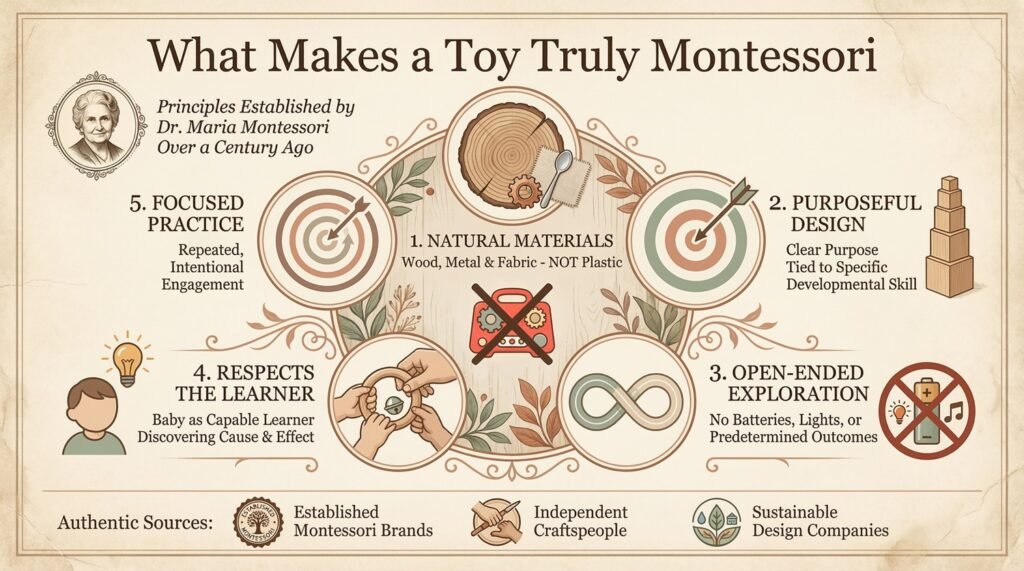
Real Montessori toys follow specific principles established by Dr. Maria Montessori over a century ago. They use natural materials like wood, metal, and fabric as opposed to plastic.
They serve a clear purpose tied to a specific developmental skill.
They allow for open-ended exploration without batteries, lights, or predetermined outcomes. Most importantly, they respect your baby as a capable learner who can uncover cause and effect through repeated, focused practice.
The toys on this list come from established Montessori brands, independent craftspeople who understand the philosophy, and companies that prioritize sustainable materials and thoughtful design. Each description includes what makes it authentically Montessori and which developmental stage it supports best.
The Complete List
1. Wooden Baby Gym with Natural Cotton Toys
This floor gym uses untreated hardwood frames with dangling toys made from organic cotton and natural wood. Unlike plastic activity gyms, the muted colors and simple shapes don’t overstimulate.
Babies from birth to six months practice reaching, tracking with their eyes, and eventually grasping.
The toys hang at the right height to encourage movement without frustration.
[Available from many Montessori retailers and Etsy shops specializing in wooden baby equipment]
2. Infant Grasping Beads
These connected wooden beads in a loop shape fit perfectly in tiny hands from about three months onward. The beads move along an elastic cord, creating satisfying clicks and rotations.
This toy teaches cause and effect while building the palmer grasp that comes before pincer grip.
The natural maple or beech wood is safe for mouthing and teething.
[Find these through Bella Luna Toys, Monti Kids, or similar Montessori suppliers]
3. Wooden Interlocking Discs
Three smooth wooden rings connect and pull apart with gentle effort. Around four to six months, babies work on transferring objects between hands.
These discs make an excellent tool for that skill.
The weight provides good sensory feedback, and the simple design means your baby focuses on the action as opposed to decorative details.
[Lovevery, Bannor Toys, and specialist Montessori shops carry versions of this classic]
4. Baby-Safe Floor Mirror
A shatterproof acrylic mirror with a sturdy wooden frame sits at floor level for tummy time. Babies are fascinated by their own reflection and will work harder to lift their heads and prop on their forearms when they can see themselves.
This supports neck strength and body awareness from the earliest weeks.
Some versions include a wooden bar across the top for pulling up later.
5. Single Wooden Rattle
Not a set, just one simple rattle made from a single piece of turned wood with a few wooden beads inside. The quiet sound differs completely from plastic rattles.
Babies from two months can begin practicing their grip, and the natural weight helps them understand how their movements create sounds.
Look for ones without any finish or only food-safe oil.
[Grimms, Maple Landmark, and person craftspeople on Etsy make beautiful versions]
6. Geometric Wooden Shapes in a Basket
A small woven basket holds five to eight wooden shapes like cubes, spheres, cylinders, and rectangular prisms. From six months onward, your baby explores these shapes through mouthing, banging, transferring, and eventually shape recognition.
The variety in form provides rich sensory input.
The basket itself teaches containment and order.
[Guidecraft, Montessori outlets, or source shapes individually from craft suppliers]
7. Wooden Egg and Cup
A smooth wooden egg sits in a matching cup. This deceptively simple toy teaches in and out, containment, fine motor control, and eventually size relationships if you get a set with graduated sizes.
Babies around seven to nine months find this endlessly engaging.
The egg shape is easier to grasp than a ball but still rolls in interesting ways.
[Classic Montessori material available from Alison’s Montessori, Bruins Montessori, and others]
8. Stacking Rings on a Rocking Base
Not the typical rainbow stacker with the tallest pole. Montessori versions use a shorter, thicker post on a gently curved base that rocks.
The rings are uniform in color or use muted natural tones.
This design emphasizes the stacking action and size sequencing without the distraction of bright colors. Suitable from around eight months as babies work on releasing objects precisely.
[Plan Toys, Hape, and Montessori Services carry suitable versions]
9. Ball Tracker with Wooden Balls
A simple inclined plane with tracks let’s wooden balls roll from top to bottom. Babies around six months watch intently, building visual tracking and understanding of gravity and movement.
By nine months, they begin placing balls at the top themselves, practicing hand-eye coordination and the pincer grasp.
The repetitive action supports concentration.
[Melissa & Doug, Hape, and Montessori curriculum suppliers offer various designs]
10. Object Permanence Box with Wooden Ball
A wooden box with a hole on top and an opening in front contains a wooden ball. The ball drops through the hole, rolls down an internal ramp, and reappears at the front.
This directly teaches object permanence, the understanding that things continue to exist even when out of sight.
This cognitive leap typically happens around eight to ten months, and this toy provides perfect practice.
[Essential Montessori material from Alison’s, Montessori N Such, or DIY plans available]
11. Wooden Coin Box
A sturdy wooden box with a rectangular slot on top and a drawer or door in front comes with large wooden discs or rectangles. Your baby practices posting the coins through the slot, then opens the drawer to retrieve them.
This teaches persistence, hand-eye coordination, and cause and effect.
Most babies engage with this around ten to twelve months.
[Available from Montessori material suppliers and some Etsy sellers]
12. Wooden Push Toy with Dowel Handle
A simple wooden cart or animal shape on wheels with a long dowel handle supports early walking from around nine to twelve months. Unlike busy walkers with electronic panels, this design focuses solely on movement support.
The weight should be substantial enough to provide stability without tipping, and the handle should be adjustable or appropriately sized.
[PlanToys, Hape, Radio Flyer wooden options, or local craftspeople]
13. Wooden Peg Board with Large Pegs
A board with five to nine large holes holds thick wooden pegs. This toy teaches vertical placement, builds pincer grasp strength, and supports concentration through repetitive action.
The pegs should be about the diameter of a quarter and protrude enough for easy grasping.
Best for babies around ten to fourteen months.
[Melissa & Doug, Guidecraft, and Montessori material companies]
14. Musical Wooden Shaker Set
A set of three to five wooden shakers, each with different materials inside like rice, beans, small beads, or bells. The variety creates different sounds and weights.
These support auditory discrimination and cause-effect learning from about four months, then become tools for intentional music-making as your baby gains more control.
[Grimms, small toymakers, or easily made at home with proper sealing]
15. Nesting Wooden Boxes or Bowls
Five to seven wooden boxes or bowls nest inside each other. Babies around eight to twelve months explore taking them apart, then gradually learn to nest them back together based on size relationships.
This builds spatial reasoning, problem-solving, and fine motor control.
The open-ended nature means they stay useful for years.
[Grimms, Grapat, PlanToys, and various Montessori suppliers]
16. Wooden Sorting Tray with Objects
A divided wooden tray with two or three sections comes with a small collection of natural objects like shells, smooth stones, large wooden beads, or fabric squares. This introduces early sorting and classification, though babies under twelve months mostly practice transferring objects between sections.
It prepares the ground for more complex sorting later.
[DIY option or from Montessori material makers]
17. Treasure Basket Collection
Not one toy but a low basket filled with safe household and natural objects: a wooden spoon, metal measuring cup, large shells, a natural loofah, a soft cloth, a silicone trivet. Babies from six months who can sit independently spend long stretches exploring these real-world textures, weights, and shapes.
Rotate objects weekly to maintain interest.
[Assemble yourself or find pre-made collections from Montessori teachers on Etsy]
18. Soft Fabric Ball Set
While not wooden, fabric balls made from organic cotton or linen with various textures and simple patterns align perfectly with Montessori principles. They’re easier for young babies to grasp than hard balls, don’t roll away as easily, and are safe for mouthing.
A set of three to five in different sizes supports tracking, reaching, and early throwing from three months onward.
[Haba, small makers on Etsy, or sew your own from scraps]
19. Pull Toy with Simple Design
A wooden animal, geometric shape, or small wagon on wheels attaches to a cotton cord. Once your baby is confidently walking, around twelve to fifteen months, they love pulling something behind them.
This builds coordination, spatial awareness, and provides motivation for walking practice.
The toy should be simple in design without unnecessary decorations.
[PlanToys, Hape, Ostheimer, local toymakers]
20. Wooden Hammering Bench
A small bench with three to four large wooden pegs and a wooden hammer. Babies around twelve months love the cause-effect of hammering pegs through holes.
This builds hand-eye coordination, bilateral coordination, and provides physical outlet for energy.
Look for designs where pegs drop through as opposed to pop back up, which better matches real-world physics.
[Melissa & Doug, Hape, and most Montessori material companies]
Finding your starting point
The best first purchase depends on your baby’s current stage. For newborns to three months, you need very little: the floor mirror, play gym, and perhaps a single rattle cover all bases.
Babies this young need lots of face time with you, floor freedom, and simple visual stimulation.
From three to six months, add grasping toys like the interlocking discs, grasping beads, and geometric shapes. Your baby is working on reaching, transferring between hands, and bringing objects to their mouth for exploration.
The six to nine month stage brings sitting up and the beginning of intentional manipulation. This is when the egg and cup, coin box, stacking rings, and ball tracker become relevant.
Your baby is learning cause and effect and how to make things happen on purpose.
From nine to twelve months, as your baby becomes mobile and more coordinated, introduce the peg board, nesting boxes, push toy, and hammering bench. These support the drive toward independence and more complex problem-solving.
You do not need every toy on this list. Montessori philosophy actually emphasizes having fewer toys available at once.
Choose three to five items suitable for your baby’s current skills, place them on a low shelf within reach, and rotate weekly.
This prevents overwhelm and allows for deep, focused engagement with each material.
The investment in quality Montessori toys pays off through years of use. Unlike battery-operated toys that break or lose appeal, these wooden pieces work for many children and often become family heirlooms.
Many keep resale value in good condition.
When shopping, check reviews specifically for durability, finish quality, and size accuracy. Some cheaply made versions splinter, have rough edges, or use pieces too small for the stated age range.
Established Montessori brands have stricter quality control, though you’ll pay more upfront.
Our favorite from this entire list is the object permanence box. It serves such a specific developmental purpose at exactly the right time, and babies show pure joy when they master it.
The wooden coin box comes in as a close second for similar reasons.
Both teach persistence and provide clear feedback that motivates repeated practice.
Start with one or two items that match where your baby is right now. Watch how they engage with it.
You’ll quickly see the difference between a toy that truly supports development and one that just entertains briefly.
Then add gradually, always keeping your baby’s growing abilities and interests as the guide.
Frequently Asked Questions
How can I tell if a toy labeled Montessori is actually authentic?
Check three things: materials should be natural like wood, metal, or fabric as opposed to plastic, the design should be simple and focused on one skill as opposed to many flashing features, and the toy should allow open-ended exploration as opposed to having one “right” way to play. Real Montessori toys also avoid bright primary colors in favor of natural wood tones or muted shades.
If it has batteries, lights, or makes automatic sounds, it’s not Montessori regardless of what the package says.
Read reviews from Montessori educators and experienced parents who mention how their child used it, not just that it’s “cute” or “educational.”
Are wooden Montessori toys worth the higher price compared to plastic choices?
The math works differently than it appears initially. A quality wooden rattle at twenty-five dollars lasts through many children and years of use, including teething, dropping, and outdoor play.
A five-dollar plastic rattle typically breaks within months and needs replacing.
Wooden toys hold their value, you can resell them for half the original price or more in good condition. They’re also safer since they don’t contain phthalates, BPA, or other chemicals that leach from plastic.
The bigger value comes from engagement time.
Babies and toddlers return to well-designed wooden toys repeatedly for years, while plastic toys often get ignored after a few days. Calculate cost per hour of engagement as opposed to just upfront price.
At what age should I introduce Montessori toys?
Start from birth with very simple items. A floor mirror and a basic play gym work from day one.
Add a single wooden rattle around six to eight weeks when grasp reflex begins intentional grasping.
The key is matching the toy to emerging skills as opposed to waiting for skills to fully develop. Babies need opportunities to practice skills as they’re developing, not after mastery.
Watch your baby closely.
When you notice them working on transferring objects between hands, that’s when you introduce toys designed for that skill. When they start trying to put objects in containers, provide the egg and cup.
The toys support practice during the sensitive period when the brain is most primed to learn that particular skill.
How many Montessori toys should I have available at once?
Fewer than you think. Montessori environments typically display only three to five items at a time on a low shelf where the baby can see and reach them.
This limited selection reduces overwhelm and allows for deep concentration with each material.
Store other toys out of sight and rotate them weekly or every two weeks. Rotation serves two purposes: it keeps toys feeling fresh and interesting, and it allows you to match available toys to your baby’s current developmental focus.
You might have fifteen toys total but only show five at a time.
This approach also makes cleanup simpler and helps your baby develop focus and attention span.
Can I make Montessori toys myself instead of buying them?
Many Montessori toys work well as DIY projects if you have basic woodworking skills and tools. The treasure basket is the easiest, just collect safe household items in a basket.
You can make simple rattles from smooth wooden rings, small bells, and cotton cord.
The wooden coin box can be constructed from craft wood with a hand saw and wood glue. What matters more than perfect construction is using natural materials, keeping the design simple and focused, and ensuring safety through smooth edges and suitable sizing.
Several Montessori blogs and YouTube channels provide free plans with measurements.
If you’re making toys for your own baby, they don’t need to be beautiful, just functional and safe. Sanding is the most important step since rough wood can splinter.
Use food-safe finish like mineral oil or beeswax if any finish at all.
What if my baby seems bored with Montessori toys and prefers flashy plastic ones?
This usually happens when babies have access to both types simultaneously. The brain naturally orients toward bright lights, sounds, and movement because those signal potential danger or reward in our evolutionary history.
When you remove the high-stimulation toys for a week or two, most babies will reset and engage with simpler toys more deeply.
It’s similar to taste preferences: kids raised on very sweet foods find plain fruit boring, but when you reduce added sugar for a few weeks, natural sweetness becomes satisfying again. The engagement you’re looking for with Montessori toys looks different too. It’s quiet, focused, and repetitive as opposed to excited and varied. A baby shaking a rattle repeatedly for five minutes while studying it intently is getting more developmental benefit than a baby pressing buttons on a toy that lights up for fifteen minutes.
Do Montessori toys work for babies with developmental delays?
The principles often work even better because they allow babies to work at their own pace without pressure or time limits. The clear focus on one skill per toy provides less confusion than busy toys that need many abilities at once.
However, you may need to adjust which toys you introduce based on current abilities as opposed to chronological age.
A twelve-month-old working on grasping skills might benefit more from toys typically used at four to six months. Occupational therapists and early intervention specialists often incorporate Montessori materials into therapy because the design naturally supports skill progression.
The wooden balls, geometric shapes, and egg and cup are particularly useful across ability levels.
The key is following your baby’s lead and celebrating whatever level of engagement they show as opposed to comparing to age norms.
References
Montessori, Maria. The Montessori Method.
Frederick A.
Stokes Company, 1912.
Lillard, Angeline S. Montessori: The Science Behind the Genius.
Oxford University Press, 2017.
Standing, E.M. Maria Montessori: Her Life and Work.
Plume, 1998.
American Academy of Pediatrics. “Selecting Appropriate Toys for Young Children in the Digital Era.” Pediatrics, vol.
143, no.
1, 2019.
Product information sourced from manufacturer websites including PlanToys, Hape, Melissa & Doug, Lovevery, Grimms, and established Montessori material suppliers.