
We may earn money or products from the companies mentioned in this post.
Learn which ones work, costs, and age-appropriate picks.
Quick Answer (TL, DR)
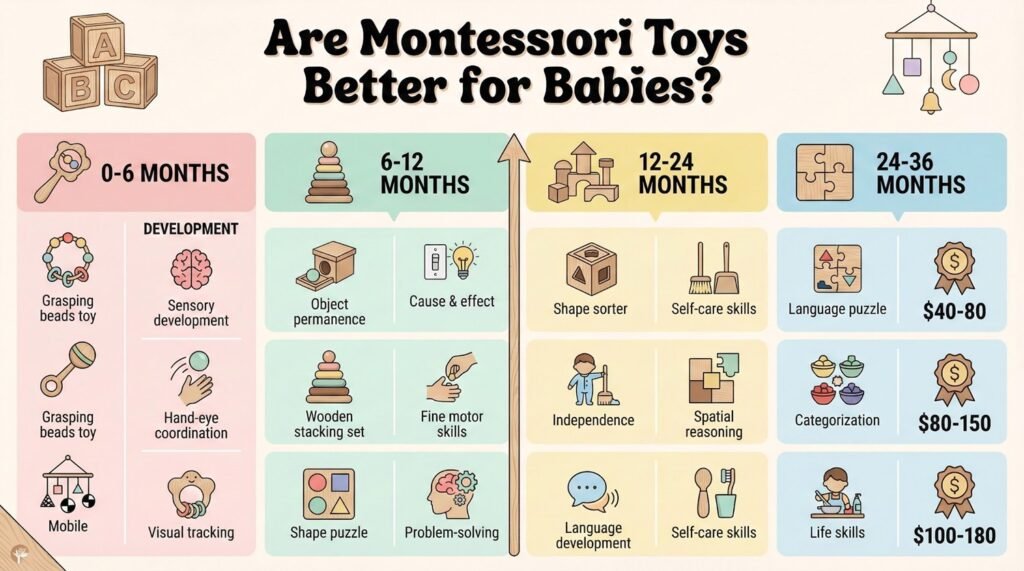
Montessori toys provide genuine developmental benefits when you pick the right ones for your baby’s stage. They’re designed to build focus, motor skills, and problem-solving without all the noise and lights.
The wooden materials last longer. Your baby can actually figure out how they work.
And research backs up that kids learn better with simpler toys that make them do the thinking.
But here’s the thing, not every wooden toy labeled “Montessori” actually follows the principles. And you don’t need to spend thousands building a collection.
So are Montessori toys better for babies? For parents who want quality over quantity and can handle the upfront cost, yes.
For parents on a tight budget who need variety, standard toys work fine too.
Understanding the Question
When parents search “are montessori toys better for babies,” they’re usually trying to figure out three things.
First, do these toys actually help development or is it just marketing hype?
Second, are they worth the price tag when you can get plastic toys for way less?
Third, how do you even know which ones to buy when everything claims to be “Montessori-inspired”?
The confusion makes sense. Walk into any store and you’ll see wooden toys with premium prices slapped with Montessori labels.
But Dr. Maria Montessori developed specific principles over a century ago about how toys should function, what materials work best, and how they fit into a child’s environment.
A wooden toy isn’t automatically Montessori just because it costs more. The design philosophy matters way more than the material or the price.
The Research Behind Montessori Toys
University of Virginia research found that Montessori education helps low-income students perform at the same level as higher-income peers. Psychology professor Angeline Lillard noted the system matches how people naturally learn and develop.
That research translates directly to toys because authentic Montessori materials operate on child development principles refined over decades.
The American Academy of Pediatrics states that play contributes to cognitive, physical, social, and emotional wellbeing. They specifically recommend toys promoting language-rich interactions, pretend play, physical activity, problem-solving, and creativity, all hallmarks of real Montessori materials.
A 2017 National Institutes of Health study found that contact with wood induces physiological relaxation. Wooden Montessori toys create a calmer play environment compared to plastic choices.
This matters because over-stimulation from too many toys and bright lights actually reduces focus and learning capacity.
Over-stimulated babies can’t concentrate. Calm babies can.
What Actually Makes a Toy “Montessori”
The label matters less than the actual design. Real Montessori toys share these traits:
Simplicity means no lights, sounds, or unnecessary features. The toy teaches through interaction, not distraction.
Natural materials like wood, cloth, metal, and silicone are standard. These materials feel better in small hands and age well without breaking down.
Self-correcting design let’s children identify and fix their own mistakes without adult help. A shape sorter is self-correcting because the wrong shape won’t fit.
A puzzle is self-correcting because missing pieces are obvious.
Open-ended nature means the toy doesn’t have one “correct” way to play. Blocks can stack, fall, line up, build houses, or create patterns.
Realism means toys represent actual objects accurately as opposed to through fantasy characters or weird proportions.
Developmental appropriateness means the challenge level matches your baby’s current abilities, not their age on the calendar.
Here’s how this looks in real life. A wooden stacking ring toy teaches spatial awareness, motor control, and cause-and-effect without batteries or constant supervision.
Your 10-month-old grabs the ring, slides it onto the dowel, and immediately understands success.
They try again if they miss.
No adult validation required. They know they did it.
Comparing Montessori Toys to Standard Toys
The difference isn’t about material quality alone. The difference is how children interact with them.
Standard toys often entertain passively. Your baby watches things light up, play sounds, or move without much input.
Montessori toys demand action.
Your baby has to manipulate, adjust, problem-solve, and figure things out.
Research shows this matters enormously. When children had access to fewer, higher-quality toys, they showed longer periods of engagement and more creative play patterns.
Studies found that Montessori education leads to more creative people.
The mechanism is straightforward. Fewer toys with more possibilities develop stronger thinking than many toys with fixed purposes.
On cost, a plastic toy might cost $15 and last 8 months (that’s $1.88 per month). A wooden Montessori version might cost $34 and last 36 months (that’s $0.94 per month).
You’re paying for durability that outlasts many children. The per-month cost actually drops.
The higher upfront investment makes sense if you have many kids or plan to pass toys to younger siblings.
[If you’re starting your Montessori collection, check out wooden stacking rings, they’re probably the best first investment because babies use them for 18+ months as skills develop]
What Babies Actually Need by Age
The confusion about are Montessori toys better for babies often comes from using the wrong toys at the wrong stages. Babies don’t have the same needs at 2 months, 6 months, and 12 months.
0-6 Months: Sensory Foundation
Newborns aren’t ready for “toys” in the traditional sense. They need sensory input and grasping practice.
Montessori materials for this stage include wooden grasping beads (smooth, large, on natural cord), simple wooden rattles with minimal sound, black and white geometric mobiles for visual development, and teethers made from soft non-toxic materials.
The focus here is building neural pathways. Research from Zero to Three shows that our earliest days, weeks and months of life create unparalleled growth when trillions of brain cell connections form.
6-12 Months: Cause and Effect
Around 9 months, babies understand cause and effect clearly. Banging a block makes noise.
Dropping one makes it fall.
This is when object permanence boxes become useful.
A wooden box with a ball that drops through a slot teaches this concept. Your baby puts the ball in, it disappears, they open the door to find it. Repeat 100 times (seriously, they’ll do it that many times).
Also include stacking rings, single-shape puzzles, nesting boxes, and simple stacking cups.
12-24 Months: Independence and Skill Building
Toddlers want to do things themselves. Fine motor skills improve dramatically.
This is the stage where shape sorters, practical life activities (child-sized tools for cleaning), and more complex building materials become suitable.
The word “toddler” literally comes from how they toddle and move. Toys should encourage this.
Look for materials that let them button, unbutton, pour, and sort while staying safe.
[Object permanence boxes are solid picks for the 9-15 month range, they teach that things still exist even when hidden, which is a huge developmental milestone]
24-36 Months: Expanding Capabilities
Two-year-old are ready for language development materials, more complex puzzles, and simple tools. Color tiles, realistic animals, and child-sized tools for food preparation become suitable.
The Real Value of Montessori Approach
The toys themselves aren’t magical. How you use them matters more.
Authentic Montessori works because it respects how children actually learn, through sensory exploration, repetition, and independent problem-solving. Parents who buy expensive Montessori toys but then direct every interaction (“Put the block there, no not there”) won’t see benefits.
Parents who create a prepared environment where the baby chooses what to do and when see remarkable development.
The environment matters as much as the toys. Low shelves, child-sized furniture, open play spaces, and easy access to materials encourage self-sufficiency.
Your baby can choose what to explore without asking permission.
They can reach toys without assistance. They learn that their choices matter.
The research is clear on this. Montessori-educated children develop stronger executive function, better emotional regulation, improved mathematical reasoning, and stronger reading comprehension.
These aren’t just academic outcomes, they continue into adulthood with research showing an association between Montessori education in childhood and adult wellbeing.
How Many Toys Does Your Baby Actually Need?
This question reveals the biggest misunderstanding about Montessori. Parents assume they need to buy a whole catalog of toys.
The opposite is true.
Research strongly supports quality over quantity. Studies show that an environment with fewer toys leads to higher quality play for toddlers.
Children show longer attention spans and more creative engagement when provided with fewer, carefully chosen materials.
Start with 3-5 core materials per developmental area and rotate items to maintain interest.
A minimalist approach isn’t deprivation. Your baby gets more mental engagement from exploring five toys deeply than from being overwhelmed by 50.
| Age Range | Essential Montessori Toys | Skills Developed | Approximate Cost |
|---|---|---|---|
| 0-6 months | Grasping beads, simple rattle, black/white mobile, teether | Sensory development, hand-eye coordination, visual tracking | $40-80 total |
| 6-12 months | Object permanence box, stacking rings, single-shape puzzle | Cause and effect, fine motor skills, problem-solving | $60-120 total |
| 12-24 months | Shape sorter, nesting boxes, practical life tools, building blocks | Independence, spatial reasoning, self-care skills | $80-150 total |
| 24-36 months | Complex puzzles, color sorting, realistic figures, child-sized utensils | Language development, categorization, life skills | $100-180 total |
Cost Breakdown: Is the Investment Worth It?
High-quality Montessori toys cost more upfront. A wooden object permanence box might run $30-50.
A set of nesting boxes might cost $40-60.
This creates genuine hesitation.
But the math shifts when you consider durability (these toys handle many children and years of use while plastic toys break quickly), resale value (wooden Montessori toys hold value and you can sell used sets to recoup 40-60% of your investment), fewer toys needed (you spend $300-400 building a proper collection as opposed to $1,000+ on toy variety that never gets used), and developmental fit (because toys match actual developmental stages, your baby gets more learning from each dollar spent).
The cost objection makes sense but often inverts when you calculate total spending. Parents who buy lots of cheap toys typically spend more money overall while seeing less engagement and learning.
[Nesting boxes punch above their weight for value, babies use them from 8 months through age 3 for stacking, nesting, hiding things, sorting, and pretend play]
Avoiding Counterfeit “Montessori” Products
This is where many parents get burned. The term “Montessori-inspired” or “Montessori-style” has no legal definition. Companies use it to charge premium prices for toys that lack the actual principles.
A real Montessori toy should have clear simple functionality with no unnecessary features, natural materials (especially wood), self-correcting design so your baby knows if they’re successful, many developmental possibilities that evolve with the child, and aesthetic appeal (nice design matters because it teaches appreciation for beauty).
If a toy has buttons, lights, sounds, or needs batteries, it’s not Montessori-designed. If it’s aimed at a specific age only (instead of growing with the child), it’s not authentic. If the company’s marketing focuses more on “boosting IQ” than on hands-on learning, it’s missing the point.
Expert Insights: What Child Development Specialists Actually Say
The Association Montessori International notes that during the past twenty years the amount of scientific research confirming the Montessori method has increased. Studies show that the principles Dr. Montessori envisioned do create joyful learners.
Dr. Maria Montessori herself emphasized quality over quantity. Recent research confirms this philosophy completely.
The benefits documented across many studies include enhanced executive function and self-regulation, improved problem-solving and critical thinking, better emotional regulation and social skills, higher levels of creative thinking, and stronger academic foundation that continues through childhood into adulthood.
Key Benefits That Actually Matter
Fine Motor Development happens because Montessori toys emphasize precise hand movements. Threading beads, manipulating shape sorters, and stacking materials build the small muscle control needed for writing and self-care.
This isn’t abstract, stronger fine motor skills in toddlerhood correlate with better writing ability in elementary school.
Concentration and Focus develop because toys designed without distraction allow babies and toddlers to focus longer. According to Zero to Three, the most useful toys are those that need the most action on the part of a young child.
Montessori toys demand participation, which builds attention span naturally.
Independence and Confidence grow because Montessori toys include built-in error correction. Babies can succeed without adult intervention.
This breeds confidence and intrinsic motivation that lasts well beyond childhood.
Your baby learns “I can figure this out,” not “I need someone to tell me if I’m right.”
Problem-Solving Capability develops because as opposed to toys with predetermined outcomes, Montessori materials present challenges requiring systematic thinking. A shape sorter doesn’t tell your baby what to do.
Your baby has to figure out which shapes fit which holes.
That’s learning.
Practical Life Skills come from many Montessori toys teaching real skills like pouring, sorting, buttoning, and cleaning. These aren’t abstract lessons, they’re actual competencies that make your baby more capable and confident.
When Montessori Toys Make Sense (And When They Don’t)
Invest in Montessori if you plan to have many children (toys pay for themselves across kids), you value developmental alignment over entertainment variety, you want toys that last and hold resale value, you’re drawn to the independent prepared-environment philosophy, and budget allows for quality purchases.
Standard toys might work better if you have one child with limited lifespan needs, budget is extremely tight (though buying fewer quality toys helps here too), your parenting style is hands-on directive as opposed to independent exploration-based, or you enjoy often changing toy selection.
[If you’re on a budget, prioritize one quality toy per developmental category as opposed to buying everything at once, you can always add more as your baby grows]
Real-World Outcomes
Research from University of Virginia shows that children in Montessori environments develop stronger executive function skills, better emotional regulation, and improved mathematical reasoning. These aren’t theoretical benefits, they show up in how children handle challenges, interact with peers, and approach academic work.
The connection between early play experiences and adult wellbeing is documented. Early Montessori experiences don’t guarantee success, but they create conditions where learning feels natural, confidence builds through success, and children develop intrinsic motivation as opposed to relying on external rewards.
Additional Resources
Books like “The Montessori Toddler” by Simone Davies provide practical guidance on implementing Montessori principles at home without needing formal training.
Websites like How We Montessori and The Montessori Notebook offer free resources, toy guides, and activity ideas organized by age and developmental stage.
Instagram accounts run by Montessori educators share daily inspiration for creating prepared environments and selecting suitable materials.
Local Montessori schools sometimes offer parent education classes or observation opportunities where you can see authentic materials in action.
The Association Montessori International website provides research summaries and teacher training resources that help parents understand the philosophy more deeply.
Conclusion
So are Montessori toys better for babies? The research says yes, but with important caveats.
They’re better if you actually use them according to Montessori principles by creating a prepared environment where your baby makes choices and learns independently.
They’re better if you value quality over quantity and can invest upfront for long-term value.
They’re better if your parenting philosophy aligns with fostering intrinsic motivation as opposed to external compliance.
For parents who check these boxes, Montessori toys represent the best investment in developmental toys available. For others, standard toys work fine.
The key insight is that Montessori toys are designed to work with how children’s brains actually develop, through sensory exploration, repetition, independent problem-solving, and meaningful success. That alignment with developmental science creates the measurable benefits researchers have documented.
Your choice comes down to whether this approach matches your parenting values and whether the investment fits your budget. If it does, the evidence strongly supports making that investment.
[Starting with a basic set of 5-7 core Montessori toys across developmental areas gives you a solid foundation, you can always expand the collection as you see what your baby gravitates toward]
Frequently Asked Questions
Are Montessori toys necessary for development?
No. Children develop with many types of toys. Montessori toys accelerate development and align with how children naturally learn, but they’re not required. What matters more is quality interaction and age-appropriate materials.
What’s the difference between “Montessori” and “Montessori-inspired”?
Authentic Montessori materials meet specific design criteria developed by Dr. Montessori and refined through research. “Montessori-inspired” is marketing language with no strict meaning.
Check if the toy has the actual characteristics (self-correcting, simple, natural materials) as opposed to relying on labels.
When should I start Montessori toys?
From birth. Even newborns benefit from sensory materials and safe grasping toys.
The approach isn’t a stage you enter later, you can apply it from day one.
Do I need to buy a complete set or can I mix brands?
Mix freely. Quality matters more than brand consistency.
A wooden shape sorter from one maker, stacking rings from another, and a puzzle from a third works perfectly fine.
Focus on the principles as opposed to following a single product line.
How long will Montessori toys last?
Well-made wooden toys last through many children and often decades. You can pass toys to younger siblings, cousins, or sell them.
This longevity is why the upfront cost works better than it seems initially.
Are Montessori toys safe?
When sourced from reputable makers, yes. The emphasis on natural materials, smooth finishes, and suitable sizing makes them safer than many choices.
Check for certifications and avoid items with small detachable parts for young babies.
What’s the best starting collection for a newborn?
Begin with sensory items like wooden grasping beads, simple rattles, black and white mobiles, and soft teethers. Add object permanence boxes and single-shape puzzles around 6 months.
Add stacking rings and nesting boxes around 9 months.
You don’t need everything at once, add toys as your baby’s abilities develop.
Can you use Montessori toys if you’re not doing full Montessori at home?
Absolutely. The toys work based on developmental principles regardless of whether you follow Montessori philosophy completely.
You can mix Montessori toys with other approaches and still see benefits from their design.