
We may earn money or products from the companies mentioned in this post.
I’ve watched the Montessori debate unfold for years now, and honestly, people get really passionate about this educational topic. Some parents swear by it like there’s no other path to raising creative, independent thinkers.
Quick answer
The main Montessori drawbacks are cost, inconsistent implementation, limited emphasis on some group activities, and a potentially difficult transition into a conventional classroom. The approach can work well, but the fit depends on the child, school, and family.
Continue with a related guide:
Others dismiss it as expensive elitism wrapped in wooden toys.
The truth sits somewhere in the complicated middle, and if you’re considering Montessori for your child, you need to understand what you’re getting into, both the incredible benefits and the very real limitations.
Why Montessori Became Controversial in the First Place
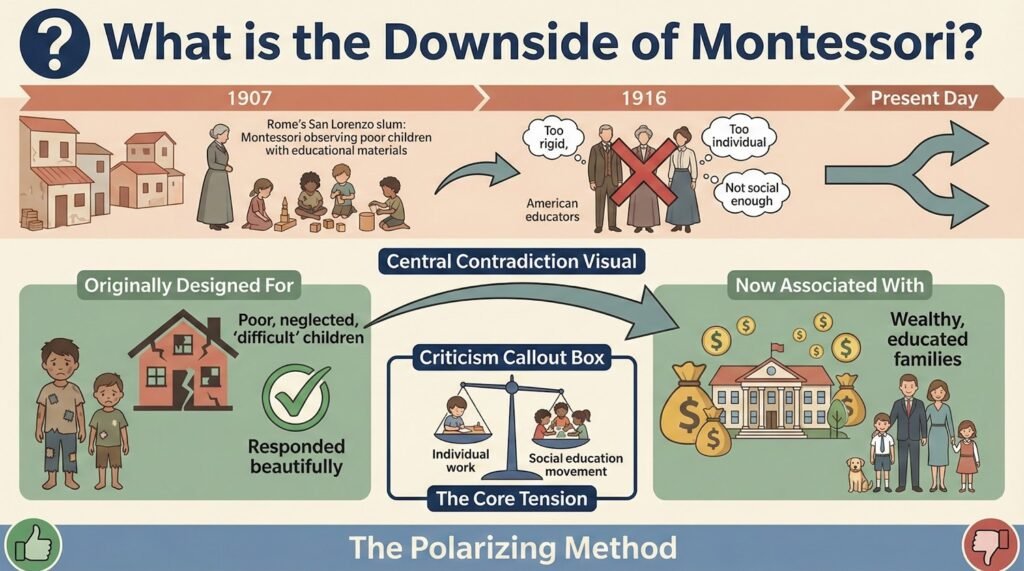
The Montessori method has always been polarizing, and that’s actually baked into its origins. When Maria Montessori first introduced her approach to American educators in 1916, progressive education leaders rejected it.
They thought it was too rigid, too focused on individual work, and didn’t align with the social education movement gaining traction at the time.
Fast forward to today, and the criticisms have shifted but haven’t disappeared.
Maria Montessori originally developed her method for disadvantaged children in Rome’s San Lorenzo slum. She observed children who were poor, neglected, and considered “difficult,” and she discovered they responded beautifully to an environment designed around their natural development.
The method worked so well that it spread globally, but somewhere along the way, it became associated with the exact opposite demographic: wealthy, educated families who could afford private school tuition.
This transformation from serving the poor to serving the privileged represents one of the method’s biggest downsides today. The very communities Maria Montessori originally served now have the least access to her educational approach.
That basic irony shapes everything else about how Montessori functions in modern society.
The Financial Reality Nobody Wants to Discuss
Let me be really blunt here: Montessori education is expensive, and that’s not changing anytime soon. The reasons go deeper than simple greed or exclusivity.
Montessori materials are genuinely costly to produce. We’re not talking about plastic bins from a warehouse store.
These are carefully designed learning tools made from wood, ceramics, glass, and metal, each with specific dimensions, weights, and textures chosen for developmental reasons.
The Pink Tower, for instance, consists of ten precisely sized pink cubes. The largest measures exactly 10cm³ and each subsequent cube decreases systematically.
The weight progression matters.
The exact shade of pink matters because it isolates the concept of size without color distraction. You can’t mass-produce these with the same quality standards at discount prices.
Then there’s teacher training. Becoming a certified Montessori teacher needs extensive coursework, practicum hours, and often significant financial investment.
Many teachers take pay cuts to transition into Montessori education because they believe in the philosophy, but that dedication doesn’t pay their bills.
Schools need to compensate trained teachers appropriately, and those costs get passed to families through tuition.
The result is predictable and really frustrating. Montessori education has become predominantly white and affluent.
Most programs are private institutions with selective admissions processes that effectively exclude low-income families and students of color.
This directly contradicts Maria Montessori’s original vision and creates an educational opportunity gap that reinforces existing inequalities.
Some public Montessori programs exist, but they’re rare, often have long waiting lists, and face funding challenges that compromise implementation quality. The families who could potentially benefit most from Montessori’s focus on independence, concentration, and intrinsic motivation often can’t access it at all.
That’s a real problem that nobody in the Montessori community has figured out how to solve.
When Self-Direction Becomes a Burden
One of Montessori’s core assumptions says that children are naturally curious, self-motivated learners who thrive when given freedom within a prepared environment. For many kids, this is absolutely true.
But the emphasis on “many” matters here, because it’s definitely not universal.
I’ve seen children who genuinely struggle in Montessori environments, not because they’re less capable, but because they need different support structures. Shy children can feel overwhelmed by the expectation to choose work independently and approach teachers for lessons.
The classroom freedom that feels liberating to outgoing, confident kids can create anxiety for children who find comfort in routine, structure, and clear expectations.
Children with certain learning disabilities or ADHD sometimes need more explicit instruction, scaffolding, and external organization than Montessori’s child-directed approach naturally provides. The method can work beautifully for these students when teachers actively adapt and provide individualized support, but that needs exceptional skill and often contradicts the pure “follow the child” philosophy some schools maintain rigidly.
There’s also the reality that not all children are ready for the level of independence Montessori expects at every developmental stage. Some kids genuinely benefit from more teacher-directed learning, especially when mastering foundational skills that need systematic instruction.
The assumption that all children will naturally gravitate toward suitable work and progress adequately without structured guidance doesn’t always hold up in practice.
When schools apply the philosophy inflexibly, certain children fall through the cracks.
The Collaboration Gap Nobody Talks About
This is probably the criticism that makes me pause most when recommending Montessori. The method excels at developing independent thinkers who can focus deeply, work persistently, and develop intrinsic motivation.
These are incredibly valuable skills that serve people well throughout their lives.
But modern life, especially modern professional life, demands collaboration, teamwork, negotiation, and the ability to work effectively within organizational structures. Montessori classrooms emphasize individual work and self-directed learning.
While children do interact socially and older students help younger ones in mixed-age classrooms, explicit instruction in collaborative skills, group projects, and teamwork isn’t central to the curriculum.
Some educators argue that collaboration happens naturally through peer interaction, and in well-functioning classrooms, it does to some extent. But collaborative skills aren’t deliberately taught, practiced, and refined the way independent work skills are.
The method builds children who know how to work alone, but doesn’t necessarily prepare them to function as team members.
The irony here is that many Montessori graduates become entrepreneurs, creative professionals, and independent thinkers. Journalist Peter Sims famously coined the term “Montessori Mafia” because of how many tech innovators attended Montessori schools.
But that same independence can make it challenging to work in hierarchical organizations or on teams where compromise and consensus-building matter more than individual excellence.
The world increasingly values both independence and collaboration, but Montessori heavily emphasizes one at the expense of the other. Families need to consciously supplement with team sports, group activities, and other experiences that develop collaborative skills outside the classroom.
You can’t rely on Montessori alone to teach children how to work effectively with others.
Technology Integration Remains Problematic
Maria Montessori developed her method in the early 1900s, before computers, tablets, smartphones, or any digital technology existed. The educational materials she designed are deliberately sensorial and hands-on, engaging many senses to build concrete understanding before moving to abstraction.
This approach has tremendous value, especially for young children whose brains develop through physical interaction with their environment. But we now live in a reality where digital literacy isn’t optional.
Technology integration in education prepares children for what happens when screens, coding, digital communication, and information technology are basic to nearly every career path.
Many Montessori schools struggle with how to incorporate technology authentically without compromising core principles. Some schools introduce computers only in upper elementary or middle school.
Others ban screens entirely.
A few progressive programs have started integrating technology thoughtfully, using it as a tool for research, creation, and communication rather than passive consumption.
But there’s no consistent approach, and the Montessori community stays genuinely divided about whether and how digital tools belong in classrooms. This creates real gaps in students’ technological fluency compared to peers in traditional schools where technology integration has become standard across grade levels.
When Montessori students eventually need to develop digital skills for high school or college, they’re starting from further behind than their conventionally educated peers.
Curriculum Gaps and Implementation Challenges
The Montessori philosophy of “following the child” is beautiful in theory but needs extremely skilled implementation in practice. When done poorly, it can mean children develop gaps in their learning because they naturally gravitate toward subjects they enjoy and avoid challenging areas.
A truly skilled Montessori teacher observes each child carefully, tracks their progress, and provides gentle guidance and required lessons to confirm balanced development. But this takes exceptional training, experience, and dedication.
In classrooms with high student-teacher ratios or less experienced educators, children can slip through the cracks, spending too much time on preferred activities while neglecting essential skills.
The language materials present specific challenges. Montessori’s phonics approach was originally designed for Italian, which has highly consistent letter-sound correspondence.
English phonics are considerably more complex and irregular.
While adaptations exist, the materials don’t address English’s inconsistencies as systematically as some phonics-focused reading programs do.
There’s also traditionally limited emphasis on fictional literature, storytelling, and poetry in early Montessori classrooms. The focus on reality-based learning means fantasy and imaginative stories are often discouraged for young children.
While this connects to developmental theories about children’s cognitive abilities, it also means students miss rich literary experiences that build vocabulary, empathy, and narrative understanding.
Some parents find this particularly frustrating because reading stories together has been such a central part of childhood for generations.
The Authenticity Problem
Here’s something that really frustrates me: the widespread confusion between authentic Montessori materials and “Montessori-inspired” products. Maria Montessori specified exact dimensions, materials, colors, and features for her learning tools based on scientific observation.
These specifications matter because they’re designed to teach specific concepts in specific ways.
But walk through any toy store or scroll through Amazon, and you’ll find countless products marketed as “Montessori toys” that bear little resemblance to actual Montessori materials. Wooden toys aren’t automatically Montessori.
Minimalist design isn’t automatically Montessori.
Even items that look similar to genuine materials often lack the self-correcting features, exact proportions, or purposeful design that make authentic materials effective.
This creates two problems. First, parents trying to create Montessori-inspired home environments often waste money on products that don’t deliver the intended learning benefits.
Second, when poorly designed “Montessori” materials don’t work well, people blame the method rather than the inferior implementation.
They come away thinking Montessori doesn’t work when they’ve never actually experienced authentic Montessori.
The same problem exists with schools. The term “Montessori” isn’t legally protected in most countries, so any school can call itself Montessori without authentic training, materials, or implementation.
Someone criticizing “Montessori education” might actually be responding to a school that uses the name for marketing while ignoring the philosophy’s core principles.
That makes it really hard to have productive conversations about whether Montessori actually works because we’re not always talking about the same thing.
When Implementation Varies Wildly
Related to the authenticity issue is the massive variability in how different schools interpret and apply Montessori principles. Some schools follow Association Montessori Internationale (AMI) standards strictly, adhering closely to Maria Montessori’s original approach.
Others affiliated with American Montessori Society (AMS) allow more flexibility and adaptation.
Still others call themselves “Montessori-inspired” and cherry-pick elements while ignoring others.
This means research on “Montessori education” effectiveness is complicated because we’re not always comparing the same thing. One study might examine a high-fidelity Montessori program with trained teachers and finish materials, while another looks at a school that uses Montessori language but implements traditional methods.
For families evaluating schools, this variability makes it really difficult to know what you’re getting. You can’t assume a school calling itself Montessori will deliver the benefits research attributes to the method.
You need to visit, observe, ask detailed questions about teacher training, examine materials, and understand how the school approaches curriculum, assessment, and parent involvement.
That takes time and knowledge most parents don’t have when they’re just starting to research educational options.
The Transition Challenge
Children moving from Montessori to traditional schools, or vice versa, often face adjustment challenges that parents underestimate. Montessori students accustomed to choosing their work, moving freely around the classroom, and working at their own pace can struggle with the rigid structure, assigned seating, and lockstep curriculum pacing of conventional schools.
The transition can be genuinely difficult for kids who’ve learned to think independently and suddenly find themselves in environments that value compliance and conformity.
Similarly, students transferring into Montessori from traditional programs sometimes find the freedom overwhelming. They don’t know how to choose work independently, manage their time, or work without constant teacher direction.
Teachers essentially need to reteach these children how to function in an educational environment, which takes time and patience.
These challenges don’t mean either approach is wrong, but they do mean families need to consider long-term educational plans. If you start with Montessori for early childhood but know you’ll transition to traditional schooling later, you need to prepare your child for that adjustment.
If you’re committed to Montessori through elementary and middle school, you need to confirm programs are available in your area for those age levels.
Many families learn too late that their local Montessori only goes through kindergarten or elementary, forcing transitions they weren’t planning for.
Addressing Different Learning Profiles
Montessori’s emphasis on hands-on, sensorial learning works beautifully for kinesthetic learners who understand concepts by manipulating materials. But not all children learn this way.
Some students are more verbal or auditory learners who benefit from explanation, discussion, and verbal processing before hands-on application.
The method’s focus on individual work means less verbal instruction, group discussion, and classroom conversation than traditional approaches. For children who learn through social interaction and verbal exchange, this can feel limiting.
They might grasp concepts faster through explanation and discussion than through solitary material manipulation.
Additionally, the specific materials and lesson sequences don’t work equally well for every child. While the prepared environment offers choices, those choices exist within defined parameters.
Children whose interests fall outside the available materials or who need different entry points to concepts might not find what they need. A child passionate about dinosaurs might find limited opportunities to explore that interest in a Montessori classroom focused on practical life, sensorial work, and mathematics.
Exceptional Montessori teachers recognize these differences and adapt, providing verbal explanation when needed, facilitating group discussions, and finding creative ways to engage diverse learners. But the method’s structure doesn’t inherently accommodate learning style diversity as flexibly as more eclectic approaches might.
You’re trusting that your child’s teacher will be skilled and flexible enough to meet your child where they are.
What About Assessment and Accountability
Montessori schools typically don’t use traditional grades, standardized testing, or conventional report cards. Assessment happens through teacher observation and portfolio documentation of student work.
For families who value these choice assessment methods, this represents one of Montessori’s strengths rather than weaknesses.
For those concerned about academic accountability and college preparation, it can feel problematic. The lack of traditional metrics makes it harder to compare student progress against standards, identify learning gaps objectively, or prepare for the standardized tests that still matter for college admissions.
Some Montessori schools introduce standardized testing in upper grades, but students who’ve never experienced timed tests, many choice formats, or performance pressure can struggle initially.
There’s also the question of whether Montessori students develop the specific skills traditional academic systems value: following instructions precisely, completing assignments on deadline, studying for tests, and performing on demand. These aren’t necessarily valuable skills in absolute terms, but they matter for navigating conventional educational pathways.
Students planning to attend traditional high schools or competitive colleges need these skills, and Montessori doesn’t always teach them.
Family Commitment Requirements
Something people underestimate is how much Montessori needs from families, not just schools. The philosophy extends beyond classroom walls into home life.
Parents are encouraged to create prepared environments at home, foster independence in daily activities, and align their parenting approach with Montessori principles.
This means allowing children to dress themselves, prepare food, clean up independently, even when it’s slower and messier than doing it yourself. It means carefully arranging your home so materials and activities are accessible at child height.
It means changing how you communicate, offering choices and respecting children’s work cycles.
For families genuinely committed to the philosophy, these changes can be wonderful and transformative.
But they need time, energy, resources, and significant lifestyle adjustments. Montessori isn’t something you can outsource entirely to school.
If home life contradicts school principles, authoritarian parenting, excessive screen time, not allowing independence, children receive conflicting messages that undermine the method’s effectiveness.
Not every family has the bandwidth for this level of engagement. Single parents working many jobs, families facing economic stress, or households dealing with other challenges might not be able to apply Montessori principles at home, limiting the method’s effectiveness even if school quality is excellent.
The family commitment piece is real and substantial.
Making the Decision for Your Family
After considering all these downsides, you need to decide if Montessori is right for your child. Start by honestly assessing your child’s temperament, learning style, and needs. Independent, curious children who are comfortable with freedom and choice often thrive in Montessori environments.
Children needing more structure, external motivation, or explicit instruction might struggle without significant teacher support and adaptation.
Consider your financial reality without guilt or shame. Montessori’s cost isn’t a reflection of parental commitment, it’s a structural barrier that exists regardless of how much you love your child.
If private tuition isn’t possible, explore whether public Montessori options exist locally, or consider incorporating Montessori-inspired practices at home while using traditional education.
Visit schools extensively before committing. Observe classrooms, watch how teachers interact with children, examine materials, and ask detailed questions about teacher training, curriculum implementation, and how the school handles challenges like technology integration, collaboration, and special needs support.
Don’t accept marketing language or glossy brochures as evidence of quality implementation.
Think about your family’s capacity for the lifestyle adjustments Montessori needs. If you can’t or don’t want to apply the philosophy at home, be realistic about whether school alone can deliver the method’s benefits. The consistency between home and school really matters for Montessori’s effectiveness.
Finally, remember that educational methods don’t have to be all-or-nothing. You can appreciate Montessori’s insights about child development, incorporate hands-on learning and independence at home, and supplement collaboration, technology, and structured instruction through other means.
Educational philosophy doesn’t have to be dogmatic to be valuable.
Take what works, adapt what doesn’t, and make decisions based on your child’s actual needs rather than idealized educational theories.
Frequently Asked Questions
Is Montessori good for ADHD children?
Montessori can work well for some children with ADHD because it allows movement, offers choices, and respects individual pacing. However, children with ADHD often need explicit instruction in organizational skills, time management, and executive function that Montessori doesn’t systematically teach.
Success really depends on the specific child and whether the teacher can provide suitable adaptations and support.
Why do Montessori schools not allow fantasy?
Traditional Montessori philosophy for young children (ages 3-6) emphasizes reality-based learning because Maria Montessori believed children at this age are working to understand the real world and that fantasy can confuse that process. Many modern Montessori schools have softened this approach, but classical programs still minimize or exclude fairy tales, Santa Claus, and imaginative play materials.
Can Montessori students transition to traditional schools?
Yes, Montessori students can transition to traditional schools, but the adjustment takes time and support. Children accustomed to choosing their work and moving freely may initially struggle with structured schedules, assigned seating, and teacher-directed instruction.
Most children adapt within a few months, though some find the transition challenging.
How much does Montessori school cost?
Montessori school costs vary widely by location and program level. Private Montessori preschools typically range from $8,000 to $20,000 annually, while elementary programs can cost $12,000 to $30,000 per year.
Public Montessori programs exist in some areas and are tuition-free, though they often have limited enrollment and long waiting lists.
Do Montessori students do better academically?
Research shows mixed results. Some studies find Montessori students perform as well or better academically than traditionally educated peers, while others show no significant differences.
The variability in Montessori implementation makes definitive conclusions difficult.
High-quality, authentic Montessori programs generally produce strong academic outcomes, but program quality varies tremendously.
Are Montessori materials worth the cost?
Authentic Montessori materials are expensive but designed for durability and specific learning purposes that cheaper choices don’t copy. For schools and families committed to the method, authentic materials represent a worthwhile investment.
However, “Montessori-inspired” products marketed to parents often don’t justify their cost and won’t deliver the same educational benefits.
Does Montessori teach reading and math?
Yes, Montessori includes systematic reading and math instruction using specialized materials. The phonics approach teaches letter sounds before letter names, and math materials provide concrete representations of abstract concepts.
However, the timing is individualized, children learn when developmentally ready rather than at predetermined grade levels.
Is Montessori better for shy children?
Montessori can be challenging for shy children who find it difficult to independently approach teachers for lessons or choose work without guidance. Some shy children thrive with the freedom to work alone, while others feel lost without more teacher direction.
Success depends on the individual child and whether teachers provide suitable scaffolding.
Key Takeaways
Montessori’s downsides are substantial and shouldn’t be dismissed. The cost creates genuine accessibility barriers that contradict the method’s origins. The emphasis on independence doesn’t develop collaborative skills modern life demands.
Technology integration stays inconsistent across programs.
Implementation variability means “Montessori” doesn’t guarantee quality or authentic practice.
The method works beautifully for certain learners but isn’t universally appropriate, particularly for children needing more structure or for families unable to make the required financial and lifestyle commitments. Understanding these limitations honestly allows for better decisions aligned with your child’s actual needs rather than idealized educational fantasies.