
We may earn money or products from the companies mentioned in this post.
Introduction
Wooden Montessori toys focus on natural materials and child-led exploration. These simple tools help babies and toddlers develop touch awareness, hand-eye coordination, and problem-solving skills without batteries or screens.
The weight, texture, and warmth of real wood provide sensory feedback that plastic simply cannot match.
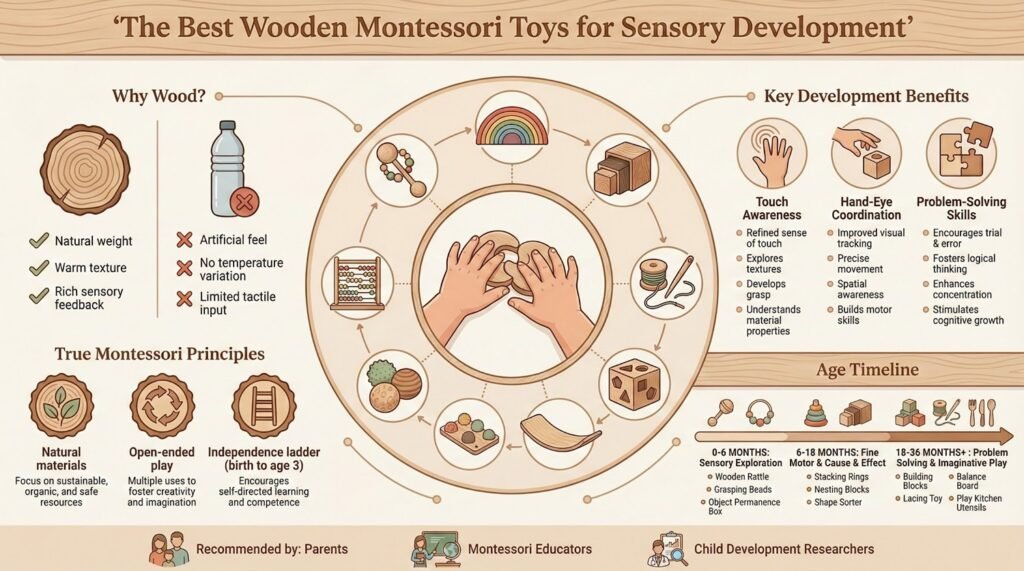
Finding authentic options can feel overwhelming when every toy claims to be educational. True montessori baby toys follow specific principles: they use natural materials, encourage open-ended play, and support independence at each developmental stage.
This list cuts through the marketing noise to highlight wooden toys that genuinely support sensory growth from birth through age three, with input from parents, Montessori educators, and child development research.
List of Wooden Montessori Toys for Ages 0-3
1. Wooden Sensory Balls Set
These textured balls come in sets of 6-8 pieces, each with different surfaces like bumps, ridges, and smooth zones. Made from natural rubberwood, they invite squeezing, rolling, and mouthing during tummy time.
The varied textures stimulate touch receptors while the satisfying weight helps babies practice transferring objects from hand to hand.
Suitable from birth through 12 months, they hold up remarkably well to drool and teething without splintering.
2. Classic Wooden Shape Sorter
A beechwood cube with 4-10 chunky shapes that slide into matching slots. Younger babies explore the pieces freely, while older infants work on fitting them correctly.
The self-correcting design means they figure out solutions independently.
Many versions include a mirror on the lid for self-discovery play. Best for ages 6-18 months as skills develop from simple exploration to intentional sorting.
3. Vertical Rainbow Stacker
Tall wooden pegs hold 8-12 colorful rings or arches that stack upward. The rainbow gradient draws visual attention while balancing teaches early physics concepts.
A weighted base prevents frustrating topples.
Toddlers experiment with patterns and sequences, making this truly open-ended with no single fix way to play. Grows with your child from 9 months through the toddler years.
4. Natural Wood Rattle
Lightweight beech rattles with embedded bells produce soft jingles when shaken. The ergonomic handle fits tiny newborn grasps perfectly.
Use it for tracking exercises by moving it slowly side to side.
The natural finish feels warm in little hands and provides that essential wood-on-skin sensory experience. An ideal first grasping toy from birth through 6 months.
5. Floor Mirror with Wooden Play Gym
A floor-standing safety mirror clips to a wooden frame with hanging rings, silks, and textured elements. Babies prop themselves during tummy time while discovering their reflection and batting at suspended toys.
The adjustable height adapts as they grow.
Exceptional for building neck strength, visual tracking, and those early social smiles at their own face. Perfect for ages 0-6 months.
6. Wooden Bead Maze Activity Center
A sturdy board with wired tracks holds colorful beads that slide, spin, and flip along different paths. Some include spinners, mirrors, and other elements.
The multi-sensory experience combines visual tracking, fine motor practice, and gentle sound feedback when beads clack together.
Builds focus and persistence as babies navigate increasingly complex paths. Best for ages 6-24 months.
7. Maple Wood Teething Rings
Ergonomic shapes like rings, animals, or geometric forms provide varied grips for sore gums. Made from smooth maple or beech with food-grade finishes, these are completely safe for extended chewing.
The natural coolness and varied textures provide genuine relief during teething peaks.
Textured versions with ridges massage effectively. Essential for ages 3-12 months but often enjoyed longer.
8. Magic Tissue Box
A wooden box dispenses colorful fabric scarves or ribbons for pulling practice. Babies work on the in-and-out concept while building fine motor control and hand strength.
The reusable, washable fabrics prevent waste.
This simple toy captivates babies who love the cause-and-effect action. Particularly engaging for ages 5-18 months during peak exploration phases.
9. Wooden Musical Instrument Set
A collection including xylophone, drum, shaker, and sometimes bells or maracas. All made from solid wood with gentle, pleasant tones as opposed to harsh electronic sounds.
Encourages rhythm exploration, self-expression, and auditory development.
Toddlers bang, shake, and experiment with different sounds. Great for family music time and building early appreciation for melody.
Best for ages 12-36 months.
10. Object Permanence Box
A wooden box with a slot on top and an opening in front. Babies drop a ball through the slot and watch it reappear in the tray below.
This teaches the concept that objects continue to exist even when out of sight, a crucial cognitive milestone.
The self-contained design means the ball cannot roll away. Especially valuable around 8-12 months when this concept develops.
11. Wooden Peg Board
Chunky wooden pegs in various shapes and colors fit into corresponding holes on a board. Builds sorting skills, color recognition, and pincer grasp strength.
The pegs are large enough for safe handling while still challenging developing dexterity.
As skills improve, toddlers create patterns and sequences. Appropriate for ages 12-36 months with increasing complexity.
12. Nesting and Stacking Boxes
A set of wooden boxes or bowls that nest inside each other and stack upward. Teaches size relationships, spatial reasoning, and sequencing.
Babies explore freely, knocking them down and filling them with treasures.
Toddlers master the fix order. These versatile toys work for both structured and imaginative play.
Suitable from 9 months onward.
13. Wooden Push and Pull Toys
Simple vehicles or animals on wheels with a cord or handle for pulling. Encourages walking, balance, and gross motor development.
The satisfying rolling motion and gentle clicking sounds provide feedback.
Choose versions with rubber-rimmed wheels to protect floors. These become beloved companions during the early walking months from 10-24 months.
14. Sensory Blocks Set
Chunky wooden blocks with different textures, colors, and sometimes enclosed elements like beads or bells. Beyond building, babies explore the varied surfaces and sounds.
Natural wood grain provides its own texture variations.
As dexterity improves, simple stacking becomes elaborate construction. These grow with your child from 6 months through the preschool years.
15. Wooden Threading Beads
Large wooden beads with generous holes pair with a thick lace or rigid threading stick. Threading builds concentration, hand-eye coordination, and bilateral coordination as both hands work together.
The wooden beads have satisfying weight and texture.
Start with just a few large beads and progress to more complex patterns. Best for ages 18-36 months.
16. Wooden Coin Box
A box with a slot accepts flat wooden discs or coins. Similar to the object permanence box but needs more precision to insert the disc correctly.
The satisfying “clink” when the coin drops provides auditory feedback.
Some versions have multiple slots for sorting practice. Excellent for ages 10-24 months as precision grip develops.
17. Wooden Rainbow Bridge
Arched pieces in graduated sizes stack to form a bridge or nest together. This open-ended toy becomes roads for cars, houses for animals, tunnels, or abstract sculptures.
The natural wood and simple rainbow gradient appeal to minimalist sensibilities while sparking creativity.
Appropriate from 12 months onward with years of play value.
18. Simple Wooden Puzzle
Chunky single-piece puzzles with knobs feature basic shapes or familiar objects. Babies grasp the knob and lift out the piece, then work on fitting it back.
The self-correcting nature let’s them learn through trial and error.
Start with 3-4 pieces and add complexity as skills grow. Foundation puzzles begin around 10-12 months.
19. Wooden Egg and Cup Set
Wooden eggs sit in matching cups, sometimes with color or pattern matching elements. Babies practice in-and-out motions, sorting, and eventually matching.
The eggs have a pleasant weight and smooth finish.
This simple material supports countless developmental skills from 8 months through age three.
20. Wooden Sound Blocks
Sealed wooden blocks contain different materials like beads, bells, or rice, each producing distinct sounds when shaken. Babies explore auditory discrimination while developing shaking and grasping motions.
The blocks often come in pairs for matching games as skills advance.
Engaging from 6 months onward.
Conclusion
Choosing wooden Montessori toys means investing in your child’s natural development while avoiding the plastic clutter and electronic overstimulation common in mainstream toys. The sensory feedback from real wood, the open-ended nature of the designs, and the focus on independence create an environment where learning happens through genuine exploration as opposed to passive entertainment.
Among all these excellent options, the wooden sensory balls stand out as the most versatile choice for newborns through toddlers. They need no explanation, support multiple developmental stages, and provide rich tactile experiences that engage babies at any age.
The durability means they survive everything from gentle newborn grasps to enthusiastic toddler throwing.
For families just beginning their Montessori journey or grandparents seeking one meaningful gift, these balls deliver exceptional value.
The beauty of authentic Montessori materials comes from their longevity. A $30 wooden stacker provides years of engagement, often serving multiple children, while plastic choices break and lose appeal within months.
When you calculate cost per use, these wooden toys prove remarkably economical despite higher upfront prices.
They also retain resale value, with quality used Montessori materials commanding strong prices in secondhand markets.
Start with one or two toys that match your child’s current stage, then gradually add pieces as new skills emerge. You don’t need everything at once.
Watch what captures their attention and follow their interests.
The goal is purposeful play, not accumulating things. Create a simple, organized space where they can independently choose and return toys, supporting the Montessori principles of order and autonomy even in infancy.
Ready to bring natural, purposeful play into your home? Start with the wooden sensory balls and watch how real materials spark genuine development in your little one.
Frequently Asked Questions
What makes a toy authentically Montessori versus just wooden or educational?
Authentic Montessori toys isolate specific skills, allow self-correction, and use natural materials without added distractions. A true Montessori shape sorter has pieces that only fit one way, teaching through natural consequences as opposed to praise or correction.
The toy itself shows the child if they succeeded. Generic educational toys often include multiple functions, electronics, or need adult intervention to use correctly.
Montessori materials also emphasize real-world skills over fantasy, so you’ll find more realistic animals than cartoon characters. The absence of batteries, lights, and sounds is intentional, allowing children to focus on the actual skill being developed without sensory overwhelm.
Are expensive wooden Montessori toys really worth it compared to cheaper choices?
Quality wooden toys from brands like HABA, Grimm’s, or Le Toy Van use hardwoods, non-toxic finishes, and superior construction that withstands years of use across multiple children. Cheaper choices often use softwoods that splinter, toxic paints that chip, or poor joinery that breaks quickly.
Calculate cost per year of use as opposed to upfront price.
A $40 wooden stacker used daily for three years costs about $1.11 per month, while a $15 plastic version that breaks in six months costs $2.50 per month. Wooden toys also maintain resale value, with quality used Montessori materials selling for 50-70% of original prices.
For budget-conscious families, buying fewer high-quality pieces or purchasing gently used options from Montessori communities makes more sense than accumulating cheap toys that quickly end up in landfills.
How do I choose age-appropriate toys for the 6-9 month stage specifically?
Between 6-9 months, babies develop sitting balance, reach and grasp with intention, and begin understanding cause and effect. Choose toys they can manipulate while sitting: object permanence boxes, sensory balls, simple rattles they can shake deliberately, and early shape sorters for exploration as opposed to mastery.
Prioritize safety with no small parts and smooth finishes since everything goes in the mouth.
Look for toys that respond to their actions, like balls that roll when pushed or rattles that make sounds when shaken, reinforcing the connection between their movements and results. Avoid toys requiring skills they haven’t developed yet, like precise placement or bilateral coordination.
Watch for interest cues, if they ignore a toy, set it aside for a few weeks as opposed to assuming they dislike it.
Development happens in bursts, and a toy that seems too advanced one week might suddenly captivate them the next.
How should I clean and maintain wooden toys safely?
Wipe wooden toys with a barely damp cloth and mild, unscented soap, then immediately dry completely. Never soak wood or put it in the dishwasher, as moisture causes warping, cracking, and finish deterioration.
For deeper cleaning after illness, use a solution of white vinegar and water (1:1 ratio), apply sparingly, and dry thoroughly.
Condition unfinished or oiled wood every few months with food-grade mineral oil or beeswax polish, letting it absorb overnight before buffing away excess. This prevents drying and cracking.
Store toys in a dry area with good air circulation, not in humid basements or hot attics.
Inspect regularly for splinters, loose parts, or finish deterioration, addressing issues immediately or retiring toys that cannot be safely repaired. With proper care, quality wooden toys last generations.
Can I mix Montessori wooden toys with regular toys or does it need to be all or nothing?
You absolutely can mix approaches. Many families keep a core selection of wooden Montessori materials while including some conventional toys.
The key is maintaining an organized environment where your child can make independent choices.
Store toys in accessible baskets or shelves as opposed to large toy boxes that create overwhelming chaos. Rotate items every few weeks to maintain interest without overstimulation.
If you notice your child ignores the wooden toys in favor of flashy plastic ones, consider whether you have too many competing options available simultaneously.
The Montessori principle is offering limited, purposeful choices as opposed to restricting to only one type of toy. That said, removing the most overstimulating toys (those with lights, sounds, and rapid movement) often results in deeper, longer engagement with simpler materials.
Observe your child’s play patterns to find the right balance for your family.
What’s the single best first wooden Montessori toy for a newborn?
A simple wooden rattle takes top place for newborns. Choose one with a smooth, easy-to-grasp handle and gentle sound, like a bell enclosed in wood as opposed to harsh plastic clattering.
Newborns can hold it briefly from birth, and you can also use it for tracking exercises by slowly moving it across their field of vision.
Around 2-3 months, they’ll begin batting at it intentionally, and by 4-5 months, they’ll grasp and shake it deliberately. The natural wood provides essential tactile input and warmth that plastic lacks.
Look for lightweight options in the $10-20 range from brands like Haba, Grimm’s, or local craftspeople.
This humble toy supports multiple developmental milestones while introducing the Montessori principle of simple, beautiful materials from the very beginning.
Do Montessori wooden toys really support sensory development better than modern educational toys with multiple features?
Yes, and the reason relates to how young brains process information. Toys with multiple features like lights, sounds, moving parts, and various textures simultaneously activate many neural pathways at once, which can overwhelm developing sensory systems.
Simple wooden toys isolate specific sensory experiences, allowing babies to fully focus on one thing: the weight and texture of a wooden ball, the sound of a rattle, the visual feedback of a disappearing object.
This focused attention builds stronger neural connections for each sense individually. As babies master isolated sensory skills, they naturally begin integrating multiple senses during play.
A wooden stacker engages vision, touch, and proprioception (body awareness) but in a calm, child-directed way as opposed to through programmed flashing and beeping.
Research on cognitive load suggests that less really is more during early development, allowing babies to become active participants in their learning as opposed to passive recipients of sensory bombardment.