
We may earn money or products from the companies mentioned in this post.
The Manhattan Toy activity centers keep showing up everywhere when you start researching baby activity gyms. Parent forums mention them, gift registries feature them, and they cost way more than the typical plastic options you see at Target.
The company makes these wooden play structures that look completely different from the standard baby activity gyms with all the batteries and electronic sounds. They’ve got two main models that most people consider: the Playground Adventure (around $170) and the Celestial Star Explorer (around $220).
Both are pretty big wooden cubes covered in activities like bead runs, spinners, and gliders. The whole idea is hands-on play without the flashing lights and loud music that come with most baby toys these days.
This review breaks down what these things actually offer, what parents report about using them, and whether the price makes sense for what you get.
What You’re Actually Getting
Manhattan Toy sells wooden activity centers for babies and toddlers. These aren’t the play mats you lay on the floor, they’re freestanding cube-shaped structures that sit on the ground.
The Playground Adventure measures about 18 inches on each side and stands 20.5 inches tall. The whole thing has a playground theme with bright illustrations covering every surface.
Activity-wise, you get 20 gliders spread across 7 different tracks, one abacus-style track, 5 bead runs, 2 spinners, and this weird springy bear on a dinosaur thing.
The manufacturer designed it for babies who can sit up and interact with stuff at ground level.
The Celestial Star Explorer is the bigger, more expensive option. It comes with 8 wire bead runs, 11 gliders, 2 wooden clacking doors, 5 spinners, and a transparent sliding door.
The space theme covers all the surfaces instead of the playground design.
This your built for multiple kids to play at the same time (they say up to 4 kids).
Both models use water-based, non-toxic finishes. They meet EN71 and CPSIA safety standards, which are the regulations for toy safety in Europe and the US.
Neither one is designed for standing play or pulling up. The manufacturer specifically states these are for sitting and kneeling activities.
That matters because it limits how long your kid will actually use it.
Breaking Down the Features
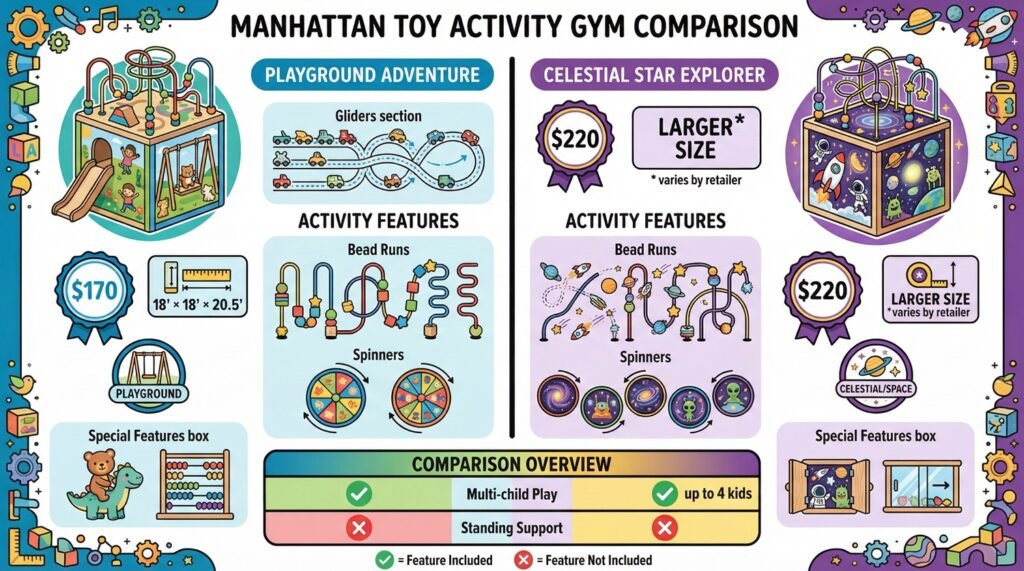
Looking at the activity lists on retail sites can make your head spin with all the numbers and features. Here’s what actually matters for how babies interact with these things.
The bead runs and gliders make up most of the play experience. The Playground Adventure has 20 gliders across its 7 tracks.
The Celestial model has 11 gliders but adds more bead runs (8 instead of 5).
These sliding pieces let babies track movement, grab at stuff, and figure out that pushing something makes it move.
More gliders doesn’t automatically mean more fun, though. The positioning and how easy they are to grab matters more than just counting how many there are.
The spinners and doors add variety without needing batteries. The wooden clacking doors in the Celestial model make satisfying sounds when babies open and close them.
The spinners on both models keep rotating when babies bat at them.
These elements help prevent the “my kid got bored after a week” problem that happens with simpler toys.
The transparent sliding door on the Celestial Star Explorer sounds cool but doesn’t really change much about how babies play with it. It’s a minor addition that probably doesn’t justify the extra $50 between models.
Size and assembly create real practical considerations. Both models need adult assembly (the instructions come in the box, and you’ll need a screwdriver).
Once assembled, neither model folds down or breaks apart for storage.
They take up permanent floor space wherever you put them.
The weight and bulk mean you can’t easily move these between rooms or pack them away when company comes over. For apartments or smaller homes, that becomes a problem pretty quickly.
How These Hold Up to Daily Use
Based on what parents report in various forums and reviews, the Manhattan Toy centers seem to hold up reasonably well over time. The wooden construction handles the constant batting and grabbing that comes with baby play.
The non-toxic finish doesn’t chip or peel like cheaper wooden toys apparently do. That said, the finish still needs proper care.
The manufacturer says to surface clean with a damp soapy cloth, don’t submerge the wood or spray it directly with cleaners.
For parents used to throwing plastic toys in the dishwasher or wiping them down with disinfectant wipes, this adds extra steps.
The illustrations on both models (playground theme or space theme) appeal to parents who want their baby stuff to look nice in the living room. The colors are bright enough to catch a baby’s attention but not so garish that adults hate looking at them.
Both models position activities at different heights and angles. Some gliders and spinners sit lower for younger babies, while others are positioned higher for babies who can kneel up or sit confidently.
The variety of positioning helps extend the useful age range a bit.
The lack of standing support really does limit things once babies hit 10-12 months and want to practice pulling up on everything. These centers can’t function as standing tables the way some competitor products do.
The Real Advantages and Drawbacks
What Works Well:
The wooden construction with non-toxic finishes addresses the safety concerns that make parents nervous about plastic toys. No worries about BPA or phthalates or whatever chemical gets flagged next.
No electronic sounds means no hearing the same jingle 47 times a day. No batteries means no middle-of-the-night beeping when your kid accidentally hits the button.
For parents who find electronic toys genuinely annoying, this solves that specific problem completely.
Both models support multiple kids playing at once (or taking turns if yours is an only child). That matters for playdates or if you have kids close in age.
The activity variety does seem to hold babies’ attention better than simpler toys. Having multiple types of activities (sliding, spinning, clacking, bead tracking) means babies can switch focus when they get bored instead of abandoning the toy entirely.
You can clean these with basic soap and water. No need for special products or complicated disassembly.
What Doesn’t Work Well:
The bulky design creates legitimate storage problems. These don’t fold.
They don’t break down (well, you could disassemble them, but you’d need tools and time).
They sit where you put them and take up that floor space permanently. For people who move frequently or live in small spaces, this becomes a dealbreaker pretty fast.
The stationary nature also makes vacuuming around them annoying. You’re working around this wooden cube instead of just moving it out of the way.
Neither model supports standing play. Once your kid wants to pull up on furniture and practice standing, these centers don’t help with that developmental stage.
That limits the active use window compared to activity tables that convert to standing height.
The price ($170-$220) represents a significant toy purchase for most families. That’s not an impulse buy.
And when your kid ages out of it around 12-15 months, you need to either store it for another kid, sell it used, or donate it.
Assembly is required, and some parents find that frustrating when they just want to hand over a gift or set something up quickly.
| Feature | Playground Adventure | Celestial Star Explorer |
|---|---|---|
| Price | ~$170 | ~$220 |
| Dimensions | 18″ x 18″ x 20.5″ | Larger (exact dimensions vary by retailer) |
| Number of Gliders | 20 gliders on 7 tracks | 11 gliders |
| Bead Runs | 5 bead runs | 8 wire bead runs |
| Spinners | 2 spinners | 5 spinners |
| Special Features | Springy bear on dinosaur, abacus track | 2 clacking doors, transparent sliding door |
| Theme | Playground | Celestial/Space |
| Multi-child Play | Yes | Yes (up to 4 kids) |
| Standing Support | No | No |
What Parents Actually Report
The feedback from parents who bought these centers follows some pretty consistent patterns.
Parents who specifically wanted to avoid electronic toys tend to love these. The quiet play and hands-on activities match exactly what they were looking for.
For families committed to reducing screen-like stimulation or Waldorf-inspired parenting approaches, these activity centers align with those values.
Parents dealing with limited space express more frustration. The size becomes a bigger issue than they expected when ordering online.
Several reviews mention not realizing how much floor space the centers would occupy until assembly.
The age range where babies actively engage with these centers varies quite a bit based on individual development. Some babies show interest as early as 4 months when they can sit with support.
Others don’t really engage until 6-7 months when they have better reaching and grabbing coordination.
The upper end of the age range tends to hit around 12-15 months for most kids. Once babies become mobile and want to explore the whole room, the stationary activity center becomes less interesting than other toys and climbing opportunities.
Grandparents buying these as gifts generally report positive reactions. The substantial feel and quality construction make these feel like significant gifts.
The safety certifications and non-toxic materials give gift-givers confidence about the purchase.
The cleaning requirements do come up as a minor annoyance. Parents used to wiping down plastic toys quickly mention needing to be more careful with the wooden surfaces.
The water-based finish needs gentle cleaning instead of aggressive scrubbing.
Figuring Out Value
At $170-$220, these centers cost significantly more than basic baby activity gyms but less than large-scale play structures or convertible activity tables.
The value calculation depends heavily on how long your baby actively uses the center. If you get solid daily engagement from 4 months through 12 months, that’s about 8 months of use.
At $170, that breaks down to roughly $21 per month.
At $220, this involves $27 per month.
If your baby loses interest quickly or you have space constraints that make the center impractical, the value drops considerably. Eight months of daily use seems to be the target range where the investment makes sense.
Having another baby shifts the math significantly. If you keep the center and use it again with a second child for another 8 months, the per-child cost drops to around $10-14 per month depending on the model.
That calculation makes the investment more reasonable for families planning multiple kids.
The resale market for Manhattan Toy wooden products stays pretty active on Facebook Marketplace, Mercari, and local parent groups. Used models in good condition typically sell for 60-75% of the original retail price.
That means you can recover a decent portion of your investment if you decide to sell after your kids age out.
For eco-conscious families, the sustainable wood sources and non-toxic finishes justify part of the premium over plastic choices. Manhattan Toy emphasizes their commitment to responsible materials, which aligns with values around reducing plastic use and choosing safer manufacturing practices.
The aesthetic appeal matters more to some parents than others. These centers photograph well and look intentional in living spaces as opposed to like plastic clutter.
For parents who care about how baby gear looks in their home, that contributes to perceived value.
Which Model Makes More Sense
The Playground Adventure works for most situations. At $170, it costs less while still providing the core experience people want from baby activity gyms made by Manhattan Toy.
The 18×18-inch footprint fits more easily into typical room layouts.
For one baby or limited floor space, the Playground Adventure delivers the essential features (bead runs, gliders, spinners) without paying extra for additions that don’t fundamentally change the play experience.
The Celestial Star Explorer justifies its higher price in specific situations. If you have multiple young kids close in age, the enhanced capacity for simultaneous play becomes valuable.
The additional bead runs (8 vs 5) and spinners (5 vs 2) add more variety for families where the center will see heavy use from multiple children.
The Toy of the Year Award nomination for the Celestial model suggests external validation of the design, though that doesn’t necessarily translate to better engagement from your specific baby.
For grandparents or gift-givers wanting to make a bigger impression, the Celestial’s higher price point and extra features support that intention.
If you’re checking out these options, Manhattan Toy’s website has detailed photos of both models so you can see the activity positioning and themes more clearly than most retail sites show.
Storage and Practical Considerations
The storage situation deserves its own discussion because it creates real problems for many families.
These centers don’t fold. They don’t have a compact mode.
Once assembled, they’re permanent fixtures until you either disassemble them completely (which needs tools and time) or dedicate storage space to the full-size cube.
For apartments, small homes, or families who move often, this limitation becomes significant. You can’t easily pack these for moves or temporarily store them when you need floor space for other activities.
The weight makes moving them around impractical for daily use. These aren’t light enough to carry room to room casually.
They go in one spot and stay there.
The footprint matters more than the measurements suggest. That 18×18-inch base needs clearance around it so babies can access all four sides.
In practice, you need about a 3-4 foot square of floor space dedicated to the center and the space for babies to sit around it.
For families with dedicated playrooms, nurseries, or living rooms where baby gear can stay out, this works fine. For families maximizing every square foot or sharing space with roommates, the permanent floor space becomes a dealbreaker.
Some parents end up putting these in basements, playrooms, or other spaces where they can stay out permanently. That reduces the convenience for casual play sessions but solves the living space issue.
Making the Decision
The decision comes down to matching your specific constraints and priorities.
Get one of these centers if: You specifically want to avoid electronic toys and noise. You have floor space that can accommodate a permanent play structure.
You value non-toxic wooden toys and sustainable materials.
You have multiple kids or expect to use it again with future babies. You can commit to proper cleaning and maintenance.
Your baby is in the 3-9 month age range where these provide the most value.
Skip these centers if: You need storage flexibility or move often. Your space is limited and you need toys that fold away or stack.
You want toys that transition to standing support as your baby develops.
You need most value per dollar and can’t recover costs through resale or reuse with another child. You prefer low-maintenance toys that can handle any cleaning method.
The honest assessment matters more than the features list. Having the wrong toy for your situation creates frustration regardless of how well-designed the toy itself is.
These centers solve very specific problems (overstimulation from electronic toys, want for non-toxic wooden options, quality gift that feels substantial) while creating other challenges (storage, limited age range, permanent floor space).
So Are These Worth It
Manhattan Toy activity centers occupy a specific spot in the baby toy market. They’re wooden choices to plastic baby activity gyms for families who prioritize non-toxic materials, sustainable manufacturing, and quiet play over electronic features.
The quality seems solid based on parent reports. The safety certifications check out.
The activities engage babies during that sitting/kneeling phase of development.
The Playground Adventure delivers the core experience at the lower price point. For most families considering these centers, the Playground model provides everything needed without paying extra for features that don’t dramatically change the play experience.
The Celestial Star Explorer makes sense for specific situations, multiple young kids, bigger budgets, or gift-givers wanting a premium option. The extra $50 gets you more activities and capacity but not necessarily longer engagement or better development outcomes.
The value calculation depends heavily on your individual situation. Families who can use these with multiple kids, have space to accommodate them, and specifically want wooden toys will find them worth the investment.
Families dealing with space constraints, single-child households, or tighter budgets might find better value in more versatile options.
For what it’s worth, if you’ve got the space and you’re already committed to the wooden toy approach, these seem like solid choices within that category. They do what they’re designed to do without pretending to be something they’re not.
To see current pricing and availability, Walmart typically stocks the Manhattan Toy Tree Top Adventure model which is similar to these.
The Playground Adventure is available directly from Manhattan Toy if you want to buy from the manufacturer.
For guys still comparing options, Sears has the Tree Top Adventure model and sometimes runs competitive pricing.
The biggest thing is being realistic about your space, your baby’s developmental stage, and how these fit into your overall approach to toys and play. These work great for the families they work for, and they’re frustrating mismatches for families where the size and limitations don’t align with daily life.