
We may earn money or products from the companies mentioned in this post.
I remember the first time I set up an activity gym for my little one. I placed them underneath, watched them stare at the dangling toys for about thirty seconds, and then thought… okay, now what?
Many parents assume that baby gyms exist solely to entertain children while laundry gets folded or emails get answered. These mats with their overhead arches actually offer developmental benefits that most people completely overlook because they stick to the basic setup and call it done.
An activity gym consists of a padded mat with an overhead arch or frame holding hanging toys, mirrors, and sensory objects. Your baby lies underneath and can reach, bat, kick, and explore the various elements.
The setup seems straightforward enough, but the way you use it decides what your baby actually gains from the experience.
Most parents follow the standard routine: plop baby down, let them play, done. The activities I’m going to share incorporate movement, sensory exploration, social interaction, and early problem-solving skills.
Some work perfectly for newborns who are just beginning to track objects with their eyes.
Others suit older babies who are starting to grab, roll, and scoot around.
These activities don’t need any fancy equipment beyond what you likely already have at home. You’re not shopping for more stuff.
You’re just using what’s there in smarter, more creative ways that actually make a difference.
Understanding the Developmental Stages of Activity Gym Play
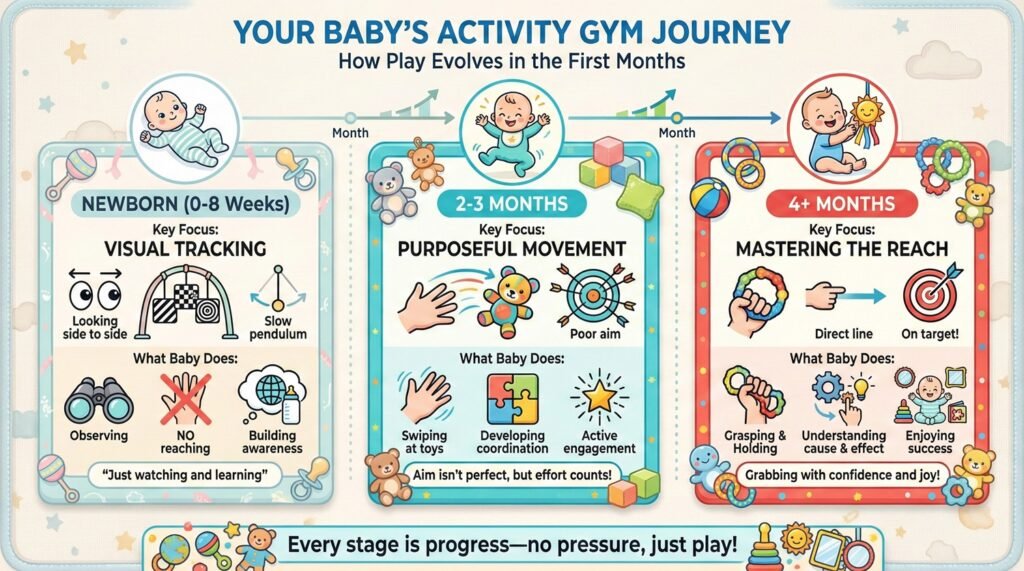
Your baby’s relationship with their activity gym changes dramatically over the first several months. A newborn won’t interact with it the same way a five-month-old will, and recognizing this removes a lot of unnecessary pressure from playtime.
In the first six to eight weeks, babies primarily work on visual tracking and focus. Their vision is still developing, so high-contrast patterns and slow-moving objects capture their attention best.
They’re not reaching for anything yet.
They’re just observing and beginning to understand that there’s a world beyond their immediate needs for food and sleep.
Around two to three months, you’ll notice more purposeful movements. Your baby might start swiping at toys, though their aim is pretty terrible at this stage.
This is when cause-and-effect learning really begins.
They accidentally hit something, it moves or makes noise, and their brain starts making connections between action and result.
By four to six months, reaching and grasping become much more coordinated. Your baby can now deliberately grab toys, bring them to their mouth, and manipulate objects with increasing skill. This is also when many babies start rolling, which changes how they interact with the gym entirely.
They’re no longer content to just lie there passively.
Understanding these stages helps you tailor activities appropriately. You’re not expecting a two-month-old to do what a six-month-old can do, which makes playtime more enjoyable and productive for everyone involved.
1. Slow-Motion Toy Movement
This is one of my absolute favorite activities for younger babies, especially those under three months. Instead of just letting the toys hang there passively, you gently move one toy slowly across your baby’s field of vision.
Hold a dangling toy and move it from one side to the other, stopping occasionally to let your baby focus on it. The key word here is slowly, much slower than feels natural to you.
Babies need time to lock onto objects and track them, and if you move too quickly, they’ll lose interest or become frustrated. Their visual processing works differently than ours.
This activity strengthens the eye muscles and improves visual tracking, which lays the groundwork for later skills like reading and hand-eye coordination. You can vary the pattern too: side to side, up and down, or in gentle circles.
I found that stopping the toy right in front of my baby’s face for a few seconds before continuing the movement really held their attention and seemed to increase their focus.
The challenge here is patience. It feels oddly slow for us adults, but for babies, this is genuinely engaging work that needs real concentration.
You’re also building anticipation skills because your baby starts to forecast where the toy will move next.
They begin predicting patterns, which is a foundational cognitive skill.
I used to feel silly moving a stuffed elephant at such a glacial pace, but watching my baby’s eyes widen and lock onto the toy made it clear that this was exactly the right speed for their developing brain.
2. Tummy Time Under the Gym
Most people use activity gyms exclusively for back play, but flipping your baby onto their tummy underneath the gym adds a whole new dimension. Tummy time builds crucial neck, shoulder, and core strength, but many babies absolutely hate it.
The crying and fussing can make parents give up on it entirely.
Placing your baby on their tummy under the gym gives them something interesting to look at and reach for, which can dramatically extend their tolerance for this position. The dangling toys become targets that encourage them to lift their head higher and hold it there longer.
They have motivation beyond just making you happy.
For younger babies who are still building head control, you can roll a small towel and place it under their chest for support. As they get stronger, remove the support and watch how hard they work to reach those toys.
The progression happens faster than you’d expect.
I noticed that my baby would tolerate tummy time for three or four minutes under the gym, versus maybe sixty seconds on a plain mat. The visual stimulation and the challenge of reaching for objects made it feel less like torture and more like an actual activity with a purpose.
Get down on the floor at your baby’s eye level during tummy time. Your face is the most interesting thing in their world, and having you there provides extra motivation to keep their head up.
I would lie on my stomach facing my baby, making silly faces and narrating what was happening.
Those sessions felt less like a developmental exercise and more like genuine quality time.
3. One Toy at a Time
This might sound counterintuitive since most activity gyms come loaded with many hanging toys, but there’s real value in simplifying the experience, especially for younger or easily overwhelmed babies.
Remove all but one toy from the gym. Let your baby focus exclusively on that single object for an entire play session.
This reduces visual clutter and allows for deeper exploration and learning.
Your baby can study the color, texture, how it moves, and what sound it makes without competing stimulation pulling their attention in six different directions.
Overstimulation is a genuine concern with baby gear these days. When there are six different toys, three mirrors, lights, and music all competing for attention, some babies just shut down.
They can’t process it all, so they either cry or zone out entirely.
Neither response helps development.
By offering just one toy, you’re allowing your baby to truly engage with it. This is how sustained attention develops.
Tomorrow or at the next play session, you can swap it out for a different toy, keeping things fresh without overwhelming their sensory system.
I found this approach particularly helpful during fussy times of day. When my baby was tired or irritable, the simplified gym was much more soothing than the full sensory explosion version.
It became a calming activity as opposed to another source of stimulation to process.
4. Foot Play and Kicking Practice
Most activity gym play focuses on the hands and upper body, but your baby’s legs need practice too. Reposition some of the hanging toys lower so they’re within kicking range instead of reaching range.
Babies love kicking. It’s one of their earliest forms of self-expression and exercise.
When they kick and hit a toy, making it swing or jingle, they start understanding their own power and impact on the environment.
This realization is genuinely exciting for them. You can see it in how their kicking becomes more deliberate and enthusiastic.
This activity builds leg strength and coordination while giving you insight into your baby’s personality. Some babies kick with wild enthusiasm, while others are more deliberate and focused. These early movement patterns often persist as they grow.
You can increase the challenge by attaching lightweight scarves or ribbons to their ankles, though you absolutely must supervise this closely. When they kick, the fabric moves, adding another layer of visual feedback that’s really captivating for babies.
They’re seeing cause and effect in action, which is basic learning.
The foot-eye coordination that develops here is a precursor to later skills like walking and even athletic abilities. You’re not training an Olympic athlete at three months old, obviously, but you are laying important neurological groundwork that supports all future movement.
5. Mirror Talk and Social Interaction
If your activity gym came with a mirror attachment, you’ve got a built-in tool for social-emotional development. Position yourself next to the mirror during playtime and narrate what your baby sees.
Point to your baby’s reflection and say their name. Make faces, stick out your tongue, smile widely.
Then point to your own reflection and identify yourself.
This helps babies begin to distinguish between self and others, which is a foundational concept for identity development that starts much earlier than most people realize.
Mirrors are absolutely fascinating to babies. They don’t understand that they’re looking at themselves until much later, usually around 18 months, but they’re drawn to faces, even their own.
The human face is the most compelling visual stimulus for infant brains.
I used to sit cross-legged at the edge of the gym with the mirror between us and have full conversations with my baby about what we were seeing. Yes, I felt ridiculous talking to a three-month-old about reflections, but the engagement was undeniable.
My baby would coo and babble back, clearly invested in the interaction.
This activity also supports language development. Even though your baby can’t respond with words, they’re absorbing speech patterns, taking turns in conversation (you talk, they coo, you respond), and learning that communication is a back-and-forth process.
Every word you speak is building their future vocabulary.
6. Texture Exploration Sessions
Most activity gyms include toys with different textures: crinkly fabric, smooth plastic, soft plush, bumpy rubber. You can enhance this by temporarily adding your own textured items to the hanging toys.
Tie on a piece of silk fabric, a textured washcloth, a clean kitchen sponge, or even a soft baby sock filled with rice that’s securely tied. Rotate these textures regularly to keep the sensory experience varied and interesting. Your baby won’t get bored as quickly when the tactile input changes often.
Guide your baby’s hand to touch each texture while describing it. “This one is smooth and slippery. This one is bumpy and rough.” Your baby won’t understand the words yet, but they’re building neural pathways that connect tactile sensations with language.
Later, when they hear these words, their brain will already have associations stored.
Texture exploration supports fine motor development and sensory processing. Babies who get lots of varied tactile input tend to be less bothered by things like clothing tags or grass touching their skin later on.
They’ve learned that different textures are normal and not threatening.
The practical challenge here is keeping everything clean and safe. Only attach items that can’t break apart into choking hazards, and wash textured additions regularly since everything ends up in your baby’s mouth eventually.
That’s just how babies explore their world, and you need to plan for it.
7. Side-Lying Play Position
We tend to think of activity gyms as back-play or tummy-time zones, but side-lying is an underutilized position that offers unique benefits. Place your baby on their side under the gym with a rolled towel behind their back for support.
In this position, your baby uses different muscles to reach and explore. It also helps with digestion and can be more comfortable for babies who struggle with reflux or gas.
Some babies who seem miserable during traditional gym time suddenly become much happier when positioned on their side.
Side-lying play encourages asymmetrical movements, meaning your baby uses each side of their body differently. This is important for developing body awareness and coordination.
Make sure to alternate sides: left side one session, right side the next.
This prevents developing a preference for one side over the other.
I uncovered this position accidentally when my baby was having a rough tummy day and didn’t want to be on their back. The side position was more tolerable, and I was surprised by how engaged they stayed with the toys from this angle.
What started as a desperate attempt to soothe discomfort became a regular part of our routine.
This position also makes it easier for younger babies to bring their hands together at midline, which is a developmental milestone that sets the stage for skills like clapping, holding larger objects, and eventually self-feeding. These seemingly small movements are actually building blocks for major milestones.
8. Sound and Silence Contrast
This activity focuses on auditory development by deliberately creating patterns of sound and silence. Choose toys that make noise: rattles, crinkle toys, or the ones with built-in sound effects.
Create a pattern by activating a sound, then pausing in finish silence for a few seconds, then activating it again. This teaches your baby to anticipate and listen actively instead of just passively hearing background noise. Their brain pays attention to the pattern and starts predicting what comes next.
You can also sing or hum during play, then stop abruptly and wait for your baby’s reaction. Many babies will stare at you expectantly or even vocalize, as if asking you to continue.
That’s early communication right there.
They’re expressing a want for the interaction to continue.
Contrast is what makes learning stick. If there’s constant noise, it becomes background static that the brain tunes out.
But when you create clear differences between sound and silence, your baby’s brain pays closer attention and processes the information more deeply.
This principle applies to all learning, not just auditory.
I found that this activity was particularly good for wind-down time. Starting with more energetic sounds and gradually moving to softer, slower ones helped signal that playtime was ending and rest was coming.
My baby learned to associate the changing sound patterns with sleep time approaching.
9. Parent-Led Reaching Games
Instead of letting your baby randomly bat at toys, you can make reaching more purposeful by positioning toys just slightly beyond their comfortable reach. This creates a challenge that encourages problem-solving and persistence without crossing into frustration.
Hold a toy about six inches above their hands, moving it slowly. Your baby will stretch, wiggle, and work to make contact.
When they do, celebrate enthusiastically.
This positive reinforcement encourages continued effort and teaches them that persistence pays off.
You’re setting up achievable challenges that need just a bit more effort than they’d normally give. This is how growth happens across all domains, physical and cognitive.
Comfort zones are comfortable precisely because they don’t need growth.
As your baby gets more skilled, you can increase the challenge by holding toys at different angles or heights. You can also encourage two-handed reaching by positioning toys directly above their chest, which needs them to coordinate both arms simultaneously.
The real magic here is the interaction between you and your baby. You’re not just supervising play.
You’re actively participating and scaffolding their learning, providing just enough support to make success possible while still requiring real effort from them.
Babies thrive on this kind of responsive engagement because it shows them that their efforts matter and get results.
10. Toy Rotation and Novelty Introduction
Babies get bored with the same toys surprisingly quickly. Even if your activity gym came with a great selection, seeing the same five toys every single day loses its appeal fast.
The bright colors and interesting textures stop being novel.
Create a rotation system where you swap out hanging toys every few days. You don’t need to buy new toys constantly.
Just put some away and bring them back out later.
To a baby, something they haven’t seen in a week feels completely new because their memory is still developing.
You can also introduce household items that are safe and interesting. A wooden spoon, a whisk, measuring spoons on a ring, or a small stuffed animal all become fascinating when hung from the gym.
Everyday objects offer different shapes, weights, and textures than typical baby toys.
Novelty drives learning. When babies encounter something new, their attention sharpens and they engage more deeply.
This doesn’t mean you need constant stimulation or endless new toys.
It just means thoughtful rotation keeps things fresh and maintains interest.
I kept a small basket of gym-safe items and would swap out two or three toys every Monday and Thursday. This simple system kept my baby engaged much longer than if everything stayed the same.
The routine was easy to maintain but made a noticeable difference in how long and how enthusiastically my baby would play.
The practical benefit is that it prevents you from feeling like you need to constantly buy new entertainment. You’re maximizing what you already have through strategic use instead of endless consumption.
Baby gear companies want you to believe you need more stuff, but clever use of what you have works just as well.
Frequently Asked Questions
What age should I start using an activity gym with my baby?
You can start using an activity gym from birth, though newborns won’t interact with it the way older babies do. In the first few weeks, they’ll mainly just look at high-contrast toys.
By two to three months, they’ll start batting at objects.
The key is adjusting your expectations based on your baby’s developmental stage as opposed to waiting until they’re “old enough” to use it in a specific way.
How long should my baby spend under the activity gym each day?
Younger babies typically engage for five to ten minutes at a time before needing a break. As they get older and their attention span increases, they might play for 15 to 20 minutes.
Multiple short sessions throughout the day work better than one long session.
Watch for disengagement cues like looking away, fussing, or appearing glassy-eyed, and end the session before they become overstimulated or frustrated.
Can tummy time under the gym replace regular tummy time?
Tummy time under the gym is a great variation that often extends how long babies will tolerate the position, but it shouldn’t be the only type of tummy time your baby gets. Plain surface tummy time without toys teaches different skills and allows babies to focus on just building strength without visual distraction.
Variety in positioning and environment gives the most comprehensive developmental benefits.
What’s the best time of day to use the activity gym?
The best time is during alert, content periods, usually shortly after feeding and diaper changes but before the next sleep window. For many babies, this is mid-morning and mid-afternoon.
Avoid using the gym when your baby is hungry, tired, or already overstimulated, as they won’t engage meaningfully and might develop negative associations with the gym.
How do I know if my baby is overstimulated by the activity gym?
Signs of overstimulation include looking away from toys, arching their back, fussing or crying, appearing glassy-eyed or zoned out, becoming fussy during or after gym time, or having trouble settling for sleep afterward. If you notice these signs, simplify the gym by removing some toys, shortening play sessions, or positioning the gym in a quieter area away from other household activity.
Should I leave my baby alone under the activity gym?
Activity gyms are designed for supervised play. While it’s fine to fold laundry nearby or be in the same room doing other tasks, you should always be able to see and hear your baby.
Supervision confirms safety and also allows you to respond to their cues, celebrate their achievements, and end the session before they become frustrated or bored.
When will my baby outgrow their activity gym?
Most babies outgrow the traditional lying-underneath phase around six to eight months when they start rolling, sitting, and crawling consistently. However, the gym can still be useful in different ways.
The mat becomes a textured play surface, and you can remove the overhead arch to create open floor space.
Some toddlers even enjoy the gym as a pretend play prop.
Can I make my own toys to hang from the activity gym?
Yes, you can add safe household items or homemade toys as long as they’re securely attached and pose no choking hazard. Items like wooden spoons, textured fabric pieces, or measuring spoons work well.
Always supervise closely when using non-standard toys, and inspect them regularly for wear or damage that could create safety issues.
Key Takeaways
Activity gyms offer significantly more developmental value when you use them actively instead of just as passive entertainment devices. The ten activities outlined here each target different aspects of infant development while keeping engagement high.
Understanding developmental stages helps you set suitable expectations and choose activities that match your baby’s current abilities while gently challenging them toward new skills. Timing sessions during alert, content periods and keeping them relatively short maximizes quality engagement without frustration.
Consistency in routine structure, combined with variety in specific activities and toys, creates the predictability babies need while maintaining novelty that drives learning. As your baby grows, these core activities evolve and increase in complexity, supporting continuous developmental progression through the first several months of life.