
We may earn money or products from the companies mentioned in this post.
I remember the first time I set up our play gym. I was so excited about all those dangling toys, the crinkly sounds, the bright contrasting patterns that were supposed to help my baby’s visual development.
I laid her down underneath it, stepped back with my phone ready to capture the magic moment of discovery, and watched as her face crumpled into the most miserable expression I’d ever seen.
Within thirty seconds, she was wailing.
That’s when I learned that more isn’t always better, especially when it comes to a developing nervous system that’s still figuring out how to process this overwhelmingly bright, loud, moving world.
The question of whether play gyms can overstimulate babies really comes down to understanding how infant brains work. Your baby’s nervous system is building itself from scratch, creating neural pathways based on every single sensory input it receives.
Unlike adult brains that have learned to filter out irrelevant stimuli, your baby’s brain is essentially trying to process everything at once with very limited filtering capacity.
How Infant Nervous Systems Process Stimulation
Think about walking into a crowded restaurant. Your adult brain automatically filters out most conversations, focuses on the person across from you, and doesn’t consciously register every clink of silverware or footstep.
Your baby can’t do that yet.
Every stimulus hits their brain with equal intensity. The red toy dangling above, the musical chime to the left, the texture of the mat beneath them, the light coming through the window, your voice, the sensation of their own clothing.
All of it demands their attention simultaneously without any ability to prioritize what matters most.
Play gyms are specifically designed to provide many forms of stimulation at the same time. That’s actually their selling point.
Multiple textures, contrasting colors, sounds, movements, mirrors, all competing for your baby’s developing attention.
But here’s what manufacturers don’t always emphasize clearly enough. The dosage matters enormously, and the suitable dosage varies dramatically from one baby to another.
The period between two weeks and four months old is when babies are most vulnerable to overstimulation. This happens to be precisely when many parents enthusiastically introduce activity gyms.
The timing creates a natural collision between our want to support development and the actual capacity of an infant nervous system to handle sensory input.
During these early months, your baby’s brain is experiencing more rapid growth and neural development than at any other point in their entire life. Every experience literally shapes how their brain wires itself.
That sounds exciting until you realize it also means their system gets overwhelmed much faster than we often expect.
Understanding Individual Sensory Thresholds
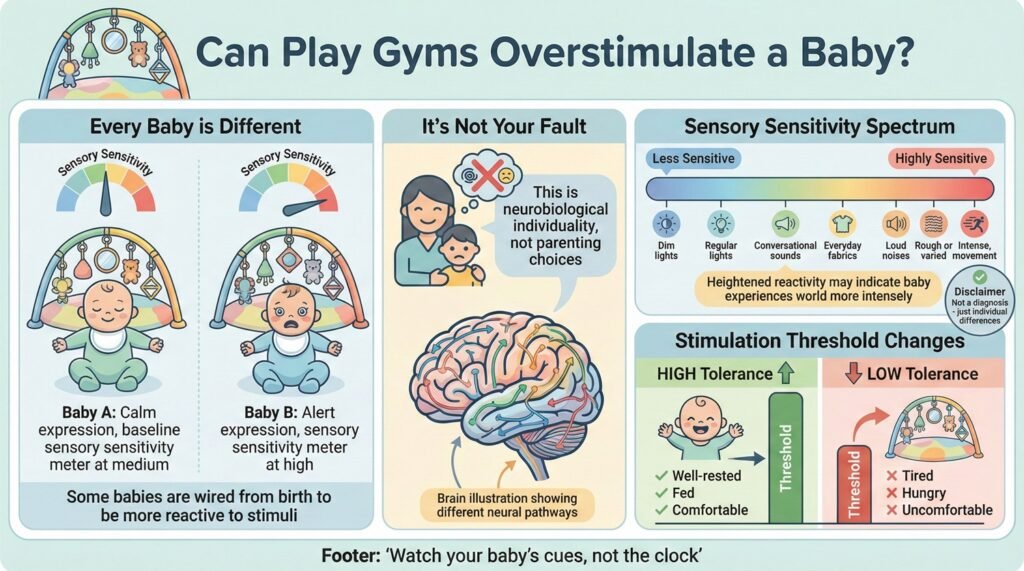
I’ve watched babies at playgroups who could happily bat at toys for twenty minutes straight, seemingly energized by all the action. I’ve also watched babies, including my own, who lasted maybe three minutes before showing clear distress signals.
Neither response is wrong or problematic.
They’re just different nervous systems with different thresholds for sensory input.
Your baby’s sensory threshold is influenced by several factors that are mostly outside your control. Temperament plays a huge role.
Some babies are simply wired to be more reactive to environmental stimuli from birth.
This isn’t something you caused through parenting choices. It’s neurobiological individuality that shows up even in newborns.
Some research suggests that babies who later show signs of neurodivergence, including autism or sensory processing differences, may have more sensitive sensory systems from birth. You obviously can’t diagnose anything in infancy, but heightened reactivity to sensory input can be an early indicator that your baby experiences the world more intensely than average.
The current state of your baby also dramatically affects their threshold at any given moment. A well-rested, fed, comfortable baby can handle significantly more stimulation than a tired, hungry, or uncomfortable one.
This is why timing your play gym sessions matters so much.
Using it right before nap time when your baby is already getting fatigued is basically asking for a meltdown. Their capacity for handling stimulation decreases as they get tired, just like your patience wears thin when you’re exhausted.
Even time of day affects sensory tolerance. Many babies have a “witching hour” in the late afternoon or early evening when they’re naturally more fussy and less able to handle stimulation.
Introducing play gym time during these periods rarely goes well, regardless of how much your baby might enjoy it earlier in the day.
Reading Your Baby’s Actual Responses
The most important skill you can develop is reading your baby’s specific cues as opposed to following generic guidelines about what babies “should” enjoy. This needs really close observation, which honestly can be challenging when you’re sleep-deprived and just hoping the play gym will entertain your baby for ten minutes so you can drink coffee.
Early engagement looks like sustained attention to the toys, reaching movements that seem purposeful as opposed to frantic, and facial expressions that range from neutral to mildly interested. Some babies smile and coo during play gym time, but many don’t, and that’s completely fine. You’re not looking for obvious joy.
You’re looking for an absence of distress combined with some level of attention.
The transition from engaged to overstimulated can happen surprisingly quickly. One moment your baby is looking at a dangling toy, the next they’re crying and arching their back.
The warning signs often appear in a predictable sequence if you know what to watch for.
First comes a slight change in body tension. Muscles get a bit stiffer, movements become slightly jerkier.
Then you might see gaze aversion, where your baby deliberately looks away from the toys or closes their eyes.
This is an active try to reduce sensory input, and it’s a clear signal that they need a break.
If you miss those early signals, the escalation continues. Fist clenching happens next, followed by increasingly frantic arm and leg movements that look uncoordinated and distressed. Color changes can occur too, with some babies getting blotchy or flushed when they’re overwhelmed.
By the time your baby is full-on crying, they’ve been trying to tell you they’re overwhelmed for a while already.
This isn’t a criticism. These cues are genuinely easy to miss, especially early on when you’re still learning your baby’s communication style.
But learning to recognize them earlier makes a real difference in preventing full meltdowns and helping your baby feel understood.
Some babies also show what researchers call “freezing” responses when overwhelmed. Instead of getting increasingly active and fussy, they become very still and quiet, almost shutting down. Parents sometimes mistake this for contentment or even think their baby is falling asleep, but it’s actually a stress response.
If your baby suddenly goes very still and glassy-eyed during play gym time, that’s a signal to stop, not continue.
The Actual Timeline for Play Gym Use
The common advice to start with just three to five minutes sounds almost absurdly short when you first hear it. You might think, “What’s the point of even setting it up for three minutes?” But those micro-sessions are genuinely suitable for very young nervous systems that are still adjusting to life outside the womb.
For newborns in the first month, one to two minutes a couple times per day is actually enough. Your baby is still adjusting to the basic sensations of being a separate person in an environment.
Gravity, air temperature, the feeling of clothing, the sight of light and shadow.
Adding a play gym on top of all that novelty is genuinely a lot for their system to handle.
Around six to eight weeks, you can usually extend sessions to five to seven minutes if your baby seems engaged and comfortable. Watch for those early warning signs and end the session before they escalate to distress.
Around three months, many babies can handle fifteen to thirty-minute sessions, though this should still be broken into smaller chunks with breaks. The key word is “can,” not “should.” If your baby shows signs of being done after eight minutes, they’re done.
The number on a developmental guideline doesn’t override your specific baby’s actual response.
What I found really helpful was thinking about play gym time as active engagement that needs energy, similar to how you might think about exercise. You wouldn’t expect yourself to jump into an hour-long intense workout if you’d been sedentary for months.
Your baby is essentially learning to “work out” their attention and sensory processing systems, and they need to build stamina gradually.
By six months, some babies can engage with play gyms for longer stretches, sometimes up to forty-five minutes with breaks. But again, this varies wildly.
I know babies who never tolerated play gyms for more than fifteen minutes at a time throughout their entire first year, and they developed perfectly normally.
Chronic Versus Occasional Overstimulation
There’s an important distinction between occasionally overwhelming your baby and creating chronically overstimulating environments. If you misjudge a play gym session once in a while and your baby gets fussy, that’s not going to cause lasting problems.
Your baby will recover once you remove them from the situation, and no developmental damage occurs from occasional sensory overload.
Think of it like accidentally staying up too late one night. You’re tired the next day, but you bounce back.
One instance doesn’t rewire your sleep patterns permanently.
Chronic overstimulation is different. If your baby is routinely pushed past their sensory threshold day after day, whether from play gyms, busy environments, constant activity, or many forms of stimulation throughout the day, there’s some evidence suggesting this could affect developing neural pathways.
The concern is that a nervous system constantly in a stressed, overwhelmed state may develop heightened reactivity as a baseline. The brain might wire itself to expect overwhelming input and respond with more intense stress reactions as a protective mechanism.
This doesn’t mean you need to create a completely sterile, quiet environment. Normal household activity is fine and actually helpful for development.
Babies need to learn to process everyday sounds and sights.
The issue arises when you’re deliberately adding high-intensity stimulation through toys and activities without adequate recovery time, especially if your baby is showing clear signs that they can’t handle it.
Creating a Sensible Play Gym Routine
The most sustainable approach involves matching your play gym use to your baby’s natural rhythm as opposed to trying to impose an arbitrary schedule. Pay attention to your baby’s alert, calm periods.
These are your windows for introducing stimulation.
For many babies, this is mid-morning after feeding and a successful diaper change but before they’re ready for their next nap. They’ve had enough wake time to be alert but aren’t yet tired and cranky.
Start your session and watch continuously. I know it’s tempting to use play gym time to get something done, but especially in the beginning, your presence and observation are critical.
Sit nearby where your baby can see you if they look away from the toys.
Your familiar face actually serves as a regulatory tool when they’re processing new sensory experiences. Research shows that babies look to their caregivers for emotional cues when encountering new situations.
If you’re calmly present, it helps them feel safer exploring the stimulation around them.
If you notice early withdrawal cues like looking away, decreased movement, or changes in muscle tone, immediately give a break. This doesn’t mean the session is over necessarily.
You can pick your baby up, have a quiet moment together, and then try again if they seem receptive.
Sometimes babies need processing breaks where they look away to integrate what they’ve just experienced before they’re ready for more input. These pauses are actually part of healthy sensory processing, not a sign that they’re done playing.
Modifying the Sensory Environment
Not all play gyms are created equal in terms of sensory intensity. Some models have every feature possible: lights, music, many textures, mirrors, crinkly sounds, and a dozen hanging toys all competing for attention.
Others are more minimalist with simple wooden elements and fewer attachments.
For sensitive babies, starting with less is definitely more effective.
Even with an elaborate play gym, you can change the experience significantly. Remove some of the hanging toys so there are fewer visual targets competing for attention.
Start with just two or three items instead of eight or ten.
Turn off any music or sound features and let the environment stay quiet. Electronic sounds are particularly stimulating and can push babies over their threshold quickly.
Use the play gym in a room with softer lighting as opposed to bright overhead lights. Natural light from a window works well, or use a lamp as opposed to harsh ceiling fixtures.
Toy rotation is another useful strategy. Instead of having all possible attachments on the gym at once, keep some in a drawer and swap them out every few days.
This keeps things interesting without overwhelming, and it also helps you identify which specific toys your baby responds to positively versus which ones seem to trigger stress.
The mat itself matters too. Some play gyms come with busy, high-contrast mats covered in patterns and images.
For a sensitive baby, a simpler mat or even placing a plain blanket over the mat can reduce visual complexity while still allowing them to benefit from reaching for the hanging toys.
What to Do When Overstimulation Happens
Despite your best efforts, you’ll eventually miss the signals or misjudge your baby’s capacity on a particular day. When you realize your baby is overstimulated, your immediate response makes a real difference in how quickly they recover.
First, remove them from the stimulating environment immediately. Pick them up and move to a quieter, dimmer space.
Your bedroom with curtains drawn often works well.
Speak in a soft, calm voice or don’t speak at all if your baby seems to respond better to quiet.
This is where understanding your specific baby becomes crucial. Some overstimulated babies want to be held firmly and swaddled. The deep pressure is organizing for their nervous system and helps them calm down faster.
But other babies, particularly during peak crying periods between two weeks and four months, actually do worse with extra touch because touch itself is another sensory input, and that’s exactly the problem.
These babies sometimes recover better when placed safely in their crib with you sitting nearby but not touching them. Your presence provides reassurance without adding more sensory input they can’t process.
White noise can help some babies by providing consistent, predictable sound that masks other environmental noises and creates a calming audio environment. But for other babies, even white noise is too much when they’re already overloaded. You have to experiment to see what actually helps your specific child.
Gentle rocking or swaying helps many babies calm down, but again, some find the movement overstimulating when they’re already dysregulated. Pay attention to whether your baby’s crying intensifies or decreases when you introduce movement.
Play Gyms Aren’t Actually Necessary
Here’s something that might be freeing to hear. Babies don’t actually need play gyms at all.
The baby product industry has convinced parents that these items are essential developmental tools, but human babies developed perfectly well for thousands of years without manufactured activity centers.
What babies genuinely need is a safe space to move, opportunities to experience different sensations, and responsive interaction with caregivers. You can provide all of that with a blanket on the floor, some simple household objects to look at, and your engaged presence.
Tummy time on a plain mat does everything a play gym does in terms of strengthening neck and shoulder muscles.
If your baby consistently shows signs of overstimulation with a play gym, you’re not depriving them of critical development by putting it away. You’re actually responding appropriately to their communication about what their nervous system can handle.
Some babies really do better with simpler, less stimulating play environments throughout infancy. They might prefer looking at a single wooden rattle or watching leaves move outside a window to having many toys dangling in their face.
Your baby lying on a blanket looking at your face while you talk to them provides massive developmental benefits. Eye contact, facial recognition, language exposure, emotional bonding.
These things matter far more than batting at toys.
Frequently Asked Questions
How long should a 2-month-old be on a play gym?
For most 2-month-old babies, sessions should be limited to 3-5 minutes most, done once or twice per day. At this age, your baby’s nervous system is still very immature and gets overwhelmed quickly.
Watch for signs that your baby is ready to stop, like looking away, getting fussy, or becoming very still.
Some babies at this age can’t handle play gyms at all, and that’s completely normal.
What are signs my baby is overstimulated?
The earliest signs include looking away from toys or closing eyes, stiffening muscles, and jerkier movements. As overstimulation increases, you’ll see fist clenching, frantic arm and leg movements, color changes in the face, and increasingly distressed vocalizations.
Some babies show a “freezing” response instead, becoming very still and glassy-eyed. By the time your baby is crying hard, they’ve been overwhelmed for several minutes already.
Can too much tummy time overstimulate a baby?
Yes, tummy time can overstimulate babies, especially when combined with play mats that have busy patterns or toys positioned too close to their face. The physical effort of holding their head up is tiring for young babies, and adding visual stimulation on top of that physical work can push them over their threshold.
Plain surfaces work better for sensitive babies, and shorter sessions of 2-3 minutes repeated throughout the day are more effective than longer stretches.
Do high-needs babies get overstimulated easier?
Babies described as “high-needs” typically do have lower thresholds for sensory stimulation and get overwhelmed more easily than average. These babies often need more help regulating their nervous systems and benefit from quieter, simpler environments.
Minimalist play setups, shorter activity sessions, and more recovery time between stimulating experiences help these babies stay within their window of tolerance.
When do babies outgrow overstimulation?
Most babies develop better sensory regulation between 3-6 months as their nervous systems mature and they develop better filtering abilities. However, some children stay more sensitive to sensory input throughout early childhood.
This doesn’t mean something is wrong, just that they have a more reactive nervous system.
By around 6 months, most babies can handle more stimulation for longer periods, but person differences stay significant.
Are baby swings too stimulating?
Baby swings can be overstimulating depending on the settings used and your baby’s sensitivity level. Swings with lights, music, and fast motion provide many forms of stimulation simultaneously.
For sensitive babies, using just the gentle swinging motion without sounds or lights works better.
Watch your baby’s responses closely. If they seem tense or distressed as opposed to calm, the swing is adding stimulation as opposed to providing soothing.
What should I do instead of a play gym?
Simple floor time on a plain blanket works beautifully for baby development. Lay your baby on their back or tummy and sit with them, talking, singing, or just being present.
Offer one or two simple objects to look at, like a wooden rattle or soft fabric toy.
Take them to a window to watch trees or clouds. These low-stimulation activities support development without overwhelming their nervous system.
Key Takeaways
Play gyms can definitely overstimulate babies, particularly those under four months old or those with naturally sensitive nervous systems. The risk varies enormously based on person temperament, current state, dosage, and environmental factors.
Learning to read your specific baby’s cues as opposed to following generic developmental guidelines is the most important skill for preventing overstimulation.
Short sessions of 1-5 minutes for young infants, gradually increasing as tolerance develops, work better than extended play gym time. Watch for early warning signs like gaze aversion and body tension changes before your baby escalates to crying.
Occasional overstimulation doesn’t cause lasting harm, but chronic daily overwhelm potentially affects developing neural pathways. Watching for patterns matters more than worrying about person incidents.
If your baby consistently shows distress with the play gym, putting it away and using simpler play options is completely suitable.
Modifying the sensory environment by removing toys, eliminating sounds, adjusting lighting, and timing sessions during alert, calm periods significantly reduces overstimulation risk. You can make almost any play gym less intense by stripping away features.
Play gyms are optional developmental tools as opposed to necessities. Babies who don’t tolerate them well develop perfectly fine through simpler play experiences and responsive caregiver interaction.
Your presence and attention matter far more than any toy.