
We may earn money or products from the companies mentioned in this post.
Starting Your Fitness Journey as a New Parent
Standing in my living room at three months postpartum, staring at my old gym bag collecting dust in the corner, I felt like that part of my life was just gone. The idea of getting back to the gym seemed impossible with a newborn who needed me constantly.
Getting back to the gym with a baby becomes doable once you understand the real strategies that work. You need logistics, realistic planning, and an understanding that your body has been through something massive.
New parents who successfully maintain gym routines have figured out the practical systems that make it work within the chaos of early parenthood.
Understanding the Postpartum Timeline and Your Bodys Reality
Before we talk about logistics, you need to understand what’s happening in your body after birth. This knowledge prevents injury and helps you make smart decisions about when and how to start exercising again.
Your pelvic floor has stretched significantly during pregnancy and birth. If you had a vaginal delivery, those muscles need proper healing time.
Even if you had a cesarean section, you have abdominal surgery to recover from, which means your core stability is compromised in ways you might not immediately feel.
The hormone relaxin, which loosened your ligaments during pregnancy, can stay in your system for several months postpartum. This makes your joints more vulnerable to injury even when you feel physically ready to push yourself.
Most healthcare providers clear women for exercise around six weeks postpartum for uncomplicated vaginal births and eight to ten weeks for cesarean deliveries. But clearance means you can begin gentle movement, not that you should immediately try to deadlift your previous max or run five miles.
Think of it more like getting cleared to start the rehabilitation process.
The separation of your abdominal muscles, called diastasis recti, affects the majority of pregnant women and doesn’t always heal on its own. This gap in your connective tissue means traditional core exercises can actually make the problem worse if you don’t know what you’re doing.
Heavy lifting, crunches, and even certain yoga poses can increase intra-abdominal pressure in ways that prevent healing or cause the gap to widen.
Before returning to any heavy lifting or high-impact exercise, you should be able to perform basic movements like squats, lunges, and modified planks without any visible doming or bulging along your midline. If you see your abdomen pushing out along the center line during an exercise, you’re not ready for that movement or load yet.
Your body also needs time to replenish nutrient stores that were depleted during pregnancy and are continuing to be depleted if you’re breastfeeding. Iron, calcium, vitamin D, and protein are particularly important for supporting your recovery and rebuilding muscle tissue.
You can’t expect your body to perform well if you’re running on inadequate fuel.
Finding Childcare Solutions That Actually Work
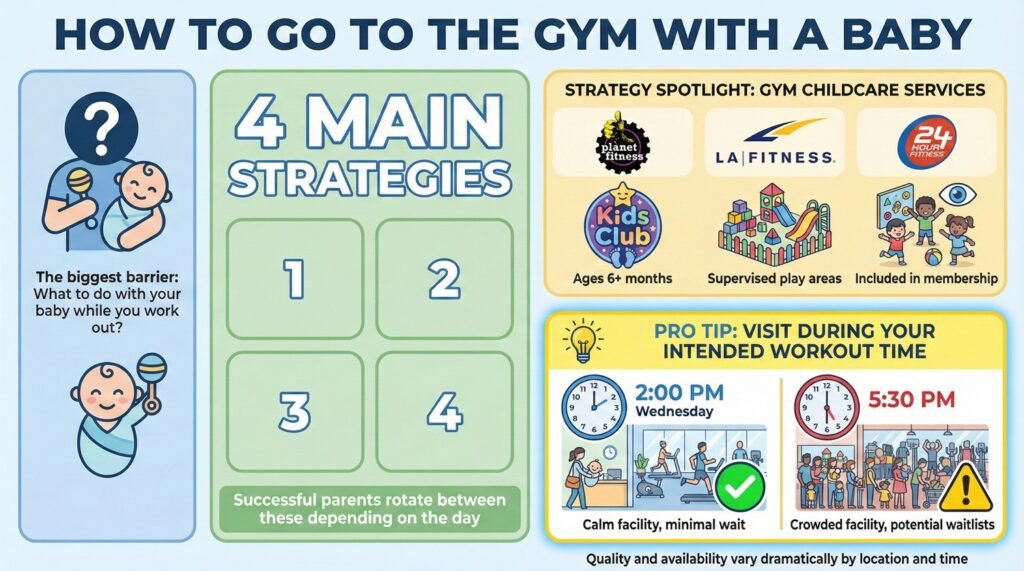
The biggest barrier most new parents face is the very practical question of what to do with your baby while you work out. Successful gym-going parents typically use one of four main strategies, and often rotate between them depending on the day.
Many commercial gyms now offer childcare services, though the quality and availability vary dramatically. Planet Fitness locations often have Kids Club facilities where you can leave children as young as six months old while you work out.
LA Fitness, 24 Hour Fitness, and other major chains often include supervised play areas as part of their membership packages.
The real key here is visiting during your intended workout time to see how the childcare actually operates. A facility that looks great at 2 PM on a Wednesday might be completely overwhelmed at 5:30 PM when every working parent in the area shows up.
When evaluating gym childcare, look beyond the toys and colorful walls. Watch how staff interact with the children already there.
Are they engaged or scrolling on their phones?
How do they handle a child who’s upset? What’s their sick child policy, and how strictly do they enforce it?
I learned this the hard way when I joined a gym with beautiful childcare facilities that turned out to have a revolving door of teenage staff who had zero experience with babies.
Ask about the most number of children they accept per session and whether you need to reserve spots in advance. Some gyms limit childcare to specific hours or need sign-ups that fill up days ahead.
Find out what happens if your baby won’t stop crying.
Do they come get you immediately, or do they try to soothe your baby first? Understanding these policies before you join saves frustration later.
Working out with your baby physically present is the second major strategy. Jogging strollers designed for running open up outdoor workout possibilities once your baby has adequate head and neck control, typically around six months.
Before that, regular stroller walks provide cardiovascular exercise and can be surprisingly challenging if you’re walking briskly on varied terrain or adding intervals.
Baby wearing during workouts has gained popularity, and it can work well for certain types of exercise. Structured carriers designed for exercise distribute weight properly and keep your baby secure while you walk, do bodyweight squats, or perform other moderate-intensity movements.
However, high-impact activities, exercises where you’re lying down, or anything involving equipment near your baby’s head aren’t suitable for baby wearing workouts.
The third strategy involves coordinating with a partner, family member, or friend to watch your baby during your gym time. This needs more planning and consistent communication, but it gives you the freedom to fully focus on your workout without worrying about your baby or time constraints.
Some parents establish a routine where one person goes to the gym early morning while the other handles baby duty, then they switch the next day or later in the week.
Home workout setups represent the fourth main approach. While this technically isn’t “going to the gym,” many parents find that investing in basic equipment like resistance bands, adjustable dumbbells, or a simple pull-up bar gives them flexibility that gym childcare can’t match.
You can work out during nap times, early mornings, or late evenings without coordinating transportation and childcare logistics.
Creating a Schedule That Survives Reality
Your schedule needs to be flexible enough to survive inevitable disruptions while still being consistent enough to create an actual routine. I’ve seen so many new parents create elaborate workout schedules that fall apart the first time their baby has a rough night or gets sick.
The most successful approach is identifying your most reliable time slot based on your baby’s patterns. Some babies are predictably happy in the morning after their first feed and nap.
Others hit a sweet spot in the early afternoon.
Very few babies are predictable in the late afternoon and evening, which makes after-work gym sessions particularly challenging for new parents.
Morning workouts before your partner leaves for work or before your baby wakes up work really well for some people, but only if you’re actually willing to go to bed earlier. If you’re up with your baby many times at night and then trying to wake up at 5 AM to work out, you’re going to burn out fast.
Sleep deprivation is real, and it affects everything from your coordination to your immune system to your ability to build muscle and recover from exercise.
Planning your gym sessions around your baby’s nap schedule sounds perfect in theory, but naps are frustratingly unpredictable, especially in the first year. A better approach is having a primary ideal time slot and a backup option.
Maybe your main plan is going to the gym while your baby is in childcare three mornings a week, but you also have some basic equipment at home for a quick twenty-minute session when that doesn’t work out.
Workout flexibility means something different when you have a baby. Instead of planning for sixty-minute gym sessions, think in terms of thirty-minute blocks.
Can you get a solid workout in thirty minutes?
Absolutely. Will it look like your pre-baby routine?
Probably not, but thirty minutes of focused strength training or cardiovascular work beats zero minutes of exercise because you couldn’t make a full hour work.
Consider splitting your workouts into even shorter chunks if needed. Ten minutes of strength work in the morning, fifteen minutes of cardio at lunch, ten minutes of stretching in the evening. These micro-sessions add up and they’re easier to fit into unpredictable days than trying to carve out one long block of time.
Building Your Workout Foundation Safely
Once you’ve got the logistics sorted and you’re cleared for exercise, the actual workout programming matters tremendously. This is where a lot of new moms either push too hard too fast and get injured, or they stay so cautious that they don’t make any progress.
Your first phase of returning to exercise should focus heavily on rebuilding core and pelvic floor function. This doesn’t mean doing hundreds of Kegels and planks.
In fact, traditional planks often aren’t suitable in the early postpartum period.
Proper core rehabilitation starts with learning to engage your deep abdominal muscles and coordinate that engagement with your breathing and pelvic floor activation.
Exercises like dead bugs, bird dogs, and glute bridges done with proper form and focus on the internal engagement teach your core to stabilize again. With dead bugs, you lie on your back with your arms extended toward the ceiling and your legs in tabletop position. You slowly lower one arm overhead while simultaneously extending the opposite leg, keeping your lower back pressed into the floor.
This simple movement needs tremendous core control when done correctly.
Bird dogs start on your hands and knees. You extend one arm forward and the opposite leg back, holding the position while maintaining a neutral spine and level hips.
The goal is to move slowly and deliberately, focusing on keeping your torso completely still rather than rushing through repetitions.
These exercises might seem basic, but they build the foundation you need for more complex movements later.
Progressive strength training is your friend as a new parent. Starting with bodyweight exercises and gradually adding resistance allows your connective tissue and bones to adapt safely.
You’ve potentially lost muscle mass during pregnancy and the postpartum period, especially if you’re breastfeeding and not eating enough.
Your body needs time to rebuild that strength foundation.
Begin with movements you can perform for three sets of ten to twelve repetitions with good form. Bodyweight squats, wall push-ups, and supported lunges are excellent starting points.
Once these feel genuinely easy and you can finish all sets without your form breaking down, you can add light weights or progress to more challenging variations.
Cardiovascular exercise should also progress gradually. If walking feels easy, try adding intervals where you increase your pace for one to two minutes, then recover.
Progress to incline walking, then very gradual return to jogging if that’s your goal.
Your pelvic floor needs to handle the impact of running, and many women return to running too quickly and develop pelvic organ prolapse, urinary incontinence, or other issues that could have been prevented with a slower progression.
A helpful test before returning to running is whether you can do twenty single-leg hops on each leg without any leaking, heaviness, or dragging sensations in your pelvic floor. If you can’t pass this test comfortably, you need more time building strength and stability before adding the repetitive impact of running.
Functional fitness takes on new meaning when you’re a parent. You’re constantly lifting your baby, holding them on one hip, bending down to pick up toys, and carrying car seats and diaper bags.
Your workout should support these real-life movement patterns.
Single-leg exercises, farmer’s carries, overhead presses, and exercises that challenge your balance all have direct carryover to parenting activities.
Navigating Common Obstacles and Mental Blocks
The physical logistics and programming are only part of the challenge. The mental and emotional aspects of returning to the gym as a new parent can be surprisingly difficult, and nobody really talks about this stuff.
Gym anxiety is real when your body has changed and you’re exhausted and you feel like everyone else has it more together than you do. Walking into a gym for the first time postpartum can feel vulnerable and overwhelming.
Your clothes might not fit right, your strength is different, and you might be dealing with leaking issues or other postpartum symptoms that make you self-conscious.
Most people at the gym are focused on their own workouts and barely notice anyone else. The judgmental stares you’re worried about probably aren’t happening.
If your gym has a genuinely unwelcoming vibe, find a different gym.
There are fitness communities specifically built around supporting parents, and those environments can make a huge difference in how comfortable you feel.
The guilt of leaving your baby, even for an hour, hits many new parents hard. You might feel like you should be with your baby every possible moment, or worry that they need you specifically and no one else can meet their needs. This is particularly intense if you’re breastfeeding and concerned about missed feeds or maintaining your supply.
Reframing exercise as something that makes you a better parent helps work through this guilt. Taking care of your physical and mental health makes you a more patient, energetic, and present parent.
Your baby benefits from having a parent who feels strong, capable, and like they have some control over their life and body.
That said, if the guilt is overwhelming every single time, it might be worth exploring whether the timing is right or whether you need to start with shorter sessions to ease into it. There’s no prize for forcing yourself to work out if it’s causing genuine distress every time you leave your baby.
Practical challenges like breastfeeding logistics need planning ahead. Nursing or pumping right before you leave for the gym helps prevent discomfort and leaking during your workout.
A supportive, well-fitted sports bra designed for nursing mothers makes a real difference.
Some women find they need to avoid high-impact exercise when their breasts are full to prevent pain or potential issues with milk supply or clogged ducts.
Sleep deprivation affects your workouts more than you might realize. If you’re running on four hours of broken sleep, your coordination is impaired, your reaction time is slower, and your body’s ability to recover from exercise is compromised. On days when you’re really exhausted, choosing a lighter workout or even just a walk is the smarter choice.
Pushing through severe fatigue to do an intense workout can lead to injury and doesn’t provide the benefits you’re hoping for anyway.
People Also Asked
Can I exercise while breastfeeding?
Yes, you can exercise while breastfeeding. Moderate exercise doesn’t affect milk supply or quality for most women.
Nursing or pumping before your workout prevents discomfort from full breasts and reduces the risk of clogged ducts.
Staying well-hydrated and eating enough calories to support both breastfeeding and exercise is important for maintaining your supply.
How long after C-section can I go to gym?
Most doctors clear women for exercise eight to ten weeks after a cesarean section, though this varies based on your person recovery. You should wait until your incision is fully healed and you have no pain with daily movements.
Start with gentle walking and core rehabilitation exercises before progressing to more intense workouts.
Always follow your doctor’s specific recommendations for your situation.
What exercises should I avoid postpartum?
Avoid exercises that cause visible doming or bulging along your midline, which shows you’re not ready for that movement. Skip heavy lifting, traditional crunches, full planks, and high-impact activities until you’ve rebuilt your core and pelvic floor foundation.
Exercises that create significant intra-abdominal pressure can worsen diastasis recti or contribute to pelvic floor dysfunction if done too early.
When can I start running after having a baby?
Wait at least three to six months postpartum before returning to running, and only after you’ve built adequate core and pelvic floor strength. You should be able to walk briskly for 30 minutes without discomfort, perform single-leg exercises with control, and finish 20 single-leg hops on each side without any leaking or pelvic heaviness before attempting to run.
Do gyms have babysitting services?
Many commercial gyms offer childcare services, including Planet Fitness, LA Fitness, 24 Hour Fitness, and YMCA locations. The quality, hours, and age requirements vary significantly between facilities.
Some gyms include childcare in the membership price while others charge extra.
Most need children to be at least six months old and may limit the amount of time per visit.
How do I get motivated to workout postpartum?
Focus on creating systems that remove barriers rather than relying on motivation. Set up your gym bag the night before, choose workout times that align with your baby’s predictable windows, and start with achievable goals like two 30-minute sessions per week.
Having accountability through a workout partner or scheduled class also helps maintain consistency when motivation is low.
Can you lose belly fat while breastfeeding?
You can lose belly fat while breastfeeding, but it needs patience and adequate calorie intake to support milk production. Aim for gradual fat loss of no more than one to two pounds per week.
Combine strength training to rebuild muscle with moderate cardiovascular exercise and focus on nutrient-dense foods.
Drastic calorie restriction can affect your milk supply and leave you exhausted.
What is diastasis recti and how do I fix it?
Diastasis recti is the separation of your abdominal muscles along the midline that commonly occurs during pregnancy. You fix it by focusing on exercises that engage your deep core muscles without creating excessive intra-abdominal pressure.
Movements like dead bugs, bird dogs, and modified planks help.
Avoid traditional crunches, sit-ups, and heavy lifting until the gap closes to less than two finger widths.
Key Takeaways
Getting to the gym with a baby needs solving logistical challenges first. Research gym childcare thoroughly before committing to a membership, and understand that quality varies dramatically between facilities and even between different times at the same facility.
Your postpartum body needs gradual progression and suitable core rehabilitation. Clearance for exercise means you can start gentle movement, not that you should immediately resume high-intensity training.
Focus on rebuilding your foundation with exercises that target your deep core and pelvic floor before advancing to more challenging workouts.
Multiple backup plans make consistency possible when life with a baby is inherently unpredictable. Have your ideal workout scenario and at least two choices that allow you to do something even when the perfect plan falls apart.
A 20-minute home workout beats skipping exercise entirely because you couldn’t make it to the gym.
Realistic scheduling based on your baby’s actual patterns and your genuine energy levels beats aspirational schedules that look good on paper but fail in reality. Start with two workouts per week and build from there rather than planning five sessions and consistently failing to meet that goal.
The mental and emotional challenges of returning to fitness as a new parent are just as real as the physical and logistical ones. Gym anxiety, guilt about leaving your baby, and feeling self-conscious about body changes all need acknowledgment and strategies to address.
Finding a supportive fitness community makes a huge difference in how sustainable your routine becomes.