
We may earn money or products from the companies mentioned in this post.
Cleaning your baby’s activity gym
If you’ve got a baby, you know that activity gym on your living room floor gets a serious workout. Between tummy time, batting at hanging toys, and the inevitable drool, spit-up, and mysterious stains that appear out of nowhere, that colorful play mat changes from pristine to grimy faster than you’d think possible.
What exactly does maintaining a baby activity gym involve?
Cleaning your baby’s activity gym means establishing a realistic routine that keeps the mat hygienic without overwhelming your already packed schedule. It involves understanding what type of materials you’re working with, choosing safe cleaning products that won’t irritate your baby’s sensitive skin, and knowing when a quick wipe-down will suffice versus when you need a deeper clean.
Most activity gyms need spot cleaning after messy incidents, a thorough surface wipe every few days, and a finish deep clean weekly or biweekly depending on use. The specific approach varies based on whether your mat is machine washable, foam-based, or constructed from rubber or vinyl materials.
You’ve got maybe 60 seconds to address a spit-up incident before it sets into the fabric, or you can opt for a preventive approach that involves daily maintenance habits. I’ll outline both reactive and proactive strategies below.
Understanding What You’re Really Working With
Before you spray anything or toss your activity gym into the washing machine, you need to know exactly what you’re dealing with. I’ve seen parents accidentally ruin expensive play mats because they assumed all baby gear could handle the same treatment.
Baby activity gyms come in wildly different constructions. Some feature entirely fabric surfaces with removable covers that zip off for easy laundering.
Others have foam cores sandwiched between fabric layers that can’t ever be fully submerged. Still others use waterproof materials like vinyl or rubber that need completely different approaches.
Your first assignment is locating the care tag or instruction manual that came with your specific gym. I know, I know, you probably threw that manual in a drawer months ago or it came in packaging you immediately recycled. If you can’t find it, search the manufacturer’s website using your product’s model number.
Most major brands like Fisher-Price, Skip Hop, Infantino, and Lovevery have detailed cleaning instructions available online.
The material composition matters tremendously. Cotton and polyester fabric mats typically handle machine washing well, though you’ll want to verify temperature requirements and whether the manufacturer recommends using laundry bags for protection.
Foam mats with enclosed elements like crinkle paper or squeakers need special consideration because water can get trapped inside these components and create mold growth if not properly dried. Memory foam or specialized cushioning materials sometimes break down when exposed to certain detergents or hot water. Rubber and vinyl surfaces are usually waterproof but can develop cracks or discoloration if cleaned with harsh chemicals or left in direct sunlight during drying.
Different materials also wear differently over time. Fabric surfaces might pill or fade with repeated washing.
Foam can compress and lose its cushioning properties if cleaned improperly.
Vinyl can become sticky or crack if you use the wrong cleaning agents. Understanding these vulnerabilities helps you choose cleaning methods that actually extend your mat’s lifespan as opposed to shortening it.
Take a photo of the care instructions tag with your phone and save it in a dedicated folder for baby gear. When you’re dealing with a blowout at 2 AM, you won’t want to hunt for that tiny tag tucked underneath the mat.
I’ve also found it helpful to write the basic cleaning method on a piece of masking tape and stick it on the bottom of the mat itself.
Something simple like “Machine wash cold, air dry” or “Wipe only, no submersion” saves you from constantly looking up instructions.
The Daily Maintenance System That Actually Works
I’m going to be honest with you, you don’t need to deep clean your baby’s activity gym every single day. That’s an unrealistic standard that will burn you out within a week.
What you need instead is a simple daily system that prevents the buildup that makes deep cleaning necessary in the first place.
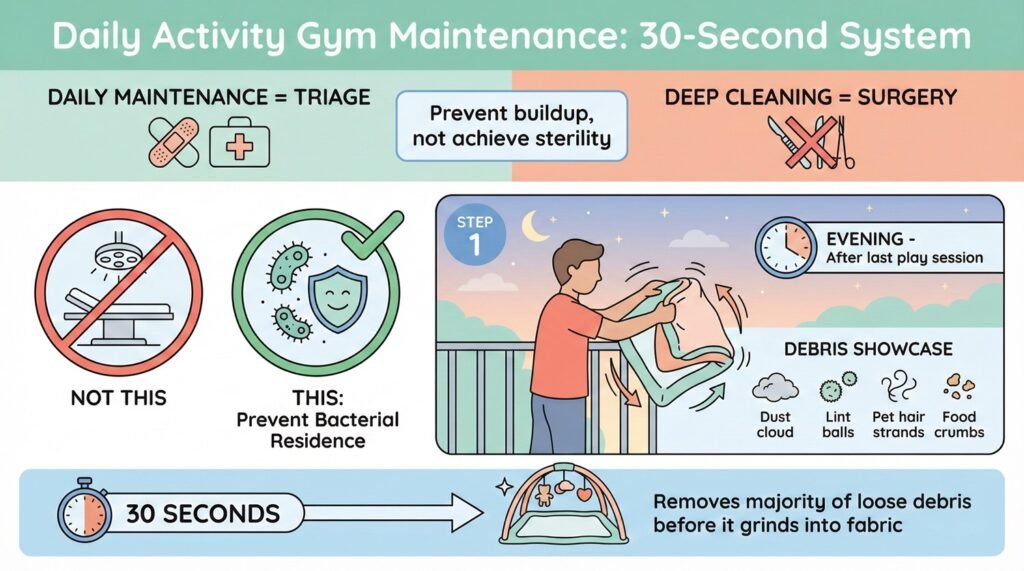
Think of daily maintenance as triage as opposed to surgery. You’re addressing visible messes and preventing bacteria from establishing permanent residence, not achieving hospital-grade sterility.
Here’s what daily maintenance actually looks like in practice. Each evening after your baby’s last play session, take the mat outside or to a balcony and give it a firm shake.
You’d be amazed how much dust, lint, pet hair, and food crumbs accumulate in those textured surfaces throughout the day.
This 30-second action removes the majority of loose debris that would otherwise get ground into the fabric.
Next, do a quick visual inspection of the entire surface. Look specifically at corners, seams, and any raised elements where moisture or food particles tend to collect.
If you spot anything concerning, grab a clean damp cloth and wipe it down immediately.
For fresh spills or spit-up, the blotting technique is your best friend. Press a clean cloth or paper towel firmly onto the mess without rubbing.
Rubbing pushes the liquid deeper into the mat’s fibers and spreads the stain outward.
Blot repeatedly, moving to clean sections of your cloth, until you’ve absorbed as much moisture as possible. Then follow up with a barely damp cloth to lift any residue.
Baby wipes are genuinely useful for these spot treatments. They’re formulated to be gentle on sensitive skin, which means they’re also gentle on your mat’s materials.
They contain just enough moisture to lift fresh messes without oversaturating the surface.
I keep a small package of wipes right next to our activity gym specifically for this purpose.
The key insight here is that consistency beats intensity. A two-minute daily check prevents the accumulation that requires an hour-long deep clean.
You’re creating a baseline of cleanliness that’s maintainable long-term as opposed to cycling between pristine and disgusting.
I’ve found that linking this maintenance to something you already do daily makes it stick. Maybe you wipe down the activity gym right after you clean your baby’s high chair.
Maybe you do it while you’re waiting for the bathwater to fill.
Maybe it happens right before you fold the day’s laundry. The specific timing matters less than the consistency.
Deep Cleaning Strategies for Different Mat Types
Weekly or biweekly deep cleaning removes the bacteria, allergens, and grime that aren’t visible but definitely accumulate with regular use. Your approach here depends entirely on your mat’s construction.
Machine Washable Fabric Mats
If you’re fortunate enough to have a fully machine-washable activity gym, this process is refreshingly straightforward. Remove any detachable elements like hanging toys, arch connectors, or removable padding before washing.
Check whether your mat has velcro, snap closures, or attachment loops.
These should be secured closed to prevent them from snagging other items or damaging the mat itself during the wash cycle.
Place the mat in your washing machine on a gentle or delicate cycle using cold water. Hot water can cause shrinkage in some fabrics and may damage elastic elements or waterproof backing.
Use a mild, fragrance-free detergent formulated for baby items or sensitive skin. The amount of detergent matters.
Too much creates excessive suds that don’t rinse out completely, leaving residue that can irritate your baby’s skin.
Some parents wash their activity gym alone to prevent color transfer or to confirm it gets thoroughly rinsed. Others wash it with similar colors like baby blankets or towels. Both approaches work fine as long as you’re not overcrowding the machine, which prevents proper agitation and rinsing.
Never use bleach, fabric softeners, or stain removers on baby activity mats. Bleach degrades fabric fibers and can leave harmful residue.
Fabric softeners coat fibers with chemicals that reduce absorbency and may irritate sensitive skin. If you’re dealing with tough stains, pre-treat with a paste of baking soda and water instead.
Mix three parts baking soda to one part water, spread it on the stain, let it sit for 15 minutes, then wash normally.
After washing, resist the temptation to toss the mat in the dryer. Heat from dryers can melt waterproof backing, shrink fabrics, and damage any electronic components in musical or light-up gyms.
Air drying is non-negotiable for extending your mat’s lifespan.
Hang it over a shower rod, outdoor clothesline, or drying rack in a well-ventilated area away from direct sunlight, which can fade colors over time. Make sure air can circulate on both sides.
If you hang it over a single rod, flip it periodically so both sides dry evenly.
For mats with squeakers, rattles, or crinkle elements sealed inside, you need an extra step during drying. Every few hours, press these elements repeatedly to squeeze out trapped water.
Shake the mat vigorously to help water move toward the edges where it can evaporate.
Moisture that stays trapped inside fabric pockets creates the perfect environment for mold and mildew growth, which ruins the mat and poses health risks.
Depending on thickness and humidity, finish drying can take anywhere from 12 to 48 hours. I usually wash our mat on Saturday morning so it has the entire weekend to dry before Monday’s play sessions.
Non-Removable Foam and Padded Mats
Foam-based activity gyms that can’t go in the washing machine need a more hands-on approach. The goal here is cleaning the surface thoroughly without oversaturating the foam interior, which takes forever to dry and invites mold growth.
Start by preparing your cleaning solution. The simplest effective option is mixing a few drops of gentle, fragrance-free dish soap or baby shampoo with cold water in a spray bottle or bowl.
You want enough soap to create light suds but not so much that rinsing becomes difficult.
A ratio of about one tablespoon of soap to two cups of water works well for most situations.
Alternative natural solutions include mixing equal parts white vinegar and water, which naturally deodorizes and cuts through organic residue without harsh chemicals. The vinegar smell dissipates completely as the mat dries, leaving no lingering odor.
Some parents worry about the smell being strong initially, but it really does disappear within an hour or two.
Dampen a soft cloth or sponge with your cleaning solution. It should be moist but not dripping wet.
Work in sections, wiping the entire mat surface using small circular motions.
Pay extra attention to seams, textured areas, and anywhere your baby’s face typically rests during tummy time.
For stubborn spots, you can apply slightly more pressure or use a soft-bristled brush like a clean toothbrush to gently work the solution into the stain. Avoid scrubbing aggressively, which can damage surface textures or cause pilling in fabric surfaces.
Once you’ve cleaned the entire surface, removing all soap residue becomes crucial. Rinse your cloth thoroughly with plain water, wring it out well, and wipe the entire mat again. You may need to rinse and re-wipe several times to eliminate all traces of soap.
Residue left behind attracts dirt faster and can irritate your baby’s skin.
The drying phase is critical for foam mats. Stand the mat upright or drape it over many chairs to maximize air circulation on all sides.
Position a fan nearby to speed evaporation.
Never fold or stack the mat while damp. Depending on the thickness of your mat and ambient humidity levels, finish drying can take 24 to 48 hours.
Never let your baby use the mat while it’s still damp.
Rubber and Vinyl Waterproof Mats
Waterproof activity mats made from rubber or vinyl are simultaneously the easiest and trickiest to clean. They’re easy because you can wipe them down without worrying about oversaturation.
They’re tricky because these materials can be damaged by incompatible cleaning products.
Avoid using any cleaners containing ammonia, bleach, or harsh solvents on rubber or vinyl. These chemicals can cause discoloration, cracking, or surface degradation.
Stick with mild soap and water or vinegar-based solutions.
You can clean these mats right on the floor where they sit. Simply spray your cleaning solution across the surface, let it sit for a minute to break down grime, then wipe clean with a damp cloth.
For textured surfaces with grooves or patterns, use a soft brush to dislodge debris from crevices.
Vinyl and rubber mats air dry quickly, usually within an hour or two. You can speed the process by wiping them down with a dry towel after cleaning.
One downside to these materials is that they can develop an odor over time if cleaned improperly.
If you notice a smell, the vinegar solution works particularly well for deodorizing.
Tackling the Components Beyond the Mat
Most activity gyms include elements beyond the basic mat surface: hanging toys, activity bars, mirror panels, and detachable accessories that also need regular attention.
Fabric Toys and Rattles
Removable fabric toys attached to your activity gym should be cleaned regularly since they go directly into your baby’s mouth. Most can be hand washed in warm soapy water, rinsed thoroughly, and air dried. Some manufacturers show their toys are machine washable, which makes things easier.
Place small toys in a mesh laundry bag before machine washing to prevent them from getting lost or tangled. Air dry completely before reattaching to prevent moisture from transferring to the mat. I’ve made the mistake of reattaching damp toys, and they left wet spots on the mat that took forever to dry.
Plastic Components
Activity bars, toy connectors, and plastic toys can be wiped down with a cloth dampened with mild soap and water. For deeper cleaning, wash them in warm soapy water in your sink, rinse well, and dry completely.
Avoid putting plastic components in the dishwasher unless explicitly stated as dishwasher-safe by the manufacturer. The high heat can warp plastic and damage any electronic elements in musical toys.
Mirror Panels
Many activity gyms include plastic baby-safe mirrors. Clean these with a barely damp cloth and dry immediately to prevent water spots.
Glass cleaners aren’t necessary and may leave residue you don’t want near your baby’s face.
Electronic Components
For gyms with lights, sounds, or music, never submerge battery compartments or electronic elements in water. Wipe these areas with a lightly dampened cloth only, ensuring no moisture enters electronic housing.
If your gym has removable electronic units, take them off before any deep cleaning.
Preventing Problems Before They Start
Small adjustments to how you use and store the activity gym dramatically reduce how often deep cleaning becomes necessary.
Consider placing a thin, washable blanket or receiving blanket under your baby during play sessions. This protective layer catches the majority of drool, spit-up, and other messes, and tossing a small blanket in the wash is far easier than cleaning the entire gym.
Just make sure the blanket is secured and won’t create a suffocation hazard.
Create designated “food-free” and “food-allowed” play spaces. If your baby is old enough for snacks, use the activity gym only for non-food play sessions.
Have a separate mat or high chair for eating times.
This single boundary prevents ground-in food stains that are notoriously difficult to remove.
Address accidents immediately as opposed to letting them sit. The longer a mess stays on the mat, the deeper it penetrates and the harder it becomes to remove.
Keep your cleaning supplies readily accessible so you’re not tempted to “deal with it later.”
Rotate toys on the activity gym regularly. This provides developmental variety for your baby and means certain toys aren’t constantly accumulating the same germs and grime.
Toys in rotation can be cleaned while they’re off the gym.
Storage Solutions That Protect Your Investment
How you store your activity gym between uses affects both cleanliness and longevity. Improper storage leads to dust accumulation, creases that become permanent, and even pest issues in some households.
For foldable gyms, avoid creating tight, compressed folds that stress fabric and foam. If storage space allows, fold loosely or store flat.
Some parents lean folded gyms against a wall behind furniture as opposed to cramming them into tight spaces.
Dedicated storage containers work well for keeping the gym protected from dust, pet hair, and other environmental debris. Large fabric bins with lids, under-bed storage containers, or even repurposed garment bags can house your activity gym when not in use.
If you’re storing the gym long-term between siblings or because your baby has outgrown it, confirm it’s completely clean and thoroughly dry before storage. Any remaining moisture or organic residue can develop into mold during extended storage.
Store in a climate-controlled area as opposed to damp basements or hot attics, which speed up material degradation.
For homes where the activity gym stays set up permanently, draping a clean sheet over it when not in use prevents dust accumulation. This is especially helpful if you have pets that shed or if the gym sits in a high-traffic area.
Frequently Asked Questions
How often should I wash my baby’s play mat?
Spot clean your baby’s play mat daily or as needed after spills. Do a thorough surface wipe every few days.
Deep clean the mat weekly if your baby uses it many times daily, or biweekly if usage is lighter.
Increase frequency during teething phases when drool is heavier.
Can I put a baby activity gym in the washing machine?
You can put a baby activity gym in the washing machine only if the manufacturer specifically states it’s machine washable. Check the care tag or instruction manual first.
Use cold water on a gentle cycle with mild detergent, and always air dry as opposed to using the dryer.
How do I get spit-up smell out of a foam play mat?
Mix equal parts white vinegar and water in a spray bottle. Lightly mist the affected area without oversaturating the foam.
Wipe with a clean, damp cloth to remove the vinegar solution.
Allow the mat to air dry completely in a well-ventilated area with a fan running nearby.
Are baby wipes safe to use on activity gyms?
Baby wipes are safe to use on activity gyms for spot cleaning. They’re formulated to be gentle on sensitive skin, which makes them suitable for surfaces your baby touches.
Use them for quick clean-ups of drool, spit-up, or other fresh messes.
How long does it take for a baby gym mat to dry?
Drying time for a baby gym mat depends on the material and thickness. Machine-washed fabric mats typically need 12 to 24 hours when hung in a well-ventilated area.
Foam mats cleaned with surface wiping need 24 to 48 hours.
Vinyl and rubber mats dry within one to two hours.
Can I use bleach to clean my baby’s play mat?
Do not use bleach to clean your baby’s play mat. Bleach degrades fabric fibers, can damage waterproof backing, and leaves potentially harmful residue that may irritate your baby’s sensitive skin. Use mild soap and water or a vinegar solution instead.
What’s the best way to clean hanging toys on an activity gym?
Remove hanging toys from the activity gym before cleaning. Hand wash fabric toys in warm soapy water, rinse thoroughly, and air dry completely.
Wipe plastic toys with a cloth dampened with mild soap and water.
Place small toys in a mesh laundry bag if machine washing.
How do I prevent mold in my baby’s activity gym?
Prevent mold by addressing spills immediately, avoiding oversaturation during cleaning, and confirming finish drying before use or storage. After washing mats with sealed elements like squeakers, press these areas repeatedly during drying to expel trapped water.
Can I use essential oils to clean my baby’s activity gym?
Avoid using essential oils to clean your baby’s activity gym. Many essential oils can irritate baby’s sensitive skin and respiratory system.
Some babies have allergic reactions to specific oils.
Stick with fragrance-free, mild cleaning solutions specifically formulated for baby items.
Key Takeaways
Effective activity gym maintenance starts with understanding your specific mat’s materials and manufacturer recommendations as opposed to applying generic cleaning approaches that might damage your gym.
Daily spot cleaning and debris removal prevent the buildup that makes deep cleaning overwhelming, creating a sustainable routine that fits into your existing schedule as opposed to adding major burden.
Machine washable mats should be cleaned on gentle cycles with cold water and mild detergent, then air dried completely, while foam and padded mats need surface cleaning with barely damp cloths to avoid oversaturation that leads to mold.
Immediate treatment of accidents using the blotting method prevents permanent stains and odors, making your job easier long-term than trying to remove set-in messes later.
Your cleaning frequency should match your actual usage patterns and household circumstances as opposed to arbitrary schedules, with honesty about your capacity being more valuable than pursuing impossible standards of perfection.