
We may earn money or products from the companies mentioned in this post.
I remember the first time I really understood what sensory play meant for my nephew. I’d watch him on his activity gym, not just lying there, but genuinely processing the world through every sense he had.
His tiny fingers would reach for the dangling elephant, his eyes would track the spinning mirror, and this look of absolute concentration would cross his face.
That’s when it hit me, this was about building his brain, one sensory experience at a time.
Most parents think an activity gym is pretty straightforward. You lay your baby down, they bat at some toys, maybe they get bored after ten minutes, and that’s that.
But honestly, that’s leaving so much potential on the table.
The real magic happens when you understand how to layer sensory experiences in ways that genuinely captivate your baby’s developing mind and support the neural pathways they’re frantically building in those first crucial months.
Understanding the Sensory Foundation
Your baby’s brain is forming over one million neural connections every single second during the first few years of life. That’s not an exaggeration, that’s actual neuroscience.
And here’s what really matters: sensory experiences are the raw material that builds those connections.
When your baby touches something crinkly, sees a high-contrast pattern, or hears a gentle chime, their brain is literally wiring itself based on that input.
Activity gyms are designed around this principle, but most parents don’t realize they’re working with what amounts to a sensory laboratory. The typical activity gym offers visual stimulation through colors and patterns, tactile experiences through different textures, auditory input through rattles and music, and proprioceptive feedback through reaching and batting movements.
Understanding how these elements work together changes how you approach playtime.
The fascinating part is that babies process sensory information differently than older children or adults. Their nervous systems are still learning to organize and prioritize sensory input.
This means the way you present activities on that gym matters tremendously.
Too much stimulation overwhelms their system. Too little means they’re not getting the rich experiences they need to develop properly.
Finding that sweet spot is where the real work comes in.
Creating Multi-Sensory Experiences
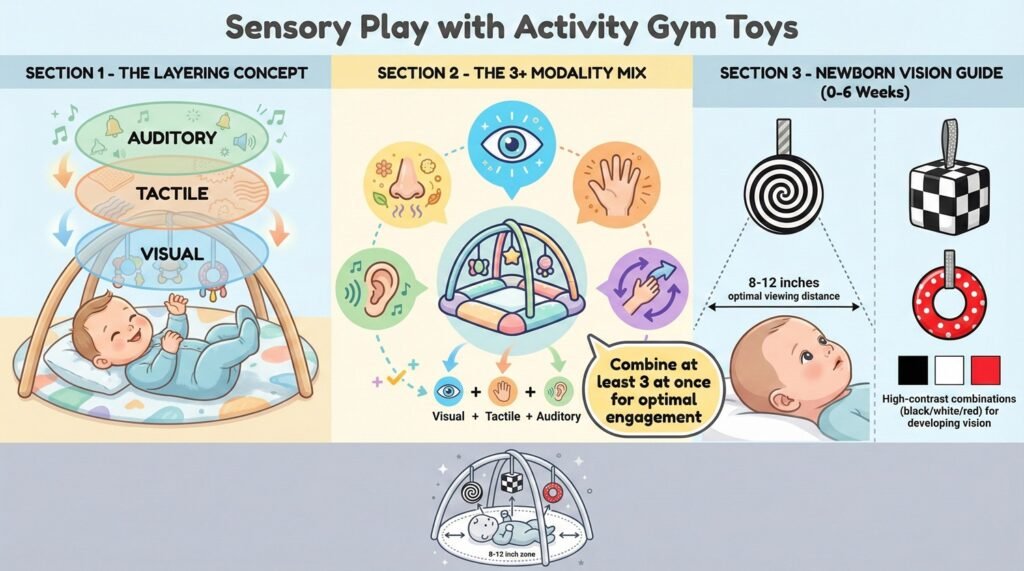
Start by thinking about layering instead of just presenting toys. When you place your baby under the gym, you’re creating an entire sensory environment.
I’ve found that the most engaging sessions happen when you mix at least three sensory modalities at once.
For newborns up to about six weeks, visual stimulation needs to be really simple. Their vision is still developing, so they can only see about 8 to 12 inches away with any clarity.
Place high-contrast black and white patterns or bold red toys at that exact distance from their face.
But here’s where it gets interesting, add a gentle sound element and a soft touch simultaneously. While they’re looking at that contrasting pattern, softly shake a rattle nearby and gently stroke their arm with a silky ribbon.
Their brain is now processing visual, auditory, and tactile information together, creating much richer neural pathways than any single stimulus would provide.
As your baby grows into the 6 to 12 week range, their sensory needs evolve quickly. They can now see further and track moving objects.
Attach toys on arches that you can slowly slide from one side to the other. But don’t just move them randomly, create patterns.
Move the toy left to right three times, pause, then do it again. Babies this age are starting to recognize patterns, and that predictability actually helps their brain organize sensory information more effectively.
The proprioceptive aspect gets really interesting around three to four months. Babies start developing more intentional reaching and grasping.
Position toys at varying heights, some low enough that they can easily bat them, others slightly higher so they have to work a bit harder.
This difference in effort provides different proprioceptive feedback. When they successfully hit a toy that’s easier to reach, they get positive reinforcement.
When they stretch for a higher toy, they’re building awareness of where their body is in space.
Temperature and Texture Variations
Here’s something most parents completely overlook, temperature adds another dimension to sensory play that’s incredibly valuable. Obviously, you’re working within safe parameters, but even slight variations in temperature provide distinctive sensory information.
Some activity gyms come with teething toys that can be chilled. When you attach a slightly cool teether next to a room-temperature plush toy, you’re giving your baby contrasting temperature experiences that heighten their tactile awareness.
Texture variety is where you can really get creative without spending extra money. Look at what’s already hanging on your activity gym.
Most gyms come with a mix of materials, maybe a velour elephant, a plastic mirror, a rubber teether, and a fabric book.
But you can dramatically increase the sensory richness by adding your own elements. Tie a small square of corduroy to one attachment point.
Add a piece of ribbon, satin on one side, grosgrain on the other.
Attach a small wooden ring. Each of these textures sends different information to your baby’s touch receptors.
I’ve seen parents get creative with textured fabric swatches from craft stores. You can find faux fur, burlap, silk, fleece, and terry cloth all in small squares.
Securely attach these to the gym’s sides or hanging loops where your baby can touch them during tummy time or while lying on their back.
The key is secure attachment, you want these additions firmly in place so there’s no choking hazard.
The textural experience extends to the mat itself. Many gyms come with mats that have different zones, maybe one area is smooth, another has a crinkly layer underneath, another has raised bumps.
If your gym’s mat is pretty uniform, consider placing different textures under it in specific spots.
A small towel under one section creates a slightly elevated area. A piece of bubble wrap under another section (sandwiched safely between mat layers) creates an interesting sensation when your baby moves over it.
Sound Layering Strategies
Auditory stimulation on activity gyms typically comes from rattles, crinkle material, and sometimes electronic music boxes. But sound layering, combining different types of sounds strategically, creates a much richer auditory environment for development.
Your baby’s auditory system is learning to distinguish between different sound qualities, locate where sounds come from, and associate sounds with actions.
Start with sound positioning. If your gym has three hanging toys that make noise, position them so they create different auditory zones.
Put the rattle on the left, the crinkle toy in the center, and a chime toy on the right.
When your baby bats at different toys, they’re learning spatial awareness through sound, that rattle sound means “left,” that crinkle means “center.” This spatial auditory processing is foundational for later language development and attention skills.
Volume variation matters more than most people realize. Not all toys need to make loud sounds.
In fact, incorporating some very soft sounds teaches your baby to attend carefully and focus their hearing.
A small bell that makes a gentle tinkle needs more auditory attention than a loud rattle. This teaches early listening skills and attention control.
Consider rhythm and pattern with sounds too. When you’re playing with your baby under the gym, don’t just randomly shake rattles.
Create rhythmic patterns, shake shake pause, shake shake pause.
Or alternate between two different sounds in a predictable pattern. Babies as young as two months can start recognizing these patterns, and pattern recognition is basic to cognitive development.
Background soundscapes add another layer. Some parents like having white noise or soft music playing during activity gym time.
There’s actually interesting research supporting varied approaches here.
Complete silence allows babies to focus entirely on the sounds they’re creating with the toys, teaching clear cause and effect. Gentle background music, especially simple melodies without lyrics, can create a calming environment that extends play time.
The key is consistency, use the same approach for several sessions so your baby learns what to expect, then you can introduce variations.
Visual Complexity Progression
Visual development happens incredibly fast in the first year, and activity gyms can support each stage if you adjust the visual complexity appropriately. Newborns really do best with simple, high-contrast images.
Black and white patterns, bold red shapes against white backgrounds, and simple geometric designs capture their emerging vision best.
But here’s what matters, you don’t just keep showing them the same high-contrast cards week after week. Visual progression means gradually introducing more complexity as their visual system matures.
Around two to three months, babies start seeing more colors, particularly bright primary colors.
Swap out some of those black and white elements for bold blues, yellows, and greens.
By four to five months, they’re ready for more detailed patterns. Instead of simple stripes, they can process polka dots, checkerboards, and simple pictures of faces or objects.
Their depth perception is developing too, so toys that have many layers or parts at different distances become more interesting.
A toy with a main body plus dangling elements provides visual complexity that engages their maturing visual system.
Reflective and translucent elements add fascinating visual variety. Mirrors are standard on most gyms, but consider the type of reflection.
A flat mirror shows a clear image, but a slightly curved or crinkled metallic material creates distorted, changing reflections that are mesmerizing for babies working on visual tracking.
Translucent toys, like those made from clear colored plastic, show color and let light through in interesting ways.
Light and shadow play is something you can introduce without any special equipment. Position your activity gym near a window where natural light creates patterns.
As the sun moves, the shadows and light spots shift, providing changing visual stimulation.
On bright days, the toys cast shadows on the mat that move when the toys swing, adding another visual element for your baby to notice and track.
Movement and Vestibular Stimulation
Most parents think of activity gyms as stationary equipment, but there’s actually significant movement and vestibular stimulation happening that supports balance and spatial awareness development. Every time your baby kicks their legs, reaches for a toy, or turns their head, they’re experiencing subtle movements that their vestibular system processes.
You can enhance this by thinking about positioning variations. The classic setup has baby on their back looking up at hanging toys.
That’s great, but it’s just one position.
During tummy time on the gym, your baby’s vestibular system gets entirely different input. Their head is working against gravity to lift up, their body position is completely changed, and the toys are now below or at eye level instead of above.
This position change provides crucial vestibular and proprioceptive feedback that strengthens neck and core muscles.
Side-lying is another position many parents forget about. Prop your baby on their side using a rolled towel or nursing pillow for support, with the activity gym’s toys positioned at their eye level.
From this position, reaching for toys needs different muscle engagement and provides different sensory feedback than reaching from their back.
It’s also gentler for babies who struggle with reflux or who get frustrated during traditional tummy time.
Some activity gyms have removable arches. When you take the arch off and place toys directly on the mat around your baby, it completely changes the play experience.
Now they’re not reaching up, they’re reaching out to the sides, grasping toys next to them, and manipulating objects on a flat plane.
This develops different motor patterns and provides different proprioceptive input.
Gentle gym repositioning creates environmental changes that stimulate the vestibular system without moving your baby at all. Turn the entire gym 90 degrees so the window light comes from a different direction.
Move it to a different room where the ceiling color or height is different, where ambient sounds are different.
These environmental shifts provide new sensory context without requiring any special equipment or complicated setup.
Timing and Rotation Methods
Sensory play effectiveness depends heavily on when and how long you offer activities. Babies have surprisingly short attention spans combined with rapidly changing states of alertness.
Understanding these rhythms changes activity gym sessions from frustrating to genuinely engaging.
The optimal time for activity gym play is during what’s called the “quiet alert state”, when your baby is calm, awake, and looking around with interest. This usually happens about an hour after feeding, when they’re not hungry but haven’t gotten tired yet.
Trying to do sensory play when your baby is hungry, tired, or overstimulated rarely works well.
You’ll both end up frustrated.
Session length matters more than frequency. For young infants under three months, even five to ten minutes of focused, engaged play is valuable.
Their nervous systems fatigue quickly, and longer sessions often lead to fussiness without added benefit.
As they grow, you can gradually extend sessions, but watch for disengagement cues, looking away, fussing, stiffening their body, or becoming quiet and still. These signs mean their nervous system needs a break.
Toy rotation is where you can really extend the useful life of your activity gym and maintain your baby’s interest. Instead of hanging all available toys at once, rotate which toys are attached every few days.
Keep half the toys in play and store the other half out of sight.
When you swap them out, the “new” toys create renewed interest even though your baby has seen them before. The break makes them novel again.
Within a single session, you can rotate which toys are in prime reaching position. Start with two toys directly overhead where your baby can easily see and reach them.
After five minutes, swap them out for two different toys without removing your baby from the gym.
This within-session rotation keeps engagement high without overwhelming them with too many options at once.
Consider what I call “complexity rotation” too. Some days, keep the sensory experience simple, just a few toys, minimal background noise, moderate lighting.
Other days, layer in more complexity, more toys, varied textures added, music playing softly.
This variation teaches your baby’s sensory system to process both simple and complex environments, building flexibility in how they handle sensory input.
People Also Asked
What age should babies start using activity gyms?
Most babies can start using activity gyms from birth, though newborns benefit most from simplified setups with high-contrast toys positioned 8 to 12 inches from their face. The gym grows with them through various developmental stages, remaining useful typically until around 8 to 9 months when babies become more mobile and prefer exploring beyond the gym’s boundaries.
How long should tummy time be on a play gym?
Start with just 2 to 3 minutes of tummy time for newborns, gradually increasing as your baby gets stronger. By three months, aim for 15 to 20 minutes total throughout the day, broken into several shorter sessions.
Using the activity gym during tummy time helps extend tolerance because the toys provide motivation to keep their head up longer than they would on a plain surface.
Can you overstimulate a baby with too many toys?
Yes, absolutely. Babies can easily become overstimulated when presented with too many toys, sounds, or visual patterns at once.
Signs of overstimulation include looking away repeatedly, becoming very still, fussing, or showing jerky movements.
Limit the number of toys visible at one time to 2 to 4 items, and watch your baby’s cues to decide what amount of stimulation works best for them.
What textures are best for baby sensory development?
A variety of textures provides the richest sensory input. Include smooth surfaces like satin or plastic, rough textures like corduroy or canvas, soft materials like fleece or velour, crinkly surfaces, and harder items like wood or firm rubber.
The contrast between different textures is what builds tactile discrimination skills, so variety matters more than any single “best” texture.
How do you clean activity gym toys safely?
Most activity gym toys can be cleaned with baby-safe disinfectant wipes or mild soap and warm water. Fabric toys often go in the washing machine inside a mesh bag on a gentle cycle.
Clean toys that go in your baby’s mouth every few days, and do a full gym cleaning weekly.
Always check manufacturer instructions for specific cleaning recommendations.
When should babies start reaching for toys on play gym?
Intentional reaching typically begins around 3 to 4 months, though some babies start a bit earlier or later. Before this, you’ll see random arm movements that occasionally make contact with toys.
True reaching involves your baby deliberately extending their arm toward a specific toy they’re looking at, showing developing hand-eye coordination.
Are mirrors safe for babies on activity gyms?
Yes, baby-safe mirrors designed for activity gyms are completely safe. These are made from shatterproof materials, not glass.
Mirrors provide excellent visual stimulation and support early self-recognition development.
Position mirrors at various angles, overhead for back-lying play and at ground level during tummy time for different visual experiences.
What sounds are most engaging for babies on play gyms?
Babies respond well to a variety of sounds including gentle rattles, soft chimes, crinkle sounds, and simple musical tones. Vary the volume, not all sounds should be loud.
Softer sounds teach listening skills and attention.
Avoid electronic toys that play complex songs or melodies continuously, as these can be overstimulating and don’t teach cause and effect as clearly as simple sounds.
Key Takeaways:
Layering many sensory inputs strategically creates richer neural connections than presenting single stimuli, but balance matters because overstimulation shuts down engagement as opposed to enhancing it.
Position toys at varying heights and distances suitable for your baby’s developmental stage, making some easily accessible while others need slightly more effort to build skills progressively.
Temperature and texture variations dramatically expand sensory richness without extra cost, fabric swatches, wooden elements, and safe household items all provide distinctive tactile experiences.
Watch carefully for overstimulation signs like stillness, looking away, or fussiness, and immediately simplify the sensory environment when these appear to prevent negative associations with play time.
Toy rotation every few days maintains novelty and interest far better than presenting all available toys constantly, and organizing toys by sensory type makes intentional planning much easier.
Timing sessions during the quiet alert state and keeping them appropriately short for your baby’s age prevents fatigue and builds positive associations with independent exploration and learning.