
We may earn money or products from the companies mentioned in this post.
I still remember the moment my daughter rolled completely across her activity gym mat and bumped into the living room bookshelf. She was seven months old, and I realized with a jolt that the cozy little gym setup that had served us so well during those early months was suddenly inadequate for her new skills.
Your baby who once lay contentedly under those dangling toys is now rolling like a little log, sitting up with determination, or maybe even army-crawling toward whatever catches their eye. The activity gym that seemed like such a perfect solution suddenly feels restrictive, and you’re wondering what comes next.
The good news is that you don’t need to pack everything away and start from scratch. I’ve learned through my own parenting experience and through countless conversations with other parents that the transition from activity gym to expanded play space is one of the most creative and rewarding shifts you’ll make in your baby’s first year.
You just need to understand what your growing baby actually needs and how to reimagine the gear you already have.
Let me walk you through exactly how to make this transition smooth, developmentally suitable, and honestly, kind of fun for both of you.
Understanding What Changes at Six Months
Around the six-month mark, something really significant happens in your baby’s development. They’re no longer just lying there observing the world.
They’re interacting with it, moving through it, and genuinely exploring it in ways that would have been impossible just weeks earlier.
The developmental shift is profound. Your baby’s brain is making millions of neural connections every day, and their body is suddenly capable of movements that need completely different play setups.
When my daughter started sitting independently, I noticed she’d literally push away toys that hung overhead because she wanted to reach for things at her level, on the floor, where she could grab them, mouth them, and truly manipulate them.
Traditional activity gyms start to fall short at this stage. Most are designed brilliantly for babies under four or five months who are primarily on their backs, gazing upward, and developing tracking skills and hand-eye coordination.
But once your baby can roll, sit, and eventually crawl, those overhead arches become obstacles as opposed to opportunities.
Your baby now needs horizontal exploration as opposed to vertical observation. They need space to move their whole body, not just their arms and legs within a confined area.
Their play needs to support gross motor skills like rolling from back to belly, pushing up on arms, transitioning from lying to sitting, and eventually, crawling and cruising.
I found that understanding this basic shift made every decision about our play space so much clearer. I wasn’t buying all new stuff.
I was reconfiguring what we had to support this new phase of movement and exploration.
Creating Your Expanded Floor Play Space
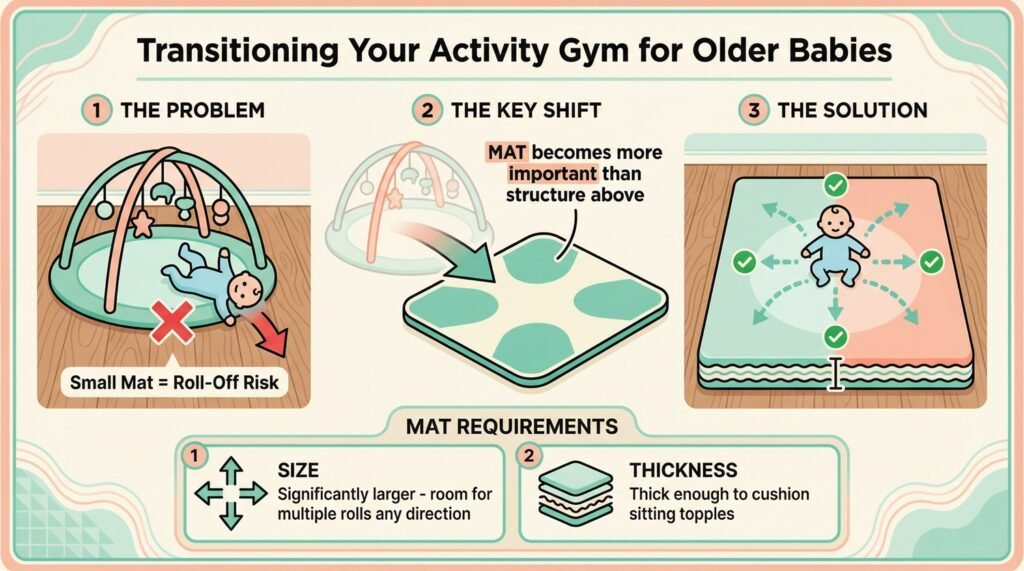
The foundation of your transition really centers on the surface your baby plays on. When babies are mobile or becoming mobile, the mat itself becomes more important than the structure above it.
I learned this the somewhat hard way when my daughter started practicing her rolling and would inevitably roll right off the edge of her small gym mat onto the hardwood floor. We needed a bigger, more substantial play surface, and honestly, that single change transformed our entire play setup.
Look for play mats that are significantly larger than your original gym mat. You want your baby to have room to roll several times in any direction without immediately hitting a boundary.
The mat should be thick enough to cushion falls when your baby is practicing sitting because, trust me, there will be topples.
A thin decorative mat won’t cut it once your baby is truly mobile.
Machine washable features are non-negotiable at this stage. Older babies drool, spit up, and generally make impressive messes during play.
I was washing our play mat weekly, sometimes more often, and if it hadn’t been machine washable, I honestly don’t know what I would have done.
Some parents I know bought two identical mats so they always had a clean one ready.
Reversible designs are genuinely clever because they extend the life of your investment. One side might have high-contrast patterns that worked well for younger babies, while the flip side offers more subtle designs that don’t overstimulate older babies who are learning to focus on specific toys and activities.
The material quality matters more than I initially realized. You want something durable that won’t show wear quickly, and something non-toxic because your baby is definitely going to mouth that mat. I looked for mats that were free from PVC, BPA, and phthalates, and I checked for safety certifications from reputable organizations.
When you’re setting up this expanded play space, think carefully about the room itself. Position your mat away from furniture edges, especially once your baby starts pulling to stand.
Keep it away from curtain cords, electrical outlets, and anything your baby could grab and pull down.
I created essentially a safe zone where I knew my daughter could explore freely without me constantly redirecting her away from hazards.
The placement of your play mat can make or break how much your baby actually uses the space. I initially put ours in a corner of our living room, thinking it would keep things contained. But my daughter kept crawling away from it toward the more interesting main part of the room.
Once I moved the mat to a central location where she could see and interact with the family, she spent so much more time engaged in play.
Reimagining Your Activity Gym Components
Your activity gym likely has several components: the frame or arches, the mat, hanging toys, and possibly some standalone elements. Each of these can be repurposed as your baby grows, and you’d be surprised how creative you can get.
The frame itself becomes optional once your baby is sitting and moving around. I started by lowering the arches on our gym so they were closer to the ground, which made them more accessible to my daughter when she was sitting.
Eventually, I removed them entirely most of the time and only brought them back out for specific activities.
Some parents I know converted their gym frames into makeshift tunnels for crawling practice by draping lightweight blankets over them. Others positioned the arches at the edge of the play mat to create a visual boundary.
One particularly clever friend of mine used the arches as a base for attaching fabric books at her son’s eye level when he was sitting.
The toys that came with your gym are probably still valuable, just not in their original configuration. Instead of hanging them overhead, place them strategically around the mat at varying distances from where your baby typically starts.
This encourages reaching, scooting, and eventually crawling to get to desired objects.
I positioned toys slightly out of my daughter’s immediate reach to motivate movement without creating frustration. If she was sitting in the center of the mat, I’d place a favorite rattle about two feet away, just far enough that she’d need to lean, reach, or scoot to get it.
This natural motivation is what drives motor development.
Toy rotation became crucial at this stage. Instead of having everything available all the time, I kept most toys in storage and rotated them every few days.
This kept the play space from becoming overwhelming and made “old” toys feel new again when they reappeared. I noticed my daughter played more deeply and for longer periods when she had fewer, more carefully chosen options available.
The gym mat itself, separated from the frame, became our primary play surface. We used it daily for tummy time that naturally transitioned into rolling practice, sitting practice, and eventually crawling expeditions across the living room.
Even after we moved to a larger play mat for general use, I kept the original gym mat for focused play sessions because it had the perfect amount of cushioning.
Storage Solutions That Actually Work
One of the biggest challenges I faced during this transition was figuring out where to put everything when we weren’t actively using it. A gym frame, even a foldable one, takes up space, and as your baby becomes more mobile, you need that floor space clear and safe.
Collapsible gym designs are genuinely worth their weight in gold during this phase. Our gym folded flat and could slide behind the couch or under our bed. This meant I could set up the full gym for specific activities and then clear it away when my daughter needed open space for crawling or when we just needed our living room back.
I invested in a large fabric storage cube system that lived in the corner of our living room. One cube held the gym frame and arches when they were folded. Another held the rotation of toys that weren’t now in use.
A third held the extra play mat we’d purchased. This kept everything organized, accessible, and importantly, out of the way when not needed.
For families with limited space, vertical storage becomes essential. I hung mesh organizers on the back of doors to store lightweight gym toys and accessories.
These organizers were perfect because I could see everything at a glance and grab what I needed quickly without digging through bins.
The key is creating a system where setup and takedown are quick enough that you’ll actually do them. If storing the gym frame is a fifteen-minute ordeal involving multiple closets, you’ll probably just leave it out all the time, which creates clutter and safety issues.
But if you can fold it and slide it away in thirty seconds, you’re much more likely to maintain a flexible, evolving play space.
Safety Considerations for Mobile Babies
The safety rules change dramatically once your baby can move independently. What was perfectly safe for a three-month-old lying on their back becomes potentially hazardous for an eight-month-old who’s pulling themselves up on anything within reach.
Supervision becomes even more critical during this phase. Mobile babies move fast and in unpredictable ways.
My daughter could be sitting peacefully one second and face-down, army-crawling toward the dog’s water bowl the next.
I learned to stay within arm’s reach during floor play, especially when she was practicing new skills.
Regular equipment inspection is something I built into my routine. Every few days, I’d check the gym components for loose parts, fraying fabric, or any damage.
I’d test the stability of toys, tug on attachment points, and look for anything that seemed worn or compromised. Babies at this age pull, yank, and test everything, and gear that was fine for gentle newborn play can develop issues under more vigorous use.
Hanging elements became a particular concern once my daughter could sit and reach upward. Anything on a cord or string needed to be short enough that it couldn’t wrap around her neck if she pulled it down.
I actually removed several toys from our gym rotation because the cords were longer than I was comfortable with for her new mobility level.
The play space boundaries needed constant reassessment. As my daughter’s crawling became more confident and fast, I expanded the safety perimeter around our play area.
Coffee table corners got bumpers.
Floor lamps were moved to rooms she couldn’t access. The fireplace got a serious gate upgrade.
Making It Last Through Multiple Stages
From both a financial and environmental perspective, extending your baby gear’s usefulness is incredibly valuable. Quality activity gyms aren’t cheap, and thoughtfully transitioning them through your baby’s developmental stages makes that investment much more worthwhile.
I looked at our activity gym purchase as a multi-year investment as opposed to a six-month item. With proper care, component separation, and creative repurposing, we used elements of that gym from birth through nearly eighteen months.
The mat itself is still in use as a cozy reading spot, even though my daughter is now well past the baby stage.
Cleaning and maintenance extend equipment life significantly. I washed fabric components monthly even when they didn’t look dirty, which prevented embedded grime and odors from building up.
I wiped down plastic and wooden elements weekly with baby-safe cleaning solutions.
This regular maintenance kept everything looking and functioning well long after friends’ similar gyms had become worn and stained.
When you do eventually outgrow your equipment, high-quality pieces have real resale value. I sold our gym frame for about sixty percent of what we paid for it, even after a year of use, because we’d maintained it well and it was a respected brand.
The buyer was thrilled to get a barely-worn item at a discount, and I recovered enough to put toward the next stage of gear.
Frequently Asked Questions
When should I remove the arches from my baby’s activity gym?
Remove the arches when your baby starts sitting independently and showing more interest in toys at their level as opposed to overhead. This typically happens between six and eight months.
You’ll notice your baby pushing away hanging toys or consistently rolling to the side to reach for objects on the mat instead of looking upward.
What size play mat is best for a crawling baby?
A play mat for a crawling baby should be at least four feet by six feet, though larger is better. Your baby needs room to move several body lengths in any direction without hitting edges.
I found that six feet by eight feet was ideal for giving my daughter enough space to really explore without constantly needing redirection.
Can I use my activity gym for tummy time after six months?
Yes, you can definitely continue using your activity gym mat for tummy time after six months. In fact, the cushioning makes it perfect for this purpose.
Just remove or lower the arches if your baby finds them distracting.
At this age, tummy time naturally advance into crawling practice, so the mat provides a great surface for that transition.
How often should I rotate toys on the play mat?
Rotate toys every three to five days for optimal engagement. This frequency keeps the play space fresh and interesting without changing things so often that your baby doesn’t have time to fully explore each toy.
I kept about four toys out at a time and rotated from a collection of about twelve total options.
Is it safe to leave my baby on a play mat unattended?
Never leave a mobile baby unattended on a play mat, even in a baby-proofed room. Babies can move surprisingly fast and get into dangerous situations within seconds.
Stay within arm’s reach during floor play, especially when your baby is practicing new motor skills like pulling up or cruising.
What’s the best thickness for a baby play mat?
Look for a play mat that’s at least half an inch thick, with three-quarters of an inch to one inch being ideal for babies who are sitting and standing. Thicker mats provide better cushioning for the inevitable falls that happen when babies are practicing new skills.
The mat should be firm enough to provide stability but soft enough to cushion impacts.
Can I make a DIY play mat instead of buying one?
You can create a DIY play mat using foam tiles or yoga mats, but make sure whatever you use is non-toxic and provides adequate cushioning. The challenge with DIY options is ensuring they’re thick enough, large enough, and easy to clean.
I tried a foam tile system initially but found it separated too easily once my daughter was mobile.
How do I clean a large play mat?
Most quality play mats are machine washable, which is the easiest cleaning method. For spot cleaning between washes, use a baby-safe cleaning solution and a damp cloth.
I kept a spray bottle of diluted vinegar nearby for quick cleanups.
Air dry the mat completely before putting it back down to prevent mildew.
Key Takeaways
The transition from activity gym to expanded play mat typically happens between six and nine months, when babies become mobile and need more space for rolling, sitting, and eventually crawling.
Your existing gym components can be repurposed, separated, and reconfigured as opposed to replaced, extending their value and supporting sustainability while saving you money on new equipment.
The mat becomes more important than the frame once babies are mobile, and investing in a large, cushioned, machine-washable play surface is the single most valuable upgrade you can make during this transition.
Safety considerations shift dramatically once babies can move independently, requiring constant supervision, regular equipment inspection, and expanded hazard-proofing beyond the immediate play area.
Toy rotation and simplified play spaces actually increase engagement and support deeper learning better than cluttered, overstimulating setups with everything available simultaneously.
Every baby’s developmental timeline is unique, and watching your individual child’s signals and frustrations is more valuable than following rigid age-based guidelines for when to make changes to their play environment.