
We may earn money or products from the companies mentioned in this post.
Fast Facts:
- Store-bought baby activity gyms undergo rigorous safety testing and meet CPSC standards, while DIY versions need careful material selection and construction knowledge to confirm infant safety.
- The average baby uses an activity gym from birth through about 6-8 months, making the cost-per-use calculation essential when deciding between DIY and commercial options.
- Overstimulation from too many toys, sounds, and colors can actually hinder development as opposed to enhance it, regardless of whether you choose DIY or store-bought options.
There’s this persistent myth that one option is universally better than the other, but the reality is so much more nuanced and really depends on your specific situation, skills, and what you’re hoping to achieve for your baby’s development.
Understanding What Baby Activity Gyms Actually Do
The fundamental purpose of any activity gym is to create a designated space that encourages babies to develop crucial motor skills, visual tracking abilities, and hand-eye coordination during those critical early months. When a baby lies beneath dangling toys and reaches upward, they’re building neural pathways that form the foundation for more complex movements later on.
This happens whether you’ve purchased a commercially designed gym or built one yourself in your garage.
Store-bought activity gyms typically feature arched supports that hold toys at varying heights and distances, often with a padded mat underneath. The design follows decades of developmental research about optimal toy placement for encouraging reaching, grasping, and visual engagement.
Commercial manufacturers employ child development specialists to determine the ideal arch height, which usually falls between sixteen and twenty inches.
They’ve calculated toy spacing and color contrast ratios that align with infant visual capabilities, taking into account that newborns can only see clearly at distances of eight to twelve inches.
DIY versions can absolutely copy these same principles, but you need a solid understanding of developmental stages and spatial relationships. I’ve seen beautifully crafted wooden gyms made from sustainable materials that completely nail the developmental aspects.
I’ve also seen well-intentioned homemade versions that miss the mark entirely by placing toys too high, too low, or without considering the baby’s field of vision from their back.
A toy hung at twenty-four inches might look perfect from your standing position, but from a baby’s perspective lying flat, it disappears completely from their limited visual range.
The theoretical framework here is grounded in sensory integration theory, which explains that babies need appropriately challenging environmental inputs to develop their sensory processing abilities. Too little stimulation and development slows.
Too much and the baby becomes overwhelmed and disengages.
This sweet spot exists regardless of whether you’re using a DIY or commercial product, but achieving it requires different approaches depending on which route you take.
The Real Cost Analysis Nobody Talks About
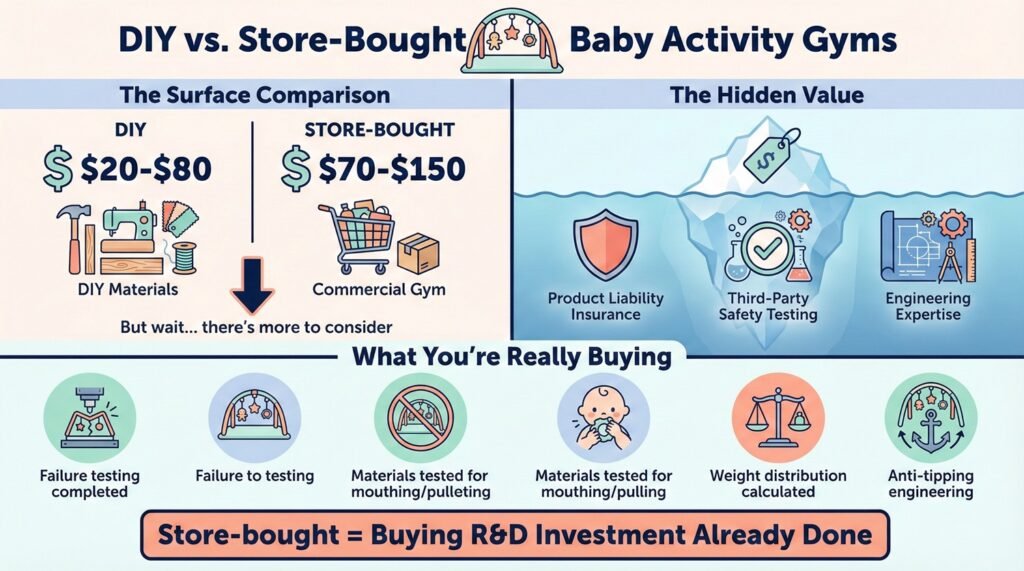
When people compare DIY versus store-bought options, they almost always focus on the upfront monetary cost. A decent commercial activity gym typically runs between seventy and one hundred fifty dollars, while DIY versions might cost anywhere from twenty to eighty dollars depending on materials chosen.
But this surface-level comparison misses several really critical factors that completely change the calculation.
Store-bought gyms come with the hidden value of product liability insurance, third-party safety testing, and engineering expertise. When you purchase from an established manufacturer, you’re essentially buying their research and development investment.
They’ve already done the failure testing, determined which materials can withstand infant mouthing and pulling, and calculated weight distributions to prevent tipping.
Someone got paid to drop test those toys fifty times and measure the force required to pull attachments loose.
The DIY route transfers all of this responsibility directly to you. You need to source materials that are genuinely non-toxic and verify those claims yourself.
You need to sand wood until there’s absolutely zero possibility of splinters, even after weeks of use and cleaning.
You need to confirm all hanging mechanisms can support vigorous tugging without breaking, and create a stable base that won’t collapse if your baby grabs a leg while underneath. This doesn’t qualify as impossible work, but it represents a significant time investment that often gets completely overlooked in cost calculations.
I’ve watched parents spend forty hours building an elaborate wooden gym that they could have purchased for one hundred dollars. If you genuinely enjoy woodworking and would spend that time on a hobby anyway, then the calculation works differently.
But if you’re sacrificing sleep or other priorities, the “savings” become really questionable.
At forty hours of labor, you’re essentially working for two dollars and fifty cents per hour to save that money, which makes sense for some budgets but not for others.
There’s also the resale value consideration that dramatically affects your net cost. High-quality store-bought gyms from reputable brands keep fifty to seventy percent of their value on secondhand markets.
A well-maintained Fisher-Price or Lovevery gym can be sold after your baby outgrows it for sixty to eighty dollars, effectively reducing your net cost to thirty or forty dollars for six months of use.
DIY versions rarely have resale value unless they’re exceptionally well-crafted and you happen to find the right buyer who appreciates handmade items and trusts your construction quality.
Safety Considerations That Keep Me Up at Night
This is where I get really serious about the differences between these options. Commercial baby products sold in the United States must meet Consumer Product Safety Commission standards, which include specific requirements for stability, small parts testing, chemical composition, and flammability.
Products undergo tip-over testing where they’re pushed and pulled at various angles to confirm they won’t collapse on an infant.
Engineers simulate worst-case scenarios like babies grabbing, kicking, and pulling with forces that would surprise most parents.
When you build a DIY gym, you become the safety engineer. You need to understand that babies generate surprising amounts of force when they kick and pull.
I’ve seen a determined four-month-old yank a poorly secured toy right off its attachment, creating a choking hazard in seconds.
The arch supports need to be weighted or secured in a way that prevents the entire structure from toppling if a baby grabs one side. This requires understanding basic physics principles about center of gravity, weight distribution, and structural stability.
The finish you choose for wooden components matters tremendously. “Food-safe” doesn’t automatically mean safe for extended infant mouthing, which involves prolonged exposure to saliva and different pH levels than adult food contact.
You really need to verify that any finish, paint, or stain is specifically rated for children’s toys and has documentation of third-party testing for lead, phthalates, and other harmful substances.
Buying a can labeled “non-toxic” at the hardware store doesn’t provide the same level of assurance as finishes that have undergone ASTM testing protocols.
Rope and fabric components present their own set of challenges. Any hanging strings or cords must be short enough to prevent entanglement hazards, generally under seven inches according to safety standards.
The attachment points need to be secured with methods that won’t loosen over time as materials shift and settle with repeated use.
I’ve seen homemade gyms where the builder used hot glue for what should have been structural connections, and the entire thing failed within two weeks of daily use.
Store-bought options aren’t automatically perfect either. You still need to inspect them regularly for wear, loose parts, or recalled components.
Check the CPSC website periodically because recalls happen even with major brands.
But commercial products start from a baseline of professional engineering that DIY builders need to intentionally copy through extensive research and careful construction.
Material Selection and Developmental Impact
The materials you choose, whether selecting a commercial product or building your own, directly influence both safety and developmental outcomes. Natural wood, organic cotton, and silicone have become increasingly popular among parents concerned about chemical exposure, and the concern is valid.
Infants explore everything through mouthing, and the materials they interact with daily accumulate significant exposure over time.
Store-bought gyms often use plastic components manufactured from materials like ABS or polypropylene, which are generally considered safe when produced to standards but vary significantly in quality between brands. Budget options sometimes use lower-grade plastics that smell strongly of chemicals right out of the package.
That odor you’re detecting is actual off-gassing of volatile organic compounds.
Premium brands like Lovevery and HABA use higher-grade materials with extensive testing documentation, but you’re paying substantially more for this quality assurance.
DIY builders have finish control over material selection and finish responsibility for material research. If you’re using wood, you want untreated hardwoods like maple, birch, or beech as opposed to pressure-treated lumber or composite materials containing formaldehyde-based adhesives.
The grain should be tight and consistent to minimize splintering potential.
Softwoods like pine can work but dent more easily and may not hold up to repeated dropping and banging that’s inevitable with baby gear.
For fabric components and padding, organic cotton seems like an obvious choice, but understanding certification helps you make informed decisions. “Organic” certification applies to growing practices, not necessarily the dyes or finishing processes.
You really want fabrics certified to GOTS or OEKO-TEX Standard 100 if you’re serious about chemical exposure reduction.
These certifications verify that the entire textile production chain meets strict chemical safety standards.
The sensory properties of materials also affect developmental outcomes in ways that might not be immediately obvious. Babies benefit from experiencing diverse textures including smooth wood, soft fabric, slightly rough natural fibers, and cool metal in small, safe applications.
A homogenous play space where everything feels the same provides less sensory input than a varied environment.
Commercial gyms sometimes overdo this by including fourteen different textures, which creates visual and tactile chaos as opposed to useful variety. The ideal approach incorporates maybe four to six distinct material experiences that provide genuine contrast without overwhelming sensory systems.
Customization Versus Convenience
One of the strongest arguments for DIY gyms is the ability to customize every single aspect to your specific preferences and your baby’s developmental stage. You can adjust hanging heights as your baby grows, swap out toys to match emerging interests, and create a completely unique aesthetic that matches your nursery design philosophy.
This flexibility allows you to respond to your specific baby’s needs as opposed to working within a manufacturer’s predetermined framework.
I’ve watched parents create stunning Montessori-inspired gyms with minimalist wooden arches, three carefully selected natural toys, and neutral-toned fabrics that photograph beautifully and provide exactly the right level of visual stimulation without overwhelming their baby. These setups work exceptionally well for babies who are easily overstimulated or for parents who value aesthetic minimalism and want their baby gear to blend seamlessly with their home decor.
The customization advantage extends beyond appearance. If your baby shows particular interest in high-contrast patterns, you can incorporate more black-and-white elements.
If they respond strongly to auditory stimulation, you can include more bells and rattles.
If they seem overwhelmed by complex toys, you can strip everything down to just two or three simple objects and build from there, adding complexity gradually as their processing abilities develop.
Store-bought gyms offer convenience but less flexibility. Most come with a predetermined set of toys and features that can’t be substantially modified. Some brands like Baby Bjorn and Skip Hop design their systems with interchangeable toy attachments, which provides some customization within the brand’s ecosystem, but you’re still working within their framework and often limited to purchasing extra accessories from the same manufacturer.
The convenience factor really matters, though, especially during those early weeks when you’re functioning on minimal sleep and every decision feels completely overwhelming. Opening a box, reading straightforward assembly instructions, and having a finished, tested system ready in twenty minutes has genuine value.
You’re not researching dowel diameters at midnight or making multiple trips to the hardware store with an infant in tow who may or may not cooperate with your errand schedule.
There’s also something to be said for the psychological load of decision-making during early parenthood. Building a DIY gym requires dozens of small choices about materials, dimensions, finishes, and accessories.
For some people, this is energizing and enjoyable.
For others, it represents exhausting mental labor during a period when cognitive resources are already depleted by sleep deprivation and constant caregiving demands.
Overstimulation and Intentional Design
Regardless of which route you choose, one of the most common mistakes I see parents make is treating the activity gym like a mobile toy store, adding every possible feature and accessory until the baby is surrounded by a chaotic explosion of colors, sounds, and movements competing for attention.
Research on infant attention and sensory processing consistently shows that babies, especially newborns and young infants, can only focus on a limited amount of information at once. Their visual systems are still developing, and they can’t filter out irrelevant stimuli the way older children and adults can.
When presented with too many options, babies often become fussy and disengaged as opposed to more engaged. You’ll see them turn their heads away, close their eyes, or start crying because they’re actually overwhelmed as opposed to bored.
Store-bought gyms often contribute to this problem by including ten to fifteen toys right out of the box, often with flashing lights, multiple sounds, and complex patterns all competing for attention simultaneously. The marketing implies that more features equal better development, but this doesn’t get supported by developmental science.
Multiple studies on infant attention show that simpler environments actually support longer engagement periods and more focused exploration.
DIY builders have the opportunity to avoid this trap entirely by starting minimal and adding elements gradually as the baby develops. A newborn needs maybe two high-contrast toys positioned within their limited focal range of eight to twelve inches.
A three-month-old can handle more complexity as their vision improves and they develop better visual tracking abilities.
By six months, they’re ready for toys with more intricate features and cause-and-effect relationships that support their growing understanding of how objects work.
The intentional design approach works with store-bought gyms too. You just remove most of the included toys and introduce them one or two at a time based on your baby’s responses.
This requires more discipline because the toys are right there in the box, and there’s a temptation to use everything you paid for.
But the developmental benefits of reduced stimulation are substantial and backed by occupational therapists who specialize in infant development and sensory processing.
Space and Storage Reality
Most baby activity gyms occupy a footprint of about thirty to thirty-six inches in diameter when set up. That’s roughly ten square feet of floor space, which becomes a significant consideration in apartments or smaller living spaces where every square foot matters for daily functioning.
Store-bought gyms vary widely in their storage capabilities. Some fold completely flat and slide under a couch or bed, taking up maybe two inches of vertical space.
Others partially disassemble but still take up closet space.
A few premium models are designed as furniture pieces that look intentional enough to leave out permanently without making your living space feel completely overtaken by baby gear.
DIY gyms can be designed with your specific space constraints in mind from the beginning. I’ve seen collapsible versions with hinged legs that fold flat, hanging gyms that suspend from door frames and take up zero floor space, and modular designs that disassemble into components that fit in a small bin. The design flexibility is genuinely useful if space is a primary concern that affects your daily quality of life.
However, the storage advantage only applies if you actually plan for it during the design phase. A beautiful arch-style wooden gym built with permanent joints takes up just as much space as a commercial equivalent.
You need to intentionally incorporate folding mechanisms, removable dowels, or other storage-friendly features into your initial design, which adds complexity to the building process.
There’s also the consideration of how often you’ll actually set up and take down the gym based on realistic use patterns. If storage requires fifteen minutes of assembly each time, you’re probably going to leave it out more often than you intended, which defeats the space-saving purpose.
The most successful space-conscious designs I’ve seen allow setup and takedown in under two minutes, making it actually practical to store between use sessions.
Lifespan and Adaptability
Baby activity gyms have a relatively short primary use period compared to other baby gear. Most babies use them actively from around two to eight months, with peak engagement typically happening between three and six months.
Before two months, babies have limited reaching ability and benefit more from simpler stimulation.
After eight months, most babies are mobile enough that they prefer exploring in other ways, crawling to reach toys as opposed to lying under them.
This short lifespan makes the investment calculation particularly important. A one-hundred-twenty-dollar gym used for six months costs about twenty dollars per month.
If you build a DIY version for forty dollars and spend ten hours on construction, you’re saving eighty dollars but investing significant time.
Whether that trade-off makes sense depends entirely on your financial situation and how you value your time during this specific life phase.
Some gyms extend their useful life by converting into other products. Certain commercial models transform into play tunnels, teepees, or ball pits for toddlers.
A few DIY designs can be repurposed into clothing racks, plant stands, or other household items after the baby outgrows them.
This adaptability significantly improves the value proposition if you’ll actually use the converted form as opposed to just appreciating it in theory.
I’ve also seen families adapt activity gyms for floor time with older babies by removing the arches and using just the mat component with strategically placed toys. This extends usefulness through about twelve months if you’re creative about adaptation and your baby still finds the setup engaging.
The build quality decides whether a gym survives multiple children. Well-constructed wooden DIY gyms can absolutely serve two or three children if properly maintained. Budget store-bought options often don’t hold up through even one child’s use.
I’ve seen plastic joints crack, fabric tear, and electronic components fail within a few months of regular use.
Premium commercial gyms typically survive multiple children and maintain enough condition for resale afterward, which factors into the long-term cost calculation for families planning more children.
Making the Decision That Actually Fits Your Life
After observing countless families navigate this decision, I’ve noticed that the “right” choice correlates more strongly with lifestyle factors than with any supposed superiority of one approach over the other. Your personal circumstances matter far more than abstract comparisons.
DIY gyms work exceptionally well for parents who genuinely enjoy building projects and find the creative process energizing. If you value having finish control over materials and aesthetics, prioritize sustainability and minimal chemical exposure, have the tools and space for construction, and already possess basic woodworking skills, then building makes considerable sense.
If you’re already planning to build other nursery furniture or have woodworking as an established hobby, adding an activity gym to your project list fits naturally into your existing interests and capabilities.
Store-bought gyms better serve parents who are overwhelmed by the existing mental load of new parenthood and can’t imagine taking on another project. If you don’t have construction experience or tools, live in small spaces where a building project isn’t practical, value the peace of mind that comes with tested and certified products, or simply don’t find DIY projects appealing, then purchasing makes finish sense.
There’s absolutely no shame in choosing convenience and professional engineering when you’re functioning on four hours of interrupted sleep and barely managing to shower regularly.
Some families find a middle ground by purchasing a quality used gym from a consignment sale or online marketplace. This provides professional construction and safety testing at DIY-comparable prices while reducing environmental impact.
A thirty-dollar secondhand gym that would have cost ninety dollars new represents tremendous value if it’s in good condition without missing pieces or safety recalls.
Another hybrid approach involves buying a basic commercial frame and customizing the toys and accessories yourself. Several brands sell simple arch structures separately, which you can then outfit with handmade toys, natural materials, or specific items that match your baby’s current developmental stage.
This gives you structural safety and engineering without the full cost of a finish system or the time investment of building from scratch.
What This Means for Your Baby’s Development
Here’s what matters more than the DIY versus store-bought decision: whether the gym you choose actually supports your baby’s current developmental stage with suitable stimulation levels, whether you’ll use it consistently for tummy time and play sessions, and whether it’s genuinely safe given your construction skills or the manufacturer’s quality standards.
I’ve watched babies thrive with both approaches. The common factors in successful setups are thoughtful toy selection suitable to the baby’s age and developmental stage, regular rotation to maintain interest without overwhelming their processing abilities, placement in a calm environment without excessive background noise or visual distraction from televisions or busy spaces, and engaged parent interaction as opposed to using the gym as an unsupervised device.
The activity gym serves as a tool that facilitates developmental opportunities. A simple DIY gym used intentionally with parent engagement supports better outcomes than an elaborate commercial system that becomes background furniture the baby ignores because nobody interacts with them during play sessions.
Your baby doesn’t care whether the arch above them cost twelve dollars in hardware store materials or one hundred twenty dollars from a boutique brand. They care whether the toys are at the right height for their current reaching ability, whether the colors and patterns hold their visual interest, whether the textures provide interesting tactile experiences, and whether you’re nearby responding to their discoveries with encouragement and shared attention.
People Also Asked
What age do babies start using activity gyms?
Babies can start using activity gyms from birth, though their interaction changes dramatically as they develop. Newborns primarily benefit from visual stimulation, looking at high-contrast toys positioned eight to twelve inches from their face.
Around two to three months, babies begin reaching for toys and benefit from objects hung at suitable heights.
Peak engagement typically occurs between three and six months when babies have developed stronger reaching and grasping abilities. Most babies naturally transition away from activity gyms around eight months when they become mobile enough to prefer crawling and exploring.
How do you make a DIY baby gym safe?
Making a DIY baby gym safe requires attention to multiple factors including structural stability, material safety, and design considerations. Use untreated hardwoods like maple or birch as opposed to composite materials containing formaldehyde.
Sand all surfaces until completely smooth with no splinter potential.
Apply finishes specifically rated for children’s toys with third-party testing documentation for lead and phthalates. Engineer a stable base that can’t tip over when a baby pulls on one side, typically requiring a wide stance or weighted base.
Keep all hanging cords shorter than seven inches to prevent entanglement.
Test all attachment points by pulling with force stronger than you think a baby could generate. Regularly inspect the gym for wear, loosening connections, or material degradation.
Are wooden baby gyms better than plastic?
Wooden baby gyms offer several advantages including durability, aesthetic appeal, and potential for reduced chemical exposure when properly finished. Quality hardwood gyms can serve multiple children and maintain structural integrity better than budget plastic options. Wood also provides sensory benefits through natural texture variation and temperature.
However, plastic gyms have their own advantages including lighter weight for portability, easier cleaning, and often lower cost.
The material choice matters less than overall quality, safety testing, and suitable design for developmental needs. A well-made plastic gym from a reputable manufacturer with proper safety certifications can absolutely serve babies better than a poorly constructed wooden gym.
Can you use an activity gym for tummy time?
Activity gyms work really well for tummy time when used appropriately. Place your baby on their stomach on the gym mat with toys positioned at eye level when they lift their head.
This encourages neck and upper body strengthening while providing visual motivation to hold their head up.
Many commercial gyms include removable arches, allowing you to configure the space specifically for tummy time. Some babies tolerate tummy time better with the visual interest of nearby toys compared to lying on a plain blanket.
Start with short sessions of three to five minutes and gradually increase duration as your baby builds strength and tolerance.
What features should I look for in a baby activity gym?
Look for adjustable hanging heights that can adapt as your baby grows and their reaching abilities develop. Choose gyms with removable toys so you can control stimulation levels and swap items to maintain interest.
Verify that any commercial gym meets CPSC safety standards and has no current recalls.
Consider whether the mat is machine washable since it will get drool, spit-up, and various other fluids on it regularly. Check that the structure has a stable base that won’t tip when grabbed or kicked. Look for variety in toy types including visual, auditory, and tactile elements, but avoid gyms with overwhelming numbers of features.
Consider storage capabilities if space is limited in your home.
How long do babies actually use activity gyms?
Most babies actively use activity gyms for about four to six months, though the total timeframe typically spans from two months to eight months of age. The duration varies significantly based on person development, with some babies losing interest by six months and others enjoying their gym until ten months.
Engagement peaks around three to five months when babies have developed reaching and grasping abilities but aren’t yet mobile.
Once babies start crawling, they generally prefer exploring their environment more actively than lying under a gym. This relatively short use period makes cost-per-month calculations important when deciding between different gym options.
What’s the difference between Montessori and regular baby gyms?
Montessori baby gyms emphasize simplicity, natural materials, and minimal visual stimulation compared to conventional commercial gyms. They typically feature wooden frames, neutral colors, and just two to three carefully selected toys as opposed to multiple stimulating features.
The philosophy focuses on allowing babies to concentrate deeply on fewer objects as opposed to experiencing sensory overwhelm from too much input.
Montessori approaches favor realistic toys over character-themed items and natural materials like wood and cotton over plastic. Regular commercial gyms often include more features, brighter colors, electronic sounds, and multiple toys.
Neither approach is inherently better, but Montessori designs work particularly well for babies who become easily overstimulated.
Can activity gyms cause developmental delays?
Activity gyms don’t cause developmental delays when used appropriately as part of varied daily activities. Problems arise when babies spend excessive time in them without adequate floor time, tummy time, and parent interaction.
Babies need opportunities to move freely, roll, and eventually crawl, which can’t happen if they’re constantly placed under an activity gym.
The gym should serve as one tool among many as opposed to the primary location for all awake time. Using a gym for short play sessions of fifteen to thirty minutes several times daily while also providing supervised floor time, carrying, and interactive play supports healthy development.
Developmental concerns emerge from overall activity patterns as opposed to any single piece of equipment.
Key Takeaways
The DIY versus store-bought decision for baby activity gyms depends on matching the approach to your specific skills, values, time availability, and life circumstances as opposed to one option being universally superior.
Store-bought gyms provide professional engineering, tested safety standards, and immediate convenience at higher upfront costs but often better resale value that reduces net expense.
DIY options offer finish control over materials and design with lower monetary costs but substantial time investment and personal responsibility for safety engineering.
Safety considerations need non-negotiable attention regardless of which route you choose, with commercial products needing CPSC standards verification and DIY builds requiring extensive research and careful material selection.
Overstimulation represents a more significant developmental concern than whether the gym is homemade or commercial, with babies benefiting from simplified environments containing thoughtfully selected toys suitable to their current developmental stage.
The actual developmental outcomes depend far more on how you use the gym, including engagement frequency and whether stimulation levels match your baby’s processing abilities, than on whether you built or bought the equipment.
Your time, skill level, and current mental capacity during early parenthood represent legitimate factors in this decision, with choosing convenience and professional engineering qualifying as practical self-awareness as opposed to inferior parenting.