
We may earn money or products from the companies mentioned in this post.
Using a baby activity gym throughout the day supports your infant’s rapidly developing brain and body through intentional, well-timed interactions with sensory-rich environments. Babies who receive consistent, age-appropriate stimulation during their alert windows develop stronger neural connections and hit developmental milestones with greater confidence.
To effectively use a baby activity gym throughout the day, you need to consider your baby’s natural alert periods, recognize their personal attention span and fatigue signals, understand how to layer different types of stimulation across multiple sessions, coordinate gym time with feeding and sleep schedules, and adapt your approach as your child moves through distinct developmental stages.
Understanding Your Baby’s Natural Rhythm
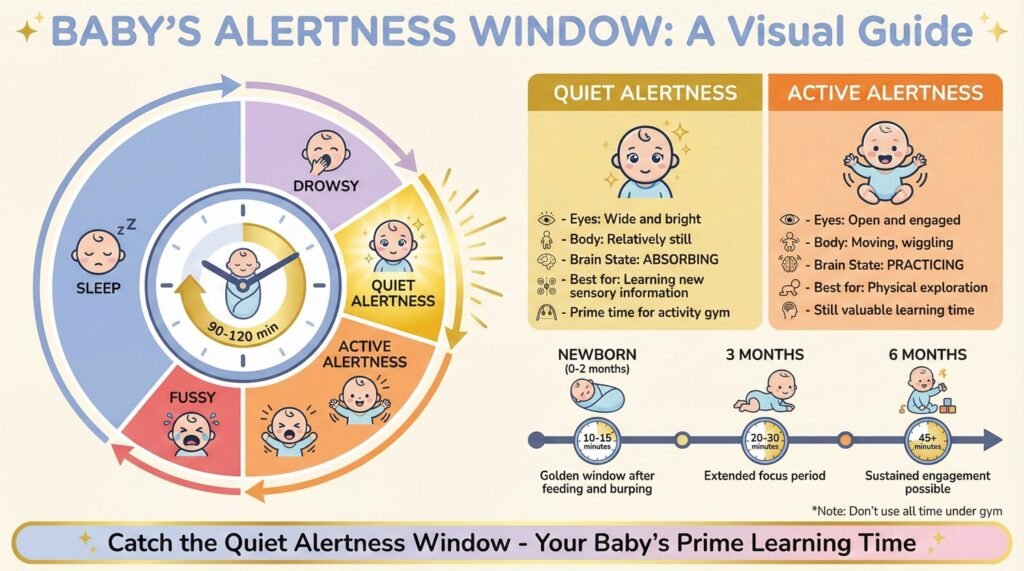
Your baby operates on an entirely different biological clock than you do. Newborns cycle through sleep and wake states roughly every 90 minutes to two hours, and within those wake windows, there’s a precious period of quiet alertness that represents prime time for activity gym engagement.
Quiet alertness differs significantly from active alertness. During quiet alertness, your baby’s eyes are wide and bright, their body is relatively still, and they’re genuinely absorbing what’s happening around them.
This is when their brain is most receptive to processing new sensory information.
Active alertness, by contrast, involves more movement and vocalization, still valuable, but the learning quality shifts from absorption to practice.
The typical newborn offers you maybe 10 to 15 minutes of this golden quiet alertness after a feeding, once they’ve burped and settled. By three months, you might get 20 to 30 minutes. By six months, some babies can sustain focused engagement for 45 minutes or longer, though that doesn’t mean they should spend all that time under the gym.
Keep a simple log for three days tracking when your baby seems most engaged and curious. You’ll quickly identify their personal peak performance windows, which might not match the textbook descriptions at all.
Every baby has their own rhythm, and discovering yours makes everything easier.
Morning Sessions: Starting Strong
The first activity gym session of the day carries particular weight because it sets neurological patterns. After your baby’s longest sleep stretch, their cortisol levels are naturally higher, which actually supports alertness and learning readiness.
This cortisol version promotes wakefulness and engagement rather than stress.
I position morning gym time about 30 to 45 minutes after the first feeding when my baby has had time to digest but hasn’t yet tired from being upright or dealing with any digestive discomfort. The morning light, even if it’s just ambient daylight in your living room, provides natural blue-spectrum wavelengths that enhance visual contrast perception, making those dangling toys significantly more interesting to your baby’s developing visual system.
During morning sessions, I focus on high-contrast visual elements and introduce gentle sounds. Your baby’s auditory processing centers are fresh, and they can track sound sources more effectively than they will later in the day when sensory fatigue sets in. This is the session where musical elements or toys with subtle rattling sounds create the strongest neural responses.
The morning is also when you’ll see the most robust reaching tries if your baby is in the 3-to-6-month window. Their muscle control is at its daily peak before repetitive use creates fatigue.
You’re providing the resistance training their developing nervous system needs to refine motor planning.
Mid-Morning: The Second Window
After the morning nap, there’s often another really productive engagement window. This session benefits from your baby having already processed their first major sensory input of the day.
Think of it as building on an established foundation rather than starting from scratch.
This is where I shift the gym configuration slightly. If toys were positioned for overhead viewing in the morning, I’ll rotate them to encourage lateral tracking, moving objects to the sides rather than directly above.
This challenges different neural pathways and different neck muscles.
Developmental progression involves systematically introducing variation rather than doing more of the same thing.
Mid-morning sessions can be slightly longer than morning ones because you’re working with added alertness rather than fresh-from-sleep engagement. However, watch for the quality of interaction rather than just duration.
Five minutes of genuine reaching, focusing, and responding is worth significantly more than 20 minutes of passive staring while your baby is starting to zone out.
The temperature of your space matters more than most parents realize. Babies who are slightly cool are more alert and engaged. If your baby seems sluggish during mid-morning gym time, check whether they’re overdressed. A baby who’s working to regulate body temperature has fewer cognitive resources available for exploration and learning.
Pre-Lunch: Tummy Time Integration
By late morning, I combine the activity gym with tummy time rather than treating them as separate activities. Many babies resist pure tummy time on a blank surface, but the visual motivation of toys hanging at eye level when they’re on their stomach creates a compelling reason to hold that head up.
This session addresses a really specific developmental need: strengthening the posterior chain muscles, the back of the neck, upper back, and shoulder stabilizers. These muscles are foundational for every gross motor milestone that follows.
A baby who builds solid tummy time endurance will typically show more confident rolling, sitting, and eventually crawling patterns.
The challenge here is that tummy time is genuinely hard work for babies. Their heads represent about 25% of their total body weight, compared to about 8% in adults.
Asking a baby to lift their head during tummy time is proportionally similar to asking you to lift a 40-pound weight with just your neck.
This context helps you appreciate why sessions need to be shorter and why your baby might protest.
I use the gym’s hanging elements as motivation but stay really present during these sessions. My face positioned at their eye level, just beyond the gym, creates dual motivation: the toys above and my social engagement ahead.
This combination typically extends tolerance by several minutes compared to tummy time without these supports.
Early Afternoon: Post-Lunch Considerations
The early afternoon presents a more complicated picture. After the midday feeding, many babies experience increased gastric activity and slight drowsiness from the energy demands of digestion.
This is typically not your prime activity gym window, and pushing for engagement during this natural low point often creates negative associations.
If your baby does show alertness in early afternoon, keep sessions shorter and focus on gentler sensory input. Softer sounds, less contrasting colors, more rhythmic movements rather than surprise elements.
You’re matching their lower energy state rather than trying to artificially elevate it.
Some babies, particularly as they approach six months, start consolidating their naps and might have a longer afternoon wake window. If your baby is one of these, the early afternoon session can shift from low-key maintenance to another productive engagement period.
The key is reading your personal child rather than following a prescribed schedule.
Late Afternoon: The Witching Hour Approach
Late afternoon brings what many parents call the “witching hour,” a period of increased fussiness that seems hardwired into infant neurology. There’s actually a cortisol dip that occurs in late afternoon for most babies, combined with accumulated sensory fatigue from the day’s stimulation.
I use the activity gym strategically during this challenging window, but with really different intentions. The goal is providing a familiar, comforting structure during a dysregulated period.
The gym becomes a known quantity in a world that suddenly feels overwhelming to your baby.
Position the gym in a slightly dimmer area during late afternoon sessions. Reduce the number of hanging elements, maybe leave just two or three favorites rather than the full array.
The goal is soothing through familiarity rather than exciting through novelty.
Some babies benefit from having a parent’s hand resting gently on their belly while they’re under the gym during this session, providing proprioceptive input that has a calming effect. This is also when you might see your baby transition from active engagement to just lying quietly under the gym, staring at a single element.
That’s actually perfectly valuable.
They’re self-regulating, using a focused visual point to organize their nervous system. Let that process happen rather than trying to increase stimulation.
Early Evening: Connection Before Bedtime
The early evening session, about 60 to 90 minutes before bedtime, serves a really specific function in the daily rhythm. You’re providing moderate engagement that creates just enough pleasant fatigue to support the transition toward sleep without creating overstimulation that would make settling difficult.
I mix the gym with more interactive play during this session. Rather than independent exploration, I narrate what my baby is seeing, sing simple songs about the objects they’re focusing on, and facilitate their reaching tries by gently guiding their hands toward toys.
This social overlay changes the gym from a sensory gym into a bonding tool.
The evening is when you can afford to be slightly less concerned about optimal developmental positioning and more focused on joy and connection. If your baby prefers being slightly reclined rather than flat, that’s fine for this session.
If they want to look at the same toy repeatedly rather than practicing new skills, follow their lead.
Watch the transition signals carefully during evening sessions. When your baby’s gaze starts to lose focus, when their movements become less purposeful, when they start showing early fatigue cues like eye rubbing or yawning, that’s your cue to wrap up.
Pushing past these signals by even five minutes can disrupt the entire bedtime routine.
Session Duration by Developmental Stage
The appropriate length of each gym session shifts dramatically as your baby develops, and really understanding these changes prevents both under-stimulation and overuse. Newborns from birth to six weeks might only maintain genuine engagement for 5 to 10 minutes per session.
Their visual range is limited to about 8 to 12 inches, and they’re primarily responding to high-contrast patterns and movement rather than engaging in goal-directed activity.
From 6 to 12 weeks, attention spans extend to 10 to 15 minutes as visual tracking abilities mature. Your baby starts following moving objects with their eyes more smoothly, and they begin to show preference for certain colors and patterns.
This is when you’ll see the first signs of intentional reaching, though they won’t have the motor control to actually grasp objects yet.
The 3-to-6-month window represents peak activity gym engagement. Sessions can extend to 20 to 30 minutes because your baby has developed genuine goal-directed behavior.
They’re actively trying to make things happen rather than just responding to stimuli.
The hand-eye coordination required to reach, grasp, and manipulate hanging toys represents complex neural integration.
After six months, many babies start outgrowing the traditional activity gym setup. They’re more mobile, more interested in objects they can manipulate in multiple ways, and less content with fixed overhead stimulation.
At this stage, I transition to shorter, more targeted gym sessions, maybe 10 to 15 minutes, while expanding other floor play opportunities that support crawling preparation and sitting balance.
Recognizing Overstimulation vs. Boredom
One of the trickiest aspects of using an activity gym throughout the day is distinguishing between a baby who’s overwhelmed and one who’s under-challenged. The signals can look surprisingly similar, both might involve fussiness, gaze aversion, and physical restlessness, but they need opposite responses.
Overstimulation typically includes specific physiological signs: color changes in the face (flushing or paleness), hiccups or spit-up that wasn’t related to feeding, sneezing without other illness signs, and a frantic quality to movements rather than purposeful exploration. An overstimulated baby often can’t calm even when removed from the gym because their nervous system has been pushed past its regulatory capacity.
Boredom, by contrast, shows up as disengagement while the baby stays physiologically calm. Their gaze wanders away from the toys repeatedly in a searching pattern, looking for something more interesting.
Their movements slow down but don’t become agitated. A bored baby typically calms immediately when you introduce a new element or change their position.
If you’re unsure whether you’re seeing overstimulation or boredom, remove your baby from the gym and provide calming input like gentle rocking, soft singing, and a dim environment. An overstimulated baby will need significant time to settle.
A bored baby will calm almost immediately and then start looking around for new stimulation.
Adapting for Different Temperaments
Not all babies approach the activity gym with the same style, and your daily usage pattern should reflect your personal child’s temperament. High-need or sensitive babies often show more intense responses to stimulation.
They engage more quickly and reach overstimulation thresholds faster.
For these babies, I reduce session frequency and duration but maintain consistency in timing.
Sensitive babies benefit from what I call “graded exposure,” starting each session with just one or two hanging elements, then adding more only if they stay regulated. Your gym setup can look sparse compared to the elaborate configurations you see in advertisements. Your goal is matching stimulation level to your baby’s processing capacity rather than using every feature.
Mellow, observer-type babies present a different adaptation challenge. They seem content to lie under the gym for extended periods, but content doesn’t equal engaged. For these babies, I actually shorten sessions and increase frequency.
Ten minutes of genuine interaction repeated six times throughout the day creates more developmental benefit than one 60-minute session where they’re passively observing.
High-energy babies need movement integrated into gym time. Rather than expecting them to lie still under the gym, I facilitate rolling practice, allow them to kick vigorously against the gym’s support arches, and position toys to encourage reaching in multiple directions.
For these babies, the gym becomes a launching point for motor exploration rather than a static activity.
People Also Asked
When should I start using a baby activity gym?
You can start using a baby activity gym from birth, though newborns will only engage for very short periods of 5 to 10 minutes. The first few weeks focus on visual tracking of high-contrast objects positioned 8 to 12 inches from their face.
Real interactive engagement typically begins around 6 to 8 weeks when babies develop better visual focus and start showing interest in overhead objects.
How long should tummy time be at 2 months?
At 2 months, aim for 3 to 5 minutes of tummy time, repeated 3 to 4 times throughout the day for a total of 15 to 20 minutes. Many 2-month-olds still protest tummy time, so breaking it into shorter sessions makes it more tolerable.
Using an activity gym with interesting toys at eye level can extend these sessions by giving your baby motivation to lift their head.
Can babies sleep under an activity gym?
Babies should never sleep under an activity gym. The hanging toys and stimulating environment work against the calm, minimal-stimulation setting babies need for safe sleep.
Always move your baby to an approved sleep surface like a crib or bassinet when they show signs of drowsiness, even if they fall asleep during gym time.
What age do babies start reaching for toys on play gym?
Most babies begin swiping at toys around 8 to 12 weeks, though these early tries are mostly accidental. Intentional, coordinated reaching typically develops between 3 and 4 months.
By 5 months, most babies can reach for and grasp hanging toys with reasonable accuracy, and by 6 months they can transfer objects between hands.
How do I know if my baby is overstimulated?
Signs of overstimulation include gaze aversion (consistently looking away from toys), flushing or paleness in the face, increased fussiness that doesn’t calm easily, hiccups or spitting up unrelated to feeding, sneezing without illness, and frantic rather than purposeful movements. An overstimulated baby often needs 15 to 30 minutes of calm, quiet time to regulate before they can settle.
Should I leave my baby alone under the activity gym?
You can leave your baby alone under the activity gym for short periods once they’re alert and settled, typically by 2 to 3 months. However, you should always stay in the same room and check frequently.
Newborns need closer supervision.
Independent gym time helps babies learn self-entertainment, but safety requires you to be nearby and responsive to their cues.
When do babies outgrow activity gyms?
Most babies start outgrowing traditional activity gyms between 6 and 9 months when they become more mobile and interested in toys they can manipulate in varied ways. Some babies stay engaged until 10 or 11 months, while others lose interest by 5 months.
Watch for signs like consistently rolling away from the gym, short engagement periods, or preference for other types of play.
Key Takeaways
The activity gym serves different functions during different wake windows throughout the day. Early sessions emphasize learning and skill building while later sessions focus on regulation and connection.
Session duration should match your baby’s developmental stage, starting with 5-to-10-minute sessions for newborns and extending to 20-to-30-minute sessions by 3-to-6 months.
Quality of engagement matters significantly more than duration of exposure. Environmental factors like lighting, temperature, and background noise should shift throughout the day to support your baby’s changing needs. Your baby’s temperament should guide session frequency and intensity more than generic schedules.
Coordination with feeding and sleep schedules decides whether gym time supports or disrupts your baby’s natural rhythm. Developmental progression happens through systematic small changes in toy position, height, and complexity rather than constant dramatic overhauls.
Different daily sessions should emphasize different skills to provide comprehensive development without overwhelming any single interaction.
Signs of overstimulation need immediate response while signs of boredom suggest the need for modest adjustments. The gym should combine with rather than dominate your baby’s overall daily activities, serving as structured anchor points within more varied sensory experiences.