
We may earn money or products from the companies mentioned in this post.
There are actually quite a few book subscription boxes designed specifically for toddlers. These services ship curated, age-appropriate books to your door each month, and honestly… they’ve become pretty popular over the last few years.
The short answer is yes, and you have more options than you might expect.
The toddler years (roughly 1-3 years old) are when kids start really engaging with books beyond just chewing on them. Their attention spans grow, they start recognizing patterns, and storytime becomes this whole thing.
But finding the right books at the right developmental stage gets overwhelming fast when you’re staring at hundreds of options at the bookstore or scrolling through endless Amazon pages.
Quick Answer (What You Need to Know)
Book subscriptions for toddlers deliver handpicked books to your home monthly or bimonthly. Most services cost between $15-30 per month and include 1-3 books per shipment.
The main players include Bookroo (wrapped books, board book focus), Literati (returns allowed, premium feel), The Reading Bug (personalized selections), Lillypost (two books monthly), and Highlights Hello (magazine format with activity guides).
These subscriptions handle the selection process so you don’t have to research which books are developmentally appropriate or worry about accidentally buying duplicates. They’re basically book curators who know way more about children’s literature than most of us have time to learn.
Why This Question Comes Up
Parents usually start asking “is there a book subscription for toddlers?” when they hit one of these situations:
Their kid has read the same 10 books about 4,000 times and everyone needs something new. Library trips sound great in theory but between nap schedules and actually remembering to return books on time… it doesn’t always happen.
Or they’re trying to build a home library but buying books individually gets expensive when your toddler loses interest after three reads.
There’s also the screen time thing. Every parent knows they should limit screens, but that means you need choices that actually hold a toddler’s attention.
Physical books check that box, but only if they’re engaging enough.
And tbh, choosing books becomes this whole research project. You want diverse characters, quality illustrations, age-appropriate themes, nothing too scary or overstimulating… it’s a lot.
Subscriptions outsource that mental load to people who do this professionally.
How Book Subscriptions for Toddlers Actually Work
The basic model is pretty straightforward. You sign up, provide your child’s age (or birthday), and books show up on a regular schedule.
Most services ship monthly, though some do bimonthly or quarterly options.
Here’s what typically happens:
You pick a plan based on your kid’s age range. Toddler categories usually cover 12-36 months, though some services break it down further (like 0-2 years vs 2-3 years).
The service chooses books based on that age and developmental stage.
Some let you mark books you already own to avoid duplicates, others just send whatever their curators picked.
Books arrive wrapped or packaged (some services make a whole thing out of the unboxing experience). You keep all the books, these aren’t rentals.
Most subscriptions are flexible, meaning you can skip months, pause, or cancel without penalties, though that varies by company.
The pricing usually breaks down to about the same or slightly less than buying those same books at retail. Where you save is the time and the curation expertise, not necessarily money per book.
Comparing the Main Toddler Book Subscription Services
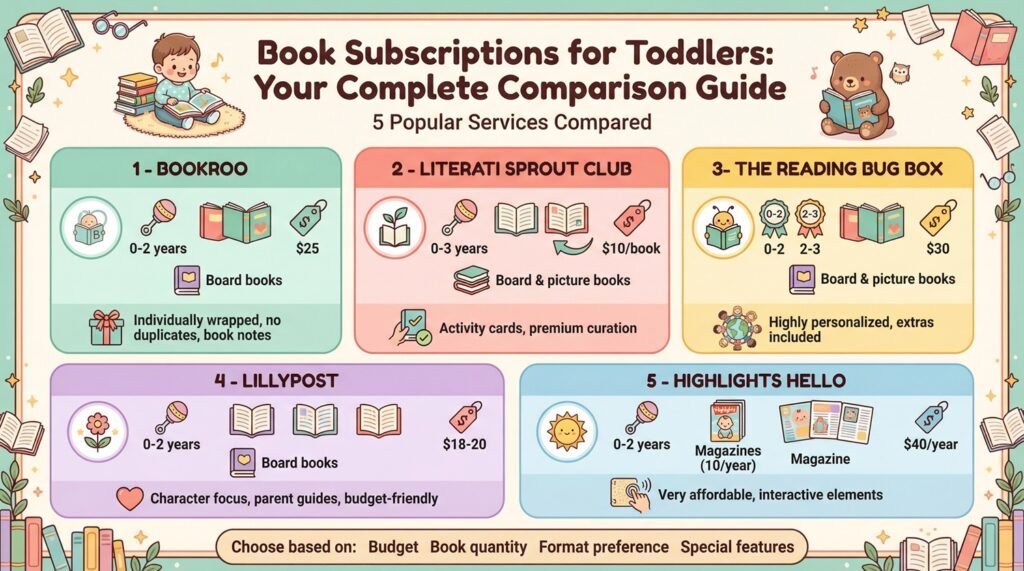
Let me break down the popular options because they each have different strengths…
Bookroo
Bookroo focuses specifically on young kids (they have separate boxes for ages 0-2, 2-6, and 7-10). For toddlers, they send board books which makes sense since those hold up better against the inevitable throwing/drooling/general destruction.
Their thing is that each book comes individually wrapped, which apparently makes kids more excited to open them. Some parents love this, others find it creates extra waste.
They ship 3 board books monthly for around $25, or you can do the 2-3 picture books option as your kid gets older.
What I appreciate about Bookroo is they include a note about each book explaining why they chose it and what developmental skills it supports. They also focus on lesser-known titles as opposed to just the bestsellers everyone already has.
The books are new (not used), and they avoid sending duplicates if you fill out your child’s existing library in their system. Check current Bookroo pricing and plans here, they sometimes run promotions for new subscribers.
Literati
Literati has a different approach. They send 5 books in a premium-looking box each month, and here’s the catch, you only buy the ones you want to keep.
The others go back in a prepaid return bag.
For toddlers, they have the “Sprout Club” (ages 0-3). The books you choose to keep cost about $10 each, so if you keep all 5, you’re paying around $50 that month.
But you might only keep 1-2, which gives you more control over spending.
This model works well if you’re picky about books or already have a large collection and worry about duplicates. You get to preview everything before committing.
The quality of their selections tends toward literary and award-winning titles, they’re pretty intentional about diverse authors and illustrators.
They also include activity cards with book-related games or discussion questions, which is nice if you want to extend the learning beyond just reading. You can see Literati’s current Sprout Club options here.
The Reading Bug Box
This your a bit different because they focus heavily on personalization. When you sign up, you fill out a detailed profile about your child, interests, books they already own, reading level, themes you want to include or avoid.
They send 3 books monthly (mix of board books and picture books depending on age) for around $30. The selection includes newer releases and backlist titles, and they’re good about avoiding the super popular books everyone probably already has.
The Reading Bug Box emphasizes reading diversity, diverse characters, authors, and family structures show up regularly in their picks. If that’s important to you, it’s worth noting.
They also include little extras sometimes, like bookmarks or activity sheets.
Their customer service is pretty responsive if you need to message about a duplicate or ask a specific focus (like potty training books or books about new siblings).
Lillypost
Lillypost keeps things simple, 2 books monthly for ages 0-10 (you pick your kid’s age range). For toddlers, they send board books and sturdier picture books.
What stands out is they really emphasize positive messages and character development. Their selections lean toward books about emotions, kindness, confidence, that kind of thing.
If you’re into gentle parenting or social-emotional learning, their curation aligns with that philosophy.
The pricing sits around $18-20 monthly, which makes it one of the more budget-friendly options. The trade-off is you get fewer books per box (just 2), but the cost per book is reasonable.
They include a parent guide explaining the themes in each book and suggested discussion points. Helpful if you want to get more educational mileage out of story time.
Highlights Hello
This isn’t strictly a book subscription, it’s more of a magazine/activity subscription, but worth mentioning because it fills a similar niche for toddlers.
Hello is Highlights’ magazine for ages 0-2. You get 10 issues per year (roughly monthly) for about $40 total, so it’s significantly cheaper than most book boxes.
Each issue includes board book-style pages with stories, poems, and interactive elements like lift-flaps.
The activity component is bigger here, there are games, simple crafts, and baby-friendly activities included. It’s less about building a permanent library and more about fresh content each month that you’ll probably end up recycling after a while.
If you’re looking for something affordable to supplement your existing books as opposed to replace library/store trips entirely, Highlights Hello makes sense. But if you want hardcover books you keep forever, the other options work better.
What Makes a Good Toddler Book Subscription
After looking at what these services offer, a few factors matter when picking one:
Age specificity, Toddlers change so fast developmentally. A 15-month-old and a 30-month-old need completely different books.
Services that break down age ranges more precisely (like separate boxes for 0-2 vs 2-3) tend to match books better to your kid’s actual stage.
Book format, Board books survive toddler handling way better than paper pages. If you have a younger toddler who’s still mouthy or rough with books, prioritize services sending board books over picture books.
Duplicate prevention, Some services let you mark owned books, others just wing it. If you already have a decent collection, the duplicate thing becomes super annoying and wasteful.
Return/exchange options, Literati’s try-before-you-buy model is unique. Most subscriptions are final sale, which is fine if their curation matches your taste, but there’s risk involved.
Curation philosophy, Think about what you value. Diversity?
Award winners?
Lesser-known titles? Educational themes?
Different services prioritize different things, and honestly, you can usually tell from their marketing which direction they lean.
Flexibility, Can you skip months easily? Pause without penalty?
Switch age ranges as your kid grows?
The more flexible, the less commitment stress.
Price per book, Do the math. Some boxes seem pricey but send 4-5 books.
Others are cheaper but only include 2 books.
Figure out the per-book cost and compare it to what you’d pay at a bookstore or Amazon.
Real Talk: Are These Subscriptions Worth It?
Here’s what I’ve noticed from people actually using these…
The convenience factor is legit. When you’re in the thick of toddler life, having books just show up without thinking about it removes one more task from your mental checklist.
That has value beyond just the book cost.
The curation tends to be better than what you’d randomly grab at Target. These services employ children’s librarians and educators who know books.
You end up with titles you wouldn’t have found otherwise, which expands your kid’s exposure beyond just the mainstream stuff.
But (there’s always a but)… if you already enjoy browsing bookstores or library sales, and you like the treasure hunt aspect of finding books yourself, subscriptions might feel restrictive. You’re giving up that control and discovery process.
The cost adds up. Even “affordable” subscriptions run $200-300 annually.
You can buy a lot of used books at library sales for that amount.
The trade-off is time and curation expertise vs raw book quantity.
Duplicates happen. Even with systems to prevent them, you’ll occasionally get a book you own.
Most services are good about exchanges, but it’s a minor hassle.
For specific situations though, these really shine:
Grandparents love them as gifts. It’s an ongoing present that keeps giving throughout the year without requiring the grandparents to know anything about current kids’ books.
Most services offer gift subscriptions specifically for this.
New parents who don’t have any books yet can build a curated starter library quickly without research paralysis.
Busy households where nobody has time to get to bookstores or libraries regularly benefit from the automatic delivery.
Kids who love getting mail (which is most kids) get genuinely excited about their box arriving. That excitement around books has its own value.
If you want to try one risk-free, Bookroo offers a solid starter plan that you can cancel after a month or two if it’s not working for you.
What Experts Say About Toddler Reading
Early childhood literacy research consistently shows that reading volume matters. Kids who are read to more often develop larger vocabularies, stronger comprehension skills, and better school readiness.
The American Academy of Pediatrics recommends reading aloud to children from birth. For toddlers specifically, interactive reading (asking questions, pointing at pictures, letting them turn pages) supports language development and cognitive skills.
What that means practically is that having a steady supply of age-appropriate books supports this kind of regular reading habit. Subscriptions can help maintain that supply without extra effort.
Children’s librarians generally recommend rotating books in and out of view as opposed to having every book accessible all the time. It keeps the “library” feeling fresh.
Subscriptions naturally create this rotation since new books arrive regularly, which pushes older ones into background storage.
The quality of books matters too, not just quantity. Books with rich vocabulary (but not frustratingly complex), diverse characters, and engaging illustrations do more developmental work than simpler books.
This is where curation helps, services that prioritize award-winners and critically acclaimed titles tend to deliver higher quality overall.
One literacy specialist I read emphasized repetition matters for toddlers. They need to hear the same books many times to internalize language patterns and story structure.
So while variety is good, don’t stress if your toddler wants the same book 12 nights in a row.
That’s actually useful for their development.
Practical Considerations Before Subscribing
A few things to think through before committing:
Storage space, Books pile up fast. If you’re in a small apartment or already drowning in toys, adding 2-4 books monthly adds up over time.
Some people rotate older books to storage bins or donate them, but that’s extra work.
Reading habits, Are you actually reading to your kid daily? If books are already gathering dust, adding more through a subscription doesn’t solve that problem.
The subscription works best when you’re already reading regularly and just need fresh content.
Budget, Be honest about whether this fits your spending. It’s recurring, which means it’s easy to forget about financially.
But it’s also around $20-30 monthly, which is roughly the cost of one family dinner out.
Prioritize accordingly.
Your child’s preferences, Some toddlers are super into books, others are indifferent. If your kid barely tolerates story time, expensive subscriptions might not be the right solution yet.
Library books let you test different types without financial commitment.
Alternative options, Before subscribing, consider whether library trips, used book stores, or hand-me-downs from friends might work just as well. Sometimes the subscription hype oversells what’s basically just… buying books regularly.
You can do that yourself if you have the time and inclination.
That said, if you know the subscription model works for your lifestyle and budget, checking out Literati’s try-before-you-buy approach removes some of the risk since you can return books you don’t want.
Comparison Table: Top Toddler Book Subscriptions
| Service | Age Range | Books Per Month | Monthly Cost | Book Format | Special Features |
|---|---|---|---|---|---|
| Bookroo | 0-2 years | 3 | ~$25 | Board books | Individually wrapped, includes book notes, duplicate prevention |
| Literati Sprout Club | 0-3 years | 5 (keep what you want) | ~$10 per kept book | Board & picture books | Try before you buy, activity cards, premium curation |
| The Reading Bug Box | 0-2, 2-3 years | 3 | ~$30 | Board & picture books | Highly personalized, diversity focus, extras included |
| Lillypost | 0-2 years | 2 | ~$18-20 | Board books | Character development focus, parent guides, budget-friendly |
| Highlights Hello | 0-2 years | 10 magazines/year | ~$40 annually | Magazine format | Activities included, very affordable, interactive elements |
Making the Decision
So is there a book subscription for toddlers? Yes, several good ones.
Which one makes sense depends on your situation.
If budget is tight but you still want something, Highlights Hello gives you consistent content for less than $4 monthly. It’s not the same as building a permanent library, but it works for regular reading material.
If you want most control and have time to assess each book, Literati’s model let’s you try before committing. The upfront cost is higher only for books you actually keep.
If you prefer simplicity and just want quality books to show up without thinking about it, Bookroo or The Reading Bug Box handle everything on autopilot. You give them minimal info and trust their curation.
If social-emotional learning and character development matter to you specifically, Lillypost aligns with that philosophy in their selections.
For gift-givers (especially grandparents), any of these work, but Bookroo’s wrapped presentation and Literati’s premium packaging make the unboxing experience more giftlike.
The honest reality is that all these services deliver basically the same outcome, age-appropriate books arriving regularly. The differences are in pricing models, curation style, and small features.
You probably won’t go wrong with any of them if the core concept appeals to you.
Start with a short subscription (most offer month-to-month or 3-month options) and see if the curation matches your taste and your kid’s interest before committing to a full year.
Beyond Subscriptions: Building a Reading Habit
Having books delivered helps, but it doesn’t automatically create a reading habit. That part still needs showing up for story time consistently.
The recommendation is to build reading into existing routines, before naps, before bedtime, after breakfast. When it becomes part of the schedule as opposed to a special activity, it happens more reliably.
Let your toddler pick books sometimes, even if it’s the same one repeatedly. Choice creates engagement.
And engagement matters more than exposing them to a huge variety if they’re not actually paying attention.
Physical books versus screens makes a difference. Tablets and apps have their place, but physical books force a different kind of interaction.
Toddlers can control the pace, go backward, point at details.
That physical manipulation supports learning in ways scrolling doesn’t quite copy.
Your own attitude toward books matters too. If you’re obviously bored or rushing through pages to get to bedtime, kids pick up on that.
When you’re engaged with the story, doing voices, commenting on illustrations, asking what they think happens next, they mirror that interest.
Book subscriptions support this habit by removing the supply barrier. You always have fresh options when the current rotation gets stale.
But the actual habit part still comes down to consistent daily practice.
Common Questions About Toddler Book Subscriptions
Can I skip months if we have too many books? Most services allow skipping or pausing. Bookroo, Literati, and The Reading Bug Box all have flexible options.
Check the specific service’s terms, but this is pretty standard now.
What happens if I get a duplicate? Policies vary. Some services let you mark books you own to prevent this.
Others will exchange duplicates if you contact customer service.
Literati avoids this entirely since you choose which books to keep.
Are these books new or used? Almost all services send new books. You’re not getting library castoffs or worn copies.
Can I choose the specific books? Generally no, that’s the whole point of the curation. Literati is the exception since you choose which of the 5 sent books you keep.
Some services let you show themes or preferences, but you don’t pick person titles.
Do these work for twins or many kids? Most services are priced per child/box. Some families with kids close in age just get one subscription and share the books.
If your kids are different ages/stages, you might need separate subscriptions for age-appropriate content.
Can I give this as a gift? Yes, most offer gift subscriptions for 3, 6, or 12 months. You pay upfront and the recipient gets books delivered on schedule.
What if my kid doesn’t like the books? This is hit or miss. Toddlers can be unpredictable in their preferences.
Most services have good enough curation that at least some books land well.
But you might occasionally get boxes where nothing clicks. That’s part of the trade-off with giving up personal selection control.
Are subscriptions better than just going to the library? Not necessarily better, just different. Libraries are free and offer unlimited selection, but need time and transportation.
Subscriptions cost money but deliver convenience and expert curation.
Some people do both, library for high-volume reading, subscription for building a personal library of keepers.
Final Thoughts
Book subscriptions for toddlers fill a specific need, consistent delivery of quality, age-appropriate books without research and shopping time. They’ve gotten popular because they work well for busy households, gift-giving, and building reading habits.
The cost is real though. You’re paying for convenience and expertise, not getting books dramatically cheaper than retail.
Decide whether that trade-off makes sense for your situation.
If you already spend $25-30 monthly on kids’ books anyway, redirecting that toward a subscription adds curation value without extra cost. If you’re not currently buying books regularly, the subscription might feel like unnecessary expense when libraries exist.
The services themselves are pretty solid across the board. Bookroo, Literati, The Reading Bug Box, and Lillypost all deliver what they promise.
Pick based on your specific priorities, budget, flexibility, curation philosophy, book quantity, etc.
Starting with a short trial makes sense. Most services offer month-to-month or quarterly options so you can test before committing to a year.
See if the curation matches your taste, whether your kid engages with the books, and whether the convenience actually saves you time and mental energy.
But remember the books themselves are just tools. The actual value comes from the time spent reading together, the snuggling on the couch, the silly voices, the conversations about pictures.
The subscription handles the “what books” question, but you still have to show up for the actual reading part.
And honestly? That’s the good part anyway.