
We may earn money or products from the companies mentioned in this post.
Have you ever found yourself standing in a bookstore aisle, completely overwhelmed by the sheer number of toddler books available, wondering which ones are actually worth the investment? Or maybe you’ve ordered books online based on glowing reviews, only to have them sit unread on your shelf because they just didn’t resonate with your child.
Choosing the right books for your toddler can feel surprisingly complex, but a well-matched book subscription can transform this challenge into a simple, enjoyable experience.
In this post, I’ll walk you through the strategic approach to selecting a toddler book subscription that genuinely works for your family’s unique situation.
Understanding What You’re Really Buying
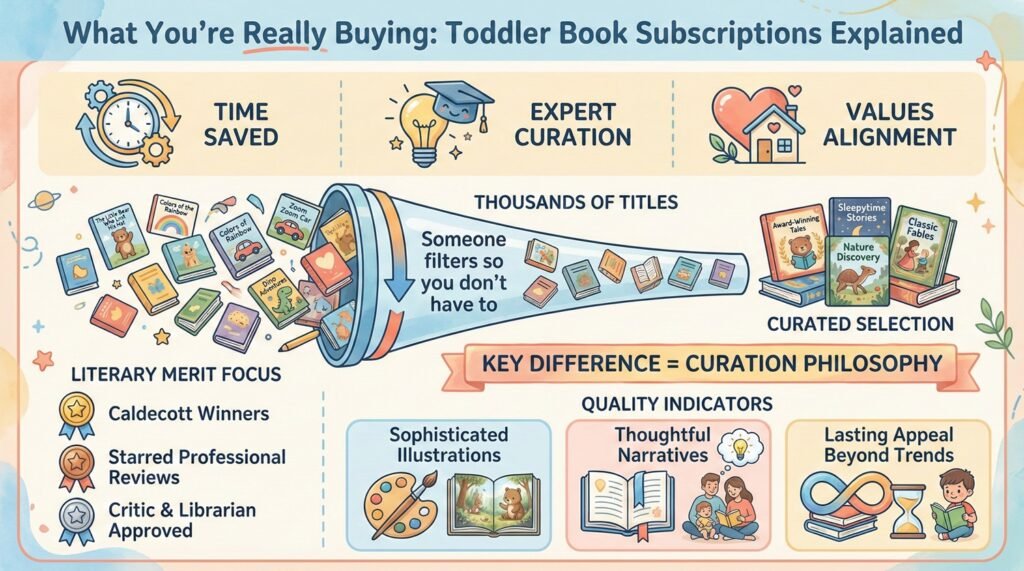
When you subscribe to a toddler book service, you’re purchasing time, expertise, and a curated experience that should align with your family’s values and needs. You’re also paying someone to filter through thousands of titles so you don’t have to.
The basic difference between services comes from their curation philosophy. Some subscriptions prioritize literary merit and award-winning titles, which means you’ll receive books that critics and librarians consider exceptional.
These services might send you Caldecott winners or titles that have received starred reviews from professional journals.
The books will typically show sophisticated illustration techniques, thoughtful narratives, and lasting appeal that transcends momentary trends.
Other services focus heavily on representation and diversity, ensuring children see various family structures, cultures, and experiences reflected in their reading material. These subscriptions make deliberate choices to include books featuring characters of different races, abilities, family configurations, and socioeconomic backgrounds.
The goal is exposing your child to a wider world than they might experience in their immediate environment.
Still others emphasize pure discoverability, sending lesser-known gems that you’d never encounter at your local bookstore. These services often work with independent publishers, debut authors, and small presses that produce exceptional work without major marketing budgets.
You’ll get books that few other families own, which creates a unique reading experience.
Understanding this distinction matters because it shapes every book that arrives at your doorstep. If you value literary quality above all else, a service curated by librarians with an eye toward award winners makes sense.
If your priority is raising a child who understands and appreciates diversity, you’ll want a service with an explicit commitment to inclusive representation.
If you’re tired of seeing the same popular titles everywhere and want fresh discoveries, you need a service known for finding hidden treasures.
The ownership versus borrowing model creates another basic divide. Ownership models mean you’re building a permanent library, which works beautifully if you have space, plan to have more children, or simply love the idea of creating a collection your child can return to over years.
The emotional connection to a home library shouldn’t be underestimated. There’s something really special about a child being able to revisit beloved books from their younger years, seeing how their understanding deepens with each return.
Borrowing models offer variety without accumulation. You get to test many books, keep what resonates, and return what doesn’t.
This approach suits families with limited space, those who prefer minimalism, or parents who want exposure to many titles without the commitment of ownership.
The downside is the administrative burden of tracking return dates and managing the logistics of exchanges. Some families find this aspect stressful as opposed to liberating.
Matching Subscription Features to Your Actual Lifestyle
The best subscription on paper might be completely wrong for your real-world situation. I’ve seen families choose premium services with beautiful extras, only to realize they don’t have time to engage with activity guides or seasonal crafts.
That doesn’t show a failure of the subscription, it represents a mismatch between the service and the family’s bandwidth.
Consider your reading routine honestly. If you’re struggling to find even ten minutes for bedtime stories most nights, a subscription that arrives with extensive parent guides and discussion prompts might create more guilt than value.
You’d be better served by a simpler service that sends great books without expectations of elaborate engagement.
Some families read constantly throughout the day, while others manage one consistent bedtime story. Neither approach is superior, but they require different subscription features.
Your home’s physical space matters more than you might think. If you live in a small apartment with limited storage, receiving three board books every month means you’re adding thirty-six books to your home annually.
Within two years, that’s seventy-two books.
If you don’t have shelf space or storage solutions, those books become clutter, and clutter creates stress. In this situation, a borrowing model or a less frequent delivery schedule makes practical sense.
I’ve watched families become genuinely distressed by accumulating piles of books they feel guilty about not displaying properly.
Budget reality needs honest assessment. A subscription priced at twenty-five dollars monthly equals three hundred dollars annually.
That’s a meaningful expense for most families.
The real question is whether the value matches the cost for your specific situation. If that subscription saves you three hours of monthly bookstore browsing, eliminates decision fatigue, and consistently delivers books your child loves, the value might far exceed the cost.
If half the books sit unread because they miss the mark on your child’s interests, you’re wasting money regardless of how reasonable the price seems in isolation.
Strategic Selection Based on Your Child’s Reading Stage
Toddlers develop at vastly different rates, and chronological age doesn’t always match reading readiness. A subscription that works perfectly for one two-year-old might completely miss the mark for another child the same age with different developmental characteristics.
Younger toddlers around twelve to twenty months need extremely durable board books with simple, high-contrast images and minimal text. At this stage, books function as sensory objects as much as reading material.
Children at this age often mouth books, throw them, and generally treat them roughly.
You need subscriptions that understand this reality and send appropriately sturdy selections. Books with lift-flaps or delicate pop-ups will be destroyed within days at this stage.
As toddlers approach two to three years, their attention spans lengthen and their comprehension deepens. They start following simple narratives and enjoying books with rhythm and repetition.
Services that understand this transition offer books with engaging patterns, predictable text, and more complex illustrations that reward repeated readings.
Your child might want the same book read five times in a row because they’re finding new details in the illustrations or anticipating favorite phrases.
Older toddlers moving toward preschool age can handle longer stories with more sophisticated themes. They’re developing preferences about topics, characters, and illustration styles.
At this stage, a subscription’s ability to personalize based on feedback becomes really valuable.
If your three-year-old is obsessed with construction vehicles but the subscription keeps sending books about princesses, you have a basic problem with how the service operates.
The best approach is choosing services that offer many age brackets and allow easy transitions between them. Some children advance quickly and need to move up sooner than the suggested age range.
Others benefit from staying in a younger category slightly longer.
Flexibility matters more than rigid age categorization.
Evaluating Curation Quality
All curation looks roughly equivalent in service descriptions, but the actual quality of book selection varies dramatically across services. Some subscriptions employ actual librarians with children’s literature expertise and years of professional training.
Others use algorithms or less qualified curators who might simply be parents with opinions as opposed to professionals with systematic knowledge.
One practical way to assess curation quality is reviewing past month selections. Most services publish their previous boxes on social media or their websites.
Spend twenty minutes looking at three to six months of past selections.
Do the books look genuinely interesting and diverse in style, or do they seem generic? Are you familiar with most titles, or do they feel fresh?
Do the illustrations appeal to you, since you’ll be looking at them repeatedly during nightly readings?
Pay attention to publisher diversity as well. If every book comes from the same two or three major publishers, the subscription isn’t working very hard to find unique titles.
Quality curation involves relationships with smaller, independent publishers who produce exceptional work that doesn’t always get mainstream distribution.
These relationships take years to develop and show a curator who is actively engaged with the children’s literature community.
Author and illustrator diversity matters both for representation and for creative variety. Books created by people from diverse backgrounds offer different narrative perspectives, illustration styles, and cultural touchpoints.
Even if diversity isn’t your primary motivation, it leads to a more interesting, varied collection that prevents the monotony of similar storytelling approaches.
Testing Before Committing
The single biggest mistake families make is prepaying for six or twelve months before experiencing the service. The discounts can be tempting, sometimes twenty or thirty percent off, but you’re risking significant money on an unknown experience.
Start with a single month. When that first box arrives, assess it carefully.
Do the books match your child’s current interests and abilities?
Are they titles you’re excited to read together? Do they feel worth the cost?
Is the packaging wasteful or suitable?
Did the books arrive in good condition without damage from shipping?
After your child has lived with the books for a couple weeks, you’ll have a much clearer sense of whether they’re keepers. Some books that seem promising initially don’t hold attention, while others become unexpected favorites that get requested nightly.
My own experience has repeatedly shown that I’m terrible at predicting which books will resonate most strongly.
The only reliable test is actual use over time.
Many services offer the ability to swap titles if you already own them. Test this feature during your first month.
Contact customer service with a swap ask and see how responsive and accommodating they are.
Good customer service during your trial period strongly forecasts good service when inevitable issues arise later. A company that makes swapping difficult or doesn’t respond promptly to initial inquiries will only frustrate you more after you’ve committed long-term.
Navigating the Price-Value Equation
Price comparison across subscriptions can be misleading if you only look at monthly costs. You need to calculate cost per book and factor in what you’re actually receiving beyond the physical books themselves.
A fifteen-dollar subscription that sends two books costs seven fifty per book. A thirty-dollar subscription sending four books costs seven fifty per book.
They’re equivalent in per-book cost, but you’re getting different quantities.
If you’re trying to rapidly build a library, the thirty-dollar option might be better value. If you’re supplementing library visits and just want a few curated picks monthly, the fifteen-dollar option makes more sense for your situation.
Consider what you’d pay for similar books retail. Quality board books typically cost eight to twelve dollars new.
Picture books run ten to eighteen dollars.
If your subscription is delivering books at or below retail prices while saving you selection time, you’re receiving genuine value. If you’re paying above retail without meaningful curation benefit, you’re overpaying for convenience that might not be worth the premium.
Premium-priced subscriptions often include extras beyond books themselves, activity guides, discussion prompts, crafts, or small toys. Evaluate whether these extras enhance your experience or just add cost without corresponding value.
I’ve known families who love having conversation starters because it deepens their reading time and gives them specific ways to engage beyond simply reading words on pages.
I’ve known other families who immediately recycle these materials because they don’t have bandwidth to use them. Know which type you are before paying extra for features you won’t use.
Building Your Decision Framework
Rather than trying to identify the single best subscription universally, build a decision framework specific to your family’s priorities. What works brilliantly for your neighbor might be completely wrong for you.
Start by ranking these factors in order of importance to you: price, curation quality, diversity and representation, age-specificity, flexibility and cancellation terms, physical quality of books, inclusion of extras, discoverability of titles, ownership versus borrowing, and customer service quality.
Your top three priorities should drive your decision. If your top three are price, diversity, and flexibility, you’re looking at a different set of options than someone whose priorities are curation quality, discoverability, and ownership.
These different priority sets point toward genuinely different services.
Use this ranking to assess services systematically. Create a simple comparison chart with your top priorities as rows and different subscriptions as columns.
Rate each service on each priority using whatever scale makes sense to you, numbers, letter grades, or simple rankings.
This removes emotion and marketing influence from the decision, giving you a clear, logical comparison based on what actually matters to your family as opposed to which service has the most appealing website or Instagram presence.
Managing Multiple Subscriptions for Different Ages
Families with many children at different developmental stages face the complexity of choosing between many subscriptions or finding one service that accommodates mixed ages. The decision involves both practical and financial considerations.
Some services specifically design mixed-age boxes with books suitable for different developmental levels tied together by a theme. This approach works beautifully for shared reading time where you want to engage a two-year-old and a five-year-old simultaneously.
The theme creates cohesion while the different books match different comprehension levels.
Other families prefer separate subscriptions for each child, treating book delivery as an person experience. This costs more but allows precise targeting to each child’s current stage and interests.
Some children feel special having their own deliveries as opposed to sharing boxes with siblings.
A middle approach involves subscribing for your youngest child only, since their developmental window moves fastest and their preferences are hardest to forecast, while supplementing older children’s reading through library visits where they can self-select. Toddlers benefit most from curated selection since they can’t yet express preferences clearly or browse independently.
Key Indicators That a Subscription Isn’t Working
Not every subscription works for every family, and recognizing when to change or cancel saves money and frustration. Several clear signs show a mismatch.
If more than half of each month’s books go unread or your child shows little interest, something is misaligned. This might show a curation problem, a developmental mismatch, or simply poor fit between your child’s preferences and the service’s selection style. Whatever the cause, you’re not getting value from books that sit untouched.
If you consistently feel that the books are overpriced compared to retail, and you’re not valuing the curation enough to justify the premium, you’re better off making your own selections. Some families genuinely enjoy browsing and choosing books themselves.
If you’re one of them, subscription convenience might not be worth paying for.
If customer service issues arise repeatedly, damaged shipments, incorrect age selections, or unhelpful responses to concerns, those problems rarely improve over time. Switch to a service with better operations before you waste more months being frustrated.
If you find yourself feeling guilty about unread books accumulating, or stressed about managing returns for a borrowing service, the subscription is creating more burden than value. The right subscription should simplify your life by removing decisions and providing quality options.
When it adds stress instead, something basic is wrong with the fit.
Frequently Asked Questions
What age should I start a book subscription for my toddler?
You can start a book subscription as early as six months, though many families begin around twelve to eighteen months when babies transition into toddlerhood and can sit through short board books. The key is choosing a service that offers suitable developmental categorization as opposed to focusing purely on age.
Look for subscriptions that offer specific brackets like six to twelve months, twelve to twenty-four months, and two to three years, since developmental differences are huge during these periods.
Are book subscriptions worth it compared to library books?
Book subscriptions and library books serve different purposes as opposed to competing directly. Libraries offer unlimited volume at no cost, which is unbeatable for quantity.
Subscriptions provide curated quality and ownership without requiring time spent browsing, selecting, and managing loans.
Many families use both, subscribing for a core collection of owned books while supplementing with library visits for extra variety.
How many books should come in a monthly toddler subscription?
Most toddler subscriptions send between two and four books monthly. Two books feels light but works well if you’re supplementing with library visits or have limited space.
Three books typically provides good balance between variety and manageability.
Four or more books helps rapidly build a library but can feel overwhelming if you’re new to subscriptions or have budget constraints.
Can I customize book subscriptions based on my toddler’s interests?
Customization varies significantly by service. Some subscriptions allow detailed preference profiles where you can show interests, disinterests, and topics to avoid.
Others operate with minimal customization beyond age and gender selection.
A few services don’t customize at all, sending the same titles to all subscribers in an age bracket. If personalization matters to you, research this feature specifically before subscribing.
What happens if I already own a book the subscription sends?
Most quality subscriptions offer swap or credit options if you already own a title they send. The ease of this process varies dramatically by company.
Some make swapping simple through their website or app, while others require emailing customer service and waiting for responses.
Test this process during your first month to understand how smoothly it operates before committing long-term.
Are diverse book subscriptions more expensive?
Diversity-focused subscriptions typically cost the same as other quality services, ranging from fifteen to thirty-five dollars monthly depending on how many books they include and whether they add extras. You’re paying for curation expertise as opposed to the diversity itself.
In fact, some of the most affordable subscriptions prioritize diverse representation because their founders are personally committed to that mission.
How do I cancel a book subscription if it’s not working?
Cancellation policies vary by service. The best subscriptions allow easy cancellation through your account settings with no penalties or required explanations.
Some services require email asks to customer service.
A few have cancellation deadlines each month, if you miss the deadline, you’re charged for another month. Review cancellation terms carefully before subscribing, particularly if you’re considering prepaying for many months.
Key Takeaways
The right toddler book subscription aligns with your family’s specific priorities, budget constraints, and lifestyle realities as opposed to following popularity or marketing hype. Start by honestly assessing how much time you actually spend selecting books, whether you value building a permanent library or prefer rotating variety, what your budget realistically allows, and how much space you have for accumulating books.
Test any service with a single month before committing to longer terms, regardless of discount incentives. Evaluate curation quality by reviewing past selections as opposed to relying on service descriptions.
Match the subscription’s age categorization and flexibility to your child’s actual developmental stage as opposed to just chronological age.
Factor in the total cost including both subscription fees and the value you place on time saved through curation. Switch services without guilt when your initial choice doesn’t deliver expected value, preferences change, or your child’s developmental needs evolve beyond what a service offers.