
We may earn money or products from the companies mentioned in this post.
Do you want your kids to have access to amazing books without spending a fortune on them?
I definitely did when my children were young, and honestly, I was really surprised by how many legitimate programs exist that will actually send quality books directly to your home for free. I kept track of every single program I uncovered, tested which ones really delivered, and I’ve put together everything I learned so you can take advantage of these incredible resources too.
Read on to find out about the most reliable free book programs available, learn exactly how to qualify and apply for them, plus get insider tips on maximizing your benefits so your children can build a home library that fuels their love of reading without emptying your wallet.
Understanding the Landscape of Free Children’s Book Programs
The reality is that book access stays a significant barrier to literacy development for millions of families. Research consistently shows that children who grow up in homes with books perform better academically, develop stronger vocabulary skills, and maintain a lifelong love of reading.
Children’s books are genuinely expensive. Building even a modest home library can cost hundreds or thousands of dollars.
That explains exactly why many organizations, nonprofits, government programs, and private foundations have created initiatives specifically designed to get books into the hands of children who need them most.
These programs distribute brand new, high-quality children’s literature that you’d find in bookstores and libraries, not damaged or outdated books.
The programs generally fall into several categories. Some focus on early childhood and mail books regularly from birth through age five.
Others target specific populations like low-income families, children with disabilities, or kids in rural areas with limited library access.
Some programs are universal and available to anyone regardless of income, while others have eligibility requirements based on household income, geographic location, or enrollment in other assistance programs.
What really matters is understanding which programs you qualify for, how to navigate the application processes, and how to stack many programs to maximize the number of books flowing into your home. I’ve found that families who take a strategic approach can receive anywhere from 12 to 60+ free books annually through various channels.
Dolly Parton’s Imagination Library
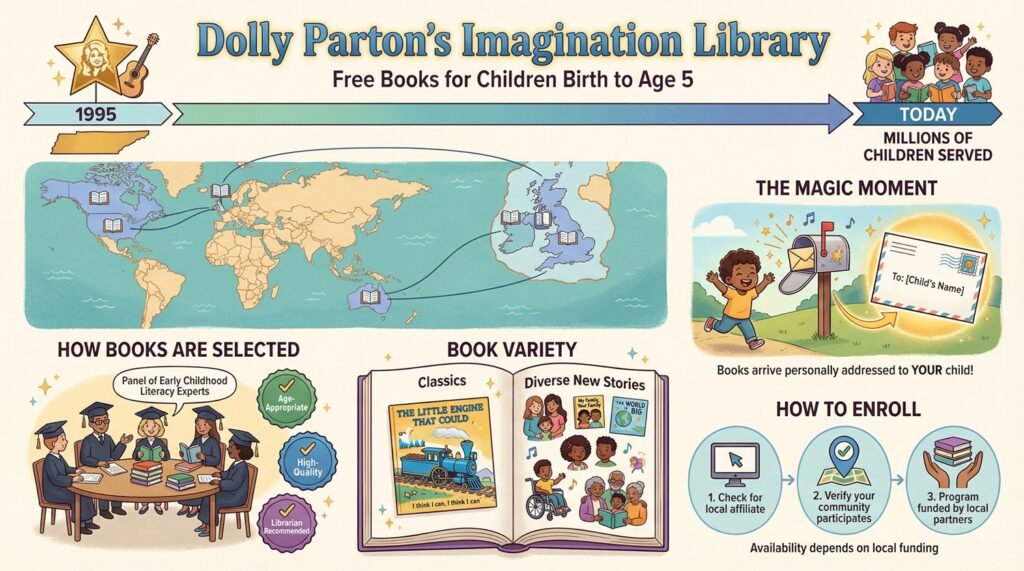
This is probably the most well-known free book program in existence, and for good reason. Dolly Parton’s Imagination Library mails one book per month to registered children from birth until their fifth birthday.
That’s 60 books total, completely free, delivered right to your doorstep.
The program started in 1995 in Dolly Parton’s home county in Tennessee but has since expanded to serve millions of children across the United States, Canada, United Kingdom, Ireland, and Australia. The books are carefully selected by a panel of early childhood literacy experts and are age-appropriate, high-quality titles that many librarians and educators recommend.
What makes this program particularly valuable is that the books arrive addressed to your child by name, which creates genuine excitement about mail and reading. I’ve watched kids literally run to the mailbox when they know their book might arrive.
The titles include classics like “The Little Engine That Could” alongside newer diverse stories that reflect various family structures, cultures, and experiences.
To enroll, you need to check if your area has a local Imagination Library affiliate. Not every community joins because the program relies on local funding partners to cover the costs.
You can verify availability by visiting the Imagination Library website and entering your zip code.
If your area joins, registration typically takes less than five minutes and needs basic information like your child’s name, birthdate, and mailing address.
The catch, if you can call it that, is geographic availability. If your community doesn’t have an active program, you’re unfortunately out of luck unless you can connect with local organizations, libraries, or government officials to bring the program to your area.
Some families have successfully advocated for their communities to join by presenting information to city councils or connecting with local Rotary clubs that often sponsor these initiatives.
First Book and the First Book Marketplace
First Book operates differently than most programs on this list. Rather than mailing books directly to families, they primarily work through schools, programs, and educators who serve children in need. However, they do have pathways for families to access books, especially if you’re connected to eligible organizations.
The First Book Marketplace offers incredibly discounted books and educational resources to registered educators and program leaders serving kids from low-income families. Books that retail for $15-20 might be available for $2-5 through their marketplace.
If you volunteer with a qualifying organization, run a Little Free Library in a low-income area, lead a community reading program, or work with an afterschool program, you might be able to register and access these resources.
First Book runs special distribution campaigns where they partner with corporations and publishers to give away books entirely free to eligible programs. During the pandemic, they distributed millions of books to families through schools and community organizations.
If your child’s school joins in Title I programs or if you’re involved with Head Start, Boys & Girls Clubs, or similar organizations, asking if they have a First Book connection can open doors.
The key here is leveraging your network. If you don’t personally qualify, think about teachers you know, community centers you’re connected to, or faith-based organizations that serve children.
Many of these entities can access First Book resources and might not even realize it.
Reading Is Fundamental
Reading Is Fundamental has been the largest children’s literacy nonprofit in the United States since 1966. They’ve distributed over 420 million books to children over the decades.
RIF operates primarily through schools, literacy centers, and community programs as opposed to direct-to-home mailing, but their reach is extensive enough that many families can access their resources.
RIF programs typically work by partnering with schools and community organizations to host book distribution events where children get to choose their own books to take home and keep. The choice element is actually really important for engagement.
Research shows that when kids choose their own books, they’re significantly more likely to read them.
To access RIF books, check whether your child’s school has a partnership with them. Many Title I schools and schools in low-income areas have established RIF programs.
Community centers, libraries, and literacy programs in your area might also host RIF events.
These distribution events often happen two to four times per year, with children receiving many books at each event.
RIF also provides literacy resources for parents, including reading tips, discussion questions, and activities to do alongside books. Their website offers free access to downloadable resources that complement the physical books children receive.
If your community doesn’t now have RIF programming, schools and organizations can apply to establish partnerships. This needs some legwork, but I’ve known parents who successfully advocated for their schools to join RIF networks by presenting information to principals and PTA groups.
United Through Reading
This program serves a specific but important niche. United Through Reading primarily serves military families dealing with deployment separations.
Service members can record themselves reading children’s books, and those videos are sent to their families along with physical copies of the books.
This allows children to maintain connection with deployed parents through shared reading experiences.
If you’re a military family, this program offers something uniquely valuable beyond just free books. The emotional connection of hearing a deployed parent’s voice reading a bedtime story cannot be overstated. The program provides books free of charge and coordinates the video recording and distribution.
United Through Reading has expanded to serve families dealing with other types of separation as well, including incarceration. Some correctional facilities partner with the program to allow incarcerated parents to record themselves reading books that are then sent to their children along with the physical books.
Enrollment typically happens through military family support services, deployment centers, or directly through the United Through Reading website. The program focuses on maintaining family bonds through literacy, which makes it particularly meaningful for families navigating difficult separations.
Public Library Programs
Your local public library likely offers more than you realize when it comes to getting books into your home. While libraries obviously lend books, many have moved beyond traditional borrowing to offer programs that let children keep books permanently.
Summer reading programs at libraries frequently include book giveaways. Kids who finish reading challenges or join in programs often get to choose books to keep.
These aren’t typically old discards either.
Many libraries receive grant funding or partner with local foundations to purchase new books specifically for these giveaways.
Books for Babies and similar early literacy initiatives are offered by many library systems. When you register your newborn or young child for a library card, you might receive a welcome packet with board books, reading guides, and information about storytimes.
Some libraries continue mailing books at developmental milestones throughout the first few years.
Library outreach programs often bring books directly to underserved communities. Bookmobiles and community distribution events specifically target areas with transportation barriers or limited library access.
If your family falls into this category, connecting with your library’s outreach coordinator can reveal opportunities you didn’t know existed.
Little Free Library networks, while not officially connected to public libraries, operate on similar principles. These neighborhood book boxes allow you to take books for free.
Many are stocked by people who want to promote literacy in their communities.
You can locate nearby Little Free Libraries through their online map and check them regularly for children’s books.
Reach Out and Read
Reach Out and Read works through pediatric healthcare providers to give books to children during well-child visits from infancy through age five. If your child’s doctor joins in this program, you’ll receive a developmentally appropriate book at each checkup along with guidance from the healthcare provider about reading aloud with your child.
The program is based on substantial research showing that when doctors prescribe reading and model its importance, families read more frequently at home. This medical endorsement of literacy makes a genuine difference in how seriously parents take early reading.
Not all pediatric practices join, but the program has reached over 5.7 million children annually through more than 7,000 program sites across the United States. To find out if your doctor joins, you can ask directly at your next appointment or check the Reach Out and Read website’s program locator.
What makes this program particularly effective is its integration into routine healthcare. You’re already taking your child for checkups, so receiving books needs zero extra effort on your part.
The books arrive at developmentally appropriate times, so infants receive board books while preschoolers get picture books suited to their growing attention spans.
If your healthcare provider doesn’t now offer Reach Out and Read, they can apply to join the network. Some parents have successfully encouraged their pediatricians to investigate the program by expressing interest and sharing information about it.
Maximizing Your Benefits Across Multiple Programs
The real strategy here involves stacking programs to maximize the number of books coming into your home. Many of these programs can be used simultaneously because they serve different purposes or operate through different channels.
Start by enrolling in universal programs that don’t need income verification. Dolly Parton’s Imagination Library should be your first stop if you have children under five and your area participates.
That immediately gets you 12 books per year per child.
Next, connect with school-based programs. Ask your child’s teacher about RIF partnerships, Reach Out and Read if they’re young enough to receive pediatric care, and any other school-connected book distribution.
This layer can add another 8-15 books per year.
Check your public library’s programs and mark your calendar for summer reading program registration and completion deadlines. Libraries often cap book giveaways, so early participation confirms your child receives them.
This might add 3-10 books annually depending on your library’s funding.
Investigate specialized programs you might qualify for based on circumstances. Military families should absolutely enroll in United Through Reading.
Families receiving WIC, SNAP, or other assistance should ask those program offices about literacy initiatives or partnerships they might have.
Build relationships with teachers, librarians, and community leaders who manage book access programs. Being known as a family that values literacy and genuinely needs support often results in educators thinking of you when opportunities arise.
Common Challenges and Solutions
Program availability varies dramatically by location. If you live in a rural area or a region without strong literacy nonprofit presence, your options might be limited to library programs and online giveaways.
The solution here involves being willing to drive to distribution events if they’re within reasonable distance and advocating to bring programs to your area.
Application processes can sometimes be confusing or buried on organizational websites. Many programs designed to serve low-income families assume participants have strong internet access and digital literacy, which isn’t always realistic.
If you struggle with online applications, call the organizations directly.
Most have staff who can help you register over the phone or through paper applications.
Eligibility verification for income-restricted programs can feel invasive or complicated. Some families who genuinely need support avoid applying because they’re unsure whether they qualify or they’re uncomfortable sharing financial information. Most programs keep eligibility requirements fairly straightforward, often simply requiring enrollment in another assistance program or income documentation.
The benefit of free books throughout childhood genuinely outweighs the minor inconvenience of verification.
Irregular distribution schedules mean books might not arrive when you expect them. Dolly Parton’s Imagination Library is reliably monthly, but other programs might send books quarterly, seasonally, or based on funding availability.
Managing your child’s expectations and framing book arrival as surprise gifts as opposed to scheduled deliveries helps prevent disappointment.
Book selection isn’t customized to your child’s interests in most programs. You receive whatever title the program sends based on age appropriateness.
While you can’t choose specific books, exposing children to variety they wouldn’t personally choose often broadens their reading interests more than letting them stick to preferred topics.
Tips for Different Family Situations
Families with many children should enroll each child individually in programs that allow it. Imagination Library, for instance, sends books per child, so a family with three children under five receives 36 books per year.
Some programs limit participation to one child per household, so check the specific rules.
Families moving between locations can often transfer enrollment in programs like Imagination Library if both areas join. Contact the program when you move to update your address and verify continued eligibility.
Multilingual families should specifically seek out programs offering books in languages other than English. Some organizations provide Spanish-language books, and a few offer books in extra languages.
Specifically asking about language options often yields better results than assuming only English books are available.
Families with children who have disabilities or different learning needs should investigate whether programs offer adaptive books or titles featuring characters with disabilities. Organizations like Bookshare provide accessible formats for children with print disabilities, though this operates more like a library than a book ownership program.
Foster families and kinship caregivers absolutely qualify for these programs. Some organizations specifically prioritize children in foster care.
Making sure caseworkers and foster parent support services know you want to enroll children in book programs confirms those connections happen.
Building Long-Term Reading Habits
Getting free books is valuable, but the ultimate goal is fostering genuine love of reading. When books arrive in the mail, create a small ritual around opening them together.
Let your child open the package, examine the cover, and forecast what the story might be about before reading it.
Keep the books accessible as opposed to stored away. Children are significantly more likely to engage with books they can easily reach and look through independently.
Board books in a low basket, picture books on accessible shelves, and chapter books within reach all encourage spontaneous reading.
Reread favorite books repeatedly even when new ones arrive. Young children benefit enormously from repetition, which builds vocabulary and comprehension more effectively than constantly introducing new stories.
The new books add variety, but returning to favorites creates deeper learning.
Talk about books beyond just reading the words. Ask open-ended questions about characters’ feelings, forecast what might happen next, and connect stories to your child’s own experiences.
These conversations build critical thinking alongside literacy skills.
Model your own reading. When children see adults reading for pleasure, they internalize that reading is a valuable activity.
Even if you’re reading news on your phone, mentioning that you’re reading helps children understand that literacy extends beyond children’s books.
Frequently Asked Questions
Does Dolly Parton’s Imagination Library work in every state?
Dolly Parton’s Imagination Library operates in all 50 states, but not every community within each state participates. The program relies on local funding partners like Rotary clubs, United Way chapters, or municipal governments to sponsor registration costs.
You need to check availability for your specific zip code on their website.
Some counties have full coverage while neighboring areas might have no access at all.
Can I get free books if my family income is above the poverty line?
Yes, several programs like Dolly Parton’s Imagination Library have no income restrictions whatsoever. They serve any family in participating communities regardless of financial status.
Other programs like Reach Out and Read through pediatric offices also serve all patients.
Income-restricted programs typically use fairly generous eligibility guidelines, often 185% or 200% of the federal poverty level, which covers far more families than just those in extreme poverty.
How do I find book programs in my specific area?
Start by calling your local public library and asking their children’s librarian about book distribution programs. Contact your child’s school and ask if they partner with Reading Is Fundamental or similar organizations.
Check the websites for Dolly Parton’s Imagination Library, Reach Out and Read, and First Book to use their location finders.
Search online for “children’s book bank” plus your city name to find regional organizations.
Are the free books used or damaged?
Most major programs distribute brand new books purchased specifically for distribution. Dolly Parton’s Imagination Library sends only new books.
Reading Is Fundamental distributes new books.
Reach Out and Read provides new books at pediatric visits. Some smaller local book banks might include gently used donated books alongside new ones, but damaged books are typically recycled as opposed to given to children.
Can homeschool families access school-based book programs?
This varies by program and state. Some programs that operate through schools extend eligibility to registered homeschool families, especially if you join in district programs like special education services or enrichment activities.
Other programs restrict distribution to children physically attending partner schools.
Contact programs directly and explain your homeschool situation to decide eligibility. Library-based and healthcare-based programs are fully accessible regardless of schooling choices.
Do military families overseas qualify for book programs?
United Through Reading specifically serves military families regardless of location, including those stationed overseas. Dolly Parton’s Imagination Library now operates in the United States, Canada, United Kingdom, Ireland, and Australia, so families stationed in participating countries may qualify.
Other programs vary in their international reach.
Military family support services on base can often connect you with book distribution programs specific to military communities abroad.
What if books arrive that my child has already read or owns?
Duplicate books happen occasionally, especially if you’re enrolled in many programs. Consider donating duplicates to your child’s classroom, a Little Free Library in your neighborhood, a pediatrician’s waiting room, or a local shelter.
Some families keep duplicates at grandparents’ homes.
You could also offer them to friends with younger children who haven’t reached that reading level yet.
Key Takeaways
Getting free books for children by mail is absolutely achievable through many channels including universal programs like Dolly Parton’s Imagination Library, school-based initiatives like Reading Is Fundamental, healthcare-connected programs like Reach Out and Read, local book banks, library programs, and community organizations. Families can receive 12-60+ free books annually by strategically enrolling in many programs simultaneously.
The key is researching which programs serve your specific geographic area and family situation, completing applications even when they feel slightly tedious, building relationships with teachers and librarians who manage book distribution, and consistently following up on opportunities over time.
These programs exist specifically to address book poverty and literacy gaps, so using them when your family needs support is exactly what they’re designed for. The long-term impact of building a home library through these free resources creates educational advantages that compound throughout childhood and genuinely changes academic outcomes.