
We may earn money or products from the companies mentioned in this post.
For the past several years, I’ve watched friends and family members struggle with the same parenting challenge. They know reading to their toddlers matters, they understand it’s foundational for everything that comes later, but they’re completely overwhelmed by the sheer volume of choices.
Every trip to the bookstore becomes an exhausting decision-making marathon, and honestly, they often leave empty-handed or grab the same familiar titles they already own three copies of.
I started researching book subscriptions when my sister mentioned she’d been to the library four times in a month but her two-year-old son showed zero interest in any of the books she brought home. She had parent guilt written all over her face, convinced she was somehow failing at this basic aspect of raising him.
That’s when I realized the problem wasn’t her effort or her son’s potential. The system itself was broken.
A toddler book subscription solves many problems simultaneously, and after taking a close look at the research and seeing real results with families I know, I’m convinced this is one of those rare parenting shortcuts that genuinely works. There’s solid science backing why this approach creates better outcomes than the traditional library-and-bookstore routine most of us default to.
Why Decision Fatigue Is Destroying Your Reading Routine
When you walk into a children’s section with literally thousands of titles staring back at you, your brain enters a state of cognitive overload.
Psychologists call this decision fatigue, and it’s the same phenomenon that explains why Steve Jobs wore the same outfit every day.
Every decision you make reduces a finite resource of mental energy.
For toddlers who are already dealing with developing brains that get overwhelmed easily, this effect is magnified exponentially. When you present a reluctant reader with shelves of options, they often shut down completely before even opening a single book.
Their nervous system interprets the overwhelming choice as stress, not opportunity.
A subscription service delivers two or three carefully selected titles each month. That’s it.
The paradox of choice disappears entirely, and what you’re left with is a simple, manageable interaction.
Your child opens the box, discovers what’s inside, and the natural curiosity takes over. There’s no paralysis, no anxiety about making the wrong choice, just pure engagement with what’s directly in front of them.
I’ve seen this play out repeatedly with families who were convinced their toddlers “just weren’t interested in books.” Within weeks of switching to a subscription model, those same kids were asking for their books at bedtime and carrying them around the house during the day. The content hadn’t changed because books are books, but the delivery mechanism completely transformed the experience.
The cognitive load reduction happens for parents too. You’re no longer spending mental energy researching which titles are age-appropriate, whether the themes align with your values, or if the illustrations will engage your specific child.
Someone with expertise in child development has already made those determinations, and you get to focus entirely on the actual reading experience.
I’ve talked with parents who described feeling liberated by not having to be the curator anymore. They could just be the reader, the person sharing stories, without the exhausting preliminary work of selection.
The Compounding Effect of Consistency
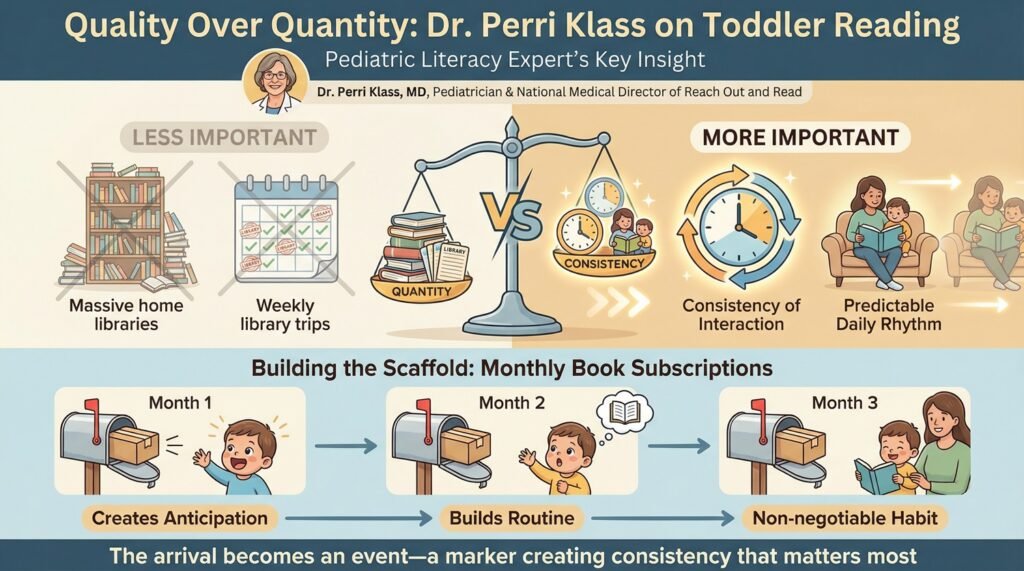
Dr. Perri Klass, who’s done extensive work on pediatric literacy initiatives, makes a point that fundamentally changed how I think about reading with toddlers. She emphasizes that the quantity of books matters far less than the consistency of interaction.
This insight is really liberating because it takes the pressure off accumulating massive home libraries or making weekly library trips.
What matters most is creating a predictable rhythm where reading becomes a non-negotiable part of your child’s day. When you receive books monthly on a subscription, you’re essentially building a scaffold for that consistency.
The arrival becomes an event, a marker in time that creates anticipation and routine.
I’ve watched families apply this with remarkable precision. They designate Sunday mornings as “new book time,” and their toddlers start asking about it days in advance.
That anticipation primes the brain for learning because it creates an emotional context where the child is already engaged before they’ve even seen the title.
The rhythm also matters developmentally. Toddlers thrive on predictable patterns because their brains are literally wiring themselves based on repeated experiences.
When reading happens at consistent times, in consistent ways, those neural pathways strengthen exponentially.
Research from the American Academy of Pediatrics confirms that children read to daily show vocabulary growth that compounds over time. We’re talking about differences measured in thousands of words by kindergarten entry.
The child who’s been read to consistently from infancy enters school with an estimated vocabulary of 1.4 million more words than a child who wasn’t.
That advantage doesn’t disappear, it accumulates throughout their entire educational experience.
The subscription model creates external accountability too. When you’ve invested money in the service, you’re more likely to protect that reading time.
The books arriving feel like a commitment you’ve made, and humans are remarkably good at honoring commitments that involve financial investment.
Matching Content to Developmental Windows
One area where subscriptions really outperform the DIY approach is developmental appropriateness. Most parents, myself included before I researched this, don’t actually know what cognitive and linguistic skills their toddler is developing month by month.
We guess based on what seems engaging, but we’re often either overshooting or undershooting the optimal challenge level.
For infants in that birth to twelve-month window, the focus needs to be on high-contrast images and sensory experiences. Their visual systems are still developing, so books with bright, bold illustrations and textures they can touch create multi-sensory learning opportunities.
Lift-the-flap books work beautifully here because they mix visual tracking, fine motor development, and cause-and-effect understanding all in one interaction.
Once toddlers hit that twelve to thirty-six month range, the game changes completely. Now they’re ready for simple narrative structures with clear beginnings, middles, and ends.
Repetitive language becomes incredibly valuable because their brains are pattern-recognition machines at this stage.
Books like “Brown Bear, Brown Bear, What Do You See?” aren’t just entertaining, they’re actually optimal brain food for this specific developmental window. The predictable structure let’s toddlers anticipate what comes next, and that prediction activates their prefrontal cortex in ways that random content doesn’t.
The preschool years from three to five open up to much richer content. Now you can introduce books that explore complex emotions, diverse perspectives, and imaginative scenarios that stretch beyond their immediate experience.
Books about starting school, dealing with sibling rivalry, or understanding different family structures become tools for social-emotional development alongside literacy.
Quality subscription services employ children’s education experts who understand these developmental progressions intimately. They’re not just picking “good books,” they’re matching specific titles to specific cognitive capabilities.
Literati, for example, emphasizes that their selections are curated by specialists who consider genre diversity, thematic relevance, and age-appropriate complexity simultaneously. You’re getting recommendations from people who’ve studied child development extensively, not just someone who likes children’s books.
Creating Interactive Reading Experiences That Build Brains
There’s a really significant difference between passive reading and interactive reading, and this distinction decides whether you’re merely entertaining your child or actually building their cognitive architecture. Interactive reading means treating the book as a conversation starter as opposed to a script to be performed.
When you pause to ask your toddler what they think will happen next, you’re activating their prefrontal cortex, the part of the brain responsible for prediction and executive function. When you encourage them to point at objects and name them, you’re strengthening vocabulary retention through motor memory.
When you connect the story to their own experiences like asking “Remember when you felt scared like the character?” you’re building emotional literacy and self-awareness simultaneously.
Research consistently shows that this interactive approach raises a child’s IQ by measurable points. We’re not talking about abstract benefits but actual cognitive enhancement.
The mechanism is pretty straightforward because you’re creating more neural connections through multi-modal engagement.
The story enters through their ears, they process it visually through illustrations, they connect it emotionally to their own experiences, and they express it verbally through conversation.
That’s four distinct learning pathways activated simultaneously.
I’ve coached parents to apply what’s called dialogic reading, where the adult asks open-ended questions as opposed to just narrating. Instead of “Look at the red ball,” you ask “What do you think the boy will do with that ball?” This subtle shift changes the child from passive receiver to active participant.
Their brain engages at a completely different level because they’re now co-creating the meaning as opposed to just absorbing it.
The beautiful thing I’ve noticed is how quickly toddlers adapt to this interactive style once you establish the pattern. Initially they might look confused when you pause and ask questions, but within days they start volunteering observations and predictions without prompting.
They learn that reading time is thinking time, not just listening time.
Subscriptions that include parent guides or suggested discussion questions make this approach infinitely more accessible. You don’t need a degree in early childhood education to apply these strategies, you just need prompts that redirect your natural reading style toward more interactive patterns.
The Hidden Benefits of Thematic Selections
Something I didn’t initially appreciate about quality subscriptions is how they use thematic organization to deepen learning beyond individual books. When a monthly box arrives with three titles all exploring the theme of “autumn changes” or “understanding emotions,” you’re creating a concentrated learning experience that reinforces concepts through many entry points.
This design is based on how memory consolidation works. When toddlers encounter the same concept through different stories, different characters, and different narrative structures, their brains build more robust schema for that concept. A single book about sharing might introduce the idea, but three books approaching sharing from different angles creates genuine understanding.
One might use animal characters, another might tell the story through realistic fiction, and a third might approach it through humor. Each angle strengthens different neural pathways associated with the concept.
The thematic approach also gives you natural extensions beyond the books themselves. A box focused on nature becomes the jumping-off point for outdoor exploration, collecting leaves, discussing seasonal changes, and connecting abstract concepts to tangible experiences.
This multi-sensory integration, where you read about something, talk about it, and then experience it directly, speeds up both literacy development and conceptual understanding.
I’ve seen families use this structure brilliantly by planning activities around their monthly themes. They receive books about ocean life, so that weekend they visit an aquarium.
They get books about emotions, so they start checking in about feelings during everyday moments.
The books become tools for navigating the real world as opposed to escapes from it.
Services that organize around seasons also tap into something really valuable for young children. Toddlers are just beginning to understand time as a concept, and seasonal markers like falling leaves, first snow, or spring flowers give them concrete anchors for that abstract understanding.
When books arrive that reflect what’s happening outside their window, it creates coherence between their reading life and their lived experience.
Building the Parent-Child Bond Through Shared Stories
There’s a relationship dimension to reading together that honestly gets overlooked in most conversations about literacy. When you carve out dedicated time to read with your toddler, completely present and undistracted, you’re communicating something profound through actions as opposed to words.
You’re saying that they matter enough for your full attention.
Toddlers become familiar with the sound of your voice, its rhythm, its emotional tones, and this creates deep feelings of security and reassurance. When they’re constantly navigating new experiences and big emotions, your voice reading a beloved story becomes an anchor of safety.
That emotional foundation is actually prerequisite for optimal learning because stressed brains don’t absorb information as effectively as calm, secure ones.
I’ve talked with parents who described their reading time as the most connected moments of their day. Between the morning rush and evening chaos, those fifteen minutes with a book become sacred. The toddler sits in your lap or curled beside you, and for that brief window, nothing else demands your attention.
That presence builds attachment security that influences their confidence and social development far beyond literacy itself.
The interesting thing about subscriptions in this context is that they create ceremonial moments. The box arrives, and opening it together becomes a ritual.
You uncover the new titles as a team, you share the excitement of unfamiliar covers and stories, and that shared experience becomes part of your family’s narrative.
Years later, kids remember those moments, not because of specific books, but because of the feeling of mattering to their parent. They remember the warmth of sitting close, the security of routine, and the pleasure of discovery.
Those memories shape their entire orientation toward learning and exploration.
Strategic Book Rotation for Sustained Engagement
Here’s a practical strategy that elevates how you use subscription books. Instead of keeping every title in constant rotation, apply a strategic system where books move in and out of active circulation.
Toddlers benefit enormously from revisiting familiar stories because repetition is how their brains solidify learning, but they also need novelty to maintain engagement.
The approach I recommend is keeping your current month’s books in prime reading locations like bedside, living room, or wherever you typically read. Last month’s selections move to a backup shelf but remain accessible.
Anything older rotates into storage for several months.
Then, periodically, you reintroduce stored books as if they’re new discoveries.
What happens is really fascinating. Your toddler encounters a book they haven’t seen in four months, and it feels fresh and familiar simultaneously.
They remember fragments of the story, which gives them confidence, but they’ve developed cognitively in the interim, so they notice details they missed before.
They’re essentially reading a different book because they’re a different reader.
This rotation system also solves the problem of oversaturation. When you have fifty books constantly available, toddlers often default to the same three favorites and ignore everything else.
By limiting options intentionally, you increase the likelihood that each book gets meaningful attention.
The constraint paradoxically creates more reading diversity.
Many subscription services offer flexible keep-or-return policies that support this approach beautifully. You can keep the titles that genuinely resonate with your child’s interests and developmental needs while returning others.
Over time, you build a curated home library that reflects your child’s actual preferences as opposed to guessing in a bookstore what might work.
I’ve watched families apply a quarterly “rediscovery day” where they bring out books from storage and their toddlers react with genuine excitement at seeing old friends again. The books feel new because the child has grown, but they also feel safe because there’s recognition and familiarity.
Common Mistakes That Undermine Reading Success
The biggest mistake I see parents make is treating reading time as an obligation to finish as opposed to an experience to savor. When you’re watching the clock, rushing through pages to meet some self-imposed quota, your toddler senses that urgency.
They internalize that reading is a task to finish as opposed to a pleasure to enjoy.
Your attitude toward books becomes their attitude, and if you’re conveying “let’s get this over with,” that’s exactly what they learn.
Another common pitfall, problem, issue, problem, issue, problem, issue is forcing books that clearly aren’t connecting. Not every book resonates with every child, and that’s completely fine.
If you’re three pages into a title and your toddler is squirming away or asking for something else, honor that feedback.
You haven’t failed, you’ve just discovered a mismatch between that particular book and your child’s current interests or developmental readiness.
Parents also often underestimate how much their own reading habits influence their children. If your toddler never sees you reading for pleasure, if books aren’t part of your life, they receive a powerful unspoken message that reading is something adults make kids do as opposed to something people choose.
Even reading on a device counts, just occasionally narrate what you’re doing so they understand you’re engaging with written content.
The inconsistency trap catches many well-meaning families. They read together daily for two weeks, then life gets busy and they skip a week, then they feel guilty and overcompensate with marathon reading sessions.
That irregular pattern doesn’t build the neural pathways that consistent, shorter sessions create.
Ten minutes daily beats an hour on Sundays every single time.
Finally, parents sometimes neglect the physical reading environment. Reading in chaotic spaces with television noise, sibling distractions, or constant interruptions fragments attention and undermines comprehension.
Create a designated reading spot, even if it’s just a specific chair or corner of the couch, where reading happens in relative calm.
That environmental cue helps your toddler’s brain shift into “reading mode” automatically. Over time, just sitting in that spot triggers the mental state conducive to focus and absorption.
From Early Literacy to Lifelong Learning
The ultimate goal isn’t just preparing your toddler for kindergarten, though that certainly happens. What you’re really building is a foundational belief that learning is pleasurable, that stories offer windows into experiences beyond their immediate world, and that books are treasured parts of a rich life.
When children experience consistent, joyful reading interactions during their earliest years, they develop what researchers call “emergent literacy,” which is a constellation of skills and attitudes that forecast academic success. They understand that print carries meaning, they recognize that stories have structure, they’ve internalized thousands of vocabulary words, and crucially, they believe they’re capable learners.
This confidence creates a positive feedback loop that speeds up throughout their education. Early literacy success builds confidence, confidence increases voluntary reading, increased reading speeds up skill development, and advanced skills make reading more enjoyable.
By the time your child enters formal schooling, they’re already inside this cycle while peers who lacked early literacy experiences struggle to catch up.
The statistics on this are sobering. Children who haven’t developed basic literacy skills by school entry are three to four times more likely to drop out in later years.
That correlation stems from the advantage that early readers maintain throughout their educational experience.
They’re reading to learn while others are still learning to read, and that gap compounds with every passing year.
But beyond academics, there’s something more valuable at stake. You’re teaching your toddler that there are worlds accessible through books that they’ll never physically visit, ideas they’ll never encounter in daily conversation, and perspectives they’ll never experience firsthand.
Books become tools for understanding themselves and others, for developing empathy, for exercising imagination, and for finding solace during difficult times.
People Also Asked
What age should I start a book subscription for my toddler?
You can start a book subscription as early as birth. Many services offer specialized collections for infants that focus on high-contrast images, textures, and simple board books.
The earlier you establish reading routines, the stronger the neural pathways become for language acquisition and literacy development.
Are board books better than picture books for toddlers?
Board books work better for younger toddlers between twelve and twenty-four months because they’re durable and allow independent exploration without pages tearing. Picture books become suitable as fine motor skills develop, typically around age two and beyond.
The best approach includes both formats depending on your child’s current developmental stage and how they’ll interact with the books.
How many books should I read to my toddler each day?
The number matters less than the consistency and quality of interaction. Three short books read with full engagement and interactive discussion provide more developmental benefit than ten books rushed through at bedtime.
Aim for at least fifteen to twenty minutes of dedicated reading time daily, whether that’s one longer book or several shorter ones.
Do bilingual book subscriptions help with language development?
Bilingual books support language development in both languages simultaneously, particularly when parents read in their native language. Children’s brains are exceptionally receptive to many languages during toddler years, and exposure to books in both languages strengthens cognitive flexibility and cultural awareness alongside literacy skills.
What should I do if my toddler won’t sit still for books?
Start with books that incorporate physical interaction like lift-the-flap, touch-and-feel, or sound books that keep kinesthetic learners engaged. Keep initial sessions very short, even just two to three minutes, and gradually extend duration as their attention span develops. Some toddlers need to move while listening, and that’s completely normal.
Let them stand, rock, or fidget as long as they’re still processing the story.
Can book subscriptions replace library visits completely?
Book subscriptions complement library visits as opposed to replace them entirely. Subscriptions provide curated, age-appropriate titles that build your home library, while libraries offer broader exploration and community programs.
The combination gives children both consistency at home and variety through library access.
Key Takeaways:
Decision fatigue undermines reading routines for both parents and toddlers. Subscription services eliminate choice overwhelm by delivering expertly curated selections that create simple, engaging experiences without paralysis.
Consistency matters exponentially more than quantity because predictable reading rhythms build neural pathways that compound into measurable vocabulary and cognitive advantages of thousands of words by kindergarten.
Developmental appropriateness needs expertise most parents lack. Services curated by child development specialists deliver books matched to specific cognitive capabilities and optimal learning windows for different age ranges.
Interactive reading where you ask questions and create dialogue changes passive entertainment into active brain-building that measurably increases IQ, comprehension, and executive function development.
Thematic organization deepens learning through many exposures to concepts from varied narrative approaches, allowing toddlers to build robust understanding as opposed to superficial familiarity.
Parent-child bonding during dedicated reading time creates emotional security that serves as the foundation for confident learning across all domains throughout childhood and beyond.
Strategic book rotation maintains novelty while allowing useful repetition, letting children rediscover familiar stories with more developed cognitive capabilities as they grow.
Your attitude toward reading directly shapes your child’s attitude. Treating books as treasured pleasures as opposed to obligatory tasks decides whether they develop genuine love of literacy that sustains lifelong learning.
Early literacy advantages compound throughout education because children who enter school with strong foundational skills maintain accelerating advantages while peers without those experiences face persistent achievement gaps.