
We may earn money or products from the companies mentioned in this post.
I’ve watched countless parents stand paralyzed in the children’s section of bookstores, phones out, frantically googling reviews while their toddlers pull books off shelves. The sheer volume of choices available today creates what psychologists call decision fatigue, and honestly, it gets exhausting trying to figure out which books will actually engage your child versus which ones will sit untouched on the shelf.
A toddler book subscription simplifies this process by delivering expertly selected titles right to your doorstep on a predictable schedule. These services take the guesswork out of building your child’s library while exposing them to books you might never have discovered on your own.
The subscription market has exploded in recent years, and the quality varies dramatically from one service to another. Some genuinely understand child development and curation, while others just seem to repackage whatever they can get cheaply.
Understanding what separates exceptional subscriptions from mediocre ones will save you both money and disappointment. Let me walk you through the essential factors that determine whether a subscription will become a cherished part of your family’s routine or just another forgotten expense on your credit card statement.
The Real Cost Beyond the Price Tag
When you’re comparing subscriptions, that monthly fee listed on the website only tells part of the story. I’ve learned to look further into what you’re actually getting for your money because the advertised price can be really deceptive.
Start by calculating the per-book cost. A subscription charging twenty-five dollars for five books breaks down to five dollars per book.
Compare that to retail prices for similar titles, which typically range from ten to eighteen dollars for new hardcover picture books.
Suddenly, that subscription looks like a pretty solid deal. On the other hand, a fifteen-dollar subscription delivering just one book might seem affordable until you realize you’re paying premium prices for what could be a title you’d find discounted at your local bookstore.
Hidden costs matter too. Some services add shipping fees of four to six dollars per box, which really adds up over a year.
Others need you to purchase a membership before you can even access the subscription.
I’ve also seen services that look affordable monthly but lock you into six-month commitments, making it expensive to exit if the books don’t match your expectations.
The format of the books impacts long-term value as well. Board books designed for babies and young toddlers cost more to produce than paperback picture books, so subscriptions specializing in board books typically charge more per title.
Board books also withstand the inevitable chewing, throwing, and bath-time incidents that come with toddler ownership, so the durability justifies the higher price.
Annual subscriptions almost always offer better value than month-to-month plans. Most services discount annual commitments by fifteen to twenty-five percent, which translates to two or three free months of books.
The tradeoff is flexibility.
If you’re uncertain whether a service will work for your family, starting monthly makes sense even at the higher rate. Once you’ve confirmed it’s a good fit, switching to annual billing maximizes your investment.
Curation Philosophy Separates Great from Mediocre
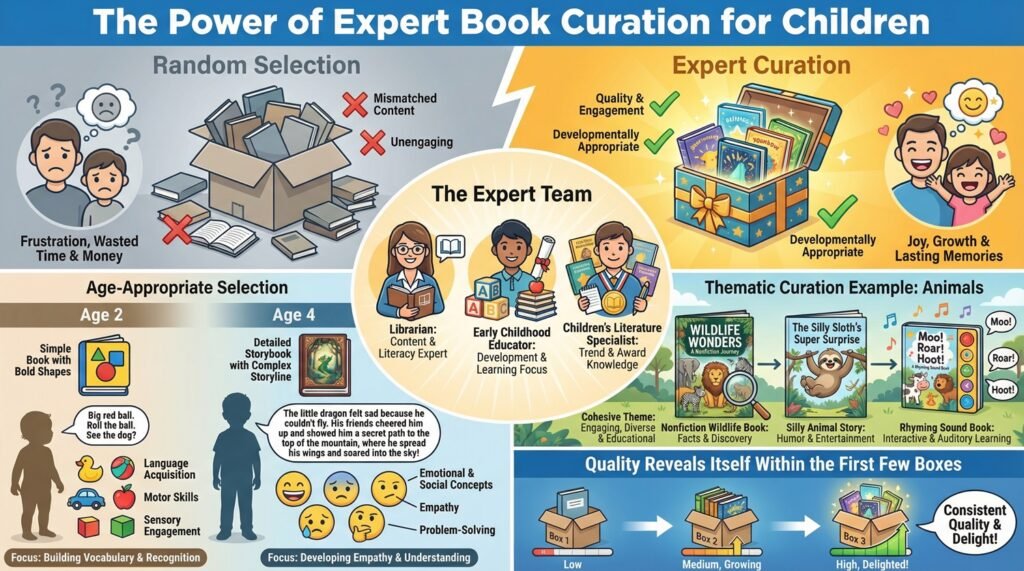
The expertise behind book selection really separates worthwhile subscriptions from disappointing ones. Anyone can throw together a box of children’s books, but thoughtful curation requires understanding child development, literary quality, and how different books serve different purposes in a child’s reading journey.
Some services employ professional librarians, early childhood educators, or children’s literature specialists who personally review and select titles. These curators understand that a two-year-old needs books with simple narratives and bold illustrations that support language acquisition, while a four-year-old benefits from more complex storylines that introduce emotional concepts and social situations.
The difference in selection quality becomes obvious within the first few boxes.
Thematic curation creates cohesion across the books you receive each month. A box centered on animals might include a nonfiction book about wildlife, a silly story featuring animal characters, and a rhyming book using animal sounds.
This approach reinforces concepts through repetition while maintaining variety in storytelling styles.
I’ve noticed my own children engage more deeply with themed boxes because each book builds on ideas introduced in the others.
Personalization takes curation to another level entirely. Services that ask detailed questions about your child’s interests, reading level, and preferences can deliver remarkably targeted selections.
The intake questionnaire might seem tedious when you’re signing up, but taking time to answer thoughtfully pays off when books arrive that seem chosen specifically for your child as opposed to randomly pulled from inventory.
Diversity in curation extends beyond just the characters depicted in stories. It encompasses authors from varied backgrounds, illustration styles ranging from classic to contemporary, story structures that include both linear narratives and experimental formats, and subject matter spanning everyday experiences to fantastical adventures.
A well-curated subscription exposes children to the full spectrum of what children’s literature offers as opposed to recycling the same types of stories month after month.
Be cautious of services that seem to prioritize trendy titles or bestsellers over literary merit. Popularity doesn’t always equal quality, and some of the most valuable books for young children are quieter titles that haven’t achieved mainstream recognition.
Curators who genuinely understand children’s literature will include a mix of award-winners, overlooked gems, and carefully selected new releases.
Age Appropriateness Goes Deeper Than Reading Level
Matching books to your child’s developmental stage involves more than just checking the suggested age range printed on the cover. I’ve received plenty of books labeled for my daughter’s age that completely missed the mark because they didn’t account for person development variations or specific interests.
The best subscriptions allow you to specify not just your child’s chronological age but their reading level and attention span. A precocious three-year-old who sits through twenty-minute stories needs different books than a three-year-old who prefers short, action-packed narratives.
Services that recognize this distinction will ask follow-up questions as opposed to relying solely on age.
Physical book format matters tremendously for younger toddlers. Board books with thick pages are essential for children under two who are still developing fine motor skills and tend to treat books roughly.
Picture books with regular paper pages work better for older toddlers who’ve developed gentler handling skills.
Some subscriptions offer separate tracks for board books versus picture books, while others mix formats based on the child’s age.
Content appropriateness extends to emotional themes and subject complexity. A book about dealing with divorce might be perfectly suitable for a four-year-old whose parents are separating but completely irrelevant and potentially confusing for a child in a stable family situation.
Services that allow you to specify sensitive topics to avoid show sophisticated understanding of how books affect children’s emotional development.
Illustration style also connects to developmental appropriateness. Very young toddlers respond best to simple, high-contrast images with clear focal points.
As children develop visual literacy, they can appreciate more detailed illustrations with many elements to explore.
The progression from simple to complex images should mirror the child’s growing cognitive abilities.
I’ve found that subscriptions specializing in narrow age ranges tend to nail developmental appropriateness better than services trying to serve children from birth through elementary school. A company focusing exclusively on ages zero to three develops deeper expertise in that developmental window than a generalist service.
Book Quality You Can Assess Before Subscribing
Not all children’s books are created equal, and unfortunately, you often can’t judge quality until books arrive at your door. However, there are ways to assess a subscription’s standards before committing your money.
Research the publishers represented in subscription boxes. Top-tier children’s publishers like Candlewick, Greenwillow, Viking Children’s Books, and Lee & Low maintain rigorous editorial standards and work with exceptional illustrators.
If a subscription regularly features books from these publishers, it’s a strong quality indicator.
Conversely, if most titles come from obscure self-publishing platforms, approach with caution.
Illustration quality matters enormously in picture books. Exceptional children’s book illustrators use color, composition, and artistic technique to enhance storytelling in ways that captivate young readers.
Before subscribing, search for unboxing videos or Instagram posts from current subscribers that show the actual books included. Examine the illustrations carefully.
Do they display artistic skill and creativity, or do they look generic and mass-produced?
Story substance separates memorable books from forgettable ones. Quality children’s literature respects young readers by presenting genuine narratives as opposed to just stringing together cute images.
The text should have rhythm, interesting vocabulary, and either emotional resonance or humor that works for both children and adults reading aloud.
Books that bore parents rarely get read repeatedly, which reduces their value.
Binding and production quality determine how long books will last in your home. Hardcover picture books with sewn bindings survive years of use, while cheaply glued paperbacks fall apart within months.
Board books should have rounded corners that won’t bend or puncture, and pages thick enough to resist tearing.
If a subscription’s website includes detailed book photos, zoom in to check production quality indicators.
Look for subscriptions that feature award-winning titles and critically acclaimed authors. Books that have won Caldecott Medals, Coretta Scott King Awards, or other prestigious children’s literature honors show proven quality.
A subscription incorporating award-winners alongside new releases shows commitment to literary excellence.
Flexibility for Your Family’s Evolving Needs
Children’s reading needs change rapidly, especially during the toddler years. A subscription that worked perfectly when your child was eighteen months old might feel completely wrong six months later.
Services that accommodate this growth without penalty or hassle provide significantly better value.
The ability to pause your subscription matters more than most people realize when signing up. Life gets unpredictable with young children.
Maybe you’re moving, expecting another baby, or just overwhelmed by the stack of unread books already in your home.
Being able to skip a month or two without losing your subscription status or paying cancellation fees reduces stress and prevents wasting money on books you can’t use right now.
Age range switching should be straightforward as your child develops. Some services allow you to adjust your selected age category through your account dashboard, while others need contacting customer service and jumping through hoops.
Before subscribing, confirm exactly how the adjustment process works and whether any fees apply.
Duplicate replacement policies protect your investment when you receive books your child already owns. The best services encourage subscribers to report duplicates and will send replacement titles at no additional cost.
Less customer-friendly services tell you that duplicate risk is just part of subscription life and offer no recourse.
Gift subscription options add flexibility beyond your own family’s needs. The ability to purchase three, six, or twelve-month subscriptions as gifts for birthdays, baby showers, or holidays makes the service more versatile. Look for services that allow gift recipients to customize their preferences so you’re not forcing your book choices onto someone else’s child.
Cancellation terms reveal a lot about a company’s confidence in their product. Services that allow easy, no-penalty cancellation believe their books will speak for themselves and keep customers voluntarily.
Companies that bury cancellation procedures or charge fees are often trying to trap subscribers who would otherwise leave.
The Value of Thoughtful Extras
While books are the main attraction, the supplementary materials included with subscriptions can significantly enhance the reading experience and justify higher prices. I’ve been surprised by how much my children engage with well-designed extras compared to subscriptions that just ship books in a plain envelope.
Activity guides that connect to the stories create extended learning opportunities beyond just reading the book. These might include discussion questions that encourage children to think critically about the narrative, simple craft projects inspired by the story, or science experiments related to book themes.
The best activity guides are designed for parents without early childhood education backgrounds, providing clear instructions that make implementation easy.
Curated discussion prompts help parents move beyond just reading words on a page to having meaningful conversations with their children. These prompts encourage prediction skills, emotional intelligence, and critical thinking.
For example, a prompt might ask, “How do you think the character felt when her friend moved away? Have you ever felt sad like that?” These conversations build comprehension skills that serve children throughout their education.
Bookmarks, stickers, and other small surprises add an element of delight to receiving a subscription box. My daughter immediately checks for bookmarks now when boxes arrive, and she’s more excited to open the new books because of that small added treat.
These extras cost the company very little but significantly impact the unboxing experience.
Parent guides that explain the developmental benefits of each book selection help you understand why the curator chose particular titles. Learning that a seemingly simple board book actually supports object permanence or that a picture book models healthy emotional regulation makes you appreciate the expertise behind the curation.
Be wary of extras that seem designed just to justify higher prices without adding real value. A cheap plastic toy loosely related to one of the books or generic coloring pages available anywhere online don’t enhance the subscription meaningfully.
Focus on extras that genuinely extend the reading experience as opposed to superficial additions.
Representation and Values in Your Book Selection
The books your toddler reads shape their understanding of the world and their place in it. Subscriptions that prioritize diverse representation confirm children see themselves reflected in stories while also exposing them to experiences different from their own.
Character diversity encompasses race, ethnicity, family structure, ability, gender expression, and body type. High-quality subscriptions intentionally include books featuring characters from varied backgrounds as opposed to defaulting to homogeneous representation.
This matters for all children, not just those from underrepresented groups.
White children benefit from seeing diverse characters as protagonists, and children of color deserve to see themselves as heroes, not just side characters.
Author and illustrator diversity confirms that stories are told by people with authentic lived experiences as opposed to outsiders imagining what particular experiences might be like. Books about multicultural experiences created by authors from those cultures provide nuance and authenticity that well-meaning but culturally distant creators often miss.
Inclusive storytelling goes beyond surface-level representation to confirm that diverse characters are depicted with depth and agency as opposed to serving as tokens or teaching tools for majority-culture protagonists. A subscription demonstrating real commitment to inclusion will feature books where children of color, disabled children, or children from non-traditional families are simply living their lives, not existing primarily to teach lessons about diversity.
Gender representation in children’s books has evolved significantly in recent years, with more stories featuring girls in active, leadership roles and boys expressing emotions and vulnerability. Subscriptions that include books challenging traditional gender stereotypes help all children develop fuller, healthier self-concepts.
Some services explicitly center particular values in their curation. Subscriptions focusing on environmental awareness, social justice, feminist themes, or cultural heritage serve families who want their children’s libraries to reflect their priorities.
These specialized services typically cost more than general subscriptions but deliver precisely targeted content.
Before subscribing, examine sample book lists or current month selections to assess whether the service’s approach to representation aligns with your values. Some families prioritize this highly and will pay premium prices for subscriptions demonstrating strong commitment to diversity.
Others view it as one factor among many in their decision-making process.
Common Mistakes Parents Make When Selecting Subscriptions
Having helped many parents navigate book subscription choices, I’ve noticed recurring mistakes that lead to disappointment and wasted money.
Choosing based purely on Instagram aesthetics sets you up for frustration. A service with gorgeous packaging and beautiful marketing photos might deliver mediocre books while a less Instagram-friendly competitor sends exceptional literature.
Pretty packaging delights for about thirty seconds, but quality books get read for years.
Ignoring your specific circumstances leads to poor matches. A subscription perfect for a family with one toddler and plenty of storage might overwhelm a family with three children sharing a small bedroom.
Consider your actual life situation, not an idealized version.
Failing to account for reading frequency means you might receive more books than you’ll realistically read. If you now read one or two books nightly with your toddler, a subscription delivering five books monthly provides variety.
But if reading happens sporadically, you’ll accumulate an unread pile that makes the subscription feel like a burden as opposed to a joy.
Overlooking growth spurts causes frustration when your child suddenly outgrows the selected age range. Toddlers develop rapidly, and reading abilities can jump dramatically over a few months.
Factor in this anticipated growth when selecting age ranges, possibly choosing the slightly older category if your child seems developmentally advanced.
Expecting every single book to be a hit creates unrealistic standards. Even expertly curated subscriptions occasionally include titles that don’t resonate with your particular child.
That’s normal and doesn’t mean the service is bad.
Focus on whether most books engage your child as opposed to demanding perfection.
Not utilizing included extras wastes part of your investment. Those activity guides and discussion prompts represent work by educators and children’s literature experts.
Taking ten minutes to review and implement them multiplies the value of each book beyond simple reading.
Frequently Asked Questions
Are board books or picture books better for two-year-olds?
Board books work best for children under two who are still developing fine motor skills and tend to treat books roughly. The thick pages withstand chewing, throwing, and rough handling that comes naturally at this age.
Around age two, you can start introducing picture books with regular paper pages if your child has developed gentler handling skills.
Many families use a mix of both formats during the transition period.
How many books should a toddler get per month?
This depends entirely on how often you read together. Families that read one or two books nightly will appreciate receiving four to six new titles monthly.
If reading happens less regularly, two or three books per month prevents accumulation of unread books.
Consider your current reading habits when selecting a subscription tier.
Can I return books my child already owns?
Policies vary significantly by service. The best subscriptions allow you to list titles your child already has before your first box ships and will send replacement titles if duplicates slip through.
Less customer-friendly services consider duplicate risk part of subscription life and offer no recourse.
Always check the duplicate policy before subscribing.
Do toddler book subscriptions save money compared to buying books individually?
Most subscriptions offer books at lower per-book costs than retail prices. Calculate the per-book cost by dividing the total subscription price by the number of books included. Compare this to retail prices for similar new hardcover picture books, which typically range from ten to eighteen dollars.
Factor in any shipping fees or membership costs to determine true savings.
Are diverse books included in most toddler subscriptions?
This varies dramatically by service. Some subscriptions prioritize diverse representation and intentionally include books featuring characters from varied backgrounds, while others default to more homogeneous selections.
Before subscribing, examine sample book lists or current month selections to assess whether the service’s approach to diversity aligns with your values.
Can I pause my subscription if we receive too many books?
Many services allow you to pause for one or more months without losing your subscription status or paying cancellation fees. Some enable pausing through your account dashboard, while others need contacting customer service.
Always confirm the pause policy before subscribing, especially if you anticipate needing this flexibility.
What makes Caldecott Medal books worth including in subscriptions?
The Caldecott Medal recognizes the year’s most distinguished American picture book for children, judged on illustration excellence. Books that have won this award show exceptional artistic skill, creative visual storytelling, and production quality.
Subscriptions incorporating Caldecott winners show commitment to literary excellence as opposed to just selecting popular titles.
Should I choose subscriptions that include activity guides?
Activity guides significantly enhance value if you actually use them. They extend learning opportunities beyond just reading by providing discussion questions, craft projects, and activities connected to the stories.
These materials help parents without early childhood education backgrounds implement developmentally suitable extensions.
If you’re unlikely to use activity guides, prioritize subscriptions that focus budget on book quality instead.
Key Takeaways
Quality toddler book subscriptions save time while building your child’s library with expertly curated titles, but significant variation exists among services. Calculate per-book cost as opposed to focusing solely on monthly fees to understand true value.
Curation philosophy decides whether books will genuinely engage your child or just take up shelf space, so prioritize services employing children’s literature specialists. Age-appropriateness extends beyond reading level to include physical format, illustration complexity, and emotional content matching your child’s development.
Book quality encompasses illustration artistry, story substance, and physical durability that affects long-term value. Flexibility in pausing, adjusting age ranges, and handling duplicates protects your investment as circumstances change.
Thoughtful extras like activity guides and discussion prompts extend value beyond the books themselves when you actually use them. Representation in characters, authors, and storylines shapes how your child understands themselves and others, making it worth prioritizing in subscription selection.
Start with shorter commitments and systematically compare options against your specific priorities as opposed to choosing based on marketing appeal alone.