
We may earn money or products from the companies mentioned in this post.
Look, if you’ve got a toddler, you already know the book situation gets messy fast.
They love a book for two weeks, then suddenly it’s dead to them. You buy something that looks perfect at the bookstore, and they won’t even let you finish page one.
The books pile up, your kid ignores half of them, and you’re back at square one trying to figure out what they’ll actually read.
That’s basically why book subscriptions exist now.
Companies like Literati promise to solve this whole problem by sending curated books straight to your door. Expert picks, age-appropriate, all that good stuff.
You don’t have to think about it.
But here’s what nobody really talks about upfront… the value question gets complicated real fast depending on how you actually use these services.
Some parents swear by them. Others feel like they’re paying premium prices for books they could’ve found cheaper elsewhere (or you know, at the library for free).
So let me break down what’s actually happening with these toddler book subscription services, what you’re paying for, and whether it makes sense for your situation.
What You Actually Get With Literati (And How It’s Different)
Literati works kinda weird compared to most subscriptions.
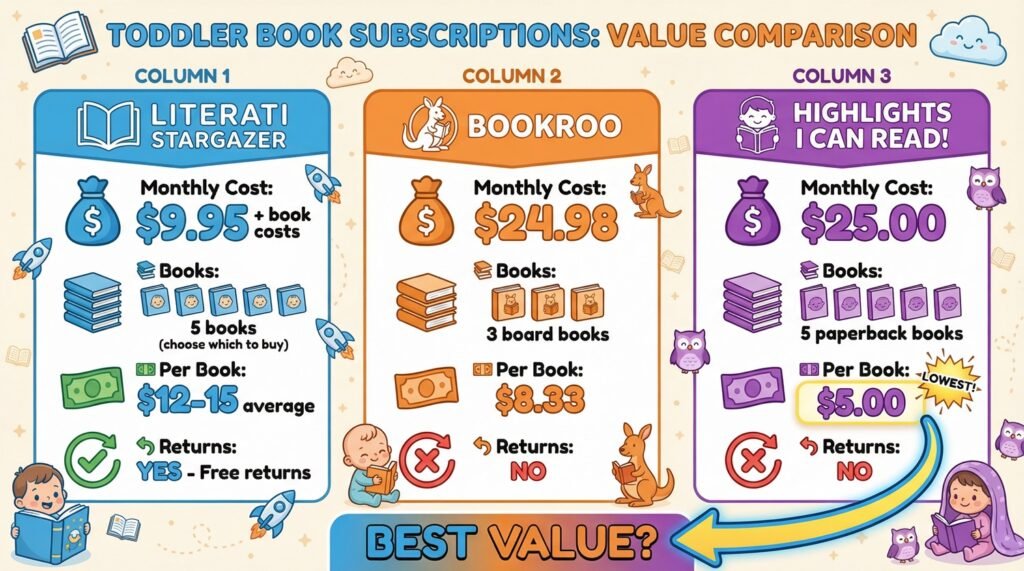
You pay $9.95 monthly, and they send you five books. But here’s the thing… you don’t automatically keep them.
You get to look through all five with your kid, see what they actually like, then decide which ones to purchase and which ones to send back. The books you buy are priced lower than Amazon (according to Literati), and if you keep all five, you get an extra 5% off.
If you don’t like any of them? Send them all back.
You’re only out the $9.95.
It’s basically like renting a personal book curator. You’re paying for someone else to do the picking, then you get the final say on what stays in your house.
Other services work totally differently.
Bookroo (which focuses specifically on ages 0-3) sends three board books every month for $19.99 plus $4.99 shipping. You keep all three automatically.
No returns, no choices to make after they arrive.
Story Captain does themed boxes with many books at different reading levels, which works better if you’ve got kids at different ages in the house.
The model matters way more than you’d think because it changes the whole value equation.
How These Actually Handle Toddler-Specific Needs
Toddlers are… particular.
What works at 18 months is boring by 24 months. They need board books that can survive getting thrown across the room or chewed on.
Their attention span is basically non-existent some days.
Bookroo gets this. Every book they send is a board book with reinforced binding that can take a beating.
They curate specifically for the 0-3 age range, so everything arrives already vetted for toddlers.
Parents mentioned the vocabulary was actually good, illustrations were colorful and engaging, and topics were complex enough to be interesting but still accessible.
Literati does offer boxes for younger kids (they call it the Stargazer Level for 12 months to 3 years), but the whole system is built around trying before buying, not around guaranteeing every book will be perfect for your toddler.
That works great if you don’t mind the extra step of boxing things up and sending them back. Less great if you’re already drowning in tasks and the idea of managing returns sounds exhausting.
The Real Costs (This Gets Messy)
Okay so here’s where the math starts mattering.
People see “$9.95 per month” and think that’s what they’re spending. But that’s not really how it shakes out in practice.
With Literati, you’re paying $10 monthly to receive five books. If you send all five back, cool, you spent $10 that month.
But realistically? Most parents end up keeping at least some of the books.
If you keep all five and they average around $12-15 each (pretty typical for toddler books), you’re actually spending $70-85 that month. That’s… not cheap, even if it does beat retail pricing a bit.
Bookroo costs $24.98 total ($19.99 plus $4.99 shipping) for three board books. Over a year, that’s $299.76 for 36 books, which works out to about $8.33 per book.
Board books usually retail for $10-15, so that’s actually decent value if you would’ve bought those books anyway.
Highlights I Can Read! Book Club sends five paperback books for $25 monthly.
That’s $5 per book, which is the lowest per-book cost I’ve seen.
The tradeoff is way less customization and you’re stuck with whatever reading level tier you picked.
The affordability question changes completely based on whether you’re someone who keeps most books or actually uses the return system.
If you feel guilty returning books and end up keeping everything? You’re basically paying retail prices plus a convenience fee.
If you’re ruthless about only keeping books your kid actually connects with? The per-book cost stays pretty low.
| Service | Monthly Cost | Books Received | Cost Per Book | Return Option |
|---|---|---|---|---|
| Literati (Stargazer) | $9.95 + book costs (varies) | 5 (choose which to buy) | $12-15 average | Yes (free returns) |
| Bookroo | $24.98 | 3 board books | $8.33 | No |
| Highlights I Can Read! | $25.00 | 5 paperback books | $5.00 | No |
What Parents Actually Say About Using These
Real feedback from parents shows some pretty big gaps between what these companies promise and what actually shows up at your door.
The customization thing with Literati is… mixed, tbh.
You fill out this whole questionnaire about your kid’s interests during signup. Sounds great in theory.
But then several parents reported getting books that had basically nothing to do with what they selected.
One parent mentioned the personalization felt like a good idea when signing up but didn’t actually show up in the books they received.
The unboxing experience varies a lot between services too.
Some parents genuinely loved the presentation and felt like it made their kid more excited about reading. Others thought the packaging was excessive and wasteful, especially when you’re getting big boxes every month and running out of places to store them before recycling day.
Return systems matter more than you’d expect.
Literati includes free return shipping, which is nice. But you’ve got a deadline to meet or you get charged for books you didn’t actually want to keep.
That deadline stress is real when you’re juggling everything else.
Bookroo doesn’t have returns at all since you keep everything automatically. For some parents, that simplicity is actually worth more than the flexibility of choosing.
Book quality has been inconsistent for some people.
A few parents received books that looked… used? Like they had wear on them, ripped pages, fingerprints.
Despite paying full price for new books.
Duplicates are another issue. Some parents got books they already owned. Whether the service replaces duplicates or not varies, and it’s not always clear upfront how each company handles this.
If you want a toddler book subscription that’s actually specialized for that age range, Bookroo focuses entirely on ages 0-3 with board books built to survive toddler life.
Comparing Literati to the Alternatives for Toddlers Specifically
If your kid is under three, Bookroo honestly performs better than Literati when it comes to specialization.
Every single book is curated for that exact age range. The board book format is actually appropriate for how toddlers handle books (which is roughly, let’s be real).
And you don’t have to make decisions about what to keep… it just arrives, you keep it, done.
The decision fatigue disappears completely.
For parents who want to try before committing, Literati’s model is better than Bookroo. But that assumes you’re willing to actually engage with the return process and you care enough about book selection to go through that extra step.
Story Captain splits the difference by sending themed boxes with mixed reading levels. Works really well if you’ve got an 18-month-old and a 4-year-old… one subscription covers both instead of paying for two separate services.
Tiny Humans Read and Little Professor focus more on expert curation and diversity in book representation. They cost more per book but include extra materials and goodies.
Better choice if you specifically prioritize representation and underrepresented voices in kids’ books.
When These Subscriptions Actually Make Sense
Book subscriptions deliver real value in specific situations. Not all situations, but specific ones.
If you’re overwhelmed by picking age-appropriate books, a subscription helps. The parents who stand in the bookstore or library staring at 500 options and feeling paralyzed?
Yeah, expert curation takes that pressure off.
Someone else vets for developmental appropriateness and quality.
If convenience genuinely saves you meaningful time, the cost might be worth it. Dual-income households where both parents work full-time and free time is basically non-existent… subscription boxes arriving at your door beats adding library runs to an already packed schedule.
If you want to avoid accumulating hundreds of books you’ll eventually outgrow, subscriptions with return options help. Toddlers age out of books fast.
A kid who loved board books at 18 months gets bored by them at 30 months.
Rotating through subscriptions means you’re not storing a massive permanent collection.
If you’re gifting and want something ongoing without repeat effort, subscriptions work well. Grandparents especially like these because it’s a gift that keeps happening without requiring them to shop every month.
Skip a subscription if you already enjoy picking books yourself. Some people genuinely love hunting for the right books, visiting libraries, building a curated collection. Subscriptions feel restrictive to them, not freeing.
Skip if your kid has intense, rapidly changing interests. The customization promise often underdelivers. If your toddler fixates on dinosaurs one month, then completely moves on the next, generic themed boxes won’t keep up.
Skip if your main goal is saving money. Even the cheapest options still cost $10-25 monthly. Libraries exist and cost nothing.
Used book markets (ThriftBooks, Facebook Marketplace, local buy-and-sell groups) beat subscription pricing every time.
Subscriptions buy you convenience and curation. They don’t buy you affordability.
The Hidden Factor Nobody Talks About: Your Return Tolerance
This is the most overlooked piece of the whole value equation.
How much do you actually hate returns?
Parents who despise the friction of boxing things up, printing labels, and scheduling pickups will end up keeping everything just to avoid the hassle. That turns what could’ve been a low-cost trial into a full-price purchase every single month.
Parents who don’t mind returns and actively send back books their kid doesn’t love? They get genuine value from the low base fee.
The math completely shifts based on this one behavior.
So be honest with yourself about which type of person you are before signing up for something like Literati that relies on you using the return system.
If you want the flexibility to try books before buying and don’t mind managing returns, Literati’s model let’s you preview five books monthly and only pay for what you keep.
My Take on Whether It’s Worth It
For toddlers specifically, Literati offers flexibility but less specialization than competitors.
You’re paying for expert curation and the try-before-you-buy option. You’re not paying for toddler-specific features like reinforced board book bindings or developmental psychology expertise in the curation.
If your kid is under three, Bookroo probably delivers better value. Every book arrives already tested for that age group, with durability and content that matches toddler needs.
If your toddler is 2-3 and starting to develop early reading skills, Highlights I Can Read! Gives you the lowest per-book cost and consistent quality.
Less customization, but solid books.
Literati works best for families with kids ages 3-8 who want variety and are committed to using the return system. It’s less ideal for toddlers unless your kid is on the older end (2-3 years) and you’re genuinely going to send back books that don’t work.
The real question isn’t whether book subscriptions are good value in some absolute sense.
The question is whether they’re good value for your specific family given your time, your budget, and how much mental energy you have for decision-making.
Match the subscription type to your actual situation (not to what sounds good in their marketing), and you’ll figure out pretty quick whether it fits.
For toddlers under 3 who need durable board books, Bookroo specializes in that exact age range with reinforced bindings and expert curation.
Libraries are still free, used books are still cheaper, and picking books yourself is still an option. Subscriptions work when convenience and curation are worth paying for in your current life situation.
If that’s where you’re at right now? They can be genuinely helpful.
If you’re mainly trying to save money or you already love the process of finding books yourself? Skip them and stick with what’s working for you.