
We may earn money or products from the companies mentioned in this post.
There’s something really magical about watching a toddler find out about books. The way their eyes light up when they recognize a familiar character, the concentrated furrow of their brow as they try to turn a page, the unexpected giggle when a story takes a silly turn, these moments are building the neural architecture for a lifetime of learning.
But here’s the thing about toddler book subscriptions: they’re only as effective as the strategy behind using them. I’ve seen plenty of well-intentioned parents sign up for services like Literati, receive beautifully curated boxes each month, and then wonder why their child loses interest after flipping through the same book twice.
The subscription becomes just another expense, another pile of books gathering dust on an already crowded shelf.
The difference between a subscription that changes your child’s literacy development and one that becomes background noise comes down to intentionality. Literati provides expertly curated books each month during the most formative cognitive period of your child’s life.
Between ages one and three, children’s brains are forming over a million neural connections every second. The quality and frequency of language exposure during this window has lasting effects on vocabulary, comprehension, and academic success years down the road.
Whether you’re a first-time parent navigating the overwhelming world of children’s literature or an experienced caregiver looking to refine your approach, understanding how to strategically leverage a service like Literati can really change everything about your toddler’s reading experience.
Understanding the Tiered Club Structure
Literati organizes its subscriptions into age-specific clubs, and for toddlers, you’re looking at the Neo club designed for ages 0-3. This tier delivers five carefully selected books each month, but here’s what most parents don’t realize when they sign up: the age range within this club is really quite broad developmentally.
A six-month-old and a thirty-month-old are in completely different cognitive universes.
The key to maximizing value here is being really honest about where your child now sits developmentally, not chronologically. If your twenty-month-old is already speaking in full sentences and shows advanced comprehension, you might actually benefit from requesting books that skew toward the upper end of the Neo range, or even dipping into the next tier up occasionally.
Conversely, if your thirty-month-old is still building basic vocabulary and attention span, staying with simpler board books serves them better than pushing complexity prematurely.
When you’re completing Literati’s customization questionnaire, resist the temptation to project where you hope your child will be. Answer based on current reality.
The service uses these inputs to guide their curation team, and the more accurate your information, the better your monthly selections will align with actual developmental readiness.
Think of it this way: you wouldn’t buy shoes three sizes too big hoping your toddler will grow into them by next month. The same logic applies to books.
The Economics of Try-Before-You-Buy
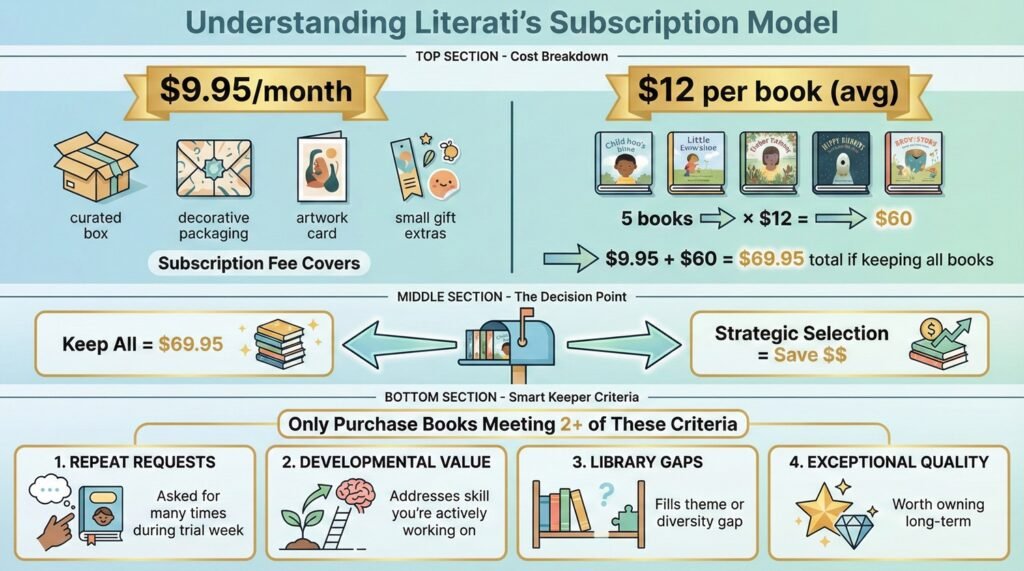
This is where Literati really differs from traditional subscription models, and it’s also where you can either save significantly or accidentally overspend. The monthly subscription fee of $9.95 doesn’t actually include the books themselves, it covers the curation service, the packaging, the artwork, and the little extras tucked into each box.
The books themselves average around $12 each, meaning if you kept all five books every month, you’d be spending roughly $69.95 monthly.
Here’s the strategic approach I recommend: establish a “keeper criteria” before you even open your first box. Decide in advance that you’ll only purchase books that meet at least two of the following conditions: your child asks it many times during the trial week, it addresses a developmental skill you’re actively working on, it fills a gap in your current library’s themes or diversity, or it shows exceptional quality that makes it worth owning long-term.
Most families find that keeping two to three books per box hits the sweet spot between building a meaningful library and maintaining budget control. This brings your monthly cost to around $34 to $46, which is really quite reasonable for high-quality, expertly curated children’s literature.
The return process itself is straightforward, Literati includes prepaid shipping labels, so there’s zero friction or extra cost to sending books back. Set a calendar reminder for day five of your trial period to make your decisions and process returns.
This prevents the default scenario where you accidentally keep everything because you forgot about the deadline.
Selecting for Sensory and Interactive Engagement
Toddlers are fundamentally sensory learners. Their understanding of the world comes primarily through touch, manipulation, and physical interaction.
When you’re evaluating your monthly Literati selections, prioritize books that offer tactile engagement beyond just turning pages.
Touch-and-feel books with varied textures, rough tree bark, soft bunny fur, bumpy dinosaur scales, do double duty. They maintain attention spans that would otherwise wander after thirty seconds, and they simultaneously develop the fine motor discrimination that later supports writing skills.
Lift-the-flap books create anticipation and teach object permanence concepts while building the pincer grasp essential for pencil control.
But here’s something that often gets overlooked: interactive doesn’t always mean physical features built into the book. Some of the most engaging toddler books use repetitive language patterns that invite participation.
Stories with predictable refrains, “Brown bear, brown bear, what do you see?”, transform passive listeners into active participants as toddlers begin anticipating and eventually “reading” these repeated phrases themselves.
When previewing your monthly box during the trial week, test each book with your toddler specifically for engagement duration. Which book holds their attention longest?
Which one do they bring back to you spontaneously after the initial reading?
These behavioral signals tell you more about a book’s value than any professional review or award sticker ever could. Your toddler is literally showing you what works for their brain right now.
Building Thematic Reading Rotations
One of the biggest mistakes I see parents make is presenting all five Literati books simultaneously. The toddler gets overwhelmed by choice, gives cursory attention to each, and then moves on to their toys.
None of the books receive the repeated exposure that actually builds comprehension and vocabulary.
Instead, structure your month around a rotating weekly theme using your Literati selections as anchors. If your box includes books about animals, weather, emotions, families, and colors, dedicate each week to exploring one theme deeply.
During “animal week,” the animal book from your Literati box becomes your primary evening read, but you supplement with animal-related activities throughout the day, visiting the zoo, watching nature documentaries, practicing animal sounds, creating animal crafts.
This thematic saturation approach mirrors how toddlers actually learn best: through repetition and multi-modal exposure. When the same concepts appear in books, conversations, songs, and activities throughout the week, neural pathways strengthen significantly.
By the end of the month, your child has encountered twenty to twenty-five repeated readings of each book, which is precisely the repetition frequency that research shows improves toddler vocabulary acquisition.
Literati’s monthly curation naturally lends itself to this rotation strategy because their selections typically include varied themes as opposed to five books about the same topic. You’re essentially getting a pre-curated thematic curriculum delivered to your door.
Converting Passive Reading into Active Language Development
Here’s something that fundamentally changed how I think about reading to toddlers: the book itself is really just a prop. The real developmental magic happens in the conversations that books facilitate.
When you’re reading from your Literati selections, aim for a 50/50 ratio between actual text and interactive dialogue. On the first read-through, go ahead and read the story straight through to establish narrative flow.
But on subsequent readings, and remember, you’ll be reading each keeper book dozens of times, start interrupting yourself with questions and observations.
Point to illustrations and ask “What color is that truck?” Wait for your toddler to respond, even if it takes fifteen seconds of silence. Name emotions visible on characters’ faces: “Look, the bunny seems worried. See his ears? What do you think he’s worried about?” Connect story events to your child’s lived experience: “Remember when we went to the beach like this family? What did you find in the sand?”
These interruptions might initially feel like they’re disrupting the story, but for toddlers, this interactive approach builds language skills far more effectively than passive listening. You’re modeling question-asking, teaching emotional vocabulary, practicing colors and counting, and making abstract story concepts concrete through personal connections.
The quality of Literati’s book selections, typically featuring rich illustrations and emotionally resonant narratives, particularly lends itself to this dialogic reading approach. Books with detailed background illustrations give you endless material for “I spy” style engagement that extends well beyond the printed text.
Aligning with Educational Philosophy
If your family follows a specific educational approach like Montessori, Waldorf, or Reggio Emilia, you can customize your Literati experience to better align with these principles, though it needs some proactive communication during the setup process.
Montessori-oriented families typically prioritize books featuring realistic illustrations over cartoon anthropomorphism, real-world scenarios over fantasy, and natural materials and processes. When completing your preferences, explicitly note these priorities.
Request nature-based themes, books about practical life skills, and stories grounded in reality.
While Literati will likely still include some imaginative fiction in your boxes, clearly stating your preferences increases the percentage of selections that align with your approach.
Waldorf families often prefer books without text or with minimal text during the early toddler years, emphasizing rich illustrations that allow for parent-guided storytelling. You can note preferences for wordless picture books or books with poetic, lyrical text as opposed to didactic or overly educational language.
The customization isn’t perfect, several reviews note that requested preferences don’t always translate to perfectly matched selections, but providing detailed input definitely shifts the curation in your preferred direction. And remember, the try-before-you-buy model means you can return books that fundamentally conflict with your educational philosophy without financial penalty.
Tracking and Documenting Reading Development
Your monthly Literati subscription provides a natural framework for tracking your toddler’s literacy milestones, but most parents don’t think to use it this way. Each box essentially becomes a monthly checkpoint for developmental progress.
Start a simple reading journal, it can be as basic as a note on your phone, where you record which books from each month’s selection your child gravitated toward, what new words they attempted after repeated readings, and any observable changes in attention span or comprehension. After six months, patterns will emerge that provide remarkably clear insight into your child’s cognitive development and interests.
For instance, you might notice that your toddler consistently returns books featuring vehicles to the keeper pile while showing minimal interest in books about emotions. This tells you something important about their current cognitive interests.
You can then ask books featuring vehicles that also incorporate emotional scenarios, using their area of interest as a bridge to developing skills in areas where they’re less naturally engaged.
Pay particular attention to books your toddler begins “reading” back to you, not actually reading, but reciting from memory after many repetitions. This is a critical pre-literacy milestone called “emergent reading,” and it shows that your child understands books contain consistent stories, that text corresponds to specific words, and that reading follows directional patterns.
When you notice this behavior emerging, note which Literati book triggered it and at what age.
This information helps you identify the complexity level that’s optimally challenging for your child.
Navigating the Donation and Sustainability Angle
One of Literati’s less-publicized features is their book donation program, and strategically using this can extend the value of your subscription beyond your own family while teaching early lessons about generosity and community.
As your child grows and certain books become too simple, as opposed to storing them indefinitely or selling them, use Literati’s donation partnership. The process involves requesting a donation bag, filling it with gently used books (they don’t need to be originally from Literati), and returning them via prepaid shipping.
These books are then distributed to communities with limited access to children’s literature.
For toddlers, you can make this tangible even though they won’t fully understand the concept. As you pack books to donate, talk about how “other kids who don’t have many books will get to read these stories now.” Show pictures of libraries or classrooms where donated books might go. This plants really early seeds of charitable thinking and community awareness.
From a practical standpoint, actively donating books you’ve outgrown prevents your home from becoming overwhelmed with children’s literature. Many parents find they’ve accumulated hundreds of books by the time their child reaches preschool, creating storage challenges and making it harder to access the now relevant books.
Regular donation creates natural circulation.
Adapting for Different Family Structures and Schedules
The theoretical advice about daily reading and thematic weeks sounds wonderful, but real life is complicated. Single parents, dual-income households, families with many children, and parents working irregular schedules all need different adaptation strategies.
For working parents with limited evening time, consider this approach: designate Literati books specifically as “parent reading” books as opposed to including them in the general rotation your toddler accesses independently throughout the day. This creates special association with parent-child time and maximizes the quality of your limited reading windows.
Even if you can only manage fifteen focused minutes before bedtime, having five high-quality books that rotate weekly ensures you’re not reading the same book every single night, which prevents parental burnout while maintaining toddler engagement.
Single parents managing everything alone might find the try-before-you-buy model particularly valuable because it reduces the mental load of researching and purchasing books separately. The curation is done for you, and you only commit to books that genuinely work during a week when you have actual data about your child’s response.
Families with many children can maximize value by keeping keeper books in a “family library” as opposed to designating them to the toddler specifically. Many high-quality picture books have multi-layered narratives that engage older siblings during family reading time while remaining accessible to toddlers.
This shared reading experience also provides modeling, toddlers hearing older siblings ask sophisticated questions about stories learn to engage with books more deeply themselves.
Addressing Cost Concerns Strategically
Literati represents a premium option in the children’s book subscription market. Even keeping just two books monthly puts your annual spending around $400, and that’s before the subscription fee.
For many families, this represents a significant portion of the enrichment activity budget.
Here’s the strategic framework I’d suggest for evaluating whether the cost makes sense for your situation. Calculate what you now spend on children’s books annually, including impulse purchases at bookstores, online orders, and book fair purchases.
For most active book-buying parents, this often totals $300 to $500 annually anyway, and often the books aren’t nearly as well-curated as Literati’s selections.
If you’re spending comparable amounts already but doing so in an ad-hoc, less strategic way, Literati’s curation service essentially restructures existing spending while improving quality and appropriateness. The subscription fee becomes a curator’s salary, ensuring expert selection as opposed to random impulse purchases.
However, if you now access children’s books primarily through library borrowing and your annual book purchasing is minimal, then yes, Literati represents a significant budget expansion as opposed to a reallocation. In this case, consider treating it as gift-giving, family and friends can contribute toward your Literati subscription instead of buying person toys or clothes your child will quickly outgrow.
Another cost-optimization approach: subscribe for six months as opposed to committing to a full year initially. This gives you two full rotation cycles through your keeper books (remember, toddlers need twenty-plus repetitions to fully absorb a book), and you can then assess whether the developmental benefits justify the ongoing expense for your specific child and family.
People Also Asked
What age is Literati Neo club suitable for?
The Neo club officially covers ages 0-3, but the developmental range within this span is really wide. A six-month-old needs completely different books than a two-and-a-half-year-old.
When you set up your subscription, be really specific about your child’s current developmental stage, not just their chronological age.
If your child is speaking in sentences, understanding complex stories, or showing advanced comprehension, ask books toward the upper end of the range.
How many Literati books should I keep each month?
Most families find that keeping two to three books per monthly box provides the best balance. This gives you enough variety to maintain interest while avoiding both library overwhelm and budget strain. Your monthly cost will run between $34-46 if you keep two to three books.
Establish clear keeper criteria before opening each box, books your child repeatedly asks, books filling gaps in themes or diversity, or books demonstrating exceptional quality worth owning long-term.
Can I customize my Literati book selections?
Yes, Literati allows customization through their initial questionnaire and ongoing preference updates. You can specify interests like nature themes, specific educational philosophies like Montessori, preferences for realistic versus imaginative stories, and topics you want to emphasize or avoid.
The customization isn’t perfect, and you’ll still receive some books outside your stated preferences, but detailed input does shift the overall curation meaningfully in your preferred direction.
How does the Literati try-before-you-buy system work?
You receive five books in your monthly box and have a week to decide which ones to purchase. The $9.95 monthly fee covers curation and shipping, but books themselves cost around $12 each.
During your trial week, read the books with your child and observe their responses.
Keep the ones that genuinely engage them and return the rest using the included prepaid shipping label. Set a reminder for day five to make your decisions and avoid accidentally keeping everything by default.
Is Literati worth it compared to library books?
This depends entirely on your current situation. If you already spend $300-500 annually on children’s books through random purchases, Literati restructures that spending with expert curation and potentially saves money.
If you now rely almost exclusively on library borrowing and rarely purchase books, then Literati represents a genuine budget increase.
Consider factors like whether you value building a permanent home library, whether the expert curation saves you research time, and whether your family would benefit from the monthly ritual and special presentation.
What should I do with Literati books my child outgrows?
Literati offers a book donation program where you can ask a donation bag, fill it with gently used books (from any source, not just Literati), and return them via prepaid shipping. These books go to communities with limited access to children’s literature.
This prevents storage overwhelm as your child grows and teaches early charitable concepts.
You can also keep outgrown books for younger siblings or pass them to friends with younger children.
How often should I read the same book to my toddler?
Toddlers need twenty to twenty-five repetitions of a book to fully absorb vocabulary and concepts. This might sound like a lot, but using the weekly thematic rotation strategy, you’ll naturally hit five to seven readings per week during a book’s featured week, plus occasional revisits.
That repetition frequency aligns with research on optimal vocabulary acquisition.
Don’t worry about your child getting bored, toddlers actually find comfort and learning value in repetition that adults find tedious.
Can I use Literati if I follow Montessori or Waldorf education?
Yes, though it requires proactive communication during setup. For Montessori families, explicitly ask realistic illustrations, nature-based themes, books about practical life skills, and stories grounded in reality as opposed to fantasy.
For Waldorf families, note preferences for wordless picture books or minimal text with rich illustrations.
The curation won’t perfectly match your philosophy every month, but the try-before-you-buy model means you can return books that fundamentally conflict with your approach without financial loss.
Key Takeaways
Choose books based on your child’s current developmental abilities as opposed to chronological age for optimal engagement and learning. Establish specific keeper criteria before opening each monthly box to prevent emotional over-purchasing and maintain budget control.
Structure your month into weekly thematic rotations using one Literati book as the anchor each week, supported by related activities, conversations, and experiences throughout those seven days. This approach provides the twenty-plus repetitions toddlers need for true vocabulary absorption and concept mastery.
Practice dialogic reading by maintaining a 50/50 ratio between reading the printed text and engaging in interactive conversation about illustrations, emotions, colors, connections to your child’s life, and open-ended questions. Wait for responses even when silence stretches fifteen seconds or longer.
Use your monthly boxes as developmental checkpoints by tracking which books your child gravitates toward, what new words emerge, and what engagement patterns you observe over six-month periods. Keep two to three books per box on average, bringing annual costs to a manageable $400-500 range that often represents restructured spending as opposed to new expenses for families already purchasing children’s books regularly.