
We may earn money or products from the companies mentioned in this post.
Standing in a bookstore aisle surrounded by thousands of colorful toddler books can feel paralyzing. You want quality literature for your child, but researching titles, comparing options, and making informed selections takes hours you simply don’t have between work, household management, and actually reading with your little one.
I’ve stood in those same aisles, overwhelmed and uncertain. Discovering toddler book subscriptions completely transformed how our family approaches building a home library.
These services eliminate the guesswork by delivering carefully selected books directly to your door each month. You skip the research phase and the weekend bookstore trips.
Instead, experts choose developmentally suitable titles that arrive on a predictable schedule.
The challenge is that subscriptions vary dramatically in quality, value, and alignment with different family needs. Some consistently deliver books that captivate your toddler and support their developmental stage. Others send titles that miss the mark entirely, accumulating dust on shelves while your money disappears.
This guide examines the essential questions you need to answer before committing to any subscription service. We’ll look past marketing promises and focus on what actually matters when investing in your child’s literacy development.
You’ll understand how to assess different services and choose one matching your family’s specific requirements, budget constraints, and core values.
Understanding What You’re Actually Purchasing
Subscribing to a toddler book service means you’re buying more than physical books. You’re paying for a curated experience designed to support your child’s cognitive and emotional development through carefully selected literature.
The strongest subscriptions employ experts who understand early childhood development milestones. These curators choose books matching specific stages of growth, choosing titles that align with where your toddler now functions developmentally.
According to the American Academy of Pediatrics, reading with children from infancy strengthens relationships and supports critical developmental growth. The words your toddler hears, the images they process, and the narratives they follow all build neural pathways that serve them throughout their educational lives.
Well-designed subscriptions make this developmental support easier by removing the research burden from your shoulders. You don’t need to become an expert in children’s literature or spend hours evaluating person titles.
What truly distinguishes subscriptions from random book purchases is the element of discovery and ritual. When that monthly package arrives, there’s genuine excitement building around the experience.
Your toddler starts associating that anticipation with books and reading. These positive emotional connections extend far beyond the person stories themselves.
I didn’t fully appreciate this psychological dimension until watching my own child begin asking when “our new books” would arrive each month.
The curation element deserves special attention. Professional curators spend considerable time evaluating hundreds of titles, considering factors like illustration quality, narrative structure, language richness, and thematic diversity.
They search for books that will captivate your toddler while expanding their worldview and introducing new concepts in developmentally suitable ways.
This expertise is difficult to copy when you’re quickly browsing Amazon recommendations before bedtime or grabbing whatever looks appealing at Target.
Age Appropriateness Forms the Foundation
Many parents make their first critical mistake here. They assume “toddler books” represent one broad category, but developmental differences between a 12-month-old and a 3-year-old are massive.
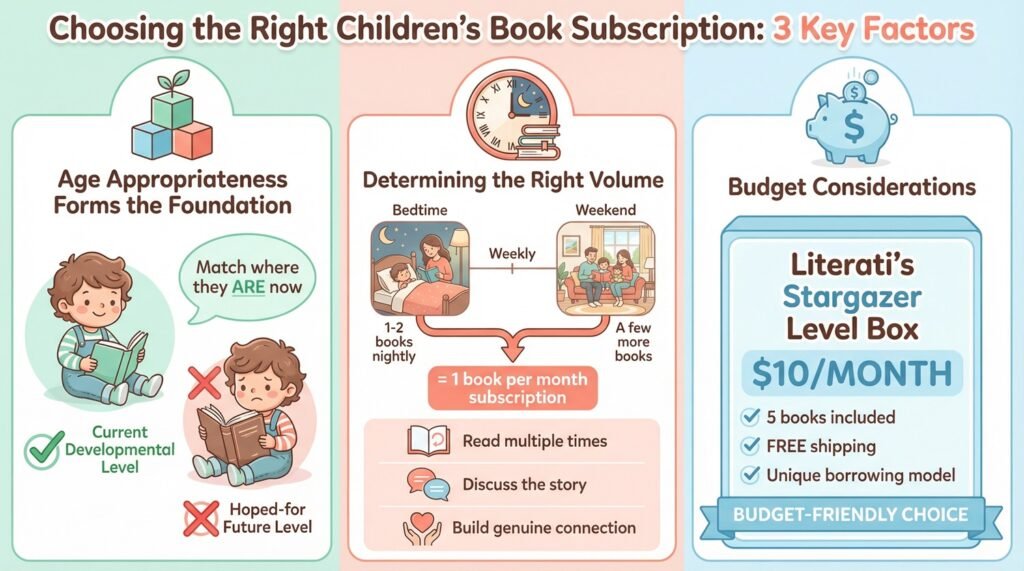
Your subscription must align with where your child actually functions developmentally right now, not where you hope they’ll be in six months.
Infants from birth to 12 months need high-contrast images, simple shapes, and books built to withstand chewing, throwing, and general rough handling. Board books with rounded corners are essential at this stage.
Touch-and-feel elements, mirrors, and crinkly pages engage many senses and hold attention longer than simple picture books can.
Language at this level focuses on basic vocabulary like colors, animals, and simple objects, with heavy repetition throughout each book.
Young toddlers between 12 and 24 months are navigating a fascinating transition period. They’re beginning to understand that words represent specific things, building associations between images and language.
Books at this stage should feature clear, bright illustrations with minimal background clutter that might distract from the main subject.
Simple storylines work best. Think “Brown Bear, Brown Bear, What Do You See?” as opposed to complex narratives with many plot points.
Your toddler develops preferences now, often requesting the same book repeatedly, which actually speeds up language acquisition significantly.
Older toddlers from 2 to 3 years can handle considerably more complex material. They follow multi-step narratives, understand character emotions, and begin predicting what might happen next in familiar stories.
Picture books with engaging plots hold their attention effectively, and they start asking questions about what they’re seeing and hearing.
Diversity in themes and characters becomes really important during this stage, as your toddler is forming their understanding of the wider world beyond their immediate family and home environment.
Popular subscriptions like Bookroo specifically segment their offerings by these age ranges. Their board book option targets younger toddlers, while their picture book tier serves older children.
Story Captain’s WobbleCaptain Club covers the full 0-3 range but adjusts selections based on the specific age you show during signup.
Literati’s Stargazer Level Box targets 12 months to 3 years, recognizing that this middle period represents relatively consistent developmental needs.
The real question you need to ask is where your child now functions developmentally, and whether the subscription actually serves that specific stage. Don’t be swayed by beautiful marketing images showing slightly older children if your 14-month-old needs something different.
Determining the Right Volume for Your Family
When we first started with book subscriptions, I thought receiving five or six books monthly would provide amazing value. I quickly realized we weren’t giving each book the attention it deserved. We were skimming through new arrivals as opposed to really engaging with them.
If your family reads one or two books before bedtime and maybe a few more on weekends, one carefully selected book per month might actually be perfect. You’ll have time to read it many times, talk about the story, and let your toddler develop a genuine relationship with the book.
A Kids Co.’s Explorer Box takes this approach, sending one thoughtfully chosen title that you can really explore together.
Two to three books monthly represents the sweet spot for most families I know. There’s enough variety to keep things interesting without overwhelming your reading routine or your shelf space.
Bookroo’s standard offering of two to three books hits this balance well.
You can introduce a new book each week or so, which gives your toddler time to process and enjoy each one before moving to the next selection.
Four to five books monthly works beautifully if you’re really committed to frequent reading sessions, if you have many children sharing the books, or if you’re planning to pass books along to other families once your child outgrows them.
The Highlights I Can Read! Book Club sends five books monthly, which translates to roughly five dollars per book when you factor in the subscription cost.
That’s genuinely competitive pricing when comparing to person retail purchases at bookstores or online retailers.
I’d really encourage you to honestly assess your family’s actual reading patterns before deciding on volume. Track how many books you now read together in a typical week.
If you’re reading the same three books on repeat, jumping to a subscription that sends six new titles monthly will likely lead to accumulation as opposed to engagement.
Budget Considerations Beyond the Sticker Price
When evaluating subscription costs, you need to calculate the true per-book value and factor in all the extra charges that might not be immediately obvious. A subscription that looks affordable at first glance can become expensive once you add shipping fees and account for the actual number of books received.
Budget-conscious families should definitely look at Literati’s Stargazer Level Box first. At ten dollars monthly with free shipping, you receive five books through their unique borrowing model.
You keep the books you love and return the others, paying only for what you want to permanently add to your library.
This approach is brilliant if you’re trying to build a collection without breaking the budget or overwhelming your storage space.
In the mid-range category, Bookroo charges between $16.95 and $24.95 monthly depending on whether you choose board books or picture books and whether you want two or three books. Add their $4.95 shipping fee, and you’re looking at roughly $7 to $10 per book.
Story Captain starts at $19.95 monthly plus shipping, which is competitive when you factor in their themed curation and included activity guides.
Little Fun Club falls into a similar range at $18.95 to $22.95 for two to three books.
Premium subscriptions like Barefoot Book Box charge $29.17 monthly, but they include themed gifts beyond just books: puzzles, plushies, games, and other items that extend the monthly theme. Whether these extras justify the higher price really depends on how much value you place on supplementary materials versus books alone.
Calculate the annual cost before committing. A $20 monthly subscription costs $240 annually.
Many services offer discounts if you prepay for many months, which can reduce your per-month cost significantly.
That approach increases your commitment if the service doesn’t meet expectations, though.
Don’t forget to factor in what you’d spend otherwise. If you now purchase three to four toddler books monthly at retail prices (typically $8 to $15 each), you’re already spending $24 to $60 monthly.
A subscription that delivers similar quality for $20 to $25 isn’t an extra expense. It’s potentially a saving while also providing expert curation you couldn’t copy on your own.
Customization Versus Expert Curation
This represents one of the fundamental philosophical decisions you’ll make when choosing a subscription. Do you want experts to surprise you with their selections, or do you want control over what arrives?
Curated, non-customizable boxes appeal to parents who genuinely trust the expertise of professional book curators and want to uncover titles they wouldn’t have found independently. There’s real value in being pushed outside your comfort zone.
You might not have chosen that book about feelings or the one featuring a family structure different from your own, but these are often the books that spark the most interesting conversations with your toddler.
Reading Bug Box’s Baby Bug Box curates three books for ages 0 to 30 months without requesting your input on preferences or themes. The curators choose based on developmental appropriateness, literary quality, and diversity of representation.
For many families, this hands-off approach is exactly what they want: no decision fatigue, just quality books arriving reliably.
Personalized or customizable subscriptions suit families with strong preferences or specific values they want reflected in their home library. Maybe you’re specifically seeking books featuring characters of color, stories from different cultures, or narratives that challenge traditional gender roles.
Maybe you want to avoid certain themes or specifically include others.
Maybe your toddler has developed a passionate interest in construction vehicles or ocean animals, and you want books that feed that curiosity.
Story Captain tries to bridge these approaches by offering themed monthly boxes. Each month focuses on a different theme like friendship, courage, nature, or diversity, giving you some sense of what’s coming while still leaving the specific titles to the curators.
This middle path works really well for families who want some structure but still appreciate being surprised.
I need to mention something important about customization promises. Some parents have reported that services claiming to customize based on preferences sometimes fall short.
One family I know selected specific themes through their subscription portal but received books that seemed randomly chosen regardless of their indicated preferences.
This could be an isolated incident or a sign of limited actual customization capability. When evaluating services that promise personalization, look for recent reviews specifically discussing whether customization actually works as advertised.
Book Format Actually Matters More Than You Think
The physical format of your subscription books significantly impacts both durability and how your toddler engages with them. This isn’t just an aesthetic consideration.
It affects the practical reality of incorporating these books into your daily routine.
Board books are basically indestructible, which matters tremendously when dealing with younger toddlers who view books as much as playthings as reading material. The thick cardboard pages withstand chewing, throwing, and those moments when your 18-month-old decides to “read” independently by flipping pages with sticky fingers.
Bookroo’s board book option specifically recognizes this need, sending three durable board books monthly that can survive even enthusiastic toddler attention.
Hardcover books represent the middle ground. They’re more durable than paperback but less indestructible than board books.
The advantage is that hardcover picture books often feature higher-quality printing and more sophisticated illustrations than their board book counterparts.
Story Captain sends hardcover picture books, which makes sense given their target audience of older toddlers and preschoolers who can treat books with a bit more care.
Paperback books are definitely the most vulnerable to damage, but they’re also the most economical format and the easiest to store if space is limited. The Highlights I Can Read! Club uses paperback format for their five monthly books, which is suitable given that their target readers are approaching the preschool stage and developing better fine motor control.
Interactive books with lift-the-flap elements, touch-and-feel textures, or pull-tabs offer tremendous engagement benefits, especially for younger toddlers. These features encourage hands-on exploration and make reading a multisensory experience.
The downside is that these interactive elements are the first things to break when books are handled roughly.
If durability is a priority, you might prefer simpler formats for your subscription while purchasing interactive books separately for supervised reading sessions.
Think about where and how your family actually reads together. If you’re mostly reading before bed, with books carefully handled and then placed back on the shelf, hardcover or even paperback works fine.
If your toddler independently “reads” throughout the day, pulling books off low shelves and carrying them around the house, board books make far more sense for subscription purchases.
Hidden Costs: Shipping and Commitment Requirements
Subscription pricing isn’t always as straightforward as the advertised monthly rate. Shipping fees and least commitment periods can significantly impact both your financial investment and your flexibility.
Shipping costs vary dramatically across services. Literati’s Stargazer Level Box and the Highlights I Can Read!
Club both include free shipping, which genuinely simplifies budgeting.
What you see is what you pay.
Bookroo and Story Captain add $4.95 to $4.99 per shipment, which adds roughly $60 annually to your total cost. That might not sound like much, but it represents two to three extra books at typical retail prices.
Most reputable subscriptions offer month-to-month signup with no long-term obligation, which I personally think is essential. You need the freedom to cancel if the service isn’t meeting expectations or if your family’s circumstances change.
The best companies make cancellation straightforward: a simple process through your account dashboard or a quick email to customer service.
Some services incentivize longer commitments by offering discounts for prepaying three, six, or twelve months. These discounts can be substantial, sometimes reducing your per-month cost by 15 to 20 percent.
There’s obvious risk here, though.
If you prepay for a year and realize after three months that the selections don’t match your needs, you’re stuck. I’d strongly recommend starting with month-to-month even if it costs slightly more, then switching to a longer commitment once you’re confident the service delivers consistent value.
Watch out for companies that make cancellation unnecessarily difficult. If you have to call during specific hours, send physical mail, or navigate through many “are you sure you want to cancel?” screens, that’s a red flag.
Customer-friendly services respect your time and autonomy.
Frequently Asked Questions
What age should I start a book subscription for my toddler?
You can start a book subscription from birth. Many services like Reading Bug Box’s Baby Bug Box specifically target ages 0 to 30 months with books designed for infants and young toddlers.
The key is choosing a subscription that matches your child’s current developmental stage as opposed to waiting until they’re older.
How much do toddler book subscriptions typically cost?
Most toddler book subscriptions range from $10 to $30 monthly. Budget options like Literati’s Stargazer Level Box start at $10 with free shipping, mid-range options like Bookroo cost $17 to $25 plus shipping, and premium services like Barefoot Book Box charge around $29 monthly including themed extras beyond books.
Are board books better than picture books for toddlers?
Board books work better for children under 2 years old because they withstand rough handling, chewing, and independent exploration. Picture books in hardcover or paperback format suit older toddlers aged 2 to 3 who can treat books more carefully and benefit from the more sophisticated illustrations and longer narratives these formats typically offer.
Can I customize which books my toddler receives?
Customization varies by service. Some subscriptions like Reading Bug Box curate without input, while others like Story Captain offer themed monthly selections.
Literati allows you to keep only the books you want from each shipment.
Review each service’s specific customization options before subscribing.
How many books should I get per month for my toddler?
Most families find two to three books monthly provides the right balance between variety and manageable volume. One book monthly works if you read less often, while four to five books suit families with many children or very frequent reading routines.
Track your current reading habits before deciding.
Do book subscriptions replace going to the library?
Book subscriptions complement library visits as opposed to replacing them. Use subscriptions to build a permanent home collection of quality books you’ll read repeatedly, and use the library for exploring new themes and authors without financial commitment.
This combination maximizes both discovery and budget efficiency.
What should I do with subscription books my toddler outgrows?
You can donate outgrown books to libraries, preschools, or community centers, sell them through consignment stores or online marketplaces, pass them to younger family members or friends, or store them if you’re planning to have more children. Some subscription services also offer return programs for certain tiers.
Are themed book subscriptions worth the extra cost?
Themed subscriptions like Story Captain provide cohesive monthly experiences around specific concepts like friendship or courage, which can deepen understanding through many related books. Whether the premium cost is worthwhile depends on how much you value this thematic approach versus simply receiving high-quality person titles.
Key Takeaways
The most important question to ask before subscribing is whether the age range precisely matches your toddler’s current developmental stage, because misalignment leads to books that won’t engage your child regardless of their overall quality.
Calculate the true per-book cost including shipping and consider value holistically as opposed to choosing based solely on the lowest sticker price, since a slightly more expensive subscription often delivers better quality and curation.
Decide whether you want expert curation that introduces you to unexpected titles or customization that reflects your specific preferences, understanding that these represent fundamentally different approaches with different strengths.
Start with month-to-month commitments even if longer prepayment offers discounts, because you need the flexibility to cancel if the service doesn’t consistently meet expectations.
Give any new subscription at least three months before making a final judgment, since one or two months isn’t enough to assess whether selections reliably match your family’s needs and values.