
We may earn money or products from the companies mentioned in this post.
So you’re drowning in picture books that looked great online but your kid won’t touch them. Or maybe you’re spending $100 a month at Target on random titles hoping something sticks.
I get it. Picking books for toddlers feels impossible because their interests change every three weeks, and what works for your friend’s kid might bore yours to tears.
That’s where book subscriptions come in, but here’s the thing… most of them just send you a box of books and you’re stuck with whatever shows up. Literati does something different that actually makes sense when you think about how unpredictable toddlers are.
They let you try the books first and send back what doesn’t work. No guilt about wasting money.
No shelf full of books collecting dust.
For people juggling work schedules and trying to keep screen time under control, or grandparents who want to send something meaningful every month without doing the research, this model fixes some real problems.
But whether it’s actually worth the monthly fee depends on what you need from a toddler book subscription. Let me break down how it works and what people are saying about it.
Introduction
The basic problem with building a toddler library is you never really know what’ll land until you sit down and read it together. Reviews help, but every kid is different.
One toddler loves trucks, another wants nothing but animals.
And those interests flip constantly.
You could spend hours researching award-winning picture books and still end up with a pile your toddler ignores.
Literati’s approach treats book selection like a trial run. You’re basically renting books for a week to see if they’re keepers.
If your toddler loves a book, you buy it at a competitive price.
If not, it goes back in a prepaid mailer.
The company aims this service at different age groups (newborn through teen), but for toddlers specifically, the curation matters because you’re in that phase where development happens fast and attention spans are short.
Let’s get into what you actually get when you sign up.
Features Overview
How the Subscription Works
You pay $9.95 per month to get five books delivered to your door. That monthly fee isn’t just shipping… it’s basically your rental fee for trying out the books.
When the box arrives, you’ve got about a week to read through everything with your kid. Keep what works, send back what doesn’t.
The return shipping is prepaid, so you’re not making post office runs.
If you keep all five books in a month, you get a 5% discount on the total. If you keep just one, you pay for that one book plus the $9.95 monthly fee.
The book prices themselves match or beat Amazon pricing according to what people report.
So basically you’re paying ten bucks to test-drive five books. Pretty low risk compared to buying five books blind at $15-20 each.
What Makes the Curation Different
Most subscriptions just send age-appropriate books based on algorithms or basic categories. Literati uses actual humans to pick the books, and they organize them around monthly themes.
One month might focus on a specific topic like animals or weather. Another month might explore a place (people mention getting Japan-themed boxes).
The books in each box connect to each other thematically instead of being five random titles.
You get a mix of fiction and non-fiction, classics and newer releases. So your toddler sees different storytelling styles and illustration approaches.
For toddlers who obsess over one thing for two weeks and then completely move on, themed boxes help you keep up with those shifts without guessing what to buy next.
The Personalization Angle
When you set up your account, Literati asks about your kid’s interests. You can flag themes or topics you want more of and skip months if needed.
Some people report the customization doesn’t always hit perfectly (like getting books that don’t match stated preferences), but the option exists if you want to guide what shows up.
Presentation Details
The packaging includes personalized artwork, bookplates with your kid’s name, and small extras like magnetic bookmarks or specialty pens.
This stuff matters more than it sounds like it would. When books show up with their name on things, toddlers treat them differently.
They become “my books” instead of just books that appeared.
Performance Analysis
Consistency and Delivery
The boxes arrive on a set schedule each month. You’re not wondering when something will show up or if this month got skipped.
For people managing work and childcare schedules, that predictability removes one more decision from your plate.
Return Process Reality Check
Multiple people mention the return process works smoothly. You get the prepaid mailer with the box, stick the books you don’t want in there, and drop it off.
No complicated steps or surprise fees.
The deadline matters though. If you miss your return window, you get charged for all the books whether you wanted them or not.
So you need to actually look at the books when they arrive instead of letting the box sit for two weeks.
Book Format Consideration
All the books are paperback. For older toddlers (2-3 years) who’ve mostly stopped destroying books, that’s fine.
For younger toddlers who still chew on everything or rip pages, paperback durability becomes an issue.
Some competing services focus specifically on board books for the youngest age range. Literati serves a slightly older toddler demographic better.
Selection Quality
People consistently mention the variety and quality of what arrives. You’re getting legitimate children’s literature, not filler books.
The mix includes recognizable characters (reviewers mention Biscuit and Pete the Cat) alongside discovery titles you wouldn’t have found yourself.
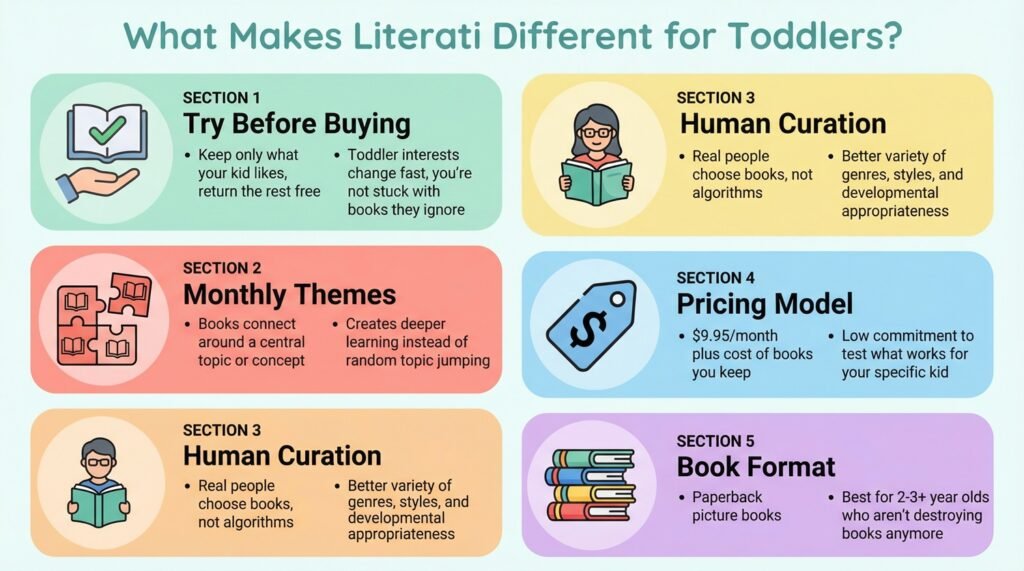
| Feature | Literati Approach | Why It Matters for Toddlers |
|---|---|---|
| Try Before Buying | Keep only what your kid likes, return the rest free | Toddler interests change fast, you’re not stuck with books they ignore |
| Monthly Themes | Books connect around a central topic or concept | Creates deeper learning instead of random topic jumping |
| Human Curation | Real people choose books, not algorithms | Better variety of genres, styles, and developmental appropriateness |
| Pricing Model | $9.95/month plus cost of books you keep | Low commitment to test what works for your specific kid |
| Book Format | Paperback picture books | Best for 2-3+ year olds who aren’t destroying books anymore |
Pros and Cons
What Actually Works
The try-before-buy thing removes the gamble from book shopping. You’re not eating the cost of bad picks.
Ten bucks monthly to test five books breaks down to about $2 per book rental. That’s genuinely affordable for most households.
You’re not spending hours scrolling reviews and second-guessing yourself. Someone else did the research.
Free returns mean you don’t feel guilty sending books back. No sunk cost fallacy keeping books you don’t want on your shelf.
The themed approach gives structure to what shows up instead of feeling random.
What Creates Problems
You pay the $9.95 even if you return all five books. So some months you might pay the fee and keep nothing, which feels like wasted money.
If you forget about the return deadline, you get charged for everything. Life gets busy with toddlers, so this can happen.
The customization doesn’t always deliver. Some people mention getting books that don’t match what they specified in their preferences.
Paperback format doesn’t work for younger toddlers who are rough with books.
You can’t test a single box without committing to at least one month. If you’re skeptical, there’s no truly risk-free trial.
The monthly commitment might feel like pressure during months when you’re busy or your budget is tight.
User Experience
Setting Up the Account
You create a profile and answer questions about your kid’s age and interests. The interface is straightforward from what people describe.
You pick your start date and set up payment.
When the Box Arrives
The packaging feels intentional. Your kid’s name shows up on materials, there’s original artwork included, and small extras make it feel like an event as opposed to just another Amazon delivery.
For toddlers who love routine and anticipation, the monthly arrival becomes something they look forward to. It creates a ritual around reading.
Making Keep/Return Decisions
This is where the model either works for you or doesn’t. You need to actually read through the books with your kid during that week window.
If you let the box sit unopened for days, you’re not getting the value. But if you make it part of your bedtime routine immediately, you’ll know pretty quick which books are hits.
Some toddlers want the same book read 47 times in a row. Others flip through once and move on.
The trial period let’s you see which category each book falls into.
The Return Process
You put unwanted books in the prepaid mailer and drop it off. People mention this being friction-free.
No printing labels or paying shipping.
The books you keep stay on your shelf and you get charged for them.
Value for Money
Let’s do the actual math here because this is where the service either makes sense or doesn’t.
If you normally buy toddler books at $15-20 each from regular stores, you might spend $60-100 on five books. Some of those books your kid will love.
Some they’ll never ask for again.
With Literati, you pay $9.95 to try five books. If you keep one book at say $14, your total for that month is about $24.
You got one book you know your kid likes, and you sent back four that didn’t work.
If you keep all five books at an average of $12 each, you’re spending $60 plus the $9.95 monthly fee (minus the 5% discount they give you), so roughly $69 total. You got five books you’ve confirmed your kid actually wants.
Over a year, if you keep an average of 2-3 books per month, you’re building a library of 24-36 books that your toddler has proven they care about. The total cost runs maybe $400-600 depending on book prices and how many you keep.
Compare that to buying 36 books blind at $15-20 each… you’d spend $540-720 and probably end up with a bunch your kid ignores.
The savings come from not wasting money on misses.
For Grandparents Specifically
If you’re looking for a recurring gift that keeps showing up without you needing to research toddler books every month, $10 monthly is manageable.
The unboxing experience gives the gift a tangible presence even though you’re not there. Your grandkid gets books with their name on materials, and you’re contributing to their library without guessing what they’d like.
Check what Literati’s current toddler boxes include and pricing
Final Verdict
Literati solves specific problems well. If you hate spending time choosing books and you want someone else to curate quality selections, this works.
If you’re tired of buying books your toddler won’t read, the try-before-buy model fixes that.
The service makes the most sense for people who value convenience and curation over having total control. You’re essentially paying $10 monthly to outsource book research and eliminate purchase risk.
It works less well if you already know your way around children’s literature and enjoy picking books yourself. If your toddler is under 18 months and still tears pages, the paperback format creates problems.
If you prefer buying curated collections outright instead of trying books first, the model feels unnecessary.
For first-time parents overwhelmed by endless book options, or working parents with limited time to research, or grandparents wanting meaningful recurring gifts, the value proposition is solid.
You’re paying roughly $2 per book to test whether it works for your specific kid. Combined with free returns and monthly themes that create structure, it addresses real frustrations with toddler book selection.
The book quality itself holds up based on what reviewers report. The curation includes both classics and contemporary titles, fiction and non-fiction, familiar characters and new discoveries.
Start your first month with Literati and try the return process yourself
Who This Makes Sense For
You’re juggling work and parenting and don’t have hours to research picture books. You value having someone else handle the selection process.
You want your toddler exposed to quality literature without trial-and-error purchasing.
You like the idea of only paying for books your kid actually engages with.
You’re a grandparent who wants to send something meaningful monthly without staying current on toddler book trends. You want a gift that creates routine and anticipation.
Ten dollars monthly fits comfortably in your budget for ongoing gifts.
You’re dealing with a toddler whose interests shift constantly and you’re tired of shelves full of books they asked for once and never touched again. You want a rotating home library without the commitment of keeping everything.
Who Should Look Elsewhere
You already maintain a strong home library and enjoy researching children’s literature yourself. You have a toddler under 18 months who needs board books instead of paperback.
You prefer buying curated collections outright.
You know you’ll forget return deadlines and don’t want the pressure of making keep/return decisions monthly.
Compare Literati to other toddler book subscription options here
The real test comes down to whether their curation approach matches how your specific toddler learns, whether the monthly fee fits your budget, and whether removing book-selection decisions from your plate has enough value to justify the subscription cost.
For many households dealing with decision fatigue around toddler books and wanting to reduce wasted purchases, those conditions line up pretty clearly in favor of trying the service.
The try-before-buy model stays the standout feature that differentiates Literati from traditional subscriptions where you’re stuck with whatever arrives. That flexibility matters significantly when you’re dealing with the unpredictable preferences of toddlers.
At least, the service deserves consideration if you’re now spending $50+ monthly on toddler books anyway and ending up with mixed results. The worst case scenario is you try one month, return all five books, and you’re out $9.95 to learn it’s not for you.