
We may earn money or products from the companies mentioned in this post.
I remember the first time I really understood what it meant to own books versus just borrowing them from the library. My daughter was eighteen months old, and she’d uncovered this one board book about construction vehicles.
She wanted it every single night, sometimes three times in a row.
The library copy was due back, and when I returned it, the absolute devastation on her face told me something important about ownership and attachment that I hadn’t fully grasped before.
Buying every single book your toddler might love gets expensive really fast. A decent board book runs anywhere from twelve to twenty dollars these days, and toddlers can burn through interests faster than you can keep up.
Book subscriptions solve this problem, but they do something even more valuable than just saving money. They create a predictable rhythm of literary exposure that mirrors how children actually learn language and develop cognitive frameworks.
When books arrive regularly on a schedule, children start to anticipate them, creating positive associations with reading as an ongoing part of life as opposed to an isolated activity.
How the Subscription Model Actually Works
The children’s book subscription market has exploded over the past decade. Most subscription services for toddlers operate on monthly delivery schedules, though some offer bimonthly or quarterly options.
The typical price range sits between fifteen and thirty-five dollars per month, depending on the number of books included, whether they’re new or gently used, and how much curation goes into the selection process.
What separates a genuinely valuable subscription from a mediocre one comes down to the curation philosophy behind the selections. Some services use algorithms based on age ranges and reading levels.
Others employ actual children’s librarians and early childhood educators who understand developmental milestones and can match books to specific cognitive stages.
The difference matters more than most parents realize. Toddlers aren’t just reading words when they look at books.
They’re building entire conceptual frameworks about how stories work, how language flows, and how meaning gets constructed through sequential information.
A service that understands this developmental reality will send very different books than one that simply sorts by age range.
Think about how subscription services work in other areas of your life. Your streaming subscriptions create habitual viewing patterns.
Your meal kit subscriptions establish cooking routines.
Book subscriptions do something similar for reading, except the stakes are considerably higher because you’re literally shaping how a developing brain processes language and narrative structure.
Why Ownership Changes Everything
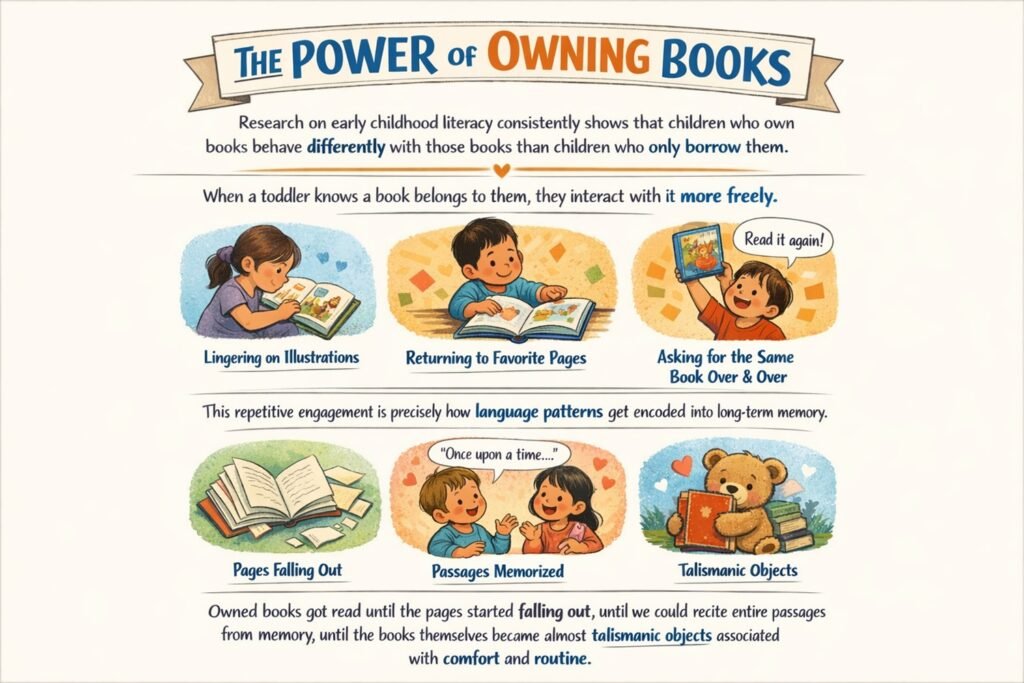
Research on early childhood literacy consistently shows that children who own books behave differently with those books than children who only borrow them. When a toddler knows a book belongs to them, they interact with it more freely.
They’ll spend longer periods examining illustrations, they’ll return to favorite pages multiple times within a single reading session, and they’ll ask for the same book repeatedly over weeks or months.
This repetitive engagement is precisely how language patterns get encoded into long-term memory.
I’ve seen this firsthand with my own kids. Library books got read once, maybe twice if they were particularly engaging.
Owned books got read until the pages started falling out, until we could recite entire passages from memory, until the books themselves became almost talismanic objects associated with comfort and routine.
Subscription services create this ownership dynamic on a predictable schedule. Every month brings new books that become part of the permanent collection, building a home library incrementally without the sticker shock of buying everything at once.
The anticipation itself becomes part of the ritual.
Toddlers start to understand that books arrive regularly, which reinforces reading as a valued activity in your household.
Psychologists call this “agency” and “investment.” When children have ownership over their books, they develop stronger attachments to reading as an activity. The books are always available, always accessible, and always ready to be revisited whenever they want.
Three Main Types of Subscriptions
New book subscriptions send pristine hardcover or board books directly from publishers or retailers. These typically cost more, often twenty-five to forty dollars monthly, but you’re getting the same quality you’d find in a bookstore.
Services like Bookroo and OwlCrate Jr. operate in this space, focusing on beautiful presentation and gift-worthy packaging.
The advantage here is obvious. New books in perfect condition can withstand years of toddler handling and potentially get passed down to younger siblings or other families.
The disadvantage is cost, especially if you’re trying to build a substantial library quickly or have multiple children at different reading levels.
Used book subscriptions source gently used titles from warehouse inventories, library sales, and other channels. These services typically cost ten to twenty dollars monthly and can send anywhere from three to six books per shipment.
The condition varies.
Most are described as “like new” or “very good,” meaning minimal wear but definitely pre-owned.
I’ve used both types, and honestly, the used book subscriptions surprised me with their quality. Toddler board books are built to last, so even before owned copies usually have plenty of life left in them.
The real benefit is volume.
You can afford to receive more books monthly, which means more variety and more chances to uncover unexpected favorites.
Personalized curation services represent a third category where librarians or educators actually choose books based on detailed questionnaires about your child’s interests, developmental stage, and existing library. These can use either new or used books and typically fall in the twenty to thirty-five dollar range.
The curation aspect adds value beyond the books themselves. You’re essentially getting professional expertise about what your specific child needs at their specific developmental moment.
This matters more for toddlers than older children because the age range from twelve to thirty-six months encompasses massive cognitive leaps.
Suitable books for a barely-walking one-year-old look completely different from suitable books for a conversational two-and-a-half-year-old.
Building Your Library Strategically
The most common mistake I see parents make with book subscriptions is treating them as the entire solution as opposed to one component of a broader literacy strategy. Subscriptions work best when they’re complementing other book sources like libraries, used bookstores, hand-me-downs from friends, and strategic retail purchases of specific titles you know your child will love.
Subscriptions give you breadth and discovery, but they don’t give you control over specific content. If your toddler becomes obsessed with dinosaurs or trucks or a particular author, you’ll need to supplement with targeted purchases.
The subscription keeps introducing new concepts and styles while the deliberate purchases go deep into areas of intense interest.
I think of subscriptions as the exploratory engine of a home library. They push you outside your comfort zone, introduce authors and illustrators you wouldn’t have uncovered independently, and confirm consistent growth of the collection.
But they shouldn’t be the only engine.
The financial math actually supports this hybrid approach pretty compellingly. A typical board book costs fifteen to eighteen dollars retail.
A subscription sending three books monthly for twenty-five dollars effectively costs about eight dollars per book.
That savings allows you to allocate funds toward specific high-priority purchases without breaking your overall book budget.
One practical technique I’ve found valuable is tracking which subscription books get read most frequently in the first two weeks after arrival. Those become candidates for similar titles to purchase separately.
If your toddler loves a particular subscription book about construction vehicles, that’s your signal to invest in the full collection from that author or to explore the construction vehicle genre more thoroughly.
Matching Books to Development Stages
Toddler book subscriptions need to evolve as your child develops, and understanding the rough timeline helps you make better decisions about which service to use when.
Twelve to eighteen months represents the peak board book phase. Fine motor control is still developing, attention spans are measured in seconds as opposed to minutes, and books function almost more as toys than traditional reading material.
During this window, you want subscriptions that prioritize durability and sensory engagement.
Think thick cardboard pages, simple high-contrast illustrations, and minimal text per page.
The books that worked best for my kids during this stage had almost sculptural qualities. They could withstand being thrown, chewed, and used as improvised building blocks.
The reading experience was more about physical interaction with the object and exposure to basic vocabulary than any kind of narrative comprehension.
Eighteen to twenty-four months marks a transition into early narrative understanding. Toddlers start anticipating what comes next in familiar stories.
They’ll point to specific objects when you name them, and they begin to understand that the marks on pages represent language.
Subscription selections during this period should include simple cause-and-effect stories, books with repetitive phrases that invite participation, and illustrations complex enough to sustain multiple readings. This is when ownership starts mattering more cognitively.
Toddlers develop favorites and want to return to specific books repeatedly, using repetition to solidify language patterns and narrative structures.
A subscription that delivers books monthly gives you fresh material regularly while the previous months’ books become the familiar favorites that anchor daily reading routines.
Twenty-four to thirty-six months represents the emergence of genuine comprehension and emotional engagement with stories. Two-year-olds understand plot, anticipate outcomes, express preferences about characters, and use books as frameworks for understanding their own experiences.
Subscriptions during this phase should prioritize more sophisticated narratives, diverse representation, and books that explore emotions and social situations. I noticed with my second child that this stage is where personalized curation really proves its value.
The gap between an early two-year-old and a late two-year-old is enormous in terms of language capacity and conceptual understanding.
A service that adjusts selections based on your child’s specific development can match books to capability in ways that age-based algorithms miss.
The Real Cost of Library-Only Approaches
Libraries are absolutely essential resources, and I’m definitely not suggesting you avoid them. But relying exclusively on library books for toddler literacy carries hidden costs that aren’t immediately obvious.
Every library trip requires planning, transportation, time browsing, and return deadlines. For working parents especially, these transaction costs add up.
If you can visit the library weekly, that’s fantastic, but realistically, most families manage biweekly or monthly trips.
That means the available books in your home at any given moment are limited to whatever you checked out during the last visit.
Toddler reading development benefits tremendously from repetition. When my daughter wanted that construction vehicle book six times a day for three weeks, she was doing exactly what her developing brain needed. She was encoding vocabulary, internalizing narrative structure, and building associations between images and concepts.
That process requires ownership or at least extended access that library borrowing periods don’t really accommodate.
The other hidden cost is discovery. Libraries organize children’s books by broad age categories, but browsing effectively requires substantial knowledge about authors, illustrators, and publishers.
Most parents don’t have that expertise.
You end up grabbing whatever looks appealing on the shelf, which is fine, but it’s not curated to your specific child’s developmental needs or emerging interests.
Subscriptions solve this discovery problem by leveraging professional curation. Someone with expertise in children’s literature and early childhood development is making selections designed to expose your child to diverse styles, themes, and complexity levels suitable for their stage.
You’re essentially paying for expertise you don’t personally possess.
Quality Versus Quantity Trade-offs
One of the most interesting tensions in children’s book subscriptions is the tradeoff between how many books you receive and how carefully those books are selected. Services that send six or eight books monthly for twenty dollars are obviously prioritizing volume over individual book quality. Services that send two carefully curated hardcover books for thirty dollars are making the opposite calculation.
Neither approach is inherently superior, but they serve different functions in building literacy. The volume approach gives you more raw material for discovery, more chances for your toddler to encounter something that resonates unexpectedly, and more books to rotate through to maintain novelty.
The quality approach gives you books that are more likely to become long-term favorites, books with literary merit that holds up to repeated readings, and books that you as a parent will genuinely enjoy reading aloud for the hundredth time.
I’ve found that the optimal strategy actually involves both, either through using two different subscriptions simultaneously or by alternating between approaches every few months. During periods when your toddler seems particularly receptive to new stories, volume subscriptions give you plenty of material to explore.
During periods when they’re deeply attached to specific books and resistant to novelty, quality subscriptions confirm that new additions are compelling enough to break through that attachment and expand their repertoire.
The reading-aloud experience matters more than parents often realize. You’re going to read these books repeatedly, and books with literary quality make that experience enriching as opposed to tedious.
Well-written picture books have rhythm and language play that makes them genuinely enjoyable to read aloud.
Mediocre books feel like chores after the third consecutive reading.
This is where spending slightly more for better curation pays dividends in your own experience as the primary reader. When your toddler requests a book for the tenth time that day, it matters tremendously whether that book has linguistic beauty or whether it’s just competently written content that checks genre boxes.
Making Subscriptions Work in Daily Life
Starting a toddler book subscription involves several practical decisions that significantly impact how useful the service actually becomes in daily life.
First, you need to decide how many books monthly makes sense for your household reading patterns. If you’re reading five to ten books daily with your toddler, a subscription sending three books monthly gives you basically one week of new material.
That might be fine if you’re supplementing heavily with library books and other sources, but if the subscription is your primary source of new books, you’ll want higher volume.
Calculate your current reading frequency, multiply by thirty days, and use that to estimate how many total books you need in rotation to avoid repetitive boredom. Most toddlers are comfortable reading the same books repeatedly, but having at least fifteen to twenty books in active rotation seems to be the sweet spot where they can choose favorites without wearing out specific titles quite so quickly.
Second, consider the timing of deliveries in relation to your toddler’s attention patterns. Books arriving at the same time each month create ritual and anticipation.
My kids started recognizing the book box and getting excited before we even opened it, which turned book arrival into a positive event as opposed to just a transaction.
Some parents I know schedule subscriptions to arrive right before particularly challenging periods, maybe timed with a new sibling’s arrival or the start of a new daycare schedule. Having fresh books appear exactly when you need new tools for comfort and distraction is genuinely strategic parenting.
Third, think about storage and display. This sounds mundane, but toddlers interact with books they can see and reach independently.
Subscription books that go directly onto a high shelf or into a closed cabinet don’t get read as frequently as books displayed on low forward-facing shelves where toddlers can browse and self-select.
I installed simple rain gutter bookshelves at toddler eye level specifically for displaying current favorites and recent subscription arrivals. This dramatically increased how often my kids initiated independent “reading,” which at that age meant flipping through pages and narrating based on pictures.
The physical environment around books matters enormously for how much they get used.
When to Skip Subscriptions
Book subscriptions aren’t universally beneficial, and there are specific scenarios where they’re actually counterproductive.
If your toddler is extremely particular about specific characters or themes, maybe they only want books about Daniel Tiger or they’re intensely focused on trains to the exclusion of everything else, a general subscription will mostly deliver books they reject. You’re better off investing directly in the specific content they’re already drawn to and using libraries for occasional exploratory reading.
If you’re already overwhelmed by book clutter and struggling to organize what you have, adding more books monthly through a subscription just compounds the problem. You need to first establish systems for rotation, storage, and donation before introducing regular new inventory.
If your household reading habits are genuinely inconsistent, maybe you’re reading together a few times weekly as opposed to daily, you probably don’t need subscription volume. The books will pile up faster than you use them, and you’ll lose the benefit of timely relevance.
Subscriptions work best when reading is already an established daily habit that consumes content quickly enough to make regular new arrivals genuinely useful.
Also, if you have easy access to extensive free book sources, maybe you live near a library with exceptional children’s collections, or you’re part of a community book swap, or you have friends with older children who pass down large batches of books regularly, the value proposition of subscriptions reduces substantially. The convenience factor matters less when you already have convenient free access.
People Also Asked
What age should I start a book subscription for my toddler?
You can start a book subscription as early as six months old, but the sweet spot is around twelve to fifteen months when toddlers begin showing interest in looking at books independently and can sit through short reading sessions. At this age, they’re developing object permanence and starting to understand that pictures represent real things, which makes books more engaging for them.
How many books should a toddler have at home?
Most child development experts recommend having at least thirty to fifty books available for toddlers to create enough variety for daily reading without constant repetition. This doesn’t mean you need to buy fifty books immediately.
You can build gradually through subscriptions, library borrowing, and occasional purchases.
The key is having enough books in rotation that your toddler can choose favorites while still encountering new content regularly.
Are board books better than paper books for toddlers?
Board books are generally better for toddlers under two years old because they can withstand rough handling, page turning tries, and occasional chewing. The thick cardboard pages help toddlers develop fine motor skills as they learn to turn pages independently.
Around age two to three, you can start introducing paper picture books for reading together while keeping board books available for independent exploration.
Can I use book subscriptions for multiple children?
Yes, book subscriptions work well for multiple children, especially if they’re close in age. Many families keep the books as the older child ages out and the younger sibling grows into them.
If your children are at very different stages, you might need separate subscriptions or a personalized service that can account for multiple age ranges in one shipment.
Do toddlers really need to own books or are libraries enough?
Toddlers benefit from both owned books and library books serving different purposes. Owned books allow for the repetition that’s critical for language development.
When toddlers can access the same book repeatedly over weeks or months, they encode vocabulary and narrative patterns more effectively.
Libraries provide variety and exploration but don’t offer the same opportunity for deep repetitive engagement with specific titles.
What should I look for in a toddler book subscription service?
Look for services that offer age-appropriate curation, clear information about book condition if used, flexible subscription terms that let you pause or cancel easily, and transparent pricing without hidden fees. The best services provide some level of personalization based on your child’s interests and development stage as opposed to just sending generic age-range selections.
Key Takeaways
Book subscriptions for toddlers create predictable rhythms of literary exposure that support how children naturally develop language and cognitive frameworks. The monthly arrival of new books establishes reading as an ongoing valued activity as opposed to an occasional event.
Ownership psychology makes toddlers interact differently with books they know belong to them compared to borrowed library books. They spend more time examining owned books, return to them repeatedly, and develop stronger emotional attachments that support deeper language learning.
The subscription landscape includes new book services, used book services, and personalized curation services, each serving different needs around budget, volume, and developmental targeting. Most families benefit from combining subscription approaches with library borrowing and strategic individual purchases.
Implementation success depends heavily on practical factors like matching monthly volume to your actual reading frequency, timing deliveries strategically, and creating accessible display storage that encourages independent toddler interaction with books.
The long-term value extends beyond immediate reading metrics into broader impacts on attitudes toward learning, comfort with sustained attention, family culture around literacy, and the accumulation of a home library that can serve multiple children across years.