
We may earn money or products from the companies mentioned in this post.
I’ll never forget the first time I watched my daughter’s eyes lock onto a simple black-and-white card I’d propped up next to her during tummy time. She was maybe six weeks old, and suddenly this tiny human who’d seemed so oblivious to everything around her was absolutely transfixed. Her little face tensed with concentration, her eyes tracking the geometric patterns like they held the secrets of the universe.
Now, I understood viscerally what all the research had been telling me: her brain was literally building itself through this simple visual experience.
That realization completely changed how I approached play with my babies. I stopped worrying about whether I had the “right” toys or if I was doing enough.
Instead, I started paying attention to what actually captivated them, what made their eyes widen or their hands reach out instinctively.
And honestly, it was rarely the expensive gadgets well-meaning relatives had gifted us.
Sensory play requires understanding what your baby’s brain needs at each stage and providing those experiences intentionally and safely. Between birth and twelve months, your baby’s neural pathways are forming at an absolutely staggering rate, with millions of connections being made every single day.
The sensory experiences you provide are literally shaping the architecture of their developing brain.
But here’s where many parents get stuck: there’s so much conflicting information out there about what’s safe, what’s useful, and what’s just marketing hype. I’ve watched friends spend hundreds of dollars on sensory subscription boxes filled with plastic toys their babies ignored, while those same babies were completely absorbed by a crinkly piece of parchment paper or the texture of a wool blanket.
The disconnect between what the baby industry sells us and what babies actually need for healthy development is really quite remarkable.
Why Your Baby’s Brain Craves Sensory Input
Before we dive into specific activities, understanding what’s actually happening in your baby’s brain during sensory play matters tremendously. Sensory experiences are genuinely how infants learn about cause and effect, spatial relationships, object permanence, and their own body’s capabilities.
This goes way beyond keeping them entertained for twenty minutes while you fold laundry, though that’s a valid bonus.
When your baby touches a soft blanket, their brain is processing texture, temperature, weight, and flexibility all at once. When they shake a rattle and hear the sound, neurons are firing to connect the action of shaking with the auditory result.
These connections form the foundational building blocks for every complex skill your child will develop later, from reading to playing piano to understanding physics.
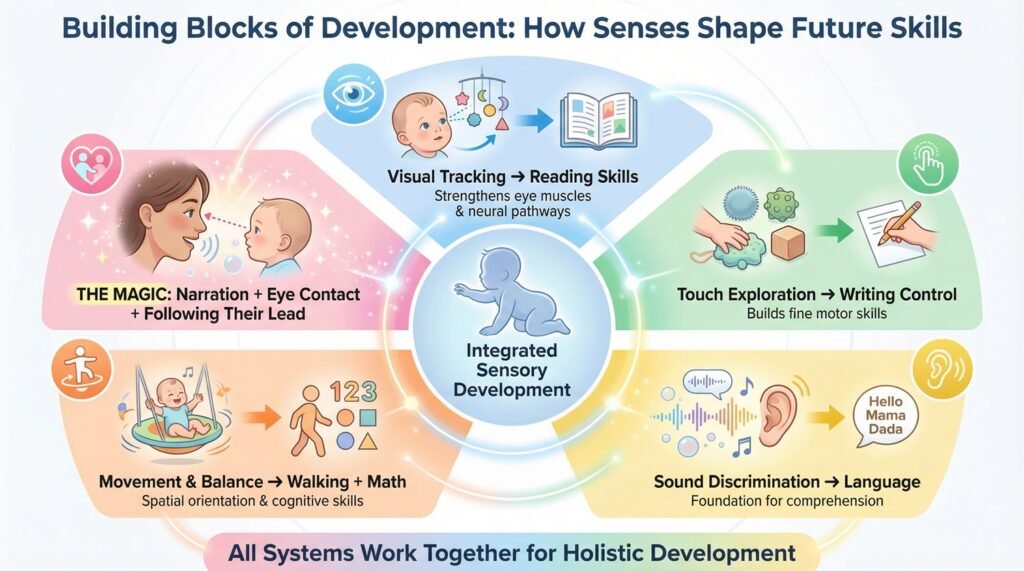
The sensory systems work together in beautifully integrated ways. Visual tracking exercises strengthen the eye muscles and neural pathways that will eventually support reading.
Tactile exploration builds the fine motor control needed for writing.
Auditory discrimination of different sounds and voices lays the groundwork for language comprehension. Movement activities that engage the vestibular system (your baby’s sense of balance and spatial orientation) support everything from walking to understanding mathematical concepts years down the line.
What really struck me when I started researching infant development was how much emphasis the scientific literature places on the caregiver’s role. Your baby doesn’t just need sensory stimulation, they need you to be present during it.
The narration you provide, the eye contact, the responsive interactions where you notice what captures their attention and follow their lead, that’s where the magic really happens.
A baby exploring a textured toy alone gets some benefit. A baby exploring that same toy while you describe what they’re feeling and respond to their reactions gets exponentially more developmental value from the experience.
Safety Foundations You Cannot Skip
I need to be really direct about this: sensory play safety is non-negotiable, and the stakes are genuinely high. Every year, emergency rooms see babies who’ve choked on small objects, ingested toxic materials, or been injured during what parents thought were safe activities.
I’m not trying to fearmonger here, but I do want you to take this seriously.
The choking hazard issue is probably the most critical. Babies explore everything with their mouths because that’s actually a vital part of how they learn about object properties.
This means anything smaller than a toilet paper roll diameter poses a real risk.
And here’s what caught me off guard as a new parent: that risk doesn’t reduce as much as you’d think during the first year. Even at ten or eleven months, when babies seem so much more capable, they’re still putting everything in their mouths and don’t have the judgment to avoid dangerous objects.
Material safety is equally important but less obvious. The research on endocrine disruptors and developmental toxins has become really compelling in recent years.
Babies’ developing brains and bodies are significantly more vulnerable to chemicals like BPA, phthalates, and lead than adults are.
When you’re selecting toys or materials for sensory play, look for products specifically labeled as non-toxic and free from these compounds. Wood toys are generally safer than plastic ones, though you need to verify the finish is food-safe since your baby will definitely be gnawing on them.
One safety issue that doesn’t get enough attention is overstimulation. We tend to think more is better when it comes to developmental activities, but babies’ nervous systems can become genuinely overwhelmed. I learned this the hard way when my son was around four months old.
I’d set up this elaborate sensory experience with many textured fabrics, a mirror, some rattles, and music playing.
He seemed engaged at first, but within about ten minutes he was crying inconsolably. His nervous system had basically hit overload, and he needed calm, quiet time to regulate.
Now I know to watch for the early signs: gaze aversion, fussiness, turning away, or becoming very still and withdrawn. Those are your baby’s way of saying they need a break.
Respecting these signals teaches them that their communication matters and helps them develop healthy self-regulation skills.
Sensory Experiences for the Fourth Trimester
The first three months are often called the fourth trimester because babies are still adjusting to life outside the womb. Their sensory systems are functional but immature, and they need gentle, simple stimulation as opposed to complex activities.
Vision develops rapidly during this period, but newborns can only focus clearly on objects about eight to twelve inches from their face, conveniently, about the distance to your face when you’re holding them. Their color perception is limited at first, which is why high-contrast black and white patterns are so effective.
I made simple cards with bold geometric patterns and would hold them in my baby’s line of sight during diaper changes.
The focused attention these garnered was really remarkable.
Mobiles are wonderful for this age, but placement matters more than most parents realize. You want the mobile positioned where your baby can actually see it, which usually means slightly to one side as opposed to directly overhead.
Watch where your baby’s gaze naturally travels when they’re lying on their back, and position the mobile there.
For tactile input, nothing compares to skin-to-skin contact. The research on this is absolutely clear: direct skin contact with caregivers regulates babies’ temperature, heart rate, and stress hormones while promoting bonding and neural development.
I kept my babies in just a diaper against my bare chest for hours every day in those early weeks.
It was genuinely therapeutic for both of us, providing essential sensory input and emotional connection simultaneously.
Beyond skin-to-skin, you can introduce varied textures gently. Let your baby’s hand brush against a soft fleece blanket, then a smooth cotton sheet, then a slightly rougher linen.
You’re not looking for a big reaction necessarily.
Just the experience of different tactile input is valuable. Their brain is cataloging these sensations, building a library of textural experiences that will serve them throughout life.
Auditory experiences at this age should emphasize your voice above everything else. Talk to your baby constantly.
Narrate what you’re doing, sing silly songs, read board books out loud even though they can’t possibly understand the words yet.
Vary your pitch and tone, babies are particularly drawn to higher-pitched, melodic speech patterns. Some gentle music is nice too, but honestly, your voice is the most neurologically significant sound your baby can hear.
Movement activities are crucial but often overlooked. Babies need to experience different positions and movements to develop their vestibular system. Carry your baby facing different directions.
Hold them upright against your shoulder, then cradle them horizontally, then hold them facing outward.
Each position provides different sensory input. I’d also do very gentle movements, swaying side to side, bouncing slightly, rocking.
These motion experiences are foundational for balance and spatial orientation later.
Tummy time deserves special mention because it’s genuinely challenging for many babies, and therefore many parents give up on it too quickly. Start with just a minute or two several times daily.
You can lay your baby on your chest while you recline as opposed to on the floor if that’s more tolerable.
The goal is building neck and shoulder strength, which is critical for every motor milestone that follows. I’d place high-contrast images or small toys just within my baby’s line of sight to give them motivation to lift their head and look around.
Expanding Exploration from Four to Six Months
Around four months, you’ll notice your baby becoming dramatically more interactive. They’re reaching for objects intentionally now, bringing things to their mouth, starting to roll, and showing clear preferences for certain toys or activities.
This is such a fun stage for sensory play because you get real feedback about what’s working.
Grasping development takes center stage during these months. Offer toys that are easy to grip, rattles with handles, soft fabric blocks, teething toys with various textures.
My babies were obsessed with crinkle toys at this age.
There’s something about that crunchy sound and the tactile feedback that’s absolutely irresistible to this developmental stage. You can actually make these yourself by sewing pockets of crinkly cellophane or parchment paper into fabric scraps, just make sure everything is securely sewn so nothing can come loose.
Sensory bottles became a staple in our house around this time. I’d fill clear plastic bottles (thoroughly cleaned, with lids glued shut) with water, oil, food coloring, and sometimes small objects like buttons or beads.
As the baby tilts and shakes the bottle, the liquids move in mesmerizing ways.
This provides visual stimulation, encourages grasping and manipulation, and teaches cause and effect. The key is making absolutely certain the lid cannot come off.
I used industrial-strength glue and then wrapped the seam with waterproof tape.
Mirrors are phenomenal for this age. Babies don’t yet recognize themselves, but they’re fascinated by faces, and the mirror provides endless visual interest.
You can prop a baby-safe mirror next to them during tummy time or attach one to the side of the crib.
Watch your baby’s expressions as they study the “other baby” in the mirror, you can practically see the neural connections forming as they process this visual information.
Musical cause-and-effect toys work beautifully now too. Simple toys where pressing a button produces a sound teach your baby that their actions have predictable results.
This seems basic, but it’s genuinely profound cognitive development.
You don’t need expensive electronic toys for this, a simple drum that makes noise when hit or a set of measuring spoons that clang together when banged serve the same developmental purpose.
I also started introducing more deliberate texture exploration during this period. I’d gather fabric scraps in different materials, velvet, corduroy, satin, burlap, fleece, and let my baby touch and manipulate them.
I’d describe what they were feeling: “This one is really soft and smooth. This one is bumpy and rough.” Even though they couldn’t respond verbally, they were absorbing that vocabulary and making associations between the words and the sensory experiences.
Complex Sensory Learning from Seven to Twelve Months
Once babies become mobile, their sensory needs and capabilities expand dramatically. They’re crawling or scooting, pulling up on furniture, maybe even taking first steps.
They can manipulate objects with increasing precision, understand object permanence, and engage in increasingly sophisticated cause-and-effect play.
Water play becomes absolutely phenomenal at this stage. Bath time changes from a purely functional activity into a rich sensory learning experience.
I’d give my babies various containers, cups of different sizes, squeeze bottles, floating toys.
They’d spend twenty minutes just pouring water from one cup to another, completely absorbed. This simple activity engages tactile sensation, visual tracking, bilateral coordination (using both hands together), hand-eye coordination, and proprioception (awareness of where their body is in space). It’s also wonderfully calming for many babies.
Sensory bins really come into their own during these months, though they need close supervision. For younger babies in this age range, I’d stick with dry bins filled with large items.
Dried pasta shapes, large cereal pieces, shredded paper, or fabric scraps work well.
Add in some tools, a small cup, a wooden spoon, a container with a wide opening, and let your baby explore scooping, pouring, and touching. The key is making sure all items are large enough that they don’t pose choking hazards.
As babies approach their first birthday and their mouthing behavior starts to decrease slightly (emphasis on slightly), you can introduce edible sensory bins. These are particularly great for babies who still put everything in their mouths because it doesn’t matter if they eat the materials.
Cooked pasta is fantastic for this.
Let it cool completely, add a tiny bit of oil so it doesn’t stick too badly, and let your baby squish it through their fingers. The texture is interesting, it’s completely safe to ingest, and the sensory input is really rich.
I made homemade finger paint using equal parts flour and water with food coloring, and my daughter absolutely loved spreading it on her high chair tray. Was it messy?
Absolutely.
But the sensory experience, the cool, slippery texture, the visual feedback of seeing colors mix, the motor control required to spread it around, was incredibly valuable. Plus, it was entirely edible, though it didn’t taste good enough that she tried more than once.
Stacking toys and nesting cups provide wonderful cognitive challenges at this age. They teach spatial relationships, size differentiation, and problem-solving.
My son would spend ages trying to fit cups together in different combinations, and you could see him working through the puzzle mentally.
When something didn’t fit, he’d try a different approach. That kind of flexible thinking is exactly what we want to encourage.
Touch-and-feel books are particularly effective now because babies can turn pages (sort of) and deliberately reach out to touch different textures. I’d spend time on each page, encouraging my baby to touch the fuzzy bunny or the smooth mirror or the rough tree bark.
The combination of visual, tactile, and language input makes these books remarkably effective developmental tools.
Musical instruments designed for babies, drums, shakers, simple xylophones, provide auditory, tactile, and motor development all at once. They’re also helping your baby develop rhythm awareness and understanding of how different actions produce different sounds.
Don’t underestimate the value of wooden spoons and metal bowls either.
Some of my babies’ most engaged musical play happened with kitchen items as opposed to actual toy instruments.
Making Sensory Play Work in Real Life
The gap between ideal sensory play and real-life implementation can feel really overwhelming. You’re tired, your house is chaotic, you have seventeen other things you need to do, and the thought of setting up an elaborate sensory activity feels impossible.
I absolutely get it.
Here’s what worked for me: integrating sensory experiences into activities I was already doing anyway. Bath time became water play.
Getting dressed became texture exploration as I’d let my baby touch the different fabrics before putting them on.
Meal preparation included letting my baby play with a silicone spatula or wooden spoon while sitting in the high chair nearby. These small moments add up to significant sensory input without requiring dedicated setup time.
I also stopped trying to do everything. Instead of attempting to provide visual, auditory, tactile, and movement input all at once, I’d focus on one or two sensory systems per play session.
Monday might be texture exploration day.
Wednesday we’d focus on auditory experiences. Friday was movement and vestibular input.
This made everything more manageable and actually prevented overstimulation.
Rotation became my best friend. Instead of having all toys available all the time, I’d keep most of them stored and rotate what was accessible.
This kept things feeling fresh and novel without requiring me to constantly buy new items.
A toy that had been stored for two weeks felt brand new again when it reappeared. I’d typically rotate toys every week or two, which meant my baby always had something “new” to explore.
The timing of sensory play matters more than I initially realized. My babies were most receptive to engaging activities in the morning after they were fed and rested. Trying to do sensory play when they were tired or hungry was an exercise in frustration. I learned to read their cues and offer these experiences when they were in the right state to benefit from them.
I also became really protective of the principle that less is more. One high-quality sensory experience beats five mediocre ones.
Fifteen minutes of focused, engaged play where I was truly present and responsive was worth more than an hour of distracted activity where I was just trying to keep my baby occupied while I did other things.
Frequently Asked Questions
When should I start sensory play with my baby?
You can start sensory play from birth. Newborns benefit from simple experiences like skin-to-skin contact, listening to your voice, and looking at high-contrast patterns.
The activities just need to be age-appropriate and gentle for their developing nervous systems.
How long should sensory play sessions last?
For newborns, even two to three minutes can be enough. By six months, babies might engage for ten to fifteen minutes.
By their first birthday, some babies can stay engaged for twenty to thirty minutes.
Watch your baby’s cues as opposed to forcing a specific duration.
What are signs my baby is overstimulated during sensory play?
Watch for gaze aversion (looking away persistently), fussiness or crying, arching their back, turning their head away, or becoming very still and withdrawn. These signal that your baby needs a break from sensory input.
Are sensory bottles safe for babies?
Sensory bottles can be safe if constructed properly. Use sturdy plastic bottles with lids that are glued shut with industrial-strength adhesive and then taped over.
Never give babies glass bottles or bottles with lids that could come off.
Can I use rice in sensory bins for babies?
Raw rice poses a choking hazard if ingested and can also expand in the stomach. For babies who still put everything in their mouths, stick with larger items or edible materials like cooked pasta or large cereal pieces.
What household items make good sensory toys?
Wooden spoons, measuring cups, fabric scraps, crinkly paper, cardboard boxes, pots and pans, silicone spatulas, and clean sponges all make excellent sensory toys. Many of the best sensory materials are already in your home.
How do I know if my baby needs more or less sensory input?
Sensory-seeking babies want constant stimulation, get bored easily, and often prefer intense experiences. Sensory-sensitive babies get overwhelmed quickly and prefer calmer, gentler input.
Both are completely normal, just match activities to your baby’s temperament.
Is tummy time considered sensory play?
Yes, tummy time is excellent sensory play. It provides vestibular input, proprioceptive feedback, visual stimulation as babies lift their heads and look around, and tactile input from whatever surface they’re lying on.
Do expensive toys provide better sensory experiences?
Expensive toys do not provide better developmental benefits than simple, well-chosen materials. A baby gets the same neural benefit from exploring a fabric scrap as from a designer sensory blanket.
Focus on variety and safety as opposed to price.
Can sensory play help with baby sleep?
Sensory play can help tire babies out and establish routines, but avoid stimulating sensory activities right before sleep. Calming sensory experiences like gentle music or soft textures work better as part of a bedtime routine.
Key Takeaways
Sensory play during your baby’s first year shapes neural architecture that supports all future learning, making it foundational as opposed to optional.
Safety requires constant vigilance: check for choking hazards, verify materials are non-toxic, supervise continuously, and respect your baby’s signals about overstimulation.
Match activities to your baby’s developmental stage: high-contrast visuals and gentle touch for zero to three months, grasping toys and mirrors for four to six months, water play and sensory bins for seven to twelve months.
Homemade sensory materials provide equal developmental value compared to expensive commercial products while costing pennies and often being safer.
Your narration during sensory play dramatically enhances learning by connecting sensory experiences to language, building vocabulary and conceptual understanding simultaneously.
Rotating materials prevents overstimulation and maintains novelty without requiring constant purchases or storage space for dozens of toys.
Following your baby’s lead and respecting their signals builds healthy attachment, emotional regulation, and the understanding that their communication matters.