
We may earn money or products from the companies mentioned in this post.
For years I have watched babies explore the world around them, and honestly, it never gets old. Today I am sharing everything you need to know about when and how to introduce sensory play to your little one.
There are so many factors that influence when your baby is ready for sensory activities. Things like developmental readiness, safety considerations, and understanding what sensory play actually means at different stages all come into play.
With just a bit of knowledge about how babies process sensory information, you can create really meaningful experiences that support their growth from day one.
Sensory play describes how babies use their senses to understand and interact with their environment. Every single time your newborn looks at your face, every time they grasp your finger, every time they startle at a sudden noise, they are engaging in sensory play.
The human brain processes information through seven sensory systems, not just the five we typically think about. Beyond sight, sound, smell, taste, and touch, babies also have proprioception (awareness of body position) and their vestibular system (balance and spatial orientation).
These systems do not develop in isolation. They are constantly working together, building neural pathways that form the foundation for everything from motor skills to emotional regulation to language development.
What makes sensory play so valuable is that it allows babies to be active participants in their own learning. They are gathering crucial information about their own body, about textures, about cause and effect.
That is sensory play in its purest form.
Birth to Three Months: The Sensory Foundation
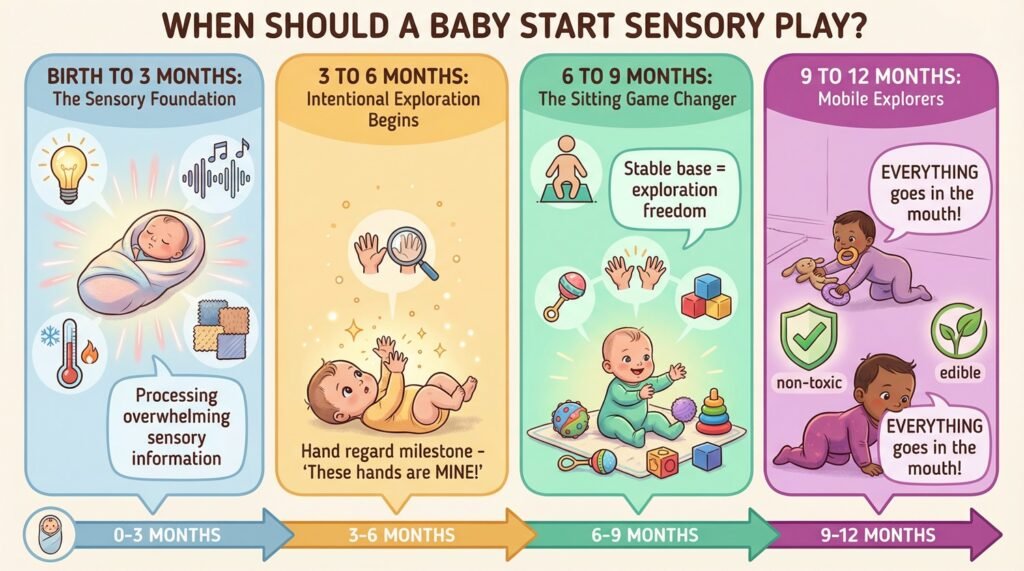
Your baby actually starts sensory play before they are even born. In utero, babies are already hearing sounds, responding to touch, and experiencing movement.
So when people ask me when sensory play should start, my answer is always that it has already started.
In those first few weeks of life, your newborn is processing an absolutely overwhelming amount of sensory information. They have gone from a warm, dark, relatively quiet environment to a world full of lights, sounds, textures, temperatures, and constantly changing stimuli.
Their sensory systems are working overtime just to understand basic existence.
During this stage, the most important sensory experiences are the ones that happen naturally through caregiving. Skin-to-skin contact provides deep pressure input that helps regulate your baby’s nervous system.
Your voice offers auditory stimulation that is familiar and comforting.
Looking at your face gives them high-contrast visual input that their developing vision can actually process. The movement of being held, rocked, or carried activates their vestibular system.
Tummy time, which most parents know is important for motor development, is actually packed with sensory benefits. When you place your baby on their stomach, they are getting proprioceptive input through their arms and chest, vestibular input from being in a different position, visual input as they work to lift their head, and tactile input from whatever surface they are on.
Even if they only tolerate thirty seconds at first, those are thirty seconds of intense sensory processing.
I have found that many parents get really anxious about structured activities during this phase, but honestly, you are already doing everything your newborn needs. Simple things like varying the textures they lie on (a soft blanket, a cotton sheet, a playmat), letting them observe different lighting conditions, and exposing them to different sounds in your daily routine are all forms of sensory play.
The key during this early stage is recognizing that your baby is already experiencing sensory overload just by existing in the world. You do not need to add extra stimulation.
Instead, focus on providing gentle, predictable sensory experiences through your everyday interactions.
The way you hold your baby, the tone of your voice, the gentleness of your touch, these are the building blocks of sensory development.
Three to Six Months: Intentional Exploration Begins
Around three months, you will notice a really significant shift. Your baby becomes much more intentional about their movements and interactions. They are starting to reach for objects, bring things to their mouth, and track moving objects with their eyes.
This is when you can start thinking more deliberately about offering sensory experiences.
Hand regard, where babies stare intently at their own hands, is a major sensory milestone during this period. They are literally discovering that these things attached to their body belong to them and that they can control them.
You can support this discovery by occasionally putting different safe textures in their hands.
A silk scarf feels completely different from a washcloth, which feels different from a wooden spoon.
Mouthing objects is absolutely critical at this stage, and it is a completely normal and important part of sensory development. Your baby’s mouth has more sensory receptors than their hands, so putting everything in their mouth is actually a sophisticated way of gathering information.
This means you need to be really thoughtful about what objects are within their reach, but it does not mean you should prevent mouthing altogether.
Water play can start to be introduced during bath time, and babies at this age are often fascinated by it. The sensation of water running over their skin, the way it moves and splashes, the temperature difference, all of this provides valuable sensory input.
You can let water drip from a washcloth onto their belly or their hands.
You can gently splash the water and let them watch the movement.
Sound exploration becomes much more interactive during this phase. Your baby might start making their own sounds and then pause, listening to themselves and to your response.
They are learning about cause and effect through auditory feedback.
Simple activities like crinkling paper near them, shaking a rattle, or singing songs with varied rhythms all support auditory processing development.
During this stage, I notice parents often want to rush into elaborate setups, but babies this age benefit most from simple, focused sensory experiences. One texture at a time.
One new sound.
One interesting object to explore fully. Giving them time to really process what they are experiencing builds deeper neural connections than constantly switching between many stimuli.
Six to Nine Months: The Sitting Game Changer
Once your baby can sit independently, the whole world of sensory play opens up in a new way. Sitting frees up their hands and gives them a stable base from which to explore.
This is when you might start thinking about what most people picture when they hear “sensory play”, contained experiences with different materials.
Food is honestly one of the best sensory materials for this age group. Whether you are doing traditional weaning or baby-led weaning, mealtimes become sensory play sessions.
The squish of a banana, the texture of avocado, the way rice cereal feels between their fingers, these are all valuable sensory experiences.
Yes, it is messy. Yes, more food ends up on the floor than in their mouth initially.
But your baby is learning so much about textures, temperatures, smells, and tastes.
Simple sensory baskets become really engaging at this stage. You can put together a basket with three or four safe household objects that have different properties.
A wooden spoon, a silicone spatula, a small metal measuring cup, and a soft cloth napkin gives your baby four completely different tactile experiences to compare.
They will likely spend a good amount of time moving these objects from hand to hand, banging them together, and yes, putting them in their mouth.
Cause and effect toys are particularly suitable now because your baby is starting to understand that their actions produce results. Toys that make noise when shaken, balls that roll when pushed, and pop-up toys all provide sensory feedback that reinforces this understanding.
This is actually early problem-solving in action.
One thing I have noticed is that parents sometimes underestimate how much sensory input babies get from everyday activities. Going for a walk provides vestibular input from the stroller movement, visual input from changing scenery, auditory input from environmental sounds, and sometimes tactile input from wind or sun on their skin. You do not need to buy special equipment or create elaborate setups to provide rich sensory experiences.
Nine to Twelve Months: Mobile Explorers
Once your baby starts crawling and potentially cruising or walking, their sensory world expands exponentially. They can now move toward interesting sensory experiences as opposed to waiting for you to bring things to them.
This increased mobility also means their vestibular and proprioceptive systems are getting constant input.
This is a really good age to introduce safe messy play. I am talking about things like letting them explore cooked pasta, playing with water in a small basin, or squishing cooked sweet potato between their fingers.
The key word here is safe.
Everything needs to be non-toxic and edible because your baby will absolutely put it in their mouth.
Texture walks become possible once your baby is mobile. You can create a path with different textures for them to crawl or walk across.
A towel, a yoga mat, a piece of cardboard, and a soft rug give four different tactile experiences under their hands and knees or feet.
This type of activity builds body awareness and helps them understand how different surfaces feel.
Container play is incredibly engaging for this age group. Putting objects into containers and dumping them out provides tactile feedback, visual tracking practice, spatial reasoning experience, and fine motor skill development all at once.
You can use a muffin tin and tennis balls, a basket and wooden blocks, or any similar combination of container and objects.
Music and movement activities become much more interactive. Your baby might start bouncing to music, swaying when they hear singing, or clapping along to songs.
These activities integrate auditory input with motor planning and proprioceptive feedback.
Dancing while holding your baby provides vestibular input and is also just really fun for both of you.
Twelve to Eighteen Months and Beyond
After the first birthday, sensory play becomes increasingly complex and purposeful. Toddlers at this stage can follow simple instructions, which means you can start introducing more structured sensory activities while still following their lead.
Sensory bins become really valuable now, though they still need close supervision. A bin filled with dry rice or oats and some scoops and containers can provide twenty minutes of focused exploration.
You can hide small objects in the material for them to uncover, which adds an element of surprise and problem-solving to the sensory experience.
Art activities start to become suitable, though with significant modifications. Finger painting with edible paint (yogurt mixed with food coloring works well) let’s your toddler explore color, texture, and cause and effect.
Drawing with chunky crayons provides different sensory feedback through the resistance of the crayon on paper and the visual result of their actions.
Water play becomes much more elaborate. A water table or even just a large plastic bin with water, cups, funnels, and sponges can provide extended sensory exploration.
Your toddler is learning about volume, about how water behaves, about buoyancy, and about cause and effect, all while getting valuable tactile input.
Outdoor play offers some of the richest sensory experiences available. Walking on grass, digging in dirt, feeling bark on trees, hearing birds, seeing clouds move across the sky, nature provides constantly changing sensory input that you cannot copy indoors.
Even something as simple as letting your toddler walk through fallen leaves provides tactile, auditory, and proprioceptive input.
Safety Considerations at Every Stage
Supervision is absolutely non-negotiable with sensory play, especially before age three. Choking hazards are the primary concern, which is why so many experts recommend that anything used for sensory play with young babies be large enough that it cannot fit entirely into their mouth, or alternatively, be completely safe if swallowed.
Materials matter tremendously. Natural materials like wood, cotton, and silk are generally better choices than plastic, particularly for young babies.
They provide more varied tactile input and often have less risk of containing harmful chemicals.
That said, there are plenty of safe plastic options, especially for water play or activities where you need something that can be thoroughly cleaned.
Temperature awareness is important but often overlooked. Materials that feel fine to your hands might feel uncomfortable to your baby. Always test the temperature of water, avoid materials that have been sitting in direct sunlight, and be aware that babies have more sensitive skin than adults.
Allergies and skin sensitivities mean you need to introduce new materials gradually, especially anything edible or anything that will be in direct contact with skin for extended periods. If you notice any redness, irritation, or unusual reactions, stop use of that material immediately.
Cleanliness is important but does not need to be taken to extremes. Regular cleaning of toys and materials is sensible.
Sterilizing everything constantly is not necessary and might actually limit the useful exposure to normal environmental bacteria that helps build immune systems.
Use judgment based on where materials have been and what they have been exposed to.
Creating a Sensory-Rich Environment Without Overwhelm
One of the biggest challenges parents face is balancing the want to provide rich sensory experiences with the reality of limited space, limited budget, and limited energy. The good news is that sensory play does not need buying lots of stuff or creating elaborate setups.
Rotation is your friend. Instead of having every toy and material available all the time, keep some things put away and rotate them every week or two.
This keeps the environment from becoming overwhelming and makes “old” toys interesting again because your baby has not seen them recently.
Household items often make the best sensory materials. Wooden spoons, metal bowls, fabric scraps, cardboard boxes, and natural items like pinecones or smooth stones (size-appropriate, of course) cost nothing and provide excellent sensory experiences.
Your kitchen is honestly a goldmine for sensory play materials.
Simplicity is often more effective than complexity. A basket with three interesting objects will usually engage your baby more effectively than a toy box overflowing with thirty items.
When there are too many choices, babies often flit from thing to thing without really engaging with any of them.
Fewer, more intentionally chosen items promote deeper exploration.
Following your baby’s lead is crucial. If they are fascinated by crinkly paper, lean into that.
If they could spend thirty minutes transferring objects from one container to another, let them.
The sensory experiences they choose for themselves are often exactly what their developing brain needs at that moment.
People Also Asked
When can babies start tummy time?
You can start tummy time from birth. Begin with just a few minutes several times a day, placing your newborn on their stomach on a firm, flat surface while they are awake and you are supervising.
This early start helps build neck strength and provides important sensory input right from the beginning.
What age can babies play with water?
Babies can experience water play during supervised bath time from birth. Around six months, when they can sit with support, you can introduce more interactive water play with cups and toys during bath time.
Always supervise closely, as even small amounts of water can be dangerous.
When do babies start putting toys in their mouth?
Most babies start bringing objects to their mouth around three to four months old. This is a normal and important part of sensory development, as babies have more sensory receptors in their mouths than in their hands.
Make sure all toys and objects within reach are safe for mouthing.
How long should tummy time be at 2 months?
At two months, aim for several short tummy time sessions throughout the day, totaling about 10-15 minutes. You can break this into sessions of just 2-3 minutes if your baby gets fussy.
The key is consistency and gradually building up tolerance as your baby gets stronger.
What textures are safe for newborns?
Safe textures for newborns include soft cotton blankets, smooth wooden toys (large enough not to be choking hazards), silicone teething toys, and natural fabrics like silk or fleece. Avoid anything with small parts, rough edges, or materials that could shed fibers.
Can 6-month-old babies play with rice?
Dry rice can be a choking hazard for babies who still put everything in their mouths. Wait until your child is older (usually around 18-24 months) and understands not to eat sensory materials before introducing dry rice play.
For younger babies, stick with larger, safer materials.
What are signs of sensory overload in babies?
Signs of sensory overload include fussiness, crying, turning away from stimuli, arching their back, becoming very still or “shutting down,” difficulty making eye contact, and changes in breathing patterns. If you notice these signs, move to a quieter, calmer environment and offer comfort.
When can toddlers start sensory bins?
Most children can start exploring sensory bins around 12-18 months, but this varies based on person development and whether they still often mouth objects. Always supervise closely and start with larger materials that cannot be swallowed before moving to smaller items like rice or beans.
Key Takeaways
Sensory play begins at birth and continues to advance as your baby grows. The earliest forms happen naturally through everyday caregiving activities like holding, feeding, and talking to your baby.
Between three and six months, babies become more intentional in their exploration, using their hands and mouth to gather information about objects and textures around them.
Sitting independently around six to nine months opens up new possibilities for contained sensory experiences with different materials, though supervision stays essential.
Mobile babies from nine to twelve months benefit from whole-body sensory experiences that incorporate movement, different textures underfoot, and increasingly complex cause-and-effect activities.
After twelve months, sensory play can include more structured activities like simple art projects, sensory bins, and elaborate water play, always matched to your child’s current abilities and interests.
Safety requires constant supervision, age-appropriate materials, awareness of choking hazards, and attention to your specific baby’s sensitivities and reactions.
You do not need expensive toys or complicated setups to provide rich sensory experiences. Household items and everyday activities offer plenty of opportunities for sensory exploration.
Following your baby’s lead and observing their preferences creates more valuable learning experiences than rigidly following activity plans designed for other children.
Every baby develops at their own pace, and sensory preferences vary significantly. What works for one baby might not work for another, and that is completely normal and expected.