
We may earn money or products from the companies mentioned in this post.
Introduction
The first year of life is packed with sensory discoveries. Every texture, sound, color, and movement helps build neural pathways in your baby’s developing brain. Baby sensory play offers structured ways to engage these developing senses without overstimulation, and the right toys make this process both safe and joyful.
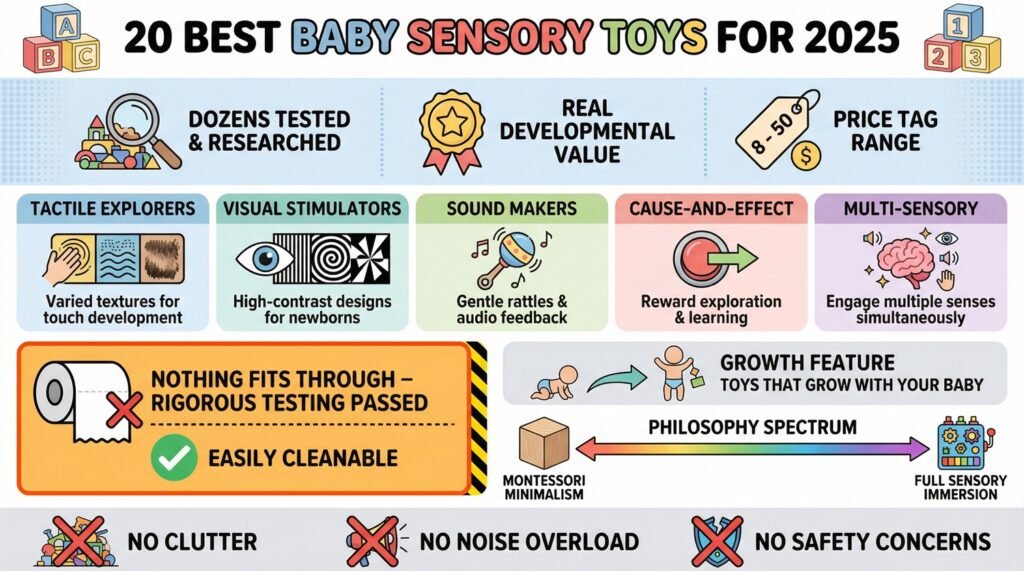
Sensory toys come in several categories: tactile explorers with varied textures, high-contrast visual stimulators for newborns, gentle rattles and sound makers, cause-and-effect toys that reward exploration, and multi-sensory combinations that engage several senses at once. The best options grow with your baby, pass rigorous safety tests (nothing fits through a toilet paper roll), and can be cleaned easily.
We’ve tested and researched dozens of options to bring you 20 toys that deliver real developmental value without the clutter, noise overload, or safety concerns that plague cheaper choices.
These picks range from $8 wooden rattles to $50 activity centers, all chosen to match different stages, budgets, and parenting philosophies from Montessori minimalism to full sensory immersion.
20 Best Baby Sensory Toys for 2025
1. Manhattan Toy Winkel Rattle & Sensory Teether
This award-winning toy features soft, continuous BPA-free plastic loops that babies can grasp, mouth, and shake from day one. The loops create a quiet rattle sound and come in bright colors that captivate even newborn eyes.
The whole thing measures about 5 inches across, passes all choking hazard tests, and wipes clean in seconds.
Parents consistently rate this as the most-used toy in their rotation because it soothes teething pain, entertains during diaper changes, and survives countless drops without breaking. It works from 0-12 months and beyond.
Get the Winkel Rattle on Amazon and give your baby a toy that grows with them from newborn to toddler.
Price: Around $18 | Ages: 0+ months | Best for: All-around tactile and auditory exploration
2. Lovevery The Inspector Play Kit (Month 5-6)
This subscription-based play kit arrives with stage-appropriate toys including a sliding top box, nesting containers, and a wooden ring-stacker. Everything is crafted from sustainable wood and organic fabrics.
The genius comes from the research-backed design: each piece targets specific developmental milestones like object permanence, cause-and-effect learning, and fine motor control.
The accompanying play guide explains exactly how to use each toy, which eliminates guesswork for anxious first-time caregivers. While pricier than single toys, the kit approach prevents accumulating random items.
Price: $120 per kit (or subscribe for many stages) | Ages: Stage-specific (0-24+ months) | Best for: Montessori-aligned milestone development
3. Fisher-Price Deluxe Kick & Play Piano Gym
This play mat changes from lay-and-play for newborns to sit-and-play as babies grow. Five hanging toys dangle overhead (a mirror, crinkle lion, elephant rattle, and more), and a detachable piano at the foot lights up and plays music when kicked. The mat itself features high-contrast patterns perfect for tummy time.
You can reposition the arches in many configurations, and the piano removes for on-the-go play.
Parents love that it keeps babies engaged for 20-30 minutes, offering much-needed hands-free time. Wipe-clean surfaces and machine-washable mat make cleanup simple.
Price: $45-60 | Ages: 0-12 months | Best for: Multi-sensory engagement and tummy time
4. Infantino Textured Multi Ball Set
Six soft balls in different textures, colors, and sizes give babies varied tactile experiences. Some balls have bumps, others are smooth, one squeaks, another rattles.
They’re lightweight enough for tiny hands to grasp and soft enough to be safe during enthusiastic throws.
The variety teaches babies that different objects behave differently, an early physics lesson. At under $15 for the full set, this offers incredible value for sensory exploration.
Just dry them thoroughly if they get wet to prevent mold growth inside the squeaker holes.
Price: $12-14 | Ages: 3+ months | Best for: Budget-friendly tactile variety
5. Sassy Stacks of Circles Stacking Ring Toy
Nine textured rings in rainbow colors slide onto a flexible post. Unlike traditional stackers with rigid posts, this bendy center prevents frustration because rings can go on in any order.
Each ring offers different textures (smooth, bumpy, ridged) and some contain rattling beads.
The rounded base wobbles when batted, adding cause-and-effect learning. This classic toy teaches size differentiation, color recognition, and hand-eye coordination.
Inspect the rings periodically for cracks and supervise water play to prevent mold.
Price: $7-10 | Ages: 6+ months | Best for: Introduction to stacking and sorting
6. Hape Rainbow Wooden Stacker
This Montessori-favorite features smooth wooden arches in rainbow colors that stack or nestle. The pieces are connected by an elastic cord, so nothing gets lost and there are no choking hazards from small pegs.
The natural wood finish (non-toxic, water-based paint) provides authentic tactile feedback that plastic can’t match.
Babies start by grasping and mouthing the pieces, then progress to stacking and creating patterns. The open-ended design means it remains engaging well into toddlerhood for imaginative play like building tunnels or bridges.
Price: $20-25 | Ages: 12+ months (younger with supervision) | Best for: Natural materials and Montessori approach
Shop Hape Rainbow Stacker on Amazon for heirloom-quality wood toys that last for years.
7. Skip Hop Bandana Buddies Activity Toy
These soft, plush animals clip to strollers, car seats, or diaper bags with built-in loops. Each features many textures including satin ribbons, crinkle fabric, and a teething bandana.
The contrasting patterns on the fabric help visual tracking, while squeakers and crinkles reward exploration.
The 6-7 inch size makes them perfect for travel, and the clip keeps them from hitting the floor repeatedly. Machine-washable, though spot-clean the interior squeakers.
Available in many animals (fox, elephant, owl), each with slightly different features.
Price: $13-16 | Ages: 0+ months | Best for: On-the-go sensory play
8. Dimpl Sensory Toy by Fat Brain Toys
Five colorful silicone bubbles sit in a sturdy plastic frame. Babies poke the bubbles, which pop through to the other side with a satisfying sensory experience.
The bubbles are different sizes, encouraging fine motor skill development as babies learn to use different amounts of pressure.
The toy is completely safe to mouth, dishwasher safe, and has won many awards for design and engagement. Babies as young as 6 months can use it, and many toddlers still find it fascinating.
It’s small enough for travel and provides quiet entertainment in restaurants or waiting rooms.
Price: $12-14 | Ages: 6+ months | Best for: Quiet, focused tactile play
9. Lamaze Freddie the Firefly
This clip-on toy packs most sensory variety into a compact package. Freddie features a mirror for self-discovery, crinkly wings, squeaking body, knotted antennae for teething, textured ribbons, and high-contrast colors.
Each body segment offers something different to explore.
The clip attaches securely to strollers or car seats, making it ideal for errands and travel. Parents report this toy consistently entertains babies for longer periods than simpler toys because there’s always something new to uncover.
Machine wash on gentle cycle.
Price: $10-13 | Ages: 0+ months | Best for: Maximum sensory variety in small package
10. Baby Einstein Magic Touch Piano
This wooden piano responds to touch without keys or buttons, using Magic Touch technology. Babies tap the colored panels to create musical notes, learning cause-and-effect as they compose their own songs.
Two modes offer either person notes or full melodies.
The volume stays reasonable (under 85dB), protecting developing ears. The wooden construction feels substantial and won’t tip easily.
This bridges the gap between sensory toy and musical instrument, introducing pitch and rhythm concepts from 6 months onward.
Price: $25-30 | Ages: 6+ months | Best for: Musical exploration without loud electronics
11. VTech Busy Learners Activity Cube
Four sides of interactive learning packed into one cube. Features include spinning gears, shape sorters, light-up buttons, a miniature piano, and moving animal characters.
The sounds and songs teach colors, numbers, and shapes while developing fine motor skills.
The stationary design (doesn’t roll away) makes it perfect for seated play. Some parents find the 65+ songs repetitive, so this works best in playrooms as opposed to small living spaces.
Requires 2 AA batteries.
The variety keeps babies engaged as they explore new features over time.
Price: $28-35 | Ages: 6-24 months | Best for: Extended engagement with many activities
12. Oball Classic Ball
This brilliantly simple ball features holes throughout its structure, making it easy for even newborns to grasp. The flexible plastic moves with little squeezes and always returns to shape.
It bounces unpredictably, encouraging crawling babies to chase it.
The holes let babies see through to the other side, teaching object permanence. Available in many colors and sizes, including versions with internal rattles.
At 4 inches diameter, it’s too large to be a choking hazard.
Dishwasher safe and nearly indestructible after thousands of floor drops.
Price: $5-8 | Ages: 0+ months | Best for: First ball and grasping practice
Add an Oball to your cart on Amazon for under $10 and watch your baby master grasping within days.
13. Melissa & Doug K’s Kids Musical Farmyard Cube
Six sides featuring barn animals, zippers, buttons, and lift-the-flaps. Squeeze the cube to hear animal sounds and music.
The soft, quilted construction is perfect for younger babies who are still developing coordination, no hard edges or pinch points.
Machine washable after removing the electronic sound unit (easy velcro access). The musical element engages auditory senses while the varied textures and activities develop fine motor skills.
Some parents remove the sound unit for quieter play, which works perfectly fine.
Price: $18-22 | Ages: 6+ months | Best for: Soft, squeezable multi-sensory cube
14. Tomy Toomies Hide & Squeak Eggs
Six colorful eggs split open to reveal cheeping chicks inside. Each egg is a different color and shape (circle, square, triangle, etc.), and they all nest in a carton.
Babies learn matching, sorting, and object permanence while enjoying the squeaking sounds.
The chunky size is perfect for small hands, and the pieces are too large to be choking hazards. This toy grows from simple sensory play (6 months) to more complex sorting activities (12+ months).
Wipe clean with damp cloth.
Price: $12-15 | Ages: 6+ months | Best for: Sorting and object permanence
15. Nuby Ice Gel Teether Keys
A set of four colorful keys on a ring, filled with purified water that can be chilled. The textured surfaces massage sore gums while the cold numbs teething pain. The keys are large enough to prevent choking and the ring is easy for babies to hold. Unlike some gel teethers, these have proven durable without leaking.
Refrigerate (don’t freeze) for best results.
They also work at room temperature for babies who don’t like cold. At under $5, keep one set at home and another in the diaper bag.
Price: $3-5 | Ages: 3+ months | Best for: Teething relief with sensory texture
16. Plan Toys Dancing Alligator Push & Pull Toy
This wooden alligator’s body sways side-to-side when pulled, demonstrating cause-and-effect in a visual way. Made from sustainable rubberwood with non-toxic finishes, it satisfies the natural materials preference of Montessori and Waldorf families.
While marketed for walkers (12+ months), younger babies enjoy watching the movement when you pull it near them during tummy time.
The motion encourages crawling as babies try to reach the moving toy. The string is short (under 7 inches) to meet safety standards.
Price: $20-24 | Ages: 12+ months (younger with assistance) | Best for: Encouraging crawling and early walking
17. Bright Starts Lots of Links
Twenty-four interlocking plastic links in rainbow colors. These simple C-shaped pieces connect to each other and to stroller bars, car seat handles, or high chair trays.
Babies practice grasping, pulling, and connecting the links, developing fine motor control.
String toys together to keep them from falling, or attach pacifiers and teethers. The links themselves become toys as babies mouth them and learn to pull them apart.
At about $5 for a set, these offer incredible versatility.
BPA-free and dishwasher safe.
Price: $5-7 | Ages: 0+ months | Best for: Multi-use connecting and grasping
18. Baby Einstein Sea & Discover Door Hanger
This fabric activity center hangs on any doorknob, bringing sensory play to eye level. Features include a mirror, crinkle starfish, spinning turtle, and ribbons in various textures.
Designed for tummy time or floor play when unhooked, giving it dual functionality.
The sea creature theme uses bright colors and patterns that engage visual development. Machine washable and folds flat for travel or storage.
This gives you another sensory station without taking up floor space, perfect for smaller homes.
Price: $15-18 | Ages: 0+ months | Best for: Space-saving sensory station
19. Green Toys Stacking Cups
Nine nesting cups made from 100% recycled plastic (milk jugs). Each cup features numbers and shapes molded into the bottom, so they double as sand or water scoops.
Stack them tall, nest them for storage, or use them in the bath.
The recycled plastic means no BPA, phthalates, or PVC, and they’re dishwasher safe. Babies start by grasping and mouthing them, then progress to nesting and stacking around 8-10 months.
The eco-friendly angle appeals to environmentally conscious families.
Price: $12-16 | Ages: 6+ months | Best for: Eco-friendly nesting and stacking
20. Glow Pal Light-Up Bath Toy
These small cubes contain LED lights that activate when they touch water. Drop them in the bath to create a glowing light show that changes bath time into sensory play.
The cubes are sealed completely (no batteries to replace) and last for dozens of baths before the light fades.
Babies are mesmerized by the colorful glowing water, which reduces bath resistance and extends bath time naturally. The cubes are too large to be choking hazards.
Some parents also use them in sensory bins with water beads (though avoid water beads for babies under 3 because of choking risks).
Price: $8-12 per cube | Ages: 6+ months | Best for: Making bath time engaging
Transform bath time with Glow Pals on Amazon and turn cleanup into playtime.
Our Top Pick: Manhattan Toy Winkel
After testing dozens of sensory toys with real families, the Manhattan Toy Winkel Rattle consistently comes out on top. Here’s why it earned our top recommendation.
The Winkel solves many problems at once. Babies can grasp it easily from birth thanks to the looped design, it soothes teething pain with its soft-but-firm texture, the gentle rattle rewards shaking without overstimulating, and it never breaks no matter how many times it hits the floor.
The continuous loop design means there are no small parts that can detach and become choking hazards.
It wipes clean in seconds (important when everything goes in the mouth), and it looks modern enough that you won’t cringe seeing it in living room photos.
The developmental progression makes it worth the $18 investment. Newborns track the bright colors with their eyes.
Two-month-olds start swiping at it during tummy time.
Three-month-olds grasp it with both hands and bring it to their mouths. Six-month-olds shake it deliberately to create rattle sounds, learning cause-and-effect.
Nine-month-olds pass it from hand to hand, developing bilateral coordination.
You’ll use this toy almost daily for the entire first year, which you can’t say about most baby products.
The Winkel also fits many parenting philosophies. Montessori families appreciate that it’s simple and allows open-ended exploration without batteries or flashing lights.
RIE proponents like that babies can use it independently without adult demonstration.
Attachment parenting advocates find it perfect for baby-wearing because it clips to carriers and keeps babies happily occupied. It works equally well at home, in the car, or at restaurants.
Your baby’s development depends on engaging those rapidly forming neural connections through safe, appropriate sensory experiences. Start with the Winkel Rattle from Amazon and build your sensory toy collection from there.
Frequently Asked Questions
What age should you start with sensory toys?
You can start from birth. Newborns benefit from high-contrast visual toys (black and white cards, bold patterns), soft textures against their skin, and gentle sounds.
Their sensory systems are already active and seeking input.
The key is matching the complexity to their developmental stage. A newborn needs simple visual tracking toys and soft tactile experiences, while a 6-month-old is ready for cause-and-effect toys with many textures and sounds.
Start simple and gradually add variety as your baby shows interest and develops new motor skills.
Even a soft cloth or ribbon can be a sensory toy for a newborn when they grasp it and bring it to their face.
How do I know if a toy is actually safe for mouthing?
Check three things: First, can any part of the toy fit through a toilet paper roll? If yes, it’s a choking hazard.
Second, look for certifications like ASTM, CPSIA, or EN71 that confirm third-party safety testing.
Third, check the materials list for BPA-free, phthalate-free, and non-toxic finishes. For wooden toys, confirm the finish is food-safe or specifically labeled as non-toxic.
Avoid toys with small parts that could detach, like button eyes on stuffed animals or removable squeakers.
When in doubt, physically inspect the toy by pulling on all parts to see if anything comes loose, and check online recall databases before purchasing.
Are expensive sensory toys better than budget options?
Not necessarily. Price often reflects brand name, marketing, or premium materials like organic cotton or sustainably-sourced wood, as opposed to developmental effectiveness.
A $7 set of stacking rings can provide the same motor skill development as a $30 designer version.
The Oball, one of the best grasping toys available, costs under $8. That said, higher-priced toys sometimes offer better durability, safer materials, or multi-stage use that justifies the cost over time.
Focus on safety certifications, developmental appropriateness, and whether the toy will genuinely engage your baby as opposed to on price alone.
Sometimes the budget option is perfect, other times spending more gets you a toy that lasts through many children.
How many sensory toys does a baby actually need?
Less than you think. Between 4-8 well-chosen toys rotated regularly will serve your baby better than 30 toys available all at once.
Too many options overwhelm babies and prevent them from deeply exploring any single toy.
A good starter set includes one tactile toy (like the Winkel), one visual toy (high-contrast cards or play mat), one auditory toy (a gentle rattle), and one cause-and-effect toy (like the Dimpl or piano). Add toys as your baby masters current ones or shows new interests.
Store most toys out of sight and rotate them weekly.
This keeps play fresh, reduces clutter, and saves money since you’ll notice which types your baby prefers before buying more.
Can I make effective sensory toys at home instead of buying them?
Yes, with caution. Many DIY sensory toys work beautifully and cost nearly nothing.
Examples include fabric scraps tied in knots, securely sealed bottles filled with colored water and oil, wooden spoons, or sealed containers filled with dry rice or beans.
The benefits are cost savings, customization, and avoiding plastic. The risks are safety hazards if parts come loose or materials are toxic.
Never use small items like buttons, beads, or balloons that pose choking risks.
Supervise all DIY toys more carefully than commercial toys since they haven’t passed safety testing. Check them before each use for wear or damage.
For young babies especially, stick with commercial toys for primary play and use DIY options as supplemental activities under direct supervision.
What’s the difference between sensory toys and regular baby toys?
Sensory toys intentionally target specific senses (touch, sight, sound) or many senses at once to build neural pathways. They typically have varied textures, high-contrast colors, responsive sounds, or interactive elements that reward exploration.
Regular baby toys might entertain without this developmental focus.
For example, a plastic rattle is a regular toy, but a rattle with many textures, a transparent section to see the beads inside, and varied rattle sounds from different chambers is a sensory toy. Baby sensory play specifically aims to provide rich, varied input that strengthens how the brain processes information.
That said, almost any safe object can become a sensory experience for a baby, from a wooden spoon to a soft blanket.
The “sensory toy” label helps identify items designed specifically for this purpose, but doesn’t mean other toys lack value.
How can I tell if my baby is overstimulated by sensory toys?
Watch for these signs: looking away or turning the head consistently, fussiness or crying that starts during play, arching the back, rubbing eyes, hiccupping, or becoming very still and quiet (different from focused attention). Some babies also get red around the eyes or ears, yawn repeatedly, or start sneezing.
If you see these signals, remove the toy and offer quiet comfort like holding them calmly, dimming lights, or moving to a quieter space.
Overstimulation happens more easily with toys that have many features activated simultaneously, like music playing while lights flash and parts spin. Prevent overstimulation by introducing one new toy at a time, keeping play sessions short (5-10 minutes for young babies), and choosing toys with simple features as opposed to everything-at-once activity centers. Follow your baby’s cues, they’ll look at and reach for toys they’re ready to engage with and ignore or avoid ones that are too much.
References
Based on research from pediatric developmental guidelines, safety standards from CPSC and ASTM International, and parent testing data from verified purchase reviews across major retailers, compiled 2024-2025.