
We may earn money or products from the companies mentioned in this post.
The Fat Brain Toys Dimpl is a silicone sensory toy with five colorful bubbles that push in and pop back out. It’s BPA-free, dishwasher safe, and works for babies from about 10 months through toddlerhood.
I bought this thing on a whim during one of those late-night Amazon spirals when my daughter was around 8 months old. She was getting bored with her usual toys, and I kept seeing the Dimpl pop up in those “Montessori toy” lists.
Honestly? I thought it looked too simple to be worth $13.
It’s just silicone bubbles on a plastic frame.
But I was desperate for something new that wouldn’t end up as more clutter in the toy basket, so I grabbed it.
Fast forward six months, and this thing is still in rotation. It comes with us to restaurants, doctor’s appointments, and long car rides.
My kid ignores about 70% of her toys at this point, but the Dimpl?
She’ll grab it and sit there popping the bubbles for a solid 10-15 minutes.
That might not sound like much, but if you’ve got a baby who constantly needs new stimulation, 15 minutes of focused play is basically a secret.
What Makes the Dimpl Different
I’ve tried a bunch of sensory toys at this point. Those crinkle books, the wooden rainbow stackers, various teething rings, textured balls… most of them get played with for maybe a week before they’re forgotten.
The Dimpl keeps coming back into rotation because it’s got this satisfying tactile feedback that babies (and tbh, adults) find weirdly addictive. Each bubble pops through to the other side with a little resistance, then snaps back when you press it again.
The bubbles are different sizes, which I didn’t think would matter much, but I’ve noticed my daughter always goes for the biggest one first, then works her way down to the smaller ones. There’s something about the different levels of resistance that keeps it interesting.
Here’s what’s in the box:
The Dimpl itself (about 5 inches across), and… that’s it. No batteries, no assembly, no extra pieces to lose.
You can literally take it out of the package and hand it to your kid immediately.
The frame is a hard white plastic, and the five bubbles are made of food-grade silicone in bright colors, blue, green, orange, yellow, and pink. The silicone is thick enough that it doesn’t feel cheap or like it’ll tear easily.
Safety Stuff (Because We All Worry About This)
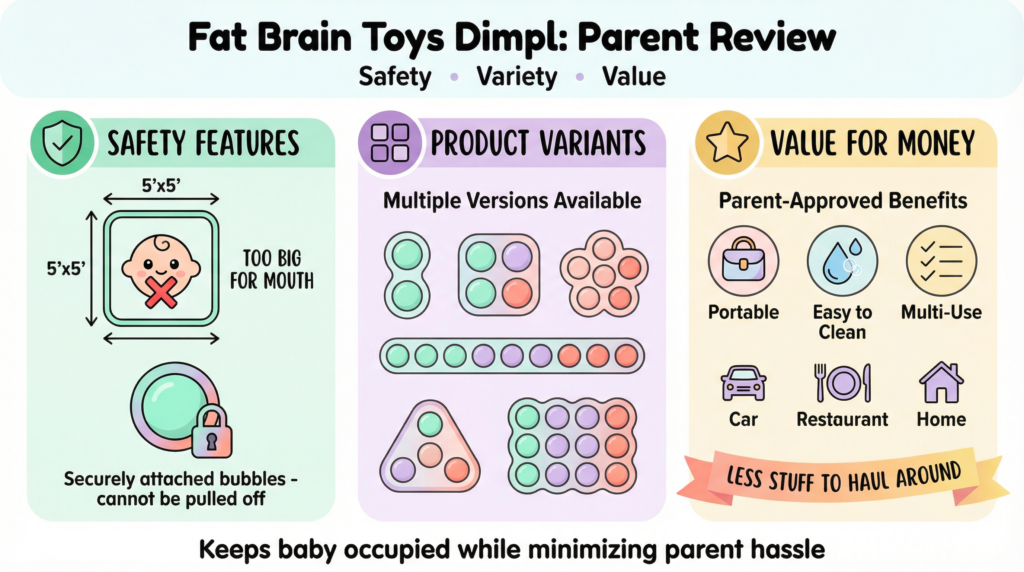
The frame measures about 5 inches by 5 inches, which makes it too big for babies to fully get in their mouths. The bubbles themselves are firmly attached to the frame, so there’s no way to pull them off (and I’ve watched my daughter really try).
It’s rated for 10 months and up, which honestly feels about right. Younger babies don’t have the finger strength to push the bubbles through, and they’re still in that phase where everything just goes directly into the mouth anyway.
My daughter was probably 9.5 months when she started actually engaging with it the way it’s designed. Before that, she’d just gum on the edges and maybe accidentally pop a bubble here and there.
The whole thing is BPA-free, phthalate-free, and latex-free. You can throw it in the dishwasher (top rack), which I do maybe once a week because it inevitably ends up on the floor or gets chewed on.
I’ve also just rinsed it in the sink with soap plenty of times when it needs a quick clean. The silicone doesn’t seem to hold onto dirt or get that weird sticky feeling some toys develop.
How Baby Sensory Play Actually Works with This
I’m not a child development expert, but I’ve done enough reading to understand that baby sensory play helps with fine motor skills, cause-and-effect learning, and hand-eye coordination.
The Dimpl hits all those points without being complicated. Babies push the bubble (cause), it pops through (effect), and they get immediate visual and tactile feedback. Then they figure out they can push it back through from the other side.
It sounds super basic, but watching a baby work this out is actually pretty cool. My daughter spent probably 20 minutes the first time just studying how the bubbles moved, poking at them cautiously, then getting bolder with her pushes.
Now she’ll flip the whole thing over to pop them from both sides, which I think is her favorite part. She’s also started using two hands at once to pop multiple bubbles, which apparently is great for bilateral coordination (I learned that term from my sister-in-law who’s an occupational therapist).
For baby sensory play specifically, the different textures help too. The smooth hard plastic frame vs. the softer silicone bubbles gives babies two different sensations to explore.
The colors are bright but not obnoxiously so. Each bubble is a different color, which I guess is supposed to help with color recognition down the line, but honestly my 14-month-old just cares that they pop.
What I Actually Use It For
Tummy time distraction: When my daughter was younger and hated being on her belly, I’d put the Dimpl just out of reach to encourage her to move toward it. The bright colors got her attention, and once she reached it, the bubbles kept her entertained long enough to get some solid tummy time in.
Restaurant survival tool: This thing lives in my diaper bag now. It’s flat enough that it doesn’t take up much space, and it’s quiet (huge plus for public places).
I can hand it to her at restaurants and buy myself at least 10 minutes to eat before she starts getting fussy.
Car seat entertainment: We do a lot of driving to visit family, and the Dimpl is one of the few toys she can hold and manipulate while strapped into her car seat. It doesn’t have any pieces that can fall on the floor, which is key because I’m not pulling over every five minutes to retrieve toys.
Diaper change distraction: Diaper changes have become a battle recently because she wants to flip over and crawl away. The Dimpl is interesting enough that she’ll hold it and focus on the bubbles while I get her changed. Not every time, but often enough that I keep one in the nursery and one in the diaper bag.
Independent play: This is probably my favorite use. I can give her the Dimpl and she’ll sit and play with it by herself for a good stretch.
That gives me time to fold laundry, answer emails, or just sit and drink my coffee while it’s still warm.
The Variants (Because There Are Options)
Fat Brain Toys makes a bunch of different Dimpl versions now. The original is the 5-bubble one I’ve been talking about, but there’s also:
Dimpl Duo, Just two bubbles, one on each side. This your good for younger babies (6+ months) who don’t have the attention span for five different bubbles yet.
It’s smaller and easier for little hands to grip.
Dimpl Digits, Ten bubbles arranged in two rows of five. This is marketed for learning to count, but honestly my daughter is nowhere near that stage yet.
She just likes that there are more bubbles to pop.
Dimpl Pops, This your on a keychain, which makes it super portable. The bubbles are smaller though, so I’d wait until your kid is older and past the phase of putting everything in their mouth.
Dimpl Splash, A bath toy version with suction cups to stick to the tub. We haven’t tried this one yet but it’s on my list.
I’ve only used the original 5-bubble version, so everything in this review is specifically about that one. The others seem cool but I haven’t felt the need to buy more variants since the original works so well.
[If you want to grab the original Dimpl to try it out, you can find it here], it usually runs about $13 which feels reasonable given how much use we’ve gotten out of it.
The Stuff That’s Not Perfect
The white plastic frame shows dirt pretty easily. It’s not a huge deal since you can wash it, but if your kid plays with it outside or drops it on the ground a lot, you’ll notice the frame looking grubby.
Some of the bubbles are easier to pop than others. I’m not sure if that’s by design or just manufacturing variance, but the big blue bubble pops through way easier than the small pink one.
My daughter doesn’t seem to care, but I’ve noticed it.
The whole toy is pretty lightweight, which makes it easy for babies to hold and means it gets knocked around and thrown a lot. We’ve had it for six months and it’s held up fine, but I could see the plastic frame eventually cracking if it gets stepped on or sat on by an adult.
There’s no way to attach it to anything. Some people have zip-tied it to car seats or high chairs, but there’s no built-in loop or attachment point.
Not a dealbreaker, but it would be convenient.
It’s not great for teething. The silicone bubbles can be chewed on, but they’re not really designed for that, and the hard plastic frame isn’t comfortable for sore gums.
If your baby is in a heavy teething phase, they’ll probably be frustrated with this toy because it won’t give them the relief they’re looking for.
Comparing It to Other Sensory Toys
vs. Pop Tubes: Those colorful tubes that extend and make noise are fun, but they’re easier to lose, and the noise gets annoying fast (for parents, not babies). The Dimpl is quieter and more compact.
vs. Busy Boards: Busy boards have more variety (latches, zippers, buttons, etc.), but they’re bulky and not portable. The Dimpl is way better for taking places.
vs. Silicone Stacking Cups: Stacking cups are great for baby sensory play and have more ways to use them (stacking, nesting, bath play). But they need more developmental skill to use properly.
The Dimpl is more straightforward, push the bubble, it pops.
Done.
vs. Pop-it Fidget Toys: Those trendy fidget poppers that got huge during the pandemic look similar, but they’re not designed for babies. The silicone is thinner, they’re easier to rip, and they’re often too big for baby hands to manipulate easily.
The Dimpl is specifically designed with baby-sized hands and baby-level durability in mind.
vs. Wooden Montessori Toys: I love wooden toys aesthetically, but they’re harder to clean and many aren’t great for mouthing. The Dimpl is completely washable and safe for babies who are still putting everything in their mouths.
For about $13, the Dimpl hits a sweet spot of being simple enough for young babies but engaging enough that toddlers still play with it. [You can check the current price here] if you’re curious.
Real Talk on Value for Money
Thirteen bucks isn’t nothing when you’re already buying diapers, formula, and all the other expensive baby stuff. So is it worth it?
For us, yeah. We’ve been using it almost daily for six months, and it shows no signs of wearing out or becoming less interesting to my daughter.
I’ve definitely wasted $13 on toys that got played with once and forgotten.
The other thing is that it’s genuinely useful for me as a parent. It’s not just a toy that keeps her occupied, it’s portable, easy to clean, and works in multiple situations (car, restaurant, home, etc.).
That versatility matters when you’re trying to minimize how much stuff you’re hauling around.
If I’d paid $25-30 for this, I’d probably feel differently. But at $13, it’s comparable to buying a board book or a pack of teething toys, and I’d argue we’ve gotten more use out of the Dimpl than either of those.
The one scenario where I wouldn’t recommend buying it is if your baby is already over 18 months. At that point, they’re probably moving on to more complex toys, and the Dimpl might be too simple to hold their attention.
Who This Actually Works For
Babies around 10-16 months: This seems to be the sweet spot age range. They have the fine motor skills to pop the bubbles intentionally, and they’re still interested in cause-and-effect toys.
Babies who like tactile stimulation: If your kid is always grabbing at different textures, pushing buttons, or exploring how things feel, they’ll probably love this.
Parents who need portable entertainment: If you’re often out and about, or travel a lot, the Dimpl is way easier to deal with than most sensory toys.
People looking for low-mess, low-maintenance baby sensory play options: No batteries, no small pieces, fully washable, nearly indestructible. That combination is pretty rare.
Gift-givers who want something actually useful: This is a good baby gift because it’s not expensive, parents probably don’t already have five of them (unlike stuffed animals or blankets), and it’s genuinely useful. Just make sure the baby is at least 9-10 months old.
It’s probably not the best choice for babies under 8 months who don’t have the finger strength yet, or for toddlers over 20 months who are ready for more complex toys and puzzles.
Table: Dimpl vs. Other Sensory Options
| Feature | Fat Brain Dimpl | Pop-it Fidget | Silicone Stacking Cups | Busy Board |
|———|—————-|—————|————————|————|
| Price | ~$13 | $5-10 | $10-15 | $20-40 |
| Age Range | 10+ months | 3+ years | 6+ months | 12+ months |
| Portability | Excellent (flat, compact) | Good | Fair (bulky when stacked) | Poor (large/heavy) |
| Washability | Dishwasher safe | Hand wash only | Dishwasher safe | Spot clean only |
| Durability | High | Low (tears easily) | High | Medium |
| Noise Level | Silent | Quiet popping | Silent | Can be noisy |
| Complexity | Simple (one activity) | Simple | Medium (multiple uses) | High (many activities) |
After Six Months of Daily Use
The silicone bubbles still pop just as well as they did on day one. The colors haven’t faded even though we’ve washed it probably 50+ times at this point.
The white plastic frame has some scuffs and marks from being dropped on various surfaces, but no cracks or structural issues. It’s definitely been thrown, stepped on (by my toddler, not an adult), and chewed on, and it’s held up fine.
My daughter’s interest level has stayed pretty consistent. It’s not her absolute favorite toy, but it’s in her regular rotation, which is more than I can say for most toys that seemed exciting when we bought them.
I’ve also noticed she uses it differently now than she did at 10 months. Back then, she’d just pop the bubbles one at a time.
Now she’s trying to pop multiple bubbles at once, flipping it back and forth quickly, and sometimes bringing it to me so we can pop bubbles together.
The toy has grown with her a bit, which I didn’t expect.
The big test is that I’d buy it again. If I lost this one tomorrow, I’d probably order a replacement the same day because it’s become one of those utility toys that makes daily life with a baby slightly easier.
[If you want to give it a shot, here’s where to find it], and honestly, at this price point, the risk is pretty low if it doesn’t work out.
Final Thoughts
The Fat Brain Toys Dimpl won’t change your life or turn your baby into a genius. It’s a simple toy that does one thing pretty well, it gives babies satisfying tactile feedback and keeps them engaged for longer than you’d expect from something so basic.
For baby sensory play, it checks a lot of boxes without being expensive or complicated. It’s safe, portable, durable, and my 14-month-old still plays with it after six months, which is a better track record than most toys in our house.
The white frame gets dirty easily, and there’s no attachment point for securing it to things, but those are pretty minor issues compared to how useful it’s been overall.
If you’re looking for something that’ll keep your baby occupied during diaper changes, car rides, or restaurant meals, this is worth the $13. Just wait until they’re at least 9-10 months old so they can actually use it the way it’s designed.
We’ve gotten way more mileage out of this than I expected from such a simple toy. Sometimes the basic stuff just works.
[Grab the Dimpl here if you want to try it](affiliate link), I’d suggest getting the original 5-bubble version first before branching out to the other variants, since it’s the most versatile option and works for the widest age range.