
We may earn money or products from the companies mentioned in this post.
I still remember the first time I watched my nephew grab a handful of cooked spaghetti and stare at it like he’d just uncovered the secrets of the universe. The way those wet noodles slipped through his tiny fingers, the concentration on his face as he tried to understand what was happening, it was like watching a little scientist at work.
That moment really drove home for me how incredibly powerful sensory play is for babies, and how surprisingly simple it can be to create these experiences at home.
You might be thinking that sensory play needs expensive kits or elaborate setups, but honestly, some of the best sensory experiences come from everyday items you probably already have sitting in your kitchen cupboards. The tricky part is knowing how to present them safely and effectively to maximize learning while keeping everything manageable for you.
What Sensory Play Actually Does for Your Baby’s Brain
Before we dive into the how-to, we need to talk about what’s really happening when your baby squishes a banana between their fingers or crinkles tissue paper. Sensory play fundamentally builds neural pathways that form the foundation for literally everything they’ll learn later.
When babies engage with different textures, temperatures, sounds, and materials, they create connections between neurons at an astonishing rate. Research from the University of California has shown that rich sensory experiences in the first two years of life can actually increase the number of synaptic connections in the brain by up to 1,000 trillion.
That number isn’t a typo. The infant brain is plastic and receptive in ways that genuinely boggle the mind.
What makes sensory play particularly powerful is that it engages many senses simultaneously. When your baby touches something cold and smooth like a metal spoon, they’re not just learning about temperature and texture, they’re also seeing the reflective surface, hearing the sound it makes when dropped, and possibly tasting it when they inevitably bring it to their mouth.
This multi-sensory integration is exactly how babies build comprehensive understanding of their world. Every time sensory input overlaps, the brain creates stronger, more interconnected pathways.
A sensory bin filled with dried beans teaches touch, but it also teaches sound when the beans are poured, visual tracking as they cascade through fingers, and even subtle smell information.
The practical application of this knowledge means you should aim to create experiences that engage as many senses as possible at the same time. Every extra sensory input creates another neural pathway, another connection, another foundation stone for future learning.
The baby who explores rice in a container is simultaneously developing visual processing, fine motor control, auditory discrimination, tactile sensitivity, and hand-eye coordination.
Each of these skills will later contribute to reading, writing, mathematical thinking, and social interaction. What looks like simple play is actually laying groundwork for complex cognitive abilities that won’t fully emerge for years.
Starting Simple: Sensory Play for Young Infants
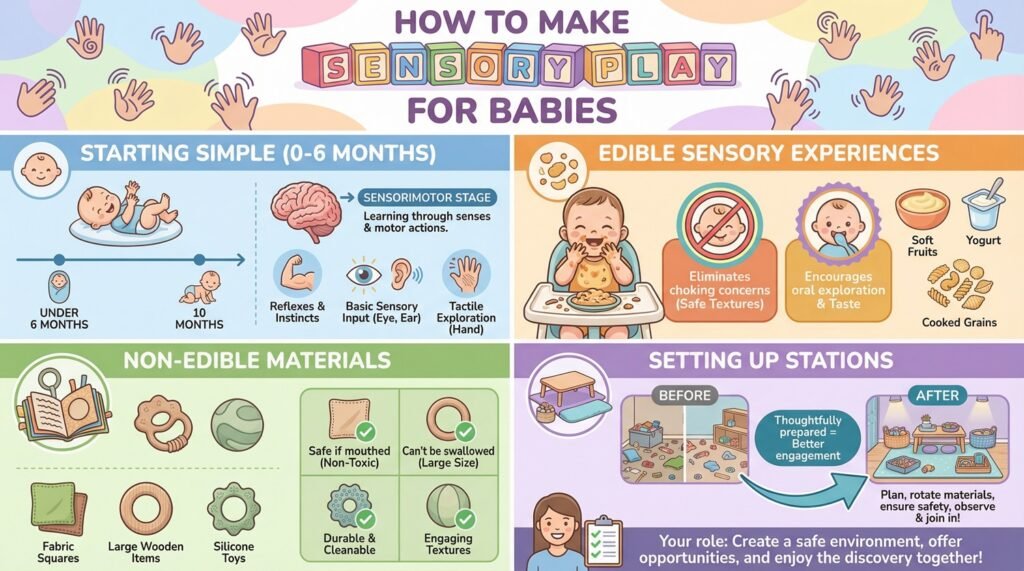
If you’ve got a baby under six months, your approach needs to be quite different from what you’d do with a mobile ten-month-old. Young infants are still developing basic motor control and are in what developmental psychologists call the sensorimotor stage, where they’re primarily learning through reflexive responses and basic sensory input.
For these tiny humans, start with high-contrast visual stimulation. You can create simple sensory cards using black and white patterns, stripes, circles, checkerboards.
Hold these about eight to twelve inches from your baby’s face during tummy time or play time.
I know it sounds almost too simple, but those developing eyes are working really hard to track and focus, building the visual processing skills they’ll need for reading and spatial awareness later. The stark contrast helps their immature visual system distinguish shapes and boundaries, which teaches the brain how to interpret visual information.
Temperature play is another underutilized sensory experience for young babies. Fill a clean sock with rice, tie it off, and place it in the freezer for an hour.
Then let your baby touch it against their palm or foot while you supervise closely.
The novel sensation of cold against their skin activates thermoreceptors and sends information to the brain about how to interpret temperature differences. Always test the temperature yourself first, it should feel cool, not actually cold enough to cause discomfort.
You can do the same thing with a sock that’s been warmed in the dryer for a minute, creating a gentle warm sensation.
Texture walks are something I discovered somewhat by accident. Simply carry your baby around your home or yard and let them touch different surfaces while you describe what they’re feeling.
The rough bark of a tree, the smooth coolness of a window, the soft give of a couch cushion, the hard surface of a wooden table.
You’re essentially narrating their sensory world, which helps them start connecting language with physical sensations. This cognitive bridge between word and sensation is crucial for later language development.
When they hear you say “rough” while feeling tree bark, they’re building an association that will become part of their conceptual understanding of roughness.
Creating Edible Sensory Experiences
Once your baby starts eating solids, edible sensory play becomes absolutely fantastic because you eliminate the biggest concern parents have, everything going straight into their mouths. If the play material is food, you’re actually encouraging that oral exploration as opposed to fighting against it.
Cooked sweet potato is genuinely wonderful for this. Bake a sweet potato until it’s soft, let it cool to room temperature, then peel it and cut it into chunks.
Place your baby in their high chair with just a diaper on for easy cleanup, and let them go to town.
The orange flesh is soft enough to squish but firm enough to hold shape initially. As your baby manipulates it, the texture changes, it becomes slipperier, mushier, more spreadable.
They’re learning that materials can transform through manipulation, a key concept in understanding how the physical world works.
Plus, it stains minimally compared to other colorful foods, and if they decide to eat some, you’re getting nutrients into them.
Chia pudding offers an entirely different textural experience. Mix three tablespoons of chia seeds with half a cup of breast milk, formula, or whole milk if your baby is over one year old.
Let it sit in the refrigerator for at least four hours.
The resulting texture is this bizarre, gelatinous consistency that’s unlike anything else in your baby’s experience. Babies find it absolutely fascinating to touch and squeeze.
The tiny seeds provide interesting visual stimulation too, and watching them move through the gel teaches cause and effect.
When pressure is applied, the seeds shift and rearrange.
Greek yogurt can become a sensory canvas. Spread it directly on the high chair tray and let your baby finger paint with it.
You can add a tiny bit of pureed berries to sections of it to create different colors and flavors.
The cool temperature provides thermal input, the smooth texture teaches about viscosity, and the slight tang adds taste exploration. I’ve watched babies spend twenty minutes just exploring yogurt this way, completely absorbed in spreading it, making patterns, and watching how it behaves when pushed. The fact that it’s edible means you can relax and let them really explore without constantly redirecting their hands away from their mouths.
Frozen fruit offers temperature and texture variation that’s really engaging. Try freezing blueberries or small pieces of mango, then placing a few in front of your baby.
They’ll experience the initial hardness and cold, then as the fruit thaws from their warm hands, they’ll notice it becoming softer and releasing juice.
This teaches cause and effect alongside sensory exploration. Their body heat causes change in the material, showing them they can affect their environment.
The contrast between frozen and thawed fruit teaches that the same item can have different properties depending on conditions.
Overripe avocado is gloriously messy but incredibly valuable sensorially. Cut one in half, remove the pit, and let your baby scoop and squish the flesh.
The fatty, slippery texture is unusual and interesting.
It changes as it’s manipulated, becoming smoother and leaving residue on hands.
The green color is visually interesting, and the mild flavor means most babies will taste it without recoiling. If you’re lucky, they’ll actually eat some of those healthy fats.
The avocado flesh also responds dramatically to pressure, light touch leaves it mostly intact, but squeezing changes it into mush.
Non-Edible Sensory Play Materials That Work
Even with edible options available, you’ll want some non-food sensory materials in your rotation. The key is choosing items that are safe if mouthed but substantial enough that they can’t be easily swallowed.
Fabric sensory books are something you can make in about an hour with fabric scraps. Cut squares of different materials, velvet, corduroy, fleece, burlap, satin, terrycloth, denim, and sew or hot glue them onto felt pages.
Bind the pages together with ribbon or metal rings.
Your baby gets to experience dramatically different textures all in one contained format. The velvet is smooth in one direction and rough in the other, teaching directional texture variation.
Burlap is scratchy and stiff, providing intense tactile input.
Satin is cool and slippery, introducing temperature and friction concepts. Each page offers completely different tactile input, and babies will return to favorite textures repeatedly while also exploring new ones.
Water beads can be controversial because of choking concerns, and I absolutely understand that worry. However, if you use the jumbo water beads (the ones that expand to about an inch in diameter) and you supervise constantly, they provide a sensory experience that’s really unique.
They’re squishy but firm, creating an unusual resistance when squeezed. They’re slippery and hard to grasp, teaching babies to adjust their grip strength and technique. They’re cool to the touch, and they’re visually mesmerizing as light passes through their translucent surfaces.
I put them in a shallow storage container so they can’t roll away, and I only bring them out during focused play sessions when I’m sitting right there.
The sensory input they provide, that combination of visual beauty, unusual texture, and problem-solving challenge, is difficult to copy with other materials.
Natural materials often get overlooked in favor of plastic toys, but they provide incredibly rich sensory experiences. Collect smooth river rocks, pine cones, large shells, pieces of driftwood, chunks of natural wool, and feathers.
Create a treasure basket, just a flat basket or container filled with these natural items.
Babies will spend ages picking up each item, examining it, mouthing it, and comparing it to the others. The varied weights teach about density and heft. Natural materials have subtle temperature variations that plastic doesn’t provide.
Wood feels different from stone, which feels different from she’ll.
Even the smells are educational, pine cones have a distinct scent, wool smells different when slightly damp, shells sometimes carry a faint ocean smell.
Scarves and fabric squares are deceptively simple but genuinely engaging. Get a collection of different fabrics in various sizes, silk scarves, cotton bandanas, fleece blankets, mesh produce bags, tulle fabric.
Show your baby how they move through the air differently, how some are transparent and others opaque, how they feel different when draped over skin.
Play peek-a-boo with them, let your baby pull them out of a box, or simply let them explore the pile. The lightweight nature of scarves means even young babies can manipulate them successfully, building confidence.
Watching a scarf float down teaches about gravity and air resistance.
Seeing their own hand through mesh or sheer fabric teaches about transparency.
Sensory bottles are perfect for younger babies who aren’t quite ready for loose materials. Fill clear plastic bottles with different contents: one with water and glitter, one with hair gel and small plastic beads, one with colored water and baby oil that separates, one with dry rice and small bells.
Seal the lids permanently with hot glue or strong adhesive tape.
These bottles are endlessly fascinating. Babies will shake them to activate sound, roll them to watch contents shift, hold them up to light to see how illumination changes appearance, and study how different materials move at different speeds. The water-and-glitter bottle creates slow, swirling patterns.
The rice-and-bell bottle is loud and responsive.
The oil-and-water bottle teaches that some liquids don’t mix and have different densities.
Setting Up Sensory Play Stations
The way you present sensory materials dramatically affects how engaged your baby will be and how manageable the experience is for you. Random handfuls of stuff dumped on the floor don’t create the same focused exploration that a thoughtfully prepared station does.
For messy sensory play, the high chair is honestly your best friend. It contains the mess to a defined area, keeps your baby at a good height for exploration, and makes cleanup infinitely easier.
I put a large splat mat or old shower curtain under the high chair to catch anything that goes over the edge.
Some parents skip containers entirely and put materials directly on the high chair tray, while others use a shallow baking dish or storage container on the tray. Both approaches work fine, but containers help keep materials more corralled and create a defined play space within the larger tray space.
The container edges also give babies something to bang against and scrape materials on, adding another dimension to exploration.
Floor-based sensory play works better for less messy materials or older babies who want more movement. Designate a specific blanket or mat as the sensory play area.
This actually teaches spatial boundaries, the play happens on this mat, not the entire floor.
Use a large storage bin lid, a baby pool, or a large shallow cardboard box as the container for materials. This keeps everything corralled and makes it clear where the sensory items belong.
When materials inevitably get scattered, they’re easier to spot and retrieve from a contained area than from an entire room.
Bathtub sensory play is tremendously underutilized. The tub is waterproof, easy to clean, and already associated with getting messy and wet. You don’t even need to fill it with water, use it as a contained space for activities like playing with shaving cream, exploring ice cubes, or manipulating kinetic sand.
When you’re done, everything can be quickly rinsed away. The tub’s smooth surfaces mean nothing stains or absorbs mess.
You can literally hose it down with the shower head and be done in thirty seconds.
For babies who are sitting independently, the tub provides a secure space where they can’t wander away from the activity.
Outdoor sensory play removes almost all the stress about mess. Spread a blanket in the grass and let your baby explore mud, wet sand, water play, or paint without worrying about your floors and furniture.
The natural environment also provides extra sensory input, breeze on skin, sun warmth, grass texture, outdoor sounds, that enriches the entire experience.
After outdoor sensory play, you can strip your baby down, hose them off if needed, and bring them straight to bath time. The freedom to let them get truly messy without consequences allows for deeper exploration and learning.
Mess-Contained Sensory Options
Sometimes you need sensory play that doesn’t create a cleanup nightmare. These contained options still provide valuable sensory input without requiring you to mop floors afterward.
Sensory bags are absolutely brilliant. Put hair gel, paint, or yogurt into a gallon-sized zip-top bag along with small items like buttons, beads, or foam shapes.
Seal it extremely well, I use clear packing tape over the seal for extra security, running it along the entire closure.
Your baby can squish the bag, push the items around, and explore the textures and movement without anything actually touching their hands or getting everywhere. The barrier of the plastic bag creates a different sensory experience than direct touch, teaching babies they can interact with materials indirectly.
Tape it to a high chair tray or window for even easier containment.
When taped vertically to a window, the contents respond to gravity differently than when flat on a tray.
Discovery bottles build on the concept of sensory bottles but with a focus on visual discovery as opposed to just movement. Layer different materials in clear bottles: sand and small shells, colored rice and hidden toys, water and floating objects, pom poms in different colors.
As babies rotate and shake the bottles, they uncover what’s hidden inside. The quest for discovery keeps them engaged longer than just watching things move.
When they tip the bottle, sand shifts and reveals a she’ll that was buried. When they shake it, rice moves and exposes a toy that was hidden.
This teaches that perspective and action reveal new information.
Textured play mats or sensory boards mounted on walls provide touch exploration that’s completely mess-free. Attach different textures to a board: a piece of bubble wrap, corrugated cardboard, sandpaper, faux fur, rubber grip liner, vinyl, cork.
Mount it low enough that your baby can reach it during tummy time or sitting play.
They’ll return to it repeatedly, running their hands over the different textures and beginning to understand comparative concepts like rough versus smooth, soft versus hard, bumpy versus flat. Because it’s mounted, you never need to set it up or put it away.
The sensory opportunity is always available.
I’ve seen babies pause during play throughout the day to go touch their sensory board, almost like they’re checking in with familiar sensations.
Basket exploration embodies heuristic play principles wonderfully. Fill a basket with safe household items that have interesting sensory properties: a whisk, wooden spoon, silicone spatula, small metal bowl, clean dish brush, measuring cups, jar lids.
Babies will empty the basket, examine each item, bang them together to hear different sounds, and stack or nest them. This heuristic play allows babies to uncover properties of objects through their own experimentation.
They learn that metal sounds different from wood when struck, that some items fit inside others, that different materials have different weights.
You’re giving them variables to experiment with and letting them draw their own conclusions.
Age-Appropriate Progression
As your baby grows, their sensory play should evolve to match their developing capabilities and interests. What fascinates a six-month-old will bore a twelve-month-old, and what’s appropriately challenging for a twelve-month-old could frustrate a younger baby.
From birth to six months, focus on sensory experiences that don’t need much motor control. Offer visual tracking cards that they can follow with their eyes.
Gently brush different textures on their skin during play time or massage.
Provide varied sounds through rattles, music, or your voice. Explore temperature with careful adult guidance, letting them touch something cool or warm briefly.
These babies are absorbing everything but can’t yet manipulate objects intentionally, so the sensory input needs to come to them as opposed to them seeking it out.
From six to nine months, introduce materials that can be grasped and transferred between hands. Fabric squares are perfect because they’re lightweight and easy to hold.
Sensory bottles can be shaken and examined. Small balls of different textures can be picked up and dropped repeatedly.
Crinkly materials provide auditory feedback when manipulated.
These babies are developing their pincer grasp and hand-eye coordination, so activities should support those emerging skills. They’re also beginning to understand cause and effect, so materials that respond to their actions are particularly engaging.
When they squeeze a ball, it changes shape.
When they shake a bottle, things move inside.
From nine to twelve months, offer materials that encourage problem-solving and more complex manipulation. Stacking cups can be nested or built into towers.
Shape sorters introduce spatial reasoning.
Containers can be filled and dumped repeatedly, teaching volume and capacity concepts. Balls can be rolled and chased, combining gross and fine motor skills.
These babies are becoming mobile and more intentional in their actions, so they need challenges that match their growing capabilities. They’re starting to understand that objects have functions and relationships to each other.
A small toy can go inside a cup.
Two blocks can be banged together to make noise.
From twelve to eighteen months, provide opportunities for creativity and more complex exploration. Finger painting with edible paint allows for artistic expression.
Play dough introduces moldable materials that hold shapes.
Water play with pouring and squeezing tools teaches about liquid behavior and tool use. Sand or dirt digging satisfies their urge to manipulate their environment on a larger scale.
These toddlers are developing symbolic thinking and language, so sensory play can become more imaginative. They might pretend the play dough is food, or use water play to act out scenarios they’ve observed. Their ability to mix many elements, scooping sand with a shovel into a bucket, shows advancing cognitive complexity.
People Also Asked
What age should you start sensory play with babies?
You can start sensory play from birth. Newborns benefit from gentle sensory experiences like skin-to-skin contact, soft music, and watching high-contrast images.
As they grow, you gradually introduce more complex materials and activities.
The key is matching the sensory input to your baby’s developmental stage as opposed to waiting for a specific age.
Is sensory play safe for babies who put everything in their mouths?
Mouthing is actually a legitimate form of sensory exploration. Babies gather information about texture, taste, and material properties through their mouths, which have more nerve endings than their hands.
The solution is to provide materials that are safe to mouth, edible sensory play, large items that can’t be swallowed, or contained sensory bags where materials are sealed inside plastic.
How long should sensory play sessions last for infants?
Sensory play sessions for young babies might last only five to ten minutes before they become tired or overstimulated. Older babies might engage for twenty to thirty minutes. Watch for signs that your baby is done, looking away, fussing, rubbing eyes, or losing interest.
Multiple short sessions throughout the day are more useful than one long session.
What household items make good sensory play materials?
Kitchen items work wonderfully, wooden spoons, silicone spatulas, measuring cups, whisks, metal bowls, and sponges all have interesting textures and properties. Fabric scraps, scarves, and textured towels provide tactile variety.
Natural items like smooth rocks, pine cones, and large shells are excellent.
Even ice cubes, cooked pasta, and safe food items become sensory materials.
Can sensory play help with baby development delays?
Sensory play supports overall development including fine motor skills, cognitive processing, language development, and problem-solving. For babies with developmental delays, sensory activities can provide the repeated practice and varied input needed to strengthen emerging skills.
However, sensory play should complement professional intervention as opposed to replace it if delays are significant.
How do you clean up after messy sensory play?
Containment strategies prevent most mess. Use high chairs with splat mats underneath, bathtubs that rinse clean, or outdoor spaces.
For edible sensory play, wipe your baby down with a wet cloth and follow with bath time if needed. For non-edible materials, sweep or vacuum loose items and wipe surfaces with appropriate cleaners.
Setting up near cleaning supplies makes the process quicker.
What’s the difference between sensory play and regular play?
Sensory play specifically focuses on engaging the senses, touch, sight, sound, smell, and taste, to build neural pathways. Regular play might prioritize other goals like physical activity or social interaction.
However, the best play often combines elements.
A baby playing with blocks is doing sensory play when they explore textures and colors, and developing spatial reasoning and fine motor skills.
Key Takeaways
Sensory play builds neural pathways that support all future learning, creating up to 1,000 trillion synaptic connections in the first two years of life through rich sensory experiences.
The best sensory materials are simple and accessible, foods, household items, natural objects, and basic craft supplies provide richer experiences than expensive commercial toys.
Edible sensory play eliminates mouthing concerns and allows babies to explore freely using their mouths, which contain more nerve endings than their hands.
Contained sensory options like sealed bags, bottles, and wall-mounted boards provide valuable stimulation without creating overwhelming cleanup, making daily sensory play sustainable.
Age-appropriate progression matters because developmental stages need different types of sensory input and challenge levels to effectively support emerging skills.
Your specific circumstances, limited space, tight budget, mess concerns, or time constraints, shouldn’t prevent sensory play because simple adaptations make it accessible regardless of situation.
Consistent exposure to varied sensory experiences throughout your baby’s day builds development more effectively than occasional intensive activities.