
We may earn money or products from the companies mentioned in this post.
When you’re in those early months with a baby, sensory development means giving your child the building blocks to understand their world. The right sensory toys genuinely support brain development during that critical first year when neural connections are forming at an absolutely staggering rate.
The challenge is that most baby toy lists recycle the same obvious picks: black and white contrast cards, a basic rattle, maybe a soft book if they’re feeling adventurous. I’m going to walk you through fifteen thoughtfully selected sensory toys that span the entire first year, mixing some classics you probably know with lesser-known options that deserve serious consideration.
Understanding Baby Sensory Development
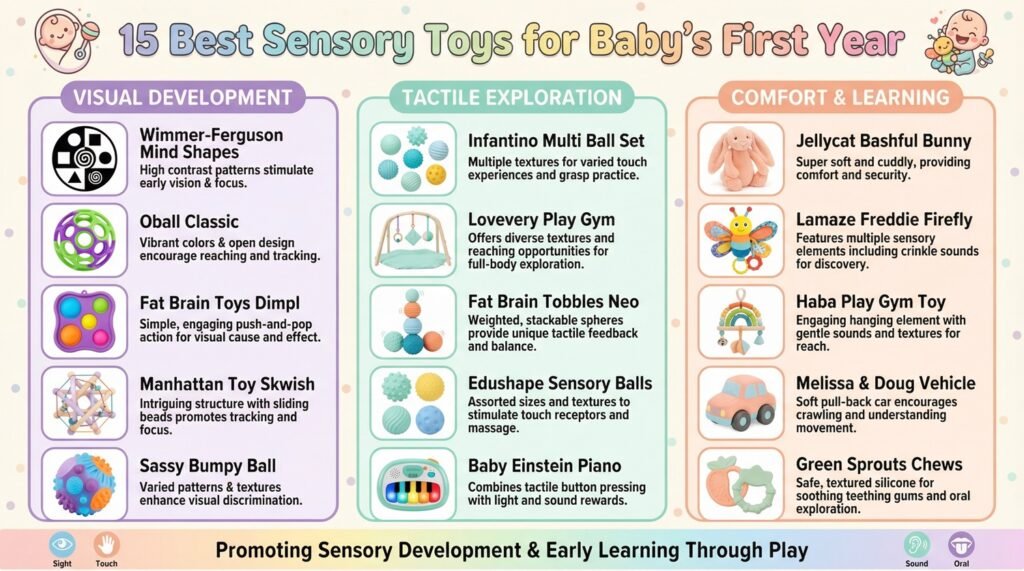
Before we jump into specific products, you need to understand what’s actually happening in your baby’s brain during these twelve months. Newborns enter the world with limited vision.
They see best at about 8 to 12 inches away, which is conveniently the distance to your face during feeding.
Their visual system develops rapidly, with color vision emerging around 3 to 4 months and depth perception improving throughout the first year. By six months, most babies can see nearly as well as adults in terms of clarity, though their ability to process and make sense of visual information continues developing well into childhood.
Touch is actually one of the most developed senses at birth. Babies use tactile information to learn about texture, temperature, and spatial relationships.
Their mouths are particularly sensitive, which is why everything ends up there around 4 to 6 months.
This behavior represents sophisticated sensory exploration, not random mouthing. The concentration of nerve endings in a baby’s lips and tongue exceeds that in their fingertips, making oral exploration an incredibly effective way to gather detailed information about objects.
Auditory processing is complex from early on, but babies learn to localize sounds and associate them with actions over time. They’re drawn to rhythmic patterns and higher-pitched voices, which is why we instinctively shift our vocal patterns when talking to infants.
By around four months, babies can distinguish their name from other similar-sounding words, showing how quickly auditory discrimination develops.
The key to choosing sensory toys means matching them to your baby’s current developmental window while providing enough complexity to remain engaging as skills advance. Toys that grow with your child offer better value and sustained learning opportunities.
A toy that’s perfect at three months but boring by five months has limited usefulness compared to one that reveals new features as capabilities expand.
1. Wimmer-Ferguson Mind Shapes
This is one of those high contrast visual stimulation toys, but it’s designed with actual research backing as opposed to just throwing black and white patterns together. The specific shapes and patterns were developed based on infant visual preferences and research about what newborns can actually perceive and process.
Developmental psychologists have studied which patterns capture and hold newborn attention most effectively, and this toy incorporates those findings.
For the first 6 to 8 weeks, babies respond best to bold, high-contrast images with defined edges. The Mind Shapes board presents geometric patterns that align with early visual capabilities.
What makes this particularly effective is that it includes a stand, so you can position it at the optimal viewing distance during tummy time or while your baby is in a bouncer.
You’re not constantly trying to prop something up or hold it at just the right distance while also managing everything else.
Around 2 to 3 months, when your baby starts tracking movement more effectively, you can move the board slowly from side to side to encourage visual tracking. The patterns remain interesting even as vision develops because they’re complex enough to hold attention beyond the newborn stage.
The board has different patterns on each side, so you can flip it when you notice your baby becoming too familiar with one set of images.
2. Oball Classic
Yes, the Oball is everywhere, and there’s a reason for that. This is one of those instances where the obvious choice earned its place through solid design.
The lattice structure is brilliant for tiny hands that haven’t developed a proper grasp yet.
Babies as young as 3 months can hook their fingers through the openings, which is incredibly satisfying for them. That early success at manipulating an object builds confidence and encourages further exploration.
The lightweight construction means that when they inevitably drop it on their face, which will happen repeatedly, it doesn’t hurt. As they develop better hand control around 5 to 6 months, they can transfer it between hands, exploring the spatial relationship of their own limbs.
This hand-to-hand transfer is a significant developmental milestone that supports bilateral coordination.
The slight rattle inside provides auditory feedback without being overwhelming. Some parents find rattles annoying, but the Oball’s sound is relatively gentle while still offering that important cause-and-effect learning opportunity.
Your baby shakes the ball, hears the sound, and begins connecting their actions to outcomes in the world around them.
3. Fat Brain Toys Dimpl
Here’s where we get into less obvious territory. The Dimpl is a silicone board with different sized bubbles that push through with a satisfying pop.
It doesn’t look particularly impressive in photos, but the tactile feedback is genuinely engaging.
Around 6 months, when babies develop more intentional finger movements, pushing these bubbles becomes an absorbing activity. The different sizes need slightly different amounts of pressure, which provides varied sensory input and teaches babies to modulate their force.
The bright colors offer visual interest, and the sturdy frame means your baby can hold it independently without needing you to position it constantly. The silicone is safe for mouthing, and the whole thing can be easily cleaned when it inevitably gets covered in drool or dropped food.
What I particularly appreciate about the Dimpl is that it has genuine longevity. Toddlers continue playing with it well past the first year, making it one of those rare toys that doesn’t end up in the donation pile after a few months.
The simple concept of pushing bubbles through holds appeal across a surprisingly wide age range because the satisfaction of that tactile feedback doesn’t diminish.
4. Manhattan Toy Skwish
The Skwish is a wooden toy that collapses and expands, with beads that slide along elastic-strung rods. It’s visually interesting, tactilely complex, and remarkably durable.
The sustainable wood construction appeals to parents who prefer natural materials, and the design has been around for decades because it simply works.
There’s something reassuring about a toy that’s remained essentially unchanged for thirty years because parents keep buying it.
For younger babies around 3 to 4 months, the movement of the beads provides visual tracking practice. The open structure is easy to grasp, and the wooden rods offer a different tactile experience than the plastic toys that dominate most toy boxes.
Wood has a warmth and texture that plastic just doesn’t match.
As grip strength develops, babies can compress the structure and watch it spring back to shape, which introduces basic physics concepts about force and reaction. The rattling beads provide auditory feedback when the toy is shaken or manipulated. The Skwish also works well for early teething because the wooden rods are firm enough to provide counter-pressure against sore gums.
5. Sassy Bumpy Ball
This textured ball combines many sensory elements in a compact design. The different textures on each section provide varied tactile input: smooth, bumpy, ridged surfaces all in one toy.
The bright, contrasting colors support visual development, and the gentle rattle inside offers auditory stimulation.
Each section of the ball presents a different learning opportunity.
Around 4 to 5 months, when babies are really exploring objects with their hands and mouths, the varying textures become particularly interesting. The ball is lightweight and just the right size for little hands to manipulate without being a choking hazard.
The size matters more than you might think.
Too large and babies can’t grasp it effectively. Too small and it presents safety concerns.
The chunky, easy-to-grasp bumps make this one of the better first balls for babies who are developing their grip. Unlike perfectly smooth balls that can slip away frustratingly, the textured surface provides something to hold onto.
That early success at grasping and holding encourages babies to keep practicing, which speeds up motor development.
6. Infantino Textured Multi Ball Set
Instead of just one textured ball, this set provides six different balls with varied textures, sizes, and firmness levels. This variety matters because different tactile inputs support sensory processing development.
Some babies prefer softer, squeezable textures while others are drawn to firmer, more structured surfaces.
Having options let’s you observe your baby’s preferences, which can tell you something about their sensory processing tendencies.
The set includes balls with nubs, ridges, and smooth sections, all in different colors and with different sound elements. Some squeak, some rattle, and some are silent.
This teaches babies that similar-looking objects can behave differently, which is an early lesson in categorization and prediction.
Around 6 to 9 months, when babies are developing object permanence and categorization skills, having many balls supports learning about similarities and differences. They’re exploring the question of what makes something a ball versus other objects.
Why does this round thing behave differently than that round thing?
These early categorization exercises build cognitive skills that will later support academic learning.
7. Lovevery Montessori Play Gym
This is definitely an investment piece, but the thoughtful design sets it apart from standard play gyms. The Lovevery gym was developed with child development experts and follows Montessori principles about simplicity and purpose.
Each element serves a specific developmental function as opposed to just providing visual stimulation or entertainment.
The wooden frame provides a different visual aesthetic than plastic gyms. It’s calmer and less visually overwhelming, which some babies really need. The hanging toys are designed for specific developmental stages, from high contrast cards for newborns to a ball for batting practice around 3 to 4 months.
As your baby masters one challenge, you can swap in the next suitable toy.
What makes this particularly clever is that it converts to a play tent as your baby grows, extending its usefulness well beyond the typical play gym lifespan of 4 to 5 months. The included guidebook explains the developmental purpose of each element, which helps you understand what your baby is learning through play.
That educational component for parents adds value beyond the physical toy itself.
8. Fat Brain Toys Tobbles Neo
These weighted, stacking pieces are absolutely mesmerizing. Six differently sized, weighted spheres stack on top of each other in various configurations.
The unique weighting means they balance in unexpected ways, introducing basic physics and spatial reasoning concepts.
Even adults find these oddly satisfying to manipulate.
For babies around 6 months, just watching you stack them provides visual interest and shows cause and effect. As they approach 9 to 12 months and develop more precise hand control, they can start manipulating the pieces themselves.
The learning curve is gradual enough that babies don’t get frustrated but challenging enough to maintain interest.
The smooth texture and satisfying weight make these pleasing to handle. The bright colors support visual discrimination skills, learning to distinguish between different hues and associate them with specific objects.
Each sphere is a different color, which eventually helps babies request specific pieces as language develops.
9. Edushape Sensory Balls
Here’s another ball option, but these are specifically designed with sensory processing in mind. The set includes balls with different textures: some with soft nubs, others with firmer protrusions, various sizes and firmness levels.
What distinguishes these from the Infantino set is the more pronounced textural differences.
Some babies, particularly those with emerging sensory sensitivities, benefit from gentler sensory input. Others need more intense stimulation to register tactile information.
Having options let’s you match the toy to your baby’s needs. If you notice your baby consistently avoiding certain textures or seeking out others, pay attention to those preferences.
The balls are safe for mouthing, which matters because oral exploration peaks around 6 to 8 months. The varied textures provide different sensations against gums, which can be soothing during teething.
The firmness variation also matters here.
Softer balls compress when bitten, providing a different experience than harder ones.
10. Baby Einstein Magic Touch Piano
This wooden piano offers auditory stimulation with a developmental twist. Unlike electronic toys with preset songs, this responds to your baby’s actual touch, providing immediate auditory feedback that reinforces the connection between action and result.
Your baby controls the music completely, which builds understanding of personal agency.
Around 6 months, when babies are developing more intentional movement, they can press the keys and immediately hear the musical result. The magic touch technology means there are no buttons or mechanical parts, just smooth wood that responds to touch, which feels almost magical.
The lack of visible mechanisms makes the cause and effect relationship seem more direct.
The volume is reasonable, which is a blessing for parents. Many electronic baby toys are inexplicably loud, as if volume equals engagement.
This produces pleasant musical tones without assaulting your ears during the 400th playing session of the day.
You can actually tolerate being in the same room while your baby plays with it.
11. Jellycat Bashful Bunny
Soft toys might seem like obvious choices, but there’s actually significant variation in quality and sensory value. The Jellycat Bashful Bunny series offers incredibly soft fabric that’s genuinely pleasant to touch.
The plush isn’t just acceptable but actually nice to stroke, which matters when you’ll be handling this toy constantly.
The different textures between the bunny’s body, ears, and paws provide subtle tactile variation. The just-right weight makes it easy for babies to hold but substantial enough to feel real.
Too light and stuffed animals feel cheap and insubstantial.
Too heavy and babies can’t manipulate them effectively.
Around 6 to 9 months, when babies start developing attachment to specific objects, having a high-quality comfort item matters. The neutral color options are visually calming as opposed to overstimulating.
While bright colors support visual development, there’s value in having some toys that don’t compete for attention with loud patterns and intense hues.
12. Lamaze Freddie the Firefly
This clip-on toy packs many sensory elements into a compact design. Different textures, crinkly wings, a squeaker, a baby-safe mirror, and high-contrast patterns all mix to provide varied sensory input.
Each part of the firefly offers something different to explore.
The clip attachment is genuinely useful. You can attach it to a car seat, stroller, or diaper bag, ensuring you always have engaging sensory input available.
Around 4 to 6 months, when babies are developing reaching and grasping skills, having a toy readily available supports practice opportunities throughout the day, not just during designated play time.
The layered design means babies learn new elements over time. Initially they might notice the crinkly sound, then discover the mirror, then find the squeaker.
This progressive discovery keeps the toy interesting across developmental stages.
Each time they interact with it, they might notice something they hadn’t focused on before.
13. Haba Color Fun Play Gym Toy
This lesser-known option features a clever design with sliding, turning, and clicking elements. The wooden frame supports different types of manipulation: pushing, turning, sliding, which develop different fine motor skills.
Each action needs slightly different hand movements and grip patterns.
The bright, primary colors support color discrimination without being visually chaotic. The smooth wood provides a calming tactile experience, and the mechanical elements produce satisfying sounds without electronic noise.
There’s something inherently pleasing about mechanical clicks and slides that battery-powered beeps can’t copy.
Around 8 to 10 months, when babies are developing problem-solving skills, they can experiment with different ways to interact with the elements. The varied mechanisms teach that different actions produce different results, supporting cognitive development.
Push here and something slides.
Turn there and something clicks. Each element teaches a specific lesson about how objects work.
14. Melissa and Doug K’s Kids Pull-Back Vehicle
This soft vehicle combines visual, tactile, and kinetic elements. The pull-back mechanism introduces basic physics: pull backward, release, watch it zoom forward.
Around 9 to 12 months, when babies are developing an understanding of force and motion, this becomes particularly engaging.
They can see a direct result from their actions, and the movement is dramatic enough to be exciting.
The soft construction means it’s safe for younger babies to explore, while the functional mechanism provides complexity that holds interest as skills develop. The different textures on various parts of the vehicle support tactile exploration.
Some parts are smooth, others ribbed, and the wheels have a different texture from the body.
The size is suitable for little hands to grasp and manipulate. The pull-back mechanism needs some strength and coordination, which provides a suitable challenge for babies approaching their first birthday.
Success at making the vehicle go creates satisfaction that motivates repeated tries, building both motor skills and persistence.
15. Green Sprouts Silicone Learning Chews
These are positioned as teethers, but they serve significant sensory purposes beyond soothing sore gums. The food-grade silicone provides a specific texture that’s different from wooden, plastic, or fabric toys.
That texture variety matters for comprehensive sensory development.
The variety pack includes different shapes and textures, allowing babies to explore how different structures feel against their palms, fingers, and gums. Around 5 to 7 months, when oral exploration is intense, having safe, purpose-built mouthing toys supports this developmental need without constantly worrying whether something should be in your baby’s mouth.
The easy-to-clean silicone is practical for items that spend significant time in mouths. Unlike fabric toys that need washing or wooden toys that can’t be fully sanitized, these can go in the dishwasher.
That convenience matters when you’re already managing a thousand other tasks.
Frequently Asked Questions
What toys help with baby sensory development?
Toys with varied textures, contrasting colors, different sounds, and many ways to interact support sensory development best. Look for options that engage touch, sight, and hearing simultaneously.
The Oball, textured balls, and multi-element toys like the Lamaze Freddie work well because they provide several types of sensory input at once.
When should I introduce sensory toys to my baby?
You can start from birth with high-contrast visual toys like the Wimmer-Ferguson Mind Shapes. Add textured toys around 3 months when grasping develops, and introduce more complex options around 6 months when intentional manipulation begins.
Matching toys to your baby’s current abilities keeps them engaged without causing frustration.
Are wooden toys better than plastic for babies?
Neither material is inherently better. Wooden toys offer different tactile experiences and tend to be more durable, while plastic toys are often lighter and easier for young babies to manipulate.
A mix of materials provides the most comprehensive sensory exposure.
The Skwish and Haba gym toy show how well-designed wooden toys work, while the Oball shows effective plastic design.
How many sensory toys does a baby need?
Three to five toys available at any time is plenty. Too many options can overwhelm babies and make focused exploration difficult.
Rotating toys every week or two keeps them novel without requiring a massive collection.
Quality and variety matter more than quantity.
What makes a good sensory toy for a 6-month-old?
Good sensory toys for six-month-olds are easy to grasp, provide varied textures, make sounds when manipulated, and are safe for mouthing. The Dimpl, textured balls, and teething toys all work well at this age because they support the specific skills developing around six months, including intentional grasping, hand-to-hand transfer, and oral exploration.
Do high contrast toys really help baby vision development?
High contrast toys help newborns practice focusing and tracking because their developing visual systems process bold patterns more easily than subtle ones. Research supports using black and white patterns for the first 6 to 8 weeks, though benefits reduce as color vision develops around 3 to 4 months.
How do I know if my baby is overstimulated by toys?
Signs of overstimulation include gaze aversion, fussiness, arching away, or becoming very still and quiet. When you notice these signs, reduce sensory input by moving to a calmer environment, offering a simpler toy, or just holding your baby quietly.
Some babies have lower thresholds for stimulation and need gentler sensory experiences.
What’s the difference between teethers and sensory toys?
Teethers are designed specifically for safe mouthing and gum relief, but many double as sensory toys by providing varied textures. The Green Sprouts silicone chews serve both purposes.
Dedicated sensory toys typically offer more varied input across many senses as opposed to focusing solely on oral exploration.
Key Takeaways
The sensory toys you choose for your baby’s first year should match their current developmental stage while providing enough complexity to remain engaging as skills advance. High-contrast visual toys work beautifully for newborns but lose relevance around 3 to 4 months.
Textured balls and stacking toys that seem too complex for a 3-month-old become perfect around 6 to 9 months.
Variety in materials, textures, and types of sensory input supports comprehensive sensory development and helps you identify your baby’s preferences and processing style. A collection that includes wood, silicone, fabric, and plastic toys provides different tactile experiences that build sensory discrimination skills.
The best sensory toys grow with your baby and support many developmental areas simultaneously. The Skwish, Tobbles, and Dimpl all remain engaging across several months because they can be explored in increasingly complex ways as motor and cognitive skills advance.
Safety needs ongoing attention, particularly as toys age and babies develop new skills. What was safe for a 4-month-old who couldn’t grasp might become problematic for an 8-month-old with better fine motor control and a tendency to pull at attachments.
Rotating toys, narrating play, and following your baby’s lead maximizes the developmental value of even simple sensory toys. The toy matters less than how it’s used and integrated into responsive, engaged interactions.