
We may earn money or products from the companies mentioned in this post.
For generations, parents have instinctively known that babies learn by touching, tasting, seeing, hearing, and smelling everything they can get their tiny hands on. What has changed in recent years is our understanding of just how profoundly these early sensory experiences shape brain architecture, setting the foundation for every skill your child will develop throughout their lifetime.
Sensory play opportunities need to be introduced thoughtfully, safely, and in ways that genuinely match where your baby is developmentally right now.
Understanding What Sensory Play Actually Means
When most parents hear “sensory play,” they immediately picture Pinterest-perfect setups with rainbow rice bins and elaborate water tables. While those can be wonderful, they miss the point of what sensory exploration actually means for babies.
Sensory play gives your baby safe opportunities to use their senses to understand how the world works. When your three-month-old stares intently at the ceiling fan, that counts as sensory play.
When your seven-month-old squishes banana between their fingers before it ever reaches their mouth, that qualifies too.
When your eleven-month-old dumps out a basket of wooden blocks just to hear them clatter against the floor for the fifteenth time, yes, that also counts.
The theoretical foundation here is really fascinating. Neuroscientists have uncovered that babies are born with roughly 100 billion neurons, but the connections between those neurons, the synapses that actually do the work of thinking, learning, and processing, form primarily through experience.
Every time your baby touches something new, sees an unfamiliar pattern, or hears a different sound, their brain literally builds the wiring that will support all future learning.
This process, called synaptogenesis, happens most rapidly during the first three years of life. During peak periods, your baby’s brain forms an absolutely staggering one million new neural connections every single second.
The sensory experiences you provide directly shape the physical structure of their developing brain, far beyond just keeping them entertained.
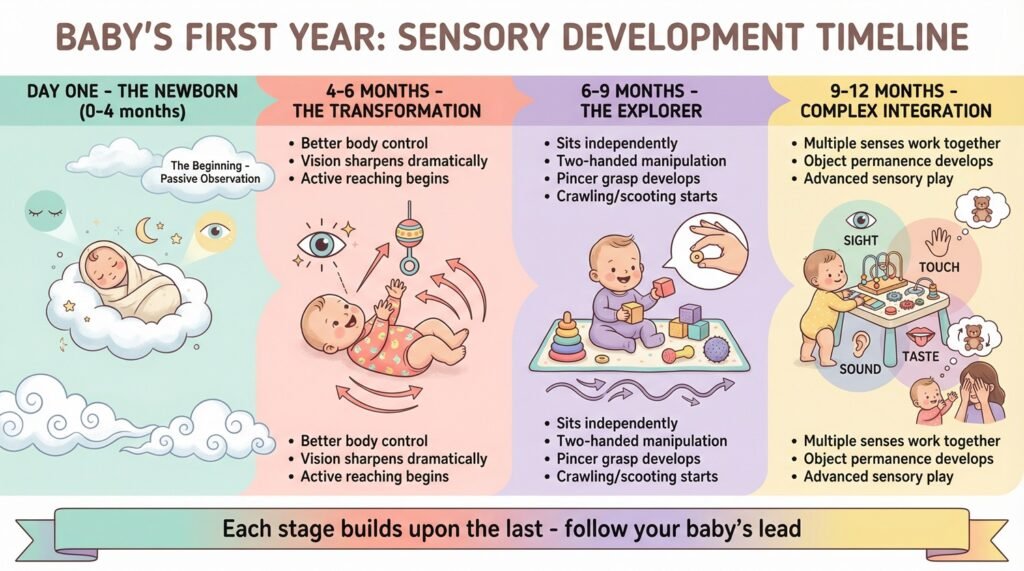
Starting From Day One: The Newborn Sensory Window
The practical application of this knowledge starts immediately. I remember feeling completely overwhelmed with my first baby, thinking I needed to be doing something educational every waking moment.
The reality turned out to be much simpler and honestly more beautiful than that.
For newborns up to about three months, sensory play looks remarkably understated. Your baby’s visual system is still developing, which is why they can only focus on objects about 8 to 12 inches away from their face, conveniently, exactly the distance to your face when you’re holding them. They see best in high-contrast patterns, particularly black and white, because their developing visual cortex can process those stark differences more easily than subtle color variations.
This is where those black-and-white visual cards become genuinely useful as opposed to just trendy. Place simple geometric patterns, bold stripes, checkerboards, or concentric circles, where your baby can see them during tummy time or while lying on their back.
You don’t need expensive sets.
Hand-drawn designs work perfectly well.
The challenge at this stage comes down to matching your expectations to your baby’s actual capabilities. A newborn’s attention span for any given activity might be 30 seconds to two minutes at most.
That doesn’t reflect the quality of the activity you’re offering.
That’s just developmental reality. When your baby turns away, gets fussy, or zones out, they’re telling you they’re done processing that particular sensory input.
Gentle massage provides incredible multi-sensory benefits during these early months. The combination of touch, the sound of your voice as you talk or sing, the visual connection as you make eye contact, and even the subtle scent of whatever lotion or oil you’re using creates a rich sensory experience that also deepens your bond.
The key here is following your baby’s cues.
Some babies absolutely melt into massage. Others find it overstimulating and prefer lighter touch or simply being held.
Both responses are completely normal.
The Four to Six Month Transformation
Around four months, something really remarkable happens. Your baby gains significantly more control over their body, their vision sharpens dramatically, and they start actively reaching for objects as opposed to just passively observing.
This is when sensory play gets genuinely interactive.
Tummy time on textured play mats changes from a tolerated exercise into actual exploration. Your baby will start using their hands to touch different fabrics, crinkly materials, or attached toys.
They’re not just strengthening their neck and shoulder muscles anymore.
They’re gathering data about how different materials feel, sound, and respond to touch.
This is the perfect stage to introduce simple cause-and-effect toys. Rattles are a classic for good reason.
When your baby accidentally makes a sound by moving their hand, then intentionally recreates that sound, they’re conducting a scientific experiment.
They’re learning that their actions have predictable consequences, which is foundational for understanding how the world works.
Baby-safe mirrors deserve special mention here. When your baby sees their reflection, they don’t yet understand that’s actually them, that awareness won’t develop until around 18 months.
But they’re fascinated by the face they see, which moves exactly when they move, makes expressions that mirror their own, and provides endless visual interest.
Place an unbreakable mirror at floor level during tummy time and watch your baby’s engagement level skyrocket.
The potential pitfall, problem, issue, problem, issue, problem, issue to watch for during this stage is overstimulation. Babies this age are processing so much new information that they can become overwhelmed relatively quickly.
Signs of overstimulation include looking away, arching their back, crying, or becoming glassy-eyed and zoned out.
When you see these signals, move to a calmer, quieter activity or simply take a break.
Six to Nine Months: The Explorer Emerges
Once your baby can sit independently, usually between six and eight months, their world expands exponentially. They can now use both hands to manipulate objects, they’re developing the pincer grasp that let’s them pick up smaller items, and many are beginning to crawl or scoot, which means they can pursue whatever sensory experience catches their interest.
This is when water play becomes absolutely magical. You don’t need anything fancy.
A shallow plastic storage container with an inch or two of water and a few floating toys provides genuinely rich sensory input.
The way water moves, splashes, drips, and feels slipping through fingers is endlessly fascinating to babies. The temperature contrast if you add a few ice cubes introduces another sensory dimension entirely.
Here’s the critical safety consideration though: water play needs your constant, undivided attention. Babies can drown in less than two inches of water in under a minute, and it happens silently.
If you need to answer the door, grab your phone, or deal with another child, you pick up your baby and take them with you.
Non-negotiable.
Food-based sensory play emerges naturally during this period since most babies start solid foods around six months. Before you start worrying about mess, consider that letting your baby squish, smear, and explore their food actually serves important developmental purposes.
They’re learning about different textures, temperatures, and consistencies.
They’re developing the fine motor control needed to eventually feed themselves. They’re even beginning to build tolerance for diverse sensory experiences, which research suggests may reduce picky eating later.
I’ve found that embracing the mess as opposed to fighting it makes this stage so much more enjoyable for everyone. Put a large washable mat under the high chair.
Let your baby wear just a diaper during meals.
Accept that cleanup is part of the process. The choice, constantly intercepting your baby’s hands, wiping them obsessively, and creating rigid rules about how food must be eaten, creates stress for both of you and actually interferes with important learning.
Touch-and-feel books become genuinely engaging around this age. Earlier, babies mostly just chewed on books, which is fine because that’s sensory exploration too.
Now they’ll deliberately touch the fuzzy bunny, the smooth mirror, or the bumpy dinosaur scales.
They’re categorizing textures, building vocabulary as you name what they’re touching, and developing the fine motor skills needed to turn pages.
Nine to Twelve Months: Complex Sensory Integration
As your baby approaches their first birthday, they’re ready for more complex sensory experiences that mix multiple senses simultaneously. They’re also developing object permanence, the understanding that things continue to exist even when they can’t see them, which opens up new possibilities for sensory play.
Sensory bins become truly valuable at this stage. The concept is simple: fill a shallow container with a safe material and hide toys or interesting objects for your baby to find out about.
The material you choose decides which senses get emphasized. Dry pasta provides a completely different sensory experience than water, sand, or fabric scraps.
The taste-safe consideration becomes really important here because babies this age still mouth absolutely everything. Traditional sensory bin fillers like dried beans, rice, or small toys pose choking hazards.
Instead, consider ground oats, large pasta shapes like rigatoni, cheerios-type cereal, or even shredded paper.
If your baby eats some while playing, it won’t hurt them.
I’ve uncovered that some of the most engaging sensory materials are things you probably already have. Cooked spaghetti, once cooled, provides an absolutely bizarre texture experience.
Fill a muffin tin with different safe materials, water, yogurt, applesauce, dry cereal, and let your baby explore the variations.
Crumple tissue paper or cellophane for fascinating sounds and textures.
Sealed sensory bags solve the mess problem entirely while still providing sensory input. Fill a gallon-sized ziplock bag about halfway with hair gel, tempera paint, or even just water with food coloring.
Seal it thoroughly, I usually add duct tape around the seal for extra security, then tape it to the floor or a high chair tray.
Your baby can squish, poke, and manipulate the contents without actually touching them. Add small waterproof items like plastic animals or pom-poms and your baby can push them around, developing hand strength and coordination.
Sand play deserves special mention because the texture is unlike anything else. Beach sand is ideal, but play sand from a hardware store works perfectly well.
Some babies absolutely love the way sand flows through their fingers.
Others find the texture aversive. Both reactions are normal and valuable because they’re learning about their own sensory preferences.
The common pitfall, problem, issue, problem, issue, problem, issue at this stage is comparing your baby to others. You might see another baby joyfully squishing handfuls of yogurt while yours recoils from the texture and cries.
That doesn’t mean you’re doing anything wrong.
Babies have different sensory thresholds and preferences, just like adults do. Keep offering varied experiences without forcing participation, and respect your baby’s individual comfort level.
Creating Contained Chaos: Mess Management Strategies
One of the biggest barriers I hear from parents about sensory play is anxiety about the mess. This is completely understandable, especially if you’re already stretched thin with cleaning, laundry, and general baby chaos.
Here’s how to structure sensory experiences to minimize cleanup while maximizing benefit.
Location matters enormously. Sensory play in the bathroom or kitchen, rooms designed to get wet and be easily cleaned, creates much less stress than the same activity in your carpeted living room.
During warm weather, moving sensory activities outside changes the experience entirely.
Suddenly you can be generous with water, let your baby dig in actual dirt, and hose everything down afterward.
Timing these activities right before bath time is genuinely brilliant. Your baby can get as messy as they want, exploring freely, and then you simply transfer them directly to the tub.
What would have been a major cleanup becomes part of your existing routine.
Containment tools make a huge difference. A large plastic storage bin becomes a sensory play station.
An old shower curtain or beach towel under the activity catches most spills.
A smock or just stripping your baby down to a diaper means less laundry. These simple adjustments reduce mess without limiting exploration.
Sensory bottles provide all the visual interest of loose materials with zero mess. Fill clear plastic bottles, squeeze-type juice bottles work great, with water, baby oil, glitter, beads, buttons, or small toys.
Secure the lid with hot glue and tape.
Your baby can shake, roll, and examine the bottle from every angle. Place it near a window or in bright light and the effects become even more captivating.
These bottles also serve as excellent calm-down tools when your baby is overstimulated or fussy.
Building Simple Explorations into Complex Learning
The beautiful thing about introducing sensory play early is watching how these simple explorations become the foundation for increasingly complex learning. That baby who spent hours dropping blocks to hear them clatter is experimenting with gravity, cause and effect, and auditory patterns.
These same concepts will eventually support understanding of physics, music, and mathematical relationships.
The tolerance your baby builds for different sensory experiences, wet, dry, smooth, rough, sticky, slippery, directly supports their willingness to try new foods, adapt to different clothing textures, and handle the sensory complexity of environments like crowded playgrounds or busy classrooms.
The language you provide during sensory play creates connections between words and experiences that are far more powerful than flashcards or apps. When you narrate what your baby is doing, “You’re squishing the soft banana. It feels mushy, doesn’t it?”, you’re teaching vocabulary and demonstrating how language describes and makes sense of sensory experience.
The self-regulation skills your baby practices during sensory play are remarkably sophisticated. When they choose to stop an activity because it’s overwhelming, when they return to a favorite texture repeatedly for comfort, when they gradually warm up to a new sensation, they’re learning to understand and manage their own sensory needs. These are foundational self-awareness and coping skills they’ll use throughout life.
Practical Exercises to Start Today
Here’s how to apply age-appropriate sensory play starting right now, regardless of your baby’s current age.
For newborns to three months: Create a simple mobile using ribbon or string and items with visual contrast, black and white fabric scraps, shiny mylar, or even old CDs. Hang it where your baby can see it during awake time.
Observe which patterns or movements hold their attention longest.
For four to six months: Gather five items from around your house with different textures, a soft towel, crinkly paper, smooth wooden spoon, bumpy silicone trivet, and cold metal measuring cup. During floor time, let your baby touch each one while you describe what they’re feeling.
Notice which textures they reach for repeatedly and which they avoid.
For six to nine months: Fill a muffin tin with different safe foods or materials. Try cold applesauce, room temperature yogurt, dry cereal, cooked pasta, and a damp washcloth.
Let your baby explore each compartment freely.
This combines sensory exploration with independent feeding practice and introduces temperature and texture variations.
For nine to twelve months: Create a discovery basket. Fill a low basket or box with household items that provide varied sensory input, wooden spoon, soft brush, plastic measuring cups, fabric scraps, a small bell, and a safely sealed container with dried beans that makes sound when shaken.
Let your baby choose what to explore.
Rotate items weekly to maintain interest.
The assignment here is simple observation. Spend one week really watching your baby during these activities.
What holds their attention?
What makes them smile or vocalize? What do they avoid?
What do they return to repeatedly?
This information tells you about your specific baby’s sensory preferences and guides what to offer next.
Frequently Asked Questions
Can I do sensory play with a 2-month-old baby?
Yes, you absolutely can do sensory play with a 2-month-old, though it looks very different from what you might picture. At this age, sensory play means high-contrast visual cards placed 8-12 inches from their face, gentle skin-to-skin contact, soft music or your voice, and varied textures against their skin during diaper changes or tummy time.
Their attention span will be very short, usually under two minutes, and that’s completely normal.
What can I use for taste-safe sensory bins?
The best taste-safe sensory bin fillers include cooked and cooled pasta, cheerios or similar cereal, ground oats, large rigatoni pasta, shredded paper, or even just water. For babies who are eating solids, you can also use applesauce, yogurt, cooked rice, or mashed sweet potato.
The goal is to use materials that won’t cause harm if your baby mouths or swallows them.
How do I know if my baby is overstimulated during sensory play?
Babies show overstimulation through several clear signals: looking away or avoiding eye contact, arching their back, crying or fussiness, becoming very still or zoned out, clenching their fists, or showing a glassy-eyed stare. Some babies also get hiccups, yawn repeatedly, or start rubbing their eyes.
When you see these signs, it’s time to move to a calmer activity or take a complete break.
Is it normal for my baby to hate messy textures?
Yes, it’s completely normal for some babies to dislike messy or wet textures. Babies have different sensory thresholds just like adults do.
Some seek out intense sensory input while others prefer gentler experiences.
Keep offering varied textures without forcing participation. Many babies who initially dislike certain textures gradually warm up to them with repeated, low-pressure exposure.
What are sensory bottles and how do I make them?
Sensory bottles are clear plastic bottles filled with visually interesting materials that babies can shake, roll, and observe safely. To make one, fill a clean plastic bottle (water bottles or juice bottles work well) about halfway with water, baby oil, or clear hair gel.
Add glitter, beads, small buttons, food coloring, or tiny waterproof toys.
Seal the lid tightly with hot glue and cover with duct tape for extra security. Your baby can explore the contents without any mess.
When should I start tummy time sensory activities?
You can start tummy time from day one, though newborns might only tolerate 1-2 minutes at a time. Place your baby on different textured surfaces, a soft blanket, a slightly bumpy play mat, or even on your chest.
Around 3-4 months, you can add more interactive elements like mirrors, crinkly toys, or textured fabrics within reach.
Always supervise tummy time closely.
Can sensory play help with baby’s sleep?
Sensory play can indirectly support better sleep by helping babies process and organize the sensory information they encounter throughout the day. Calming sensory activities like gentle massage, warm baths, or looking at slowly moving sensory bottles before bedtime can be particularly helpful.
However, avoid highly stimulating sensory play right before sleep as it can make settling more difficult.
How often should I do sensory activities with my baby?
Sensory play doesn’t need to be a separate scheduled activity. It naturally happens throughout your baby’s day during feeding, diaper changes, bath time, and floor play.
To offer specific sensory activities, even 5-10 minutes once or twice a day provides significant benefits.
Quality matters more than quantity, and following your baby’s interest level is more important than any set schedule.
Key Takeaways
Sensory play gives your baby safe opportunities to explore the world through their senses, which builds the neural architecture for all future learning. These experiences literally shape your baby’s developing brain structure during the critical period when neural connections form most rapidly.
Start where your baby is developmentally, not where social media suggests babies “should” be, and adjust activities based on your baby’s actual interest and engagement level. A three-month-old staring at a ceiling fan is engaging in just as valuable sensory play as a ten-month-old squishing yogurt.
Taste-safe materials eliminate the constant anxiety of babies mouthing everything, allowing both you and your baby to relax into genuine exploration. Ground oats, large pasta, and cooked foods work just as well as traditional sensory materials without the choking risk.
Mess is manageable through strategic choices about location, timing, and containment. Bathroom sensory play, pre-bath timing, and sealed sensory bags provide rich experiences without overwhelming cleanup.
Your baby’s sensory preferences are individual and valid. Some babies seek intense sensory input while others prefer gentler experiences, and both patterns are completely normal.
Respect your baby’s comfort level while continuing to offer varied opportunities.
The simple act of narrating your baby’s sensory experiences builds language, creates bonds, and helps your baby understand and organize what they’re feeling. “You’re touching the soft blanket” provides more learning than any expensive educational toy.
Sensory play teaches self-regulation as babies learn to recognize when they’re overwhelmed, when they need more stimulation, and which sensory experiences help them feel calm and organized. These are foundational self-awareness skills they’ll use throughout life.