
We may earn money or products from the companies mentioned in this post.
When my nephew was born, I walked into a specialty toy shop determined to find something meaningful, not just another piece of plastic that would end up forgotten in a corner. What I discovered was that three brands kept appearing in every “best of” list and on every parenting forum I consulted: Fat Brain Toys, Melissa & Doug, and HABA.
Each had passionate advocates, and each seemed to approach early childhood development from a distinctly different angle.
The thing that really struck me was how much these choices actually matter. We’re talking about keeping a baby entertained for fifteen minutes, yes, but we’re also talking about neural pathway development, fine motor skills, problem-solving abilities, and even emotional regulation during the most critical period of brain development.
According to research from the American Academy of Pediatrics, the quality and type of play materials available to infants can significantly impact cognitive development during these critical early years. This decision represents an investment in how a child’s brain literally forms connections.
The challenge is that Fat Brain Toys specializes in innovative sensory experiences with modern materials, Melissa & Doug built their reputation on classic wooden toys with broad appeal, and HABA brings German engineering precision to early childhood play. They solve different problems for different families, and what works brilliantly for you might be completely wrong for another.
I’m going to walk you through the real differences, the hidden considerations that most comparison articles miss, and how to actually choose between these three heavy hitters.
Understanding Each Brand’s Core Philosophy
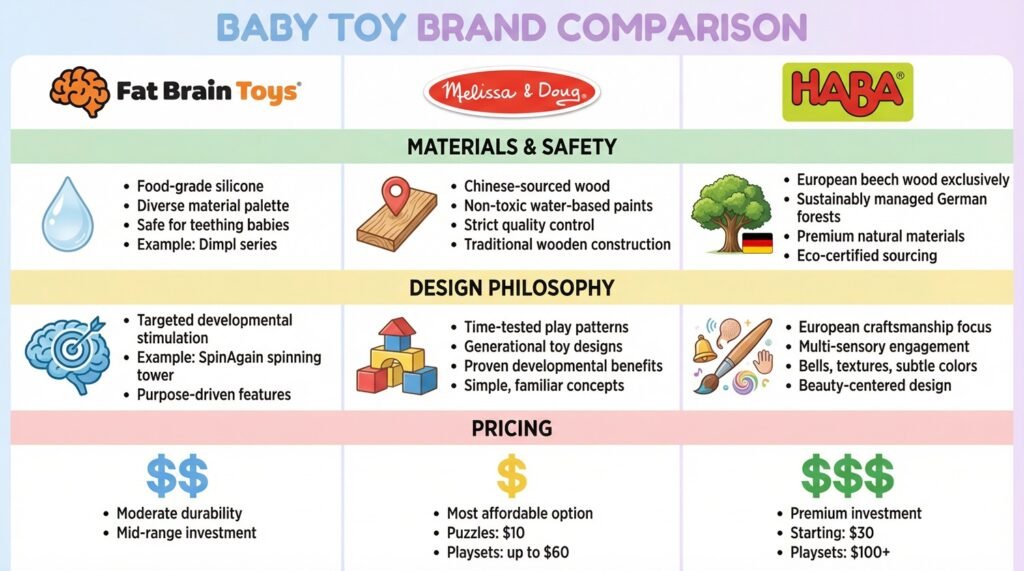
Fat Brain Toys emerged from a completely different starting point than the other two. Founded in 2002 by a father looking for better developmental toys for his own children, the company focuses heavily on what they call “play with purpose.” Their approach leans into contemporary materials like food-grade silicone, BPA-free plastics, and strategic use of wood, combined with designs that specifically target developmental milestones.
When you pick up a Fat Brain toy, you’re often holding something that looks genuinely unique, sometimes even a bit odd, but there’s always a developmental intention behind the design. The company thinks carefully about what skills a six-month-old needs versus what a fifteen-month-old is working on, then designs toys that address those specific windows.
This targeted approach produces items that look different from traditional baby toys but engage children in really specific, measurable ways.
Melissa & Doug took a totally different route. Starting in 1988, they built their entire brand identity around wooden toys that evoke nostalgia and simplicity.
Their aesthetic is immediately recognizable with bright primary colors, chunky wooden pieces, and designs that wouldn’t look out of place in a 1950s playroom.
The brand’s philosophy centers on screen-free play and open-ended exploration. They’ve really committed to making toys that parents feel good about bringing into their homes.
There’s definitely marketing savvy to their approach, but the underlying commitment to traditional play materials is genuine.
They believe that children benefit from the same kinds of toys that worked for previous generations, and they’ve built an enormous catalog around that principle.
HABA represents something else entirely. This German company has been manufacturing toys since 1938, and they approach toy design with an almost obsessive attention to detail that you’d expect from German engineering.
Their toys go through extensive testing protocols, use primarily European-sourced beech wood, and incorporate design elements that reflect decades of research into early childhood development.
HABA toys often cost more, but they’re built to survive many children and still look presentable. The company’s environmental certifications are also notably more comprehensive than most competitors.
They take sustainability seriously in ways that go beyond marketing claims, maintaining their own production facilities and controlling their supply chain with unusual rigor for the toy industry.
Material Quality and Safety Standards
This is where things get really interesting, and honestly, where I’ve seen the most misinformation floating around parenting groups. All three brands meet U.S. safety standards because that’s table stakes.
But the differences in how they exceed those minimums tell you a lot about their priorities.
Fat Brain Toys uses a really diverse material palette. Their silicone toys, like the Dimpl series, use food-grade silicone that’s incredibly durable and completely safe for teething babies.
I’ve personally watched a baby gnaw on a Dimpl for months, and the material shows basically zero degradation.
The texture stays consistent, the bubbles don’t tear or separate, and there’s no visible wearing even after intense daily use.
Their wooden toys use sustainably harvested wood with water-based finishes, and their plastic components are specifically BPA-free, phthalate-free, and PVC-free. What I appreciate about Fat Brain is their transparency.
They list materials clearly on packaging and their website.
They don’t rely on vague “eco-friendly” marketing language that doesn’t actually mean anything specific.
Melissa & Doug’s wooden toys primarily use Chinese-sourced wood, which sometimes raises eyebrows among parents looking for domestically produced options. However, they maintain strict quality control standards and use non-toxic, water-based paints.
The finish quality can be somewhat variable though.
I’ve noticed that their lower-priced items sometimes have rougher edges than their premium lines, which suggests different manufacturing standards within their product range.
Their newer initiatives include some FSC-certified wood products, though this isn’t universal across their catalog yet. The brand has made genuine improvements in recent years regarding sustainability, but they’re still playing catch-up with European manufacturers who’ve been prioritizing these standards for decades.
HABA’s material standards are genuinely impressive. They use European beech wood almost exclusively, harvested from sustainably managed forests in Germany.
Their water-based lacquers meet EN71 European safety standards, which are actually more stringent than U.S. requirements in several categories.
The company maintains their own production facilities in Germany, which means quality control happens in-house as opposed to through third-party manufacturing relationships scattered across different countries. When you examine a HABA toy closely, you’ll notice details like perfectly smooth edges, consistent grain patterns, and finishes that feel almost silky.
The wood itself is denser and heavier than typical toy-grade wood.
These details create a tactile experience that’s noticeably different from mass-market alternatives.
Design Philosophy and Developmental Approach
Fat Brain Toys really embraces the concept of targeted developmental stimulation. Take their SpinAgain toy, which is basically a twisting, spinning tower where you stack discs.
It’s visually striking with its rainbow gradient, but the real genius is how it teaches cause and effect, builds hand-eye coordination, and introduces early physics concepts all at once.
The design isn’t accidental or decorative. Their team clearly studies developmental milestones and then reverse-engineers toys to address specific skills.
The sensory focus at Fat Brain is particularly strong. They understand that babies learn through touch, sight, sound, and movement in ways that are fundamentally different from older children.
Products like the Tobbles, which are weighted, wobbly stacking pieces, or the Pip Squigz, which are suction cup creations, offer tactile experiences you simply don’t find in traditional wooden toys.
I’ve watched babies become absolutely mesmerized by the way Tobbles self-right after being knocked over. That weighted bottom creates a genuinely fascinating interaction that teaches persistence and experimentation.
The baby knocks it over, watches it wobble back upright, and immediately wants to try again. That repetition is exactly how motor skills and problem-solving develop.
Melissa & Doug champions what they call “time-tested play patterns.” Their toys intentionally mirror the kinds of playthings that have existed for generations: stacking rings, peg puzzles, building blocks, play food. There’s real value in this approach because these play patterns have proven developmental benefits over decades of use.
A Melissa & Doug rainbow stacker isn’t trying to reinvent the wheel. It’s presenting a classic learning tool with good quality materials and accessible pricing.
For parents who want to avoid overly complicated toys and trust in traditional developmental approaches, this philosophy really resonates.
There’s comfort in knowing that the toy your child is using helped develop fine motor skills and color recognition for your parents’ generation too.
What Melissa & Doug does exceptionally well is creating toys that support imaginative play. Their play food sets, dollhouses, and role-playing accessories give children frameworks for creative storytelling.
These aren’t sensory toys in the strict sense, but they support language development, social-emotional learning, and creative thinking in ways that more specialized sensory toys don’t.
The brand really shines in the 2-5 year range, where imaginative play becomes increasingly central to development.
HABA takes a distinctly European approach that emphasizes beauty, craftsmanship, and multi-sensory engagement. Their toys often incorporate elements that American toy designers might overlook: small bells that provide auditory feedback, varied wood textures that create rich tactile experiences, or color gradients that are more subtle and sophisticated than typical primary-color schemes.
The design aesthetic tends toward the understated as opposed to the visually loud, which creates a very different sensory environment. Walking into a playroom filled with HABA toys feels calmer and more organized than one dominated by brightly colored plastic, even though both might contain the same number of items.
There’s also a strong emphasis on open-ended play in HABA’s design philosophy. Their building blocks don’t have instructions or prescribed uses.
They’re precisely crafted wooden pieces that children can use in countless ways.
This approach requires more imagination from the child and supports deeper creative development. I’ve noticed that children often play longer with HABA toys because there’s no “correct” way to use them, which eliminates the frustration that can come with toys that have specific success criteria.
Price Points and Long-Term Value
Let’s talk money, because this is where the differences become really pronounced. Fat Brain Toys occupies a middle ground in pricing, generally more expensive than mass-market brands but more accessible than premium European options. Their bestselling Dimpl toy retails around twenty dollars, while more complex items like the Tobbles Neo can hit fifty dollars.
The value proposition here is innovation and developmental specificity. You’re paying for design research and proprietary materials, not necessarily for toys that will survive three generations.
I’ve found that Fat Brain toys hold up well to normal use but aren’t indestructible.
The silicone products are remarkably durable, genuinely impressive in how they withstand constant chewing and manipulation. Some of their plastic-based toys can show wear after heavy use though.
For families planning to have many children, this is worth considering. The toys will definitely survive one child and likely two, but they’re not heirloom pieces.
The resale value is decent.
These toys maintain about 40-50% of retail value in good condition, largely because parents recognize the brand and trust its developmental focus.
Melissa & Doug wins hands-down on price accessibility. Their basic wooden puzzles start around ten dollars, and even elaborate playsets rarely exceed sixty dollars.
This pricing strategy has made them the default choice for gift-givers and budget-conscious parents.
The value equation is straightforward. You’re getting solid quality at mass-market prices.
However, there’s definitely a hierarchy within their product line. The less expensive items sometimes feel a bit cheaper in terms of finish quality and design sophistication, while their premium lines compete well with more expensive brands.
You can actually see the difference when you compare a twelve-dollar Melissa & Doug puzzle to a thirty-dollar one from their higher-end collections.
Durability with Melissa & Doug is genuinely variable. I’ve seen their wooden toys survive years of daycare use and still look presentable, but I’ve also seen paint chips and loose pieces develop relatively quickly.
The wooden components themselves are quite sturdy, but painted details and small embellishments can be vulnerable points.
For the price, most parents consider this acceptable wear, but these probably aren’t toys you’ll pass down to grandchildren. Resale value is moderate, maybe 30-40% of retail, mostly because the brand is so widely available that used items compete with frequent sales and promotions on new products.
HABA represents a genuinely different investment level. Their baby toys typically start around thirty dollars and can easily exceed one hundred dollars for larger playsets or elaborate activity centers.
This pricing immediately puts them in a different category from the other two brands.
What you’re paying for is craftsmanship, materials sourcing, and toys that are genuinely built to become heirlooms. I’ve examined HABA toys that have been through three children and still look almost new.
The wood develops a nice patina, but the structural integrity stays completely intact.
Joints don’t loosen, pieces don’t warp, and the finish doesn’t chip or peel even after years of use.
The long-term value calculation with HABA is interesting. If you’re planning many children or want toys that can be passed to younger family members or friends, HABA pieces can actually be more economical over time.
A seventy-dollar HABA clutching toy that survives three children and keeps 60% of its value for resale has a lower per-use cost than a twenty-dollar toy that needs replacing after one child.
But this requires a different mindset about toy purchases. You’re essentially buying small pieces of furniture as opposed to disposable play items.
Age Appropriateness and Developmental Stages
Fat Brain Toys excels at the 6-18 month range, which is honestly when sensory play is most critical for brain development. Their designs target the specific skills emerging during this window: grasping, transferring objects between hands, understanding spatial relationships, and early problem-solving.
The Dimpl is actually perfect for around 6-10 months when babies are developing intentional finger movement and learning cause-and-effect. The satisfying pop of pushing those silicone bubbles provides immediate sensory feedback that babies find incredibly rewarding.
The Tobbles work brilliantly for 10-15 months when children are exploring balance and stability concepts.
Where Fat Brain sometimes falls short is in creating toys with extended play value as children age. A one-year-old might be fascinated by the SpinAgain, but by age three, it’s often abandoned in favor of more complex activities.
This isn’t necessarily a flaw.
Toys designed for specific developmental windows serve important purposes. But it does mean you’ll need to rotate through Fat Brain products as your child grows as opposed to investing in fewer pieces with longer relevance.
Melissa & Doug toys have broader age ranges but less developmental specificity. Their stacking toys work from about 18 months through age four, and their imaginative play sets can engage children from age three through early elementary school.
This extended usability means you buy fewer toys overall, which appeals to parents trying to avoid toy overload.
However, a 10-month-old baby won’t find much to engage with in the Melissa & Doug catalog. Their sweet spot really begins around 18 months when children are developmentally ready for puzzles and sorting activities.
The imaginative play focus means Melissa & Doug toys actually become more engaging as children age, which is the opposite trajectory from pure sensory toys. A three-year-old can create elaborate stories with their play food sets, while that same child might have exhausted the possibilities of a sensory ball months earlier.
For families thinking about the preschool years and beyond, Melissa & Doug offers better continuity, though you’ll need to supplement with more specialized sensory toys for the infant stage.
HABA manages to bridge these categories more successfully than you’d expect. Their clutching toys and rattles serve babies from 3-10 months beautifully, while their building blocks and more complex manipulation toys engage toddlers through age five and beyond.
The open-ended nature of HABA toys means they adapt to the child’s developmental level as opposed to becoming obsolete.
I’ve watched a 10-month-old mouth and shake a HABA rainbow ball, then seen a three-year-old use that same ball in imaginative play scenarios. That’s genuinely versatile design.
The same physical object provides different developmental benefits depending on what stage the child brings to the interaction.
The downside with HABA is that their product range isn’t as extensive as Melissa & Doug’s, particularly once you get past the toddler years. They don’t offer as many role-playing accessories or themed playsets, which means you’ll likely need to mix brands as your child develops more sophisticated imaginative play interests.
But for the zero-to-three window, HABA offers exceptional depth.
People Also Asked
What age is Fat Brain Toys for?
Fat Brain Toys works best for babies and toddlers between 6 months and 3 years old. Their sensory toys like the Dimpl are perfect for babies around 6-10 months who are developing finger control and learning cause and effect.
More complex items like the SpinAgain and Tobbles engage children from 10-24 months during critical motor skill development.
Some of their products extend into preschool years, but the brand really excels at that early developmental window when sensory exploration is most important for brain development.
Are Melissa and Doug toys made in China?
Yes, most Melissa & Doug toys are manufactured in China, though the company maintains quality control standards and safety testing that meet or exceed U.S. requirements. They’ve been working to incorporate more sustainable practices, including some FSC-certified wood products in their newer lines.
The Chinese manufacturing allows them to keep prices accessible, which is part of why their toys are so widely available and affordable compared to European-made choices like HABA.
Why are HABA toys so expensive?
HABA toys cost more because they’re manufactured in Germany using European beech wood from sustainably managed forests, with production happening in the company’s own facilities under strict quality control. The higher price reflects genuine material quality, the wood is denser and more carefully finished than typical toy-grade wood, extensive safety testing beyond U.S. requirements, and construction designed to survive many children.
When you calculate cost per child or cost per hour of play, HABA toys can actually be economical because they maintain structural integrity and resale value far better than cheaper alternatives.
What are the best sensory toys for babies?
The best sensory toys for babies provide varied textures, cause-and-effect feedback, and age-appropriate challenges. Fat Brain’s Dimpl offers satisfying tactile feedback for 6-10 month olds developing finger control.
HABA clutching toys provide rich wood textures and gentle sounds perfect for 3-8 month olds.
Melissa & Doug’s textured balls and simple puzzles work well for toddlers 12-24 months. The most effective sensory toys target specific developmental windows as opposed to trying to serve all ages, so rotating toys as your baby grows provides better developmental support than investing in fewer “grow with me” options.
Are wooden toys better than plastic for babies?
Wooden toys and plastic toys each offer different developmental benefits. High-quality wooden toys like those from HABA provide rich tactile experiences, are more durable, and generally have better environmental profiles.
Food-grade silicone and BPA-free plastics like Fat Brain uses can offer sensory experiences and design possibilities that wood can’t match.
The material matters less than the developmental intention behind the design. A well-designed plastic toy that targets specific skills can be more valuable than a poorly conceived wooden toy.
The best approach is mixing materials so babies experience different textures and weights during play.
What toys help baby brain development?
Toys that support baby brain development provide opportunities for cause-and-effect learning, fine motor skill practice, problem-solving, and sensory exploration. For 6-12 months, toys like Fat Brain’s Dimpl or simple HABA rattles that respond immediately to baby actions build neural connections.
For 12-24 months, stacking toys, simple puzzles, and manipulative toys from any of these three brands support spatial reasoning and hand-eye coordination.
The key is matching toy complexity to developmental stage and allowing babies extended time to explore as opposed to overwhelming them with too many options at once.
Key Takeaways
Fat Brain Toys delivers innovation and sensory-specific developmental support through modern materials and targeted design, working best for babies aged 6-18 months and families valuing contemporary approaches to skill-building.
Melissa & Doug provides accessible pricing and traditional play patterns with broad age appeal, excelling in the 18-month through preschool range for imaginative play and offering the most budget-friendly path to building varied toy collections.
HABA represents premium craftsmanship, heirloom quality, and sophisticated design that serves many children across extended age ranges, justifying higher initial costs through exceptional durability and retained value.
Material quality varies significantly. Fat Brain’s food-grade silicone offers unique sensory experiences and easy cleaning, Melissa & Doug’s painted wood provides familiar textures at accessible prices, and HABA’s European beech wood delivers superior durability and tactile appeal.
Environmental sustainability strongly favors HABA through certified sustainable sourcing and exceptional longevity, while Fat Brain shows moderate commitment through material choices and Melissa & Doug is implementing improvements but hasn’t achieved industry leadership.
Developmental specificity is highest with Fat Brain’s targeted skill-building designs, moderate with Melissa & Doug’s traditional play patterns, and sophisticated but subtle with HABA’s open-ended European design approach.
Optimal toy collections typically mix elements from all three brands, leveraging each company’s strengths for specific developmental windows as opposed to committing exclusively to a single brand philosophy.