
We may earn money or products from the companies mentioned in this post.
Getting Started with Tactile Learning
I still remember the first time I really understood how important touch is for babies. I was watching my nephew, about four months old at the time, absolutely mesmerized by a simple rubber mat with raised bumps.
He wasn’t just touching it, he was studying it with his fingers, then his whole palm, then inevitably his mouth. His face showed pure concentration as he processed this new sensation.
That moment made me realize that what looked like simple play was actually incredibly sophisticated neurological work happening in real time.
Touch is the first sense that develops in utero, and it stays the primary way babies understand their world for many months after birth. While we often focus on visual stimulation and sounds when thinking about baby development, tactile experiences are building crucial neural pathways that form the foundation for everything from fine motor control to spatial reasoning.
When babies explore different textures, they’re literally wiring their brains for future learning.
The science behind this is fascinating. Every time a baby touches something new, sensory receptors in their skin send signals to their brain, creating and strengthening neural connections.
Repeated exposure to varied textures helps develop what researchers call tactile discrimination, the ability to distinguish between different sensations through touch alone.
This skill becomes essential later for tasks like holding a pencil, buttoning clothes, or even reading braille.
During the first 18 months of life, babies are experiencing what developmental researchers call a critical period for sensory development. The brain is producing neural connections at an extraordinary rate during these months, far faster than it will at any other point in life.
The tactile experiences babies have during this window directly influence how their sensory processing systems develop and function throughout childhood and beyond.
Why Texture Variety Matters More Than You Think
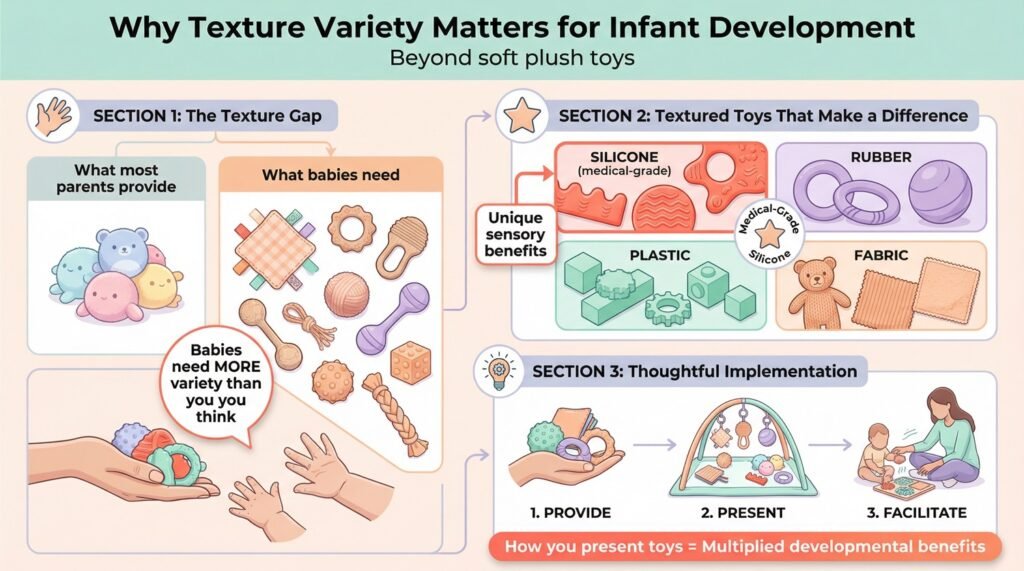
Here’s something that surprised me when I started researching infant development: babies need exposure to a much wider range of textures than most parents typically provide. We tend to default to soft, plush toys because they seem safe and comforting.
And yes, soft textures definitely have their place.
But babies who only experience smooth, fuzzy surfaces are missing out on critical sensory input.
Think about the natural world humans evolved in. Babies would have encountered rough tree bark, cool smooth stones, prickly grass, sticky sap, bumpy seed pods, and countless other textures through everyday contact with their environment. Our modern homes, with their smooth plastics and uniform fabrics, can actually be sensory deserts by comparison.
Creating a texture-rich environment means being intentional about offering diverse tactile experiences.
The developmental window for optimal sensory integration is relatively narrow. Between birth and about 18 months, babies are neurologically primed to absorb tactile information.
Their brains are incredibly plastic during this period, meaning they’re forming connections at a rate they’ll never match again in their lifetime.
What they touch during these months genuinely shapes how their sensory systems develop.
I’ve seen parents worry that providing too many textures might overwhelm their baby, but the research doesn’t support this concern. Babies are remarkably good at self-regulating their sensory input.
If something feels unpleasant or overstimulating, they’ll pull their hand away or turn their attention elsewhere.
The bigger risk is actually sensory deprivation, which can lead to tactile defensiveness later, where children avoid certain textures or become distressed by normal touch sensations.
Sensory deprivation during infancy can have lasting consequences that extend well into childhood. Children who had limited texture exposure as babies sometimes develop an aversion to certain materials, refusing to touch clay, sand, or even certain foods based on texture.
They may struggle with tasks that need tactile feedback, like using scissors or tying shoes.
Some become so sensitive to clothing textures that getting dressed becomes a daily battle. Providing rich texture experiences during infancy helps prevent these challenges.
Textured Toys That Actually Make a Difference
Let me walk you through some genuinely interesting textured toy options that go beyond the typical offerings you’ll find in every baby store.
Silicone Chew Beads
These have become really popular in recent years, and for good reason. Medical-grade silicone provides a unique texture that’s different from rubber, plastic, or fabric.
The surface has a slight drag against skin that babies find really engaging.
What I particularly appreciate about quality silicone beads is that they often incorporate many textures on a single bead, smooth areas, ribbed sections, nubby bumps. Babies can explore these variations all on one toy, which helps them develop tactile discrimination.
The mouthing aspect matters here too. Babies learn as much through their mouths as through their hands during the first year.
The sensory receptors in their lips and tongue are incredibly sensitive.
When a baby gums a silicone bead, they’re gathering detailed information about its properties, firmness, texture, temperature. This oral exploration is completely normal and developmentally suitable, not just teething behavior.
Natural Loofah Pieces
This is one of those less obvious options that I’ve found to be surprisingly valuable. A small piece of natural loofah sponge, properly sanitized and monitored, offers a texture that’s genuinely unique.
It’s scratchy but not sharp, compressible but springy, and has this fascinating fibrous structure.
You won’t find this texture replicated in plastic toys.
I usually suggest cutting a small piece from a natural loofah, boiling it thoroughly, and letting baby explore it during supervised play. The key word there is supervised, loofah can shed fibers, so this isn’t a toy to leave in the crib.
But for focused tactile play sessions, it provides sensory input that’s really different from anything else in a typical toy basket.
Crinkle Fabric with Varying Densities
Standard crinkle toys all pretty much sound and feel the same, that plastic wrapper sound and sensation. But there’s actually a whole spectrum of crinkle experiences you can provide.
Some specialty sensory toys use mylar sheets of different thicknesses, creating variations in both sound and tactile feedback.
Others incorporate mesh or tulle fabrics that have a unique texture when scrunched.
The developmental benefit here extends beyond simple texture recognition. Crinkle toys teach cause and effect, the baby squeezes, and something happens.
They also provide proprioceptive feedback, helping babies understand how much force they’re applying with their hands.
This body awareness is foundational for motor development.
Wooden Toys with Natural Grain
There’s been a resurgence of wooden toys in recent years, and there are legitimate developmental reasons beyond aesthetics. Wood has thermal properties that plastic doesn’t, it feels warmer to the touch and responds to body heat differently.
The grain patterns provide subtle texture variations that babies can detect, even when the surface is smooth.
I’m particularly interested in wooden toys that incorporate different species of wood in one item. A rattle made with maple on one end and walnut on the other provides two distinct densities and grain patterns.
To adult hands, they might feel similar, but babies detecting these subtle differences are developing sophisticated tactile perception.
Textured Rubber Balls
Not all rubber balls are created equal. The standard smooth rubber ball is fine, but balls with intentional texture patterns offer so much more developmental value.
Look for balls with raised dots, ridges, valleys, or even asymmetrical textures.
These provide varied tactile input depending on where baby grasps them.
The beauty of textured balls for development is that they combine tactile learning with gross motor practice. As babies get older and start rolling, throwing, and chasing balls, they’re reinforcing their tactile memories of that object through repeated physical interaction.
The texture becomes associated with movement and spatial awareness.
Velvet and Corduroy Fabrics
Most fabric books and soft toys use cotton, fleece, or satin. These are great textures, but velvet and corduroy offer something genuinely different. Velvet has that directional quality, it feels different when you stroke it one way versus the other.
Babies find this variation fascinating and will repeatedly stroke velvet in different directions, actively experimenting with the sensory feedback.
Corduroy provides a ribbed texture that’s really distinct. The raised wales give babies something to trace with their fingers, supporting the development of fine motor control and finger independence.
As babies get older, this kind of textured fabric helps prepare their hands for detailed manipulative tasks.
Creating Effective Texture Experiences
Just having textured toys isn’t quite enough, how you present them and facilitate exploration makes a real difference in developmental outcomes. I’ve learned that thoughtful implementation multiplies the benefit babies get from these materials.
Start by introducing textures one or two at a time during focused play sessions. Babies can engage more deeply with person textures when they’re not overwhelmed by too many options simultaneously.
Place a single textured item in your baby’s hand and give them time to process it.
You might see them pause, look away, then return their attention to the object. That’s active processing happening.
Temperature adds another dimension to texture exploration that’s often overlooked. A wooden ring feels different when it’s room temperature versus when it’s been warmed in your hands. A silicone teether that’s been refrigerated provides both temperature and texture input.
These combinations create richer sensory experiences and help babies understand that objects have many properties.
Pairing textures with language development creates powerful learning opportunities. Even though young babies don’t understand words yet, hearing descriptive language while touching objects helps build connections between sensations and concepts.
When your baby touches something bumpy, say “bumpy” with emphasis.
When they feel something smooth, name that quality. Eventually, these associations will support both sensory recognition and vocabulary development.
The environment where you offer textured toys matters too. Babies explore more freely when they’re comfortable and alert.
Right after a nap, when they’re fed and content, is often ideal for sensory play.
Rushed texture exploration while baby is hungry or tired won’t be as productive. Creating calm, focused texture time helps babies get the most developmental benefit from these experiences.
Rotation is another strategy that really enhances engagement. Rather than having all textured toys available all the time, keep some stored and rotate them every week or two.
When a texture reappears after an absence, babies often explore it with renewed interest.
This approach also prevents sensory habituation, where babies stop noticing textures they encounter constantly.
Watch Out for These Common Mistakes
I’ve observed several patterns that tend to limit the developmental value parents get from textured toys, even when their intentions are excellent. Being aware of these pitfalls, problems, issues, problems, issues, problems, issues can help you avoid them.
The biggest mistake is providing too narrow a texture range. It’s easy to accumulate ten different toys that all feel basically the same, soft, fuzzy, slightly yielding.
This happens because we gravitate toward what seems babyish and safe.
But remember, babies need contrast to develop discrimination. A toy collection should include hard and soft, smooth and rough, rigid and flexible, warm materials and cool ones.
Another common issue is prioritizing cleanliness over sensory value to an extreme degree. Yes, toy hygiene is genuinely important.
But I’ve seen parents so focused on keeping toys pristine that they only offer hard plastic items that can be bleached daily.
Fabric, wood, and natural materials provide important textures that plastic can’t replicate. With reasonable washing routines, these materials are perfectly safe and vastly expand the sensory variety available.
Rushing babies through texture exploration is problematic too. Adults tend to think babies should quickly touch something and move on, and we get impatient watching them manipulate the same object for minutes on end.
But that extended focus is exactly what supports learning.
When babies repeatedly touch, mouth, drop, and retrieve an object, they’re building robust sensory memories and understanding object permanence simultaneously. Let them work.
Some parents inadvertently talk that certain textures are unpleasant through their own reactions. If you visibly cringe when baby touches something you personally find weird or gross, they pick up on that emotional feedback.
Unless something is actually unsafe, try to maintain a neutral or positive demeanor while baby explores.
Your reactions shape their willingness to engage with new sensory experiences.
Adapting Texture Play Across Developmental Stages
The textures that work well for a two-month-old won’t necessarily be optimal for a ten-month-old. As babies develop physically and cognitively, their capacity for texture exploration advance considerably.
For young infants from birth to about three months, texture exploration is mostly passive. You’ll place textured items against their palms or the soles of their feet, and they’ll reflexively grasp.
Even though they’re not actively manipulating objects yet, they’re absolutely receiving sensory input.
Soft fabrics with subtle texture variations work well during this stage, terry cloth, fleece, ribbed knits. The goal is gentle exposure.
Around three to six months, babies develop voluntary grasping and start bringing objects to their mouths intentionally. This is when textured toys become interactive tools.
Lightweight rattles with textured grips, fabric books, and soft blocks work beautifully during this stage.
Safety becomes paramount here because everything is going directly in the mouth. Make sure textures are non-toxic and won’t shed small parts.
Between six and nine months, babies typically develop better finger control and can manipulate objects more deliberately. This is when you can introduce textures that need more sophisticated exploration, balls with finger holes, toys with moving parts, objects that have contrasting textures on different surfaces.
Babies this age love to transfer objects between hands, rotate them, and examine them from different angles while experiencing their textures.
From nine to twelve months and beyond, babies can engage with increasingly complex texture experiences. Sensory boards with many textures mounted on a surface, toys that combine textures with simple mechanisms, and texture-based sorting activities become suitable.
Babies this age are developing intentionality and can follow simple instructions like “touch the bumpy one” or “feel the soft part.”
Frequently Asked Questions
When should I start introducing textured toys to my baby?
You can start introducing textured toys from birth. Newborns benefit from passive texture exposure, placing different fabrics against their skin or letting them grasp textured objects during their reflexive grasping phase.
The key is to match the complexity of textures to your baby’s developmental stage, starting simple and gradually introducing more varied and complex textures as they grow.
Are silicone toys safe for babies to chew on?
Medical-grade silicone toys are safe for babies to chew on and mouth. Silicone is non-toxic, doesn’t contain BPA, phthalates, or other harmful chemicals, and can withstand repeated washing and sterilization.
Make sure you’re purchasing from reputable manufacturers who specifically market their products as food-grade or medical-grade silicone designed for infant use.
How do I clean textured toys properly?
Cleaning methods depend on the material. Silicone and hard plastic toys can be washed with hot soapy water or placed in the dishwasher.
Wooden toys should be wiped down with a damp cloth and mild soap, then dried immediately to prevent warping.
Fabric toys can usually be machine washed on a gentle cycle. Natural materials like loofah should be boiled periodically to sanitize them.
Can too much texture stimulation overwhelm my baby?
Babies are actually really good at self-regulating sensory input. If they’re overwhelmed, they’ll look away, pull their hand back, or fuss to signal they need a break.
Watch for these cues and respect them.
The bigger concern is under-stimulation as opposed to over-stimulation. Most babies benefit from more texture variety than they typically receive.
What household items make good textured toys?
Many household items provide excellent texture experiences. Clean kitchen sponges, wooden spoons, silicone baking mats, measuring cups, fabric napkins with different weaves, rubber jar openers, and clean makeup brushes all offer distinct textures.
Just make sure items are clean, safe to mouth, and don’t have small parts that could detach and become choking hazards.
How many different textures should my baby experience?
There’s no magic number, but aim for genuine variety as opposed to quantity. Ten toys with truly different textures provide more developmental value than fifty toys that all feel similar.
Try to include representations from major texture categories, smooth and rough, soft and hard, flexible and rigid, bumpy and flat, warm materials and cool materials.
When do babies develop tactile discrimination?
Babies begin developing tactile discrimination from birth, but it becomes increasingly sophisticated throughout the first year and beyond. By around six months, many babies can distinguish between familiar and unfamiliar textures.
By their first birthday, most babies show clear preferences for certain textures and can recognize familiar objects by touch alone.
Are natural materials better than plastic for texture toys?
Natural materials like wood, fabric, and natural rubber offer textures that plastic can’t copy, so they add important variety to a texture toy collection. However, safe plastic toys also have their place and provide their own distinct textures.
The goal is variety across all material types as opposed to exclusively using one category.