
We may earn money or products from the companies mentioned in this post.
Most first-time parents look at the overwhelming toy aisle and think, “Sure, I’ll just grab whatever looks colorful and educational!”
This may sound easy, but selecting truly developmental toys is more difficult than it appears.
Yes, there are always toys that engage babies over the first year, but not very many that grow with them.
As long as you keep buying age-specific toys, your tries to support development will drain your wallet because babies outgrow things quickly.
But if you shift from buying multiple single-purpose toys to investing in versatile sensory toys, you’ll see that the smartest way to support infant development is to choose open-ended tools that adapt as your baby grows.
Developing a curated toy collection is one of the highest leverage things you can do to support cognitive growth without cluttering your home. And if you’re preparing for a baby shower or looking for meaningful gifts, these same principles apply.
Here’s how it works: Fat Brain Toys specializes in sensory-rich, open-ended play items that babies can explore in multiple ways. Instead of battery-operated toys that dictate how play happens, these tactile tools let your baby lead the discovery.
A simple silicone toy becomes a teether at 4 months, a cause-and-effect tool at 7 months, and a fine motor challenge at 10 months.
If you can embrace this minimalist approach, it will allow you to move past the guilt of not having every trending toy, and instead focus on quality interactions.
Even if you already have a house full of toys, you can start fresh with just a few versatile pieces which will simplify cleanup, so you can actually enjoy playtime.
That being said, choosing the right starter toys makes all the difference in building a foundation that supports your baby through multiple developmental stages.
What Makes Fat Brain Toys Different
Fat Brain Toys focuses on baby sensory play through thoughtfully designed products that prioritize safety and development over flashy features. Unlike many mainstream toy brands that rely on lights and sounds, these toys use texture, color, and movement to engage developing minds.
The company emphasizes BPA-free materials, no small parts that pose choking hazards, and designs that align with Montessori and Reggio Emilia philosophies of child-led exploration.
The key difference you’ll notice is versatility. A single Fat Brain toy typically serves multiple developmental purposes across different age ranges.
This means fewer toys taking up space in your living room and more intentional play sessions that actually support your baby’s growth.
The price point ranges from around $10 to $20 per toy, making them accessible without the guilt of expensive purchases that get used for just a few weeks.
5 Essential Fat Brain Toys for Baby Sensory Play
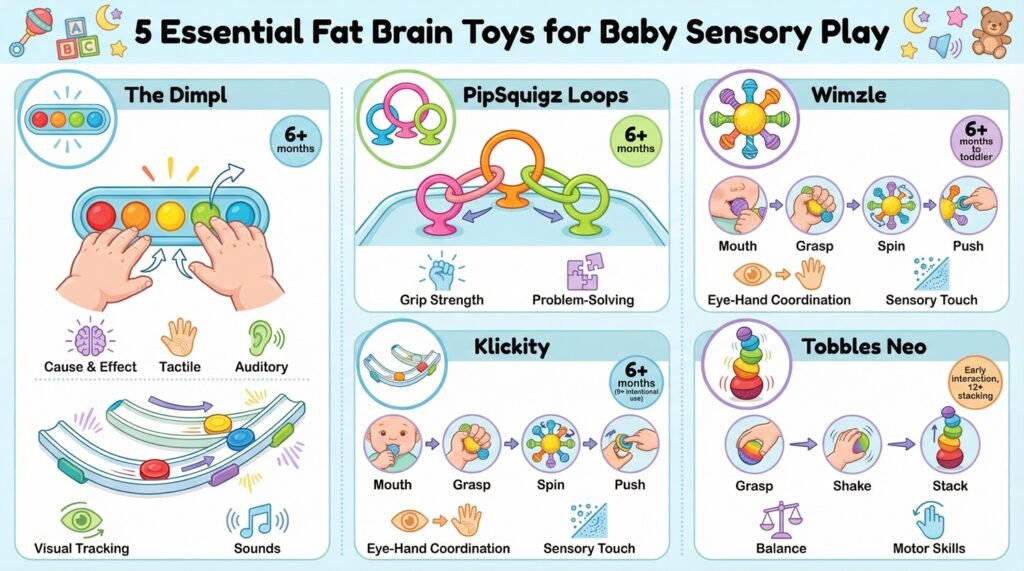
1. Dimpl
The Dimpl features five colorful silicone bubbles set in a sturdy frame that babies can push and pop. Starting around 6 months, babies learn cause and effect as they press the bubbles in and out, creating satisfying tactile and auditory feedback.
The different sizes and colors support visual tracking and fine motor development, while the soft silicone is safe for mouthing during teething phases.
[Link to Dimpl on Amazon, affiliate link]
2. PipSquigz Loops
These suction cup loops stick to any smooth surface and link together for endless configurations. From 6 months onward, babies pull, twist, and manipulate the flexible loops, building grip strength and problem-solving skills.
The suction cups work perfectly in the bathtub, on highchair trays, or windows, turning any surface into a play space.
Parents love that they’re easy to clean and genuinely hold babies’ attention during potentially fussy moments like diaper changes or meal prep.
[Link to pipSquigz Loops, affiliate link]
3. Wimzle
The Wimzle is a multi-sensory marvel with spinning parts, textured surfaces, and movable pieces that encourage exploration. Suitable from 6 months through toddlerhood, babies first mouth and grasp it, then progress to intentional spinning and pushing as hand-eye coordination develops.
The various textures provide sensory input that supports tactile discrimination, which forms the foundation for later fine motor skills like writing.
The compact size makes it perfect for diaper bags and car rides.
[Link to Wimzle, affiliate link]
4. Klickity
Klickity features colorful discs that slide and click along flexible tracks, creating satisfying sounds and visual movement. Babies as young as 6 months bat at the discs, progressing to intentional pushing and tracking by 9 months.
The bilateral design encourages using both hands together, supporting midline crossing which is crucial for brain development.
The clicking sounds provide immediate feedback without being overwhelming or electronic.
[Link to Klickity, affiliate link]
5. Tobbles Neo
This stacking toy consists of weighted spheres that wobble when stacked but don’t fall over easily. While stacking typically develops around 12 months, babies interact with Tobbles Neo much earlier by grasping, shaking, and watching the pieces wobble.
The weighted bases teach early physics concepts and the various textures engage tactile exploration.
Unlike traditional stacking rings, the self-correcting design reduces frustration and encourages repeated attempts, building persistence and spatial reasoning.
[Link to Tobbles Neo, affiliate link]
Why These Toys Support Development
Baby sensory play during the first year builds neural connections that form the foundation for all later learning. The American Academy of Pediatrics emphasizes that hands-on play with simple objects outperforms electronic toys for language development and engagement.
When babies manipulate objects, they learn about cause and effect, spatial relationships, and problem-solving in ways that passive entertainment cannot replicate.
Fat Brain Toys specifically address the developmental milestones of the first year. At 3-6 months, babies develop grasp and begin bringing objects to their mouths for exploration.
The soft silicone of the Dimpl and Wimzle safely satisfies this oral exploration while providing varied textures.
By 6-9 months, babies start transferring objects between hands and demonstrating intentional reaching. The pipSquigz Loops and Klickity encourage bilateral coordination and intentional manipulation.
Around 9-12 months, babies develop pincer grasp and begin understanding that actions have predictable results. The popping action of Dimpl bubbles and the clicking of Klickity discs provide immediate, consistent feedback that reinforces cause-and-effect learning.
As babies approach their first birthday, they begin stacking and nesting objects.
Tobbles Neo introduces these concepts with a forgiving design that prevents the frustration of constantly falling towers.
The open-ended nature of these toys means your baby will use them differently as cognitive abilities expand. A 7-month-old might bang two Tobbles Neo pieces together to hear the sound, while a 14-month-old tries deliberate stacking.
This longevity provides better value than age-specific toys that get quickly outgrown.
What to Consider Before Buying
Safety comes first. Check that any toy you purchase is free of small parts, made from non-toxic materials, and has no sharp edges. All Fat Brain Toys meet CPSIA safety standards, but always supervise play sessions, especially with babies who are still mouthing everything.
Match toys to current abilities with room to grow. If your baby is 4 months old, start with simpler options like Dimpl that need less coordination. Save the Tobbles Neo for when grasping is more established around 6-7 months.
That said, babies often surprise you by being ready earlier than expected, so having slightly advanced toys available encourages reaching new milestones.
Consider your lifestyle and space. If you travel often, prioritize compact options like Wimzle or Dimpl that fit easily in a diaper bag. For bath time entertainment, pipSquigz Loops stick to tub walls and provide distraction during hair washing.
If you have limited storage, choose toys that don’t need multiple pieces or accessories.
Think about cleaning and maintenance. Babies drool on, throw, and mouth everything. Fat Brain Toys are generally dishwasher safe or easy to wipe clean, which matters when you’re dealing with daily sanitizing.
Avoid toys with electronic components that can’t handle moisture or need battery replacements.
Budget for quality over quantity. Five well-chosen toys at $15 each provides more developmental value than 20 random items from discount stores. Quality toys last through multiple children and can be passed to friends or family, reducing long-term cost and environmental impact.
Frequently Asked Questions
When should I introduce sensory toys to my baby?
You can begin offering simple sensory toys as early as 3-4 months when babies start reaching for objects intentionally. Start with high-contrast patterns and soft textures before progressing to toys with moving parts around 6 months.
The key is matching toy complexity to your baby’s current developmental stage while offering slightly challenging options that encourage growth.
How do I know if a toy is safe for my baby?
Check for several safety indicators including age recommendations on packaging, absence of small parts that could be choking hazards, non-toxic material certifications like BPA-free, and solid construction without pieces that could break off. Avoid toys with strings longer than 7 inches, magnets, or batteries that could be accessed by babies.
When in doubt, apply the toilet paper roll test: if a toy or any part of it fits inside a toilet paper tube, it’s too small for babies under 3 years.
How many toys does a baby really need?
Research suggests that fewer toys actually leads to better quality play. Having 4-6 toys available at once allows babies to focus and engage deeply as opposed to becoming overwhelmed by choices.
Rotate toys weekly or bi-weekly to maintain novelty without purchasing new items constantly.
This approach, popular in Montessori education, supports longer attention spans and more creative exploration.
Can homemade toys work just as well as purchased ones?
Household items like wooden spoons, fabric scraps, and metal bowls can absolutely provide rich baby sensory play experiences. However, store-bought toys like those from Fat Brain offer engineered safety features and developmental research that homemade options may lack.
A balanced approach works well: use household items for supervised play while relying on tested commercial toys for independent exploration.
My baby only plays with each toy for a few minutes. Is something wrong?
Short attention spans are completely normal for babies under 12 months. Even 5-10 minutes of focused play represents good engagement for this age.
Babies also use play differently than older children, often needing to explore something multiple times over weeks before mastering it.
If your baby seems uninterested in a particular toy, put it away for a month and reintroduce it. Developmental readiness greatly affects engagement.
How do I clean silicone baby toys?
Most silicone toys including Fat Brain products can go on the top rack of a dishwasher for thorough sanitizing. For hand washing, use warm water with mild dish soap and a soft brush to reach textured areas where milk or food might hide.
Air dry completely before storing to prevent mold growth.
For quick cleaning between uses, baby-safe sanitizing wipes work well.
Are these toys suitable for babies with developmental delays?
Open-ended sensory toys often work beautifully for babies with various developmental needs because they can be explored at any ability level. The lack of a “right way” to play reduces frustration while still providing beneficial stimulation.
However, always ask with your pediatrician or early intervention specialist about specific toy recommendations based on your baby’s person needs and therapy goals.
Final Thoughts
From this list, the Dimpl stands out as the most versatile starter toy for the first year. The simple push-and-pop action engages babies from 6 months through toddlerhood, providing tactile feedback that seems to universally captivate young minds.
The compact size, easy cleaning, and under $15 price point make it accessible for any budget, and it’s substantial enough that you won’t be constantly hunting for it under furniture.
Parents consistently report that Dimpl buys them precious minutes of engagement during transitions, meals, and those late afternoon fussy periods.
That said, each toy on this list serves a unique developmental purpose. If you can invest in 2-3 options, you’ll have sensory play covered for the entire first year and beyond.
The combination of Dimpl for tactile exploration, pipSquigz Loops for problem-solving, and Tobbles Neo for stacking creates a well-rounded collection that supports fine motor skills, cause-and-effect learning, and spatial reasoning.
The beauty of Fat Brain Toys comes from their simplicity. There are no batteries to replace, no complicated instructions, and no pressure to play a certain way.
Your baby leads the exploration, discovering new properties and possibilities as cognitive abilities expand.
This child-directed approach aligns with modern understanding of how babies learn best through active engagement as opposed to passive observation.
Start with one toy today and observe how your baby interacts with it over the coming weeks. You’ll likely notice new ways of playing emerging as your little your coordination and understanding develop.
Building a small collection of quality sensory toys provides a foundation for exploration that honors your baby’s natural curiosity while supporting crucial developmental milestones.
Ready to transform playtime? [Pick your favorite from this list and order through our affiliate links above] to bring home toys that grow with your baby through that incredible first year.