
We may earn money or products from the companies mentioned in this post.
I still remember the moment I realized I’d been completely wrong about baby toys. My friend had just had her first baby, and I showed up with what I thought was the perfect gift: a colorful plastic activity center that lit up, played seventeen different songs, and had more buttons than a spacecraft control panel.
I was so proud of myself.
Then I visited her house three months later. The toy was shoved in a closet, still in its box.
Instead, her six-month-old was completely absorbed with a simple wooden ring on a dowel, taking it off and putting it back on with intense concentration. She was really focused, like, more focused than I’d ever seen a baby be with a toy.
That’s when she told me about Montessori toys, and honestly, I thought it sounded pretentious at first. Wooden toys?
For babies?
Wasn’t that just expensive minimalist aesthetic stuff for Instagram?
But then she explained the actual developmental science behind it, and I felt genuinely shocked that no one talks about this stuff more openly.
The large majority of toys marketed to parents are designed to capture parental attention at the store, not to support actual infant development. They’re loud, bright, and promise to make your baby smarter, but they’re actually doing the opposite.
Research on infant brain development shows that overstimulation from electronic toys can actually delay language development and reduce attention span, because babies aren’t doing the cognitive work themselves.
I’m not saying this to make anyone feel guilty. I bought those toys too, before I knew better.
But once you understand what babies actually need at each developmental stage, choosing toys becomes so much clearer, and honestly, a lot simpler and less expensive than the toy industry wants you to believe.
What Your Baby’s Brain Actually Needs
Here’s something that really changed my perspective: during the first year of life, your baby’s brain forms about one million neural connections every single second. Every.
Single.
Second.
That’s not marketing hype, that’s neuroscience.
But, those connections form through direct sensory experience, not through passive observation. When your baby grasps a wooden ring, their brain is integrating tactile feedback from their fingers, visual input about the object’s shape and distance, proprioceptive information about where their arm is in space, and motor planning for how to move their hand to the target.
That’s an absolutely massive amount of neural integration happening from one simple action.
Now compare that to a toy that lights up and plays music when a button is randomly pressed. Your baby’s role is just to watch and listen. They’re not planning movement, not problem-solving, not integrating many sensory systems.
They’re basically just being entertained, which feels engaging in the moment but doesn’t build the neural architecture they need for future learning.
The Montessori approach is built on this understanding of how learning actually happens. Dr. Maria Montessori was observing children scientifically over a century ago, and modern neuroscience has validated essentially everything she discovered through careful observation.
Babies learn through repetition of self-chosen activities, not through adult-directed entertainment.
They need opportunities to concentrate deeply on one thing, not to be distracted by many stimuli simultaneously.
This is why authentic Montessori toys share certain characteristics. They’re made from natural materials that provide genuine sensory feedback.
Wood has weight, texture, temperature variations, and even smell that plastic simply doesn’t offer.
They’re designed around a single developmental concept as opposed to trying to teach everything at once. They allow for open-ended exploration as opposed to having one “correct” way to play.
And critically, they’re beautiful and well-crafted in a way that invites careful handling as opposed to rough play.
I know this probably sounds idealistic, and you might be thinking, “But my baby loves their light-up toys.” And look, I get it. Babies absolutely do respond to lights and sounds because our brains are wired to orient toward novel stimuli.
But responding to something and learning from something are really different things.
The Real Developmental Timeline: What Actually Happens Month by Month
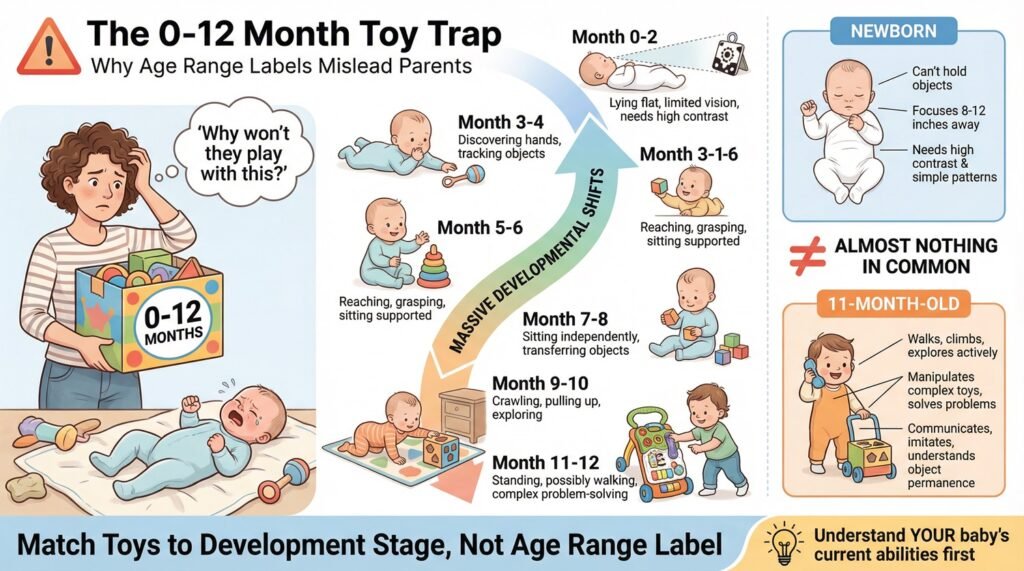
One of the biggest mistakes I see parents make (and I absolutely did this myself) is buying toys without understanding where their baby actually is developmentally. The toy packaging says “0-12 months” so you assume it’s suitable for your two-month-old, and then you’re confused when your baby seems completely uninterested or frustrated.
Babies go through absolutely massive developmental shifts during that first year. A newborn and an eleven-month-old have almost nothing in common in terms of abilities, interests, or needs.
The First Three Months: Building the Foundation
Your newborn enters the world with pretty limited abilities, and that’s completely normal and expected. Their vision is blurry beyond about eight to twelve inches, which is conveniently the distance to your face when you’re holding them. They can’t deliberately grasp objects yet.
They can’t roll over or sit up.
They’re essentially working on the absolute basics: regulating their nervous system, learning that their caregivers respond to their needs, and beginning to organize sensory input.
During these early weeks, the most valuable “toys” are really just opportunities for sensory experience within their current abilities. A soft, safe mirror positioned during tummy time let’s them begin recognizing faces and eventually their own features.
High-contrast black and white cards or images support their developing vision because they genuinely can’t process complex colors or patterns yet, so those bright multicolored toys are actually just visual noise to them.
Gentle rattles that you place in their hand help them begin noticing that they have hands and that those hands can create effects in the world. This sounds so simple, but it’s absolutely profound for a newborn who doesn’t yet understand where their body ends and the world begins.
The key during this stage is really following your baby’s cues about what they can handle. Some babies can focus on a mobile for five or ten minutes.
Others get overwhelmed after thirty seconds.
Neither is better or worse, they’re just different nervous systems with different thresholds. Overstimulation during these early months can make everything harder, from feeding to sleeping, so less is genuinely more.
Three to Six Months: The Awakening
Something really incredible happens around three to four months. Your baby starts deliberately reaching for objects.
This might not sound like a big deal, but it represents a massive shift from reflexive movement to intentional action.
They’re beginning to understand that they can make things happen through their own choices.
This is when toys become genuinely important developmental tools instead of just pleasant sensory experiences. Your baby needs objects they can successfully grasp: lightweight wooden rings, soft fabric balls, silicone links.
They need different textures to explore because they’re building their tactile library of what things feel like.
Smooth wood, bumpy rubber, soft fabric, cool metal – each texture is literally building neural pathways.
Around four to five months, most babies find out about their hands in a whole new way and suddenly everything goes directly into the mouth. This isn’t random or gross, it’s actually brilliant neurological programming.
Your baby’s mouth has more sensory nerve endings than their hands at this age, so mouthing objects is genuinely how they learn about shape, texture, hardness, and temperature.
This is where toy safety becomes absolutely critical, obviously. Everything needs to be too large to be a choking hazard, and everything needs to be clean and safe for extended mouthing.
This is also where natural materials really shine, because you’re not worried about your baby ingesting plasticizers or other chemicals.
The object permanence box becomes absolutely magical during this stage. You drop a ball into a hole, it disappears, you open a drawer and it reappears.
This teaches your baby one of the most important cognitive concepts they’ll ever learn: that objects continue to exist even when you can’t see them.
This is the foundation for everything from memory to attachment to problem-solving. And it’s fascinating to watch the exact moment this concept clicks because you can literally see the understanding dawn on their face.
Six to Twelve Months: The Problem-Solver Emerges
The second half of the first year is when things get really interesting because your baby changes from someone who explores through sensing and mouthing to someone who actively problem-solves and experiments. This is when you need to shift from primarily sensory toys to toys that present genuine cognitive challenges.
Shape sorters are the classic example. At six months, your baby probably can’t successfully insert shapes into matching holes.
They’ll bang the shapes on the box, mouth them, maybe accidentally drop one through a hole.
But by nine or ten months, you’ll start seeing deliberate tries to match shapes, and by twelve months, many babies can successfully finish simple shape sorters through trial and error.
This trial and error process is exactly the point. A toy that automatically guides the shape into the right hole removes the learning opportunity.
Your baby needs to try the circle in the square hole, find out about it doesn’t fit, and try again. That’s where the neural development happens: in the problem-solving process, not in the successful completion.
Stacking toys become absolutely absorbing during this stage. Stacking rings by size needs understanding relative dimensions, planning movement sequences, and coordinating both hands together.
It’s genuinely challenging, which is why your baby will practice it over and over and over.
That repetition isn’t boredom, it’s mastery-building.
Push and pull toys become relevant as your baby starts cruising and potentially walking. These toys support gross motor development while also providing motivation to move.
Wooden push toys with natural sounds are vastly better than plastic electronic versions because the sound provides genuine feedback about speed and force as opposed to just playing a pre-recorded tune.
This is also when practical life objects become genuinely interesting to your baby. They want to imitate what they see you doing, so safe kitchen items like wooden spoons, silicone spatulas, and stainless steel bowls are often more engaging than actual toys.
This isn’t just cute, it’s your baby learning about real-world objects and actions, which builds their understanding of how their environment works.
How to Actually Choose Toys Without Getting Manipulated by Marketing
I’m going to be really honest here: the baby toy industry is designed to exploit parental anxiety and aspiration. Every toy promises to make your baby smarter, happier, more advanced. The packaging shows babies who are clearly older than the stated age range using the toy with skills your baby doesn’t have yet, making you worry your child is behind.
It’s genuinely manipulative, and I think we need to call that out clearly before talking about how to make better choices.
You are not failing your baby if you don’t buy expensive toys. Your baby doesn’t need a massive toy collection to develop well.
In fact, research consistently shows that babies with fewer, simpler toys actually engage more deeply and develop better concentration skills.
So here’s how I think about toy selection now, after learning this stuff the hard way.
First, I observe my baby to see what they’re actually working on developmentally. Are they obsessively practicing reaching and grasping?
Then they need graspable objects in different sizes and textures.
Are they constantly trying to put objects inside other objects? Then they need containers and items that fit inside them.
Second, I ask whether a toy needs my baby to do cognitive or physical work, or whether the toy does the work for them. A toy that plays music when a button is pressed isn’t teaching problem-solving, it’s teaching that passive actions create elaborate responses.
A toy that makes sound through your baby’s own manipulation (like a rattle or a bell) teaches genuine cause and effect.
Third, I consider whether this toy will stay engaging across developmental stages or whether it’s so specific that it’ll be outgrown within weeks. The best Montessori toys are genuinely useful for months or even years because they can be used in increasingly sophisticated ways.
Simple wooden blocks, for example, are mouthed at six months, banged together at nine months, stacked at twelve months, and used for elaborate construction at two or three years.
Fourth, I really prioritize natural materials when possible. This isn’t just aesthetic preference, wood, metal, natural rubber, and fabric provide genuine sensory information that supports neural development.
They also don’t contain the endocrine disruptors and other chemicals that many plastics do.
I’m not absolutist about this, but when given the choice between plastic and natural materials at similar price points, natural materials win.
Fifth, I think about whether I could reasonably create a similar toy experience with household objects. If I can achieve the same developmental goal with a cardboard box and some fabric scraps, I don’t need to buy the expensive version.
But if the purchased version is genuinely superior in safety, durability, or developmental appropriateness, then it’s worth the investment.
The Rotation System That Changed Everything
Here’s something that absolutely transformed my experience with baby toys: rotating what’s available as opposed to keeping everything accessible all the time. This is standard practice in Montessori classrooms, but for some reason it’s not widely talked about in parenting advice.
The principle is simple. Keep about five to seven toys accessible at any given time.
Store the rest somewhere your baby can’t see them.
Every two to four weeks, swap out the accessible toys with stored ones.
The first time I did this, I was genuinely shocked by the result. Toys my baby had completely ignored for weeks suddenly became fascinating again when they reappeared after a month away.
Toys that had seemed too advanced and frustrating were suddenly exactly right after a few weeks of development.
This system works because it prevents the overwhelm that happens when babies are confronted with too many choices. Research on decision-making shows that excessive options actually reduce engagement and satisfaction, and while that research is typically done with adults, the principle applies to babies too.
When your baby sees twenty toys, they often can’t focus on any single one long enough to really explore it deeply.
When they see five toys, they engage more thoroughly with each.
Rotation also dramatically extends the value of your toy investment. Instead of toys being intensely used for two weeks and then forgotten, they stay engaging for months because they’re not constantly available.
This means you genuinely need fewer toys overall, which saves money and reduces clutter.
Practically speaking, I keep current toys on a low shelf where my baby can independently choose what to play with. This is important for supporting autonomy and decision-making skills.
Stored toys go in labeled bins in a closet with a note about what developmental skills they support, so when I’m rotating I can make intentional choices about what to bring out based on what I’m observing my baby working on.
I also keep a simple journal tracking when I rotate toys and which ones get the most engagement. This helps me notice patterns: maybe my baby consistently ignores cause-and-effect toys but is obsessed with anything involving containers and contained objects.
That information guides future purchases and helps me avoid wasting money on toy types my specific baby just isn’t drawn to.
The Safety Issues Nobody Talks About Enough
I need to address something that makes me genuinely frustrated: the baby toy safety standards in many countries, including the United States, are absolutely inadequate. Toys get recalled regularly for serious hazards, but only after babies have already been injured or even killed.
The small parts regulations are better than nothing, but they’re not comprehensive enough. The official standard is that anything smaller than a toilet paper tube is a choking hazard for children under three.
But that’s a pretty big size range, and babies develop the ability to pick up smaller objects well before they develop the judgment about what not to put in their mouths.
This is where supervision becomes absolutely non-negotiable. I don’t care what the age recommendation says on the packaging, if your baby is in their mouthing phase, you need to be actively watching when they’re playing with anything that has parts.
Not just in the same room, but actively watching.
Fabric and soft toys present a different safety concern that’s somehow even less discussed: mold and bacteria. Anything that gets wet needs to be thoroughly dried or it becomes a genuine health hazard.
Bath toys with holes that trap water inside are particularly problematic.
I’ve cut open supposedly clean bath toys and been absolutely disgusted by the mold inside.
The solution is to either choose bath toys without holes or to commit to actually cleaning and fully drying them after every single bath. Frankly, I found that unsustainable, so we just use simple wooden toys and silicone cups for bath play instead.
Chemical safety is another area where regulations fall short. Lead paint is supposedly banned, but it’s regularly found in imported toys.
Phthalates and other plasticizers are restricted but not completely eliminated. Even toys marketed as “non-toxic” may contain chemicals that aren’t yet regulated because research hasn’t caught up with what’s being used in manufacturing.
This is genuinely one of the strongest arguments for choosing established Montessori toy brands, even though they’re expensive. Companies like Grimms, PlanToys, and Haba have rigorous third-party safety testing and transparent supply chains.
You’re paying for that safety assurance, not just for aesthetic design.
Frequently Asked Questions
What are Montessori toys for infants?
Montessori toys for infants are simple, purposeful objects made from natural materials like wood, metal, or fabric that allow babies to explore through their own manipulation. They focus on one developmental concept at a time and don’t need batteries or electronic features.
Examples include wooden rattles, fabric balls, stacking rings, and object permanence boxes.
Are wooden toys actually safer than plastic toys?
Wooden toys from reputable manufacturers are generally safer because they don’t contain the plasticizers, BPA, or phthalates found in many plastic toys. High-quality wooden toys also undergo rigorous safety testing.
However, you still need to check for proper finishing, ensure there are no splinters or sharp edges, and verify that any paint or stain used is certified non-toxic.
When should I introduce an object permanence box?
Most babies start showing interest in object permanence boxes between five and eight months when they’re beginning to understand that objects continue to exist even when they can’t see them. You’ll know your baby is ready when they start looking for dropped objects or searching for toys that have been partially hidden.
How many toys should a baby have at once?
Research on cognitive load and infant attention suggests that babies engage more deeply with five to seven toys available at one time. Having too many choices actually reduces concentration and the quality of play.
This is why the Montessori approach emphasizes toy rotation as opposed to keeping a large collection constantly accessible.
Can I make Montessori toys at home?
Yes, many effective Montessori-style toys can be created from household items. Safe kitchen utensils like wooden spoons and silicone spatulas, fabric squares in different textures, cardboard boxes for exploration, and baskets filled with natural objects all provide valuable sensory and motor experiences.
The key is ensuring everything is safe for mouthing and appropriately sized to prevent choking.
Do electronic toys really delay development?
Studies published in pediatric journals have found that electronic toys can reduce the quantity and quality of language interaction between parents and babies, potentially impacting language development. These toys also encourage passive engagement as opposed to active problem-solving, which may affect attention span and executive function development over time.
What’s the difference between Montessori and Waldorf toys?
Montessori toys tend to be realistic, precisely crafted, and focused on specific developmental skills, often featuring natural wood finishes. Waldorf toys are typically more imaginative and open-ended, often including soft dolls and toys with minimal features to encourage creative play.
Both philosophies value natural materials and simple designs, but they emphasize different aspects of child development.
How do I handle family members who give non-Montessori toys?
The most effective approach is proactive communication before gift-giving occasions. Share a specific wish list with explanations of how certain toys support your baby’s current developmental work.
Frame it as helping them give gifts that will be truly valued and used. For unwanted gifts, you can rotate them into storage and bring them out only during visits with those family members.
Key Takeaways
The first year is about building the foundation for all future learning through direct sensory experience and self-directed exploration, not passive entertainment.
Your baby needs far fewer toys than the baby industry wants you to believe, and simple, open-ended options support deeper engagement and longer developmental relevance than complex electronic choices.
Natural materials provide genuine sensory information that plastic cannot copy, while also avoiding the chemical exposure concerns that come with many synthetic toys.
Rotating toys every few weeks maintains novelty and engagement without requiring constant new purchases, while also preventing the cognitive overwhelm that comes from too many simultaneous choices.
Observing your specific baby’s current developmental work is vastly more useful than following generic age recommendations when selecting toys and deciding what should be accessible.