
We may earn money or products from the companies mentioned in this post.
I’ll be honest with you, when I first encountered Montessori toys, I thought they were just overpriced wooden blocks that wealthy parents bought to feel superior about their parenting choices. I mean, who spends $75 on a simple shape sorter when Target has perfectly functional plastic versions for $12?
But after really taking a close look at the research and watching how children interact with these materials versus conventional toys, I completely changed my perspective.
There’s actually something fundamentally different happening here, and it goes way beyond aesthetics or price tags. The Montessori method of toys centers on understanding how children’s brains are wired to learn.
When you grasp that concept, suddenly the design choices make perfect sense.
These materials are engineered around a century of observational research about childhood development, not around what’ll sell well during the holiday shopping season.
Why Traditional Toy Design Fails Most Children
Walk into any big-box toy store and you’re assaulted by flashing lights, electronic sounds, and packaging that screams “BUY ME!” The entire mainstream toy industry is built around capturing attention, not sustaining it. Those toys are designed to appeal to adults who are making purchasing decisions, not to support the actual developmental needs of children who’ll use them.
The average electronic toy gets played with for about three weeks before being abandoned in a toy bin. Parents blame their kids for being fickle or ungrateful, but the real issue is that these toys don’t allow for genuine exploration. They’re prescriptive: press this button, hear this sound, watch this light.
There’s no problem-solving involved, no real challenge to overcome, no opportunity for the child to uncover anything independently.
Montessori-aligned toys take the opposite approach entirely. They’re designed to be what researchers call “low-stimulation, high-engagement” materials.
Instead of bombarding a child’s senses, they invite careful observation and thoughtful interaction.
A simple wooden cylinder block, where different-sized cylinders fit into corresponding holes, doesn’t look exciting on a shelf. But watch a two-year-old work with one for thirty minutes straight, completely absorbed in figuring out the size relationships, and you’ll see genuine learning happening in real time.
The difference comes from what the toy demands from the child versus what it offers. Electronic toys do the work for the child, providing predetermined responses to minimal input.
Montessori materials need the child to do the cognitive work, which is exactly where learning happens.
The child has to observe carefully, make predictions, test hypotheses, adjust their approach, and assess results. That’s the scientific method happening naturally through play.
The Neuroscience Behind Hands-On Materials
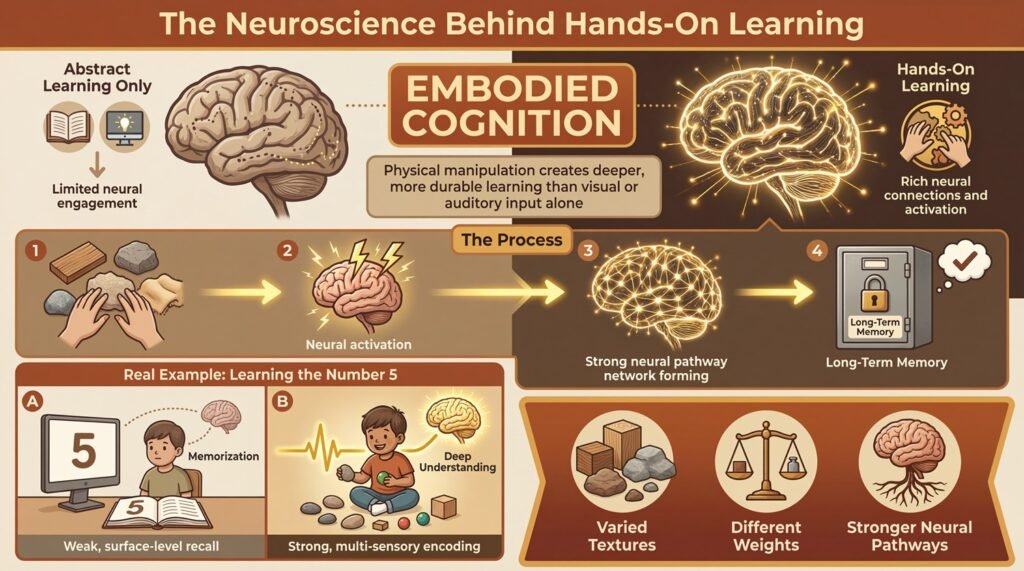
What really convinced me about the Montessori approach was understanding the brain science behind it. When children manipulate physical objects, especially natural materials with varied textures and weights, they’re building neural pathways that abstract learning simply can’t create.
This is called embodied cognition, and researchers are finding that physical manipulation of objects creates deeper, more durable learning than visual or auditory input alone.
Think about learning to count. You can show a child the number “5” on a screen or in a book, and they might memorize it.
But when they physically hold five smooth wooden beads, thread them onto a string one at a time, feel the weight increase with each addition, and see the visual representation of “five-ness” in their hands, that’s a completely different level of understanding.
The concept gets encoded in many areas of the brain simultaneously: motor cortex, visual processing centers, tactile sensation areas, and the regions responsible for numerical understanding.
This multi-sensory encoding is why children who learn with manipulatives develop stronger mathematical reasoning than those who learn through worksheets alone. The Montessori golden bead materials are brilliant for this reason.
They make the decimal system tangible: a single unit bead, a bar of ten, a square of one hundred, a cube of one thousand.
Children can hold these concepts in their hands before they ever encounter abstract written numbers. That concrete-to-abstract progression mirrors how the brain naturally develops mathematical thinking.
Research in neuroscience consistently shows that motor activity strengthens learning. When you physically manipulate objects while learning a concept, you’re creating what scientists call “motor memory” alongside conceptual understanding.
This dual encoding makes the information more accessible and more resistant to forgetting.
Years later, children who learned math with manipulatives can often recall concepts more easily because their hands remember the physical experience of working with the materials.
Natural Materials Versus Plastic: The Sensory Difference
I used to think the emphasis on natural materials was just aesthetic snobbery, but there’s legitimate sensory science here. Different materials provide distinct information to the developing brain. Wood has grain, weight, and a specific warmth that changes with handling.
Metal is cool, smooth, and conducts temperature differently.
Cotton provides soft compression feedback. Each material offers unique sensory data that helps children build a comprehensive understanding of physical properties.
Plastic, conversely, is sensorially homogeneous. Whether you’re holding a plastic car, plastic blocks, or plastic kitchen utensils, the tactile information is essentially identical.
Your brain stops paying attention because there’s nothing new to process.
This is called sensory adaptation. When stimuli stay constant, our nervous system tunes them out to conserve processing power.
Natural materials also connect children to the real world in ways that plastic cannot. When a child uses a small wooden spoon to practice transferring beans from one bowl to another, they’re working with a material that resembles what they see adults using in the kitchen.
The weight, the sound it makes against ceramic, the way it feels in their hand, all of this mirrors real-life experience.
This congruence between play and reality helps children understand that their activities have purpose and meaning beyond entertainment.
There’s also emerging research about how plastic toys affect children’s imaginative play. Because plastic toys often represent specific things, this particular superhero, that specific character, they actually constrain imagination.
A simple wooden figure with minimal features can become anyone: a parent, a doctor, a firefighter, a space explorer.
The lack of prescribed identity creates space for genuine creativity. Children aren’t limited by the manufacturer’s vision when the toy itself remains open to interpretation.
Single-Skill Focus and Cognitive Load Management
One of the most counterintuitive aspects of Montessori toy design is the deliberate limitation of features. Modern toys are designed with the opposite philosophy: pack in as many activities, sounds, textures, and functions as possible to justify the price point and keep children “engaged.” But this approach fundamentally misunderstands how learning works.
Cognitive load theory explains that working memory has severe limitations. When a toy demands attention across many domains simultaneously, match these shapes AND press these buttons AND listen to these songs AND identify these colors, the child’s brain becomes overwhelmed. Instead of deep learning in any area, you get shallow interaction across all of them.
Think of it as educational multitasking, which research consistently shows is far less effective than focused attention.
Montessori materials isolate variables intentionally. A color sorting activity focuses exclusively on color discrimination, not color plus counting plus shape recognition plus auditory processing.
This isolation allows children to build genuine mastery in one domain before complexity increases.
The learning gets scaffolded at the design level, so you don’t need to constantly intervene to simplify tasks for your child.
I’ve watched this principle in action countless times. Give a toddler one of those busy boxes with twelve different activities, and they’ll bounce between features every thirty seconds, never settling into deep engagement.
Give that same child a single knobbed puzzle with six pieces, and they’ll work with it for twenty minutes, developing problem-solving strategies and experiencing genuine accomplishment when they finish it.
The focused attention creates actual learning, while the busy box just creates busyness.
Self-Correction: Teaching Independence Through Design
This might be the most elegant aspect of Montessori toy design. Traditional toys need adult validation: “Good job! You did it! That’s right!” This creates extrinsic motivation and dependence on external approval.
Montessori materials build intrinsic motivation through immediate, impersonal feedback.
A shape sorter where the triangle simply will not fit through the circular hole teaches the child about shapes without any adult intervention needed. The toy itself provides clear, consistent feedback. There’s no emotional component, no judgment, just physical reality.
The child learns to trust their own problem-solving process instead of constantly looking to adults for approval or correction.
This design philosophy extends beyond simple puzzles. Pink tower blocks are precisely graduated in size so they only stack correctly one way.
Cylinder blocks have knobs sized to encourage the pincer grasp that precedes writing.
Sound cylinders contain materials that create specific auditory feedback when shaken. In each case, the material itself guides the child toward correct usage through physical properties rather than verbal instruction.
The psychological impact of this approach is really significant. Children who learn with self-correcting materials develop what researchers call “mastery orientation.” They view challenges as problems to solve rather than threats to avoid.
When you’re not afraid of adult disapproval for making mistakes, you’re much more willing to take risks and continue through difficulty.
That mindset transfers from toy play to academic learning and eventually to professional challenges throughout life.
Real-World Alignment and Practical Life Skills
There’s this fascinating developmental phase around 18 months to 3 years where toddlers become absolutely obsessed with imitating adult activities. They want to sweep, cook, wash dishes, water plants, basically anything they see caregivers doing.
Most conventional toy manufacturers respond to this by creating plastic miniature versions: toy vacuum cleaners that make sounds, play kitchens with electronic features, pretend tools that don’t actually function.
Montessori takes a completely different approach: provide real materials scaled to child size. An actual small broom that genuinely sweeps.
A real pitcher sized for small hands that actually pours water.
Genuine cooking utensils that function properly. This respects children’s legitimate want to contribute to household functioning and develop real competence.
The difference in engagement is remarkable. A child with a toy vacuum cleaner pushes it around for five minutes making “vroom vroom” sounds.
A child with a small, functional carpet sweeper will actually help clean up messes, developing both motor skills and a sense of household responsibility.
They’re not pretending to help, they’re genuinely helping, which satisfies a deep developmental need for purposeful activity.
This principle extends to materials that prepare for specific academic skills. Rather than alphabet flashcards or electronic learning tablets, Montessori uses sandpaper letters: wooden tablets with letters cut from fine sandpaper.
Children trace the letters with their fingers, encoding the shape through motor memory, tactile sensation, and visual input simultaneously.
When they eventually learn to write, their hands already know the letter formations because they’ve traced them hundreds of times during play.
Age-Appropriate Progression Without Rigid Age Restrictions
Here’s where Montessori toy selection gets really interesting and somewhat controversial. The method doesn’t use rigid age categories the way conventional toy marketing does.
You won’t see “18-24 months” or “Ages 3-5” on authentic Montessori materials.
Instead, materials are organized by developmental readiness, which varies enormously between person children.
This approach needs more observation and understanding from adults. You can’t just buy the toys marketed for your child’s age and assume they’re suitable.
You need to watch your actual child and notice what captures their attention, what challenges them without frustrating them, what skills they’re working to develop.
A practical example: wooden stacking rings seem like an obvious baby toy, and most children work with them intensively around 12-18 months. But the learning doesn’t end there.
A three-year-old might return to stacking rings and suddenly start creating complex patterns, arranging them by color instead of size, or using them in imaginative play scenarios.
The toy hasn’t changed, but the child’s interaction with it has become more sophisticated.
This multi-age functionality is actually one of the best arguments for the higher initial investment in quality Montessori materials. A $60 set of rainbow wooden blocks serves a six-month-old as a grasping toy, a 15-month-old as a stacking challenge, a two-year-old as a sorting activity, a three-year-old as a building material, and a four-year-old as props for elaborate imaginative play.
That’s potentially four years of daily use from one toy, which makes the cost-per-use remarkably low compared to age-specific items that get outgrown within months.
The Prepared Environment: Context Matters as Much as Content
You can buy every authentic Montessori material available and still completely fail to support your child’s development if you ignore the concept of the prepared environment. This is where a lot of well-intentioned parents go wrong.
They focus on acquiring the right toys but don’t think about presentation and accessibility.
Montessori environments are characterized by order, beauty, and child-level accessibility. Materials are displayed on low, open shelves where children can see and reach them independently.
Each item has a designated place, and children learn to return materials after use.
The visual simplicity helps children focus without feeling overwhelmed by choices.
This is radically different from the typical toy storage approach where everything gets dumped into bins or toy boxes. When toys are jumbled together out of sight, children don’t engage with them purposefully.
They dump the entire bin looking for something specific, creating chaos and ending up distracted by the mess instead of engaged with meaningful play.
I recommend starting with fewer materials displayed attractively rather than many toys stored away. Six to eight carefully chosen items on a low shelf will get far more use and support deeper learning than thirty toys crammed into a closet.
The visible, organized presentation invites independent selection and teaches respect for materials.
Rotation is another crucial element that most people miss. Even the most engaging toy loses appeal with constant availability.
By rotating materials every couple of weeks, storing some away and bringing others out, you maintain freshness and interest without constantly buying new items.
Children often engage with rotated-back toys as enthusiastically as if they were brand new, approaching them with fresh perspectives and new developmental skills.
Frequently Asked Questions
What makes a toy Montessori?
A toy qualifies as Montessori when it has these specific characteristics: made from natural materials like wood or metal, focuses on developing one skill at a time, is self-correcting so the child can identify mistakes independently, and connects to real-world activities or concepts. The toy should also be beautiful, well-constructed, and designed to last through many years of use.
Are Montessori toys worth the high cost?
Quality Montessori materials cost more upfront but typically last for many children and years of daily use. A $60 set of blocks that gets used daily for four years costs about four cents per day of play.
Compare this to electronic toys that break or get abandoned within weeks.
The durability, combined with multi-age functionality, makes the cost-per-use actually quite reasonable.
Can I make Montessori toys at home?
You can absolutely create Montessori-inspired materials at home. Practical life activities use household items you already own: beans for transferring practice, sponges for washing activities, real fruits for cutting practice.
Treasure baskets filled with safe household objects cost almost nothing.
While you can’t replicate the precision of manufactured materials like pink towers or golden beads, many foundational activities work perfectly well with DIY versions.
What toys should I start with for a baby?
For infants from birth to 12 months, start with these foundational materials: a simple wooden rattle or grasping toy, a low mirror mounted horizontally so the baby can see themselves during tummy time, a small basket of natural objects with varied textures for sensory exploration, and simple fabric balls that are easy to grasp. Avoid anything with batteries, lights, or electronic sounds.
How many toys should be available at once?
Six to eight toys displayed on open shelving is ideal for most children. This provides enough variety to maintain interest but not so much that the child feels overwhelmed. Rotate materials every two to three weeks, bringing out stored toys and putting current ones away.
This rotation system keeps things fresh without requiring constant new purchases.
Do Montessori toys help with developmental delays?
Children with developmental delays often benefit significantly from Montessori materials because these toys isolate specific skills and provide clear, consistent feedback without adult intervention required. The self-correcting nature means children can practice at their own pace without pressure. However, always ask with your child’s therapists about which materials best support their specific developmental goals.
What’s the difference between Montessori and Waldorf toys?
Montessori materials tend to be more structured and skill-focused, like shape sorters or number rods, designed to teach specific concepts. Waldorf toys lean toward open-ended imaginative play with simple natural materials like wooden figures, silk scarves, and plain building blocks.
Both emphasize natural materials and child-directed play, but Montessori has more explicit learning goals built into each material.
Can you mix Montessori toys with regular toys?
You can absolutely mix different types of toys. The goal is supporting your child’s development, not achieving some pure Montessori aesthetic.
However, you’ll likely notice that when given choices, children often gravitate toward simpler, more focused materials once they experience the satisfaction of deep engagement.
Let your child’s actual play patterns guide what you keep accessible.
Key Takeaways
The Montessori method represents a basic shift from entertainment-based to development-based toy design. Materials are carefully engineered around how children’s brains actually learn rather than around what sells well or looks impressive on store shelves.
Natural materials provide diverse sensory information that plastic cannot match, building richer neural networks through varied tactile experiences. Each different material, wood, metal, cotton, ceramic, offers unique sensory data that helps children build comprehensive understanding of physical properties.
Single-skill focus prevents cognitive overload and allows deep mastery before complexity increases. This isolation of variables follows what we know about working memory limitations and creates the conditions for genuine learning rather than superficial engagement.
Self-correcting design builds independence and intrinsic motivation by providing immediate, impersonal feedback without requiring adult validation. Children develop trust in their own problem-solving abilities and become more willing to continue through challenges.
Real-world alignment respects children’s developmental need for purposeful activity and genuine contribution to household functioning. When children use real tools that actually work, they develop both competence and confidence.
The prepared environment matters as much as the materials themselves. Organization, accessibility, and rotation significantly impact engagement and learning.
Six toys displayed beautifully will get more use than thirty toys jumbled in a bin.
Observation of your actual child trumps age recommendations and marketing claims when selecting suitable materials. Watch what captures your child’s attention and challenges them appropriately, then provide more materials in that developmental area.
Quality over quantity combined with multi-age functionality makes higher-priced materials a worthwhile investment compared to quickly outgrown conventional toys. A single high-quality material that serves many developmental stages has remarkable cost-per-use value.