
We may earn money or products from the companies mentioned in this post.
I still remember the afternoon I sat in my daughter’s cluttered nursery, surrounded by plastic toys that blinked and buzzed, feeling completely overwhelmed. She was six months old and seemed perpetually overstimulated, crying more than playing. A friend suggested I look into Montessori principles, and honestly, I thought it was just another parenting trend I’d have to decode.
But when I actually started implementing a proper Montessori play space, everything shifted. My daughter began engaging with materials for longer stretches. She seemed calmer, more focused, genuinely curious about the world around her.
The transformation wasn’t because I spent thousands on fancy equipment. I finally understood what my infant actually needed from her environment.
If you’re struggling with a play space that doesn’t seem to work, or you’re just starting out and want to get it right from the beginning, you’re probably dealing with the same confusion I faced. What makes something truly Montessori versus just marketed that way? How do you know which materials matter and which are just expensive clutter?
And how on earth do you create this environment when you’re exhausted and overwhelmed?
Understanding the Montessori Environment Philosophy
Before you purchase a single item or rearrange any furniture, you need to really grasp what a Montessori environment actually does. I’m talking about designing an environment that respects your infant as a capable human being who’s actively constructing their understanding of the world.
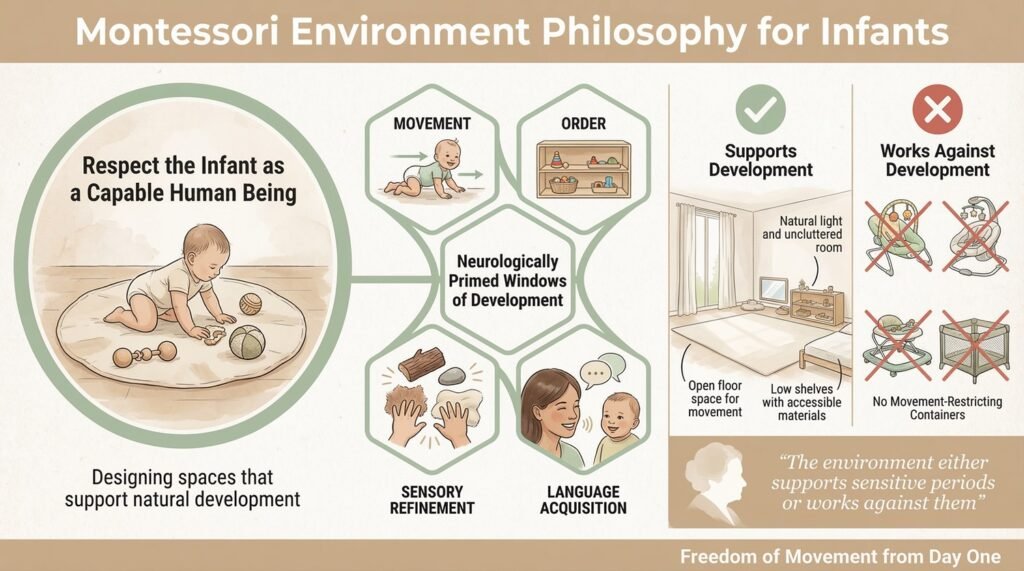
Dr. Maria Montessori observed that children have what she called “sensitive periods,” windows of time when they’re neurologically primed to develop specific skills. The environment you create either supports these sensitive periods or works against them.
For infants, these periods center around movement, order, sensory refinement, and language acquisition.
A proper Montessori infant space supports freedom of movement from the very beginning. That means no containers that restrict natural movement like bouncy seats, swings, or walkers.
Instead, you’re creating generous floor space where your baby can move their body freely, roll, push up, eventually crawl and pull up on sturdy furniture.
The practical application here requires some mindset shifts. You’re preparing an environment where your infant can do the work of childhood, which is exploring, practicing, concentrating, and discovering their own capabilities.
The challenge most parents face is trusting this process. We’ve been conditioned to think babies need constant stimulation and intervention.
Watching your infant spend fifteen minutes intently examining their own hands or repeatedly dropping a wooden egg from a basket feels like you should be doing something more.
But this is exactly the deep concentration and self-directed learning Montessori environments facilitate. Your infant knows what they need to practice.
Your job is creating the space where that practice can happen.
Creating the Physical Foundation
The layout of your space matters significantly more than the specific toys you purchase. I learned this the hard way after buying beautiful Montessori materials that sat unused because I hadn’t created an environment that invited my daughter to use them independently.
Start with flooring. A firm play mat or area rug defines the play space and provides a comfortable but stable surface for movement.
Avoid overly plush surfaces that make it harder for babies to push up or crawl.
The mat should be large enough to allow rolling and movement in all directions. At least six feet by six feet if your space allows.
Next comes the foundational furniture piece of any Montessori infant space: low shelving. This needs to be stable, preferably mounted to the wall for safety, and positioned so the bottom shelf is truly at floor level.
The top shouldn’t exceed about twenty-four inches high for an infant space.
This low height allows your baby to see available materials from a lying or sitting position, and eventually choose and return items independently as mobility develops.
I mounted a simple three-shelf unit that cost about sixty dollars. Nothing fancy.
What mattered was that each shelf could hold just a few items with space between them, allowing my daughter to visually distinguish each material.
Cramming many items together defeats the purpose because infants can’t yet isolate person objects from visual clutter.
The movement area is equally critical. This might be a pull-up bar mounted securely to the wall at the appropriate height for your infant to grasp when they begin pulling to stand, usually around eight to ten months.
Before that stage, the movement area is simply protected floor space.
Some families invest in Pikler triangles or climbing furniture, which absolutely support gross motor development beautifully, but they’re not mandatory for a functional Montessori space. My daughter developed excellent coordination and strength without them.
One element that surprised me with its impact was a floor-level mirror. Mounting a large, safety-backed mirror horizontally along one wall at floor level gives your infant the opportunity to observe themselves, which supports visual tracking, self-recognition, and tummy time motivation.
My daughter would spend substantial time just watching her own movements reflected back, which was fascinating to observe.
She wasn’t being vain. She was learning where her body was in space, how her movements looked, that the baby in the mirror matched her own actions. This visual feedback accelerated her physical coordination noticeably.
Selecting Materials by Developmental Stage
Materials should match your infant’s current developmental needs while offering just slightly more challenge than they’ve already mastered. Too easy and they’re bored. Too difficult and they’re frustrated. Getting this balance right requires observation and flexibility.
For the newborn stage up to about three months, your baby’s vision is still developing. They see best at about eight to twelve inches from their face, which is roughly the distance to your face when you’re holding them.
They’re also most responsive to high contrast, particularly black and white patterns.
During this stage, I used simple mobiles hung above the movement area, changing them as her visual abilities developed. The Munari mobile, with its geometric black and white shapes, came first. Then the Gobbi mobile with graduated colored spheres around six to eight weeks.
These aren’t toys your baby manipulates but rather visual experiences that support concentration and tracking.
I also created high contrast cards using just black paper and white paper cut into simple shapes: circles, stripes, checkerboards. Propping these near her during floor time gave her something visually engaging to focus on.
This cost me essentially nothing but provided appropriate stimulation for her developmental stage.
Around three months, grasping becomes intentional. This is when you introduce materials your baby can actually hold.
Wooden rattles, soft cotton balls in various sizes, simple grasping toys made from natural materials.
The key characteristic is that these items should be graspable by small hands and provide sensory feedback when manipulated.
I found that a simple wooden ring on a ribbon was one of the most used materials during this stage. My daughter could grasp it, bring it to her mouth for oral exploration, hear the gentle sound when it hit the floor.
One simple object, many learning opportunities.
From six to nine months, sitting improves and your infant becomes increasingly interested in manipulating objects with purpose. This is when you introduce materials that offer problem-solving opportunities.
Object permanence boxes, where your baby drops a ball through a hole and it reappears, teach cause and effect while supporting that crucial cognitive milestone.
Stacking cups or rings introduce concepts of size relationship. Your baby won’t stack them correctly at first, but they’ll explore fitting them together, nesting them, knocking them over.
All of this is valuable learning.
I watched my daughter spend twenty minutes just repeatedly putting one cup inside another and dumping it out, completely absorbed. She was learning about spatial relationships, practicing hand-eye coordination, experiencing cause and effect. That twenty minutes of focus built neural pathways that electronic toys with their instant gratification couldn’t touch.
Nine to twelve months brings increased mobility and refined hand control. Push toys that support cruising, larger balls to chase while crawling, simple puzzles with large knobs.
This is also when practical life activities can begin, things like a small basket with scarves to pull out and stuff back in, or a treasure basket filled with safe household items of varied textures.
The potential problem many parents encounter is accumulating materials faster than their infant can meaningfully engage with them. I became really intentional about having only about six to eight items available at any given time.
The rest stayed in a closet to rotate in later.
This limited selection meant my daughter actually exhausted the learning potential of each material instead of flitting between dozens of options. Less really is more when you’re supporting concentration development.
Setting Up Material Rotation Systems
In practical terms, rotation works like this. Every two to three weeks, I’d observe which materials my daughter was ignoring consistently.
Those got removed and replaced with either something she hadn’t seen before or something I’d rotated out weeks earlier.
Materials she was deeply engaged with stayed available.
The theoretical foundation here is novelty versus mastery. New materials capture attention and motivate exploration.
But materials need to stay available long enough for mastery to develop.
If you rotate too often, your infant never gets beyond surface-level exploration. Too slowly, and they lose interest before you refresh the environment.
I kept a simple log on my phone, just noting what was on the shelves and when I’d rotated items. This prevented me from reintroducing something too soon and helped me notice patterns.
For instance, I uncovered my daughter returned to certain materials repeatedly even after they’d been gone for weeks, indicating they matched a persistent developmental interest.
For practical storage, I used simple fabric bins on a closet shelf, organized by approximate age range and material type. Sensory materials in one bin, manipulative materials in another, movement materials in a third.
This made rotation decisions faster because I could quickly see what hadn’t been in use recently.
One challenge is resisting the urge to keep adding new materials constantly. The marketplace for Montessori baby toys has absolutely exploded, and beautiful, expensive options are everywhere.
I had to remind myself regularly that my daughter didn’t need more, she needed suitable.
Some of her most-used materials were things I’d made myself or purchased secondhand for a few dollars. A basket of wooden spoons from the thrift store got more use than the expensive imported rattle I’d splurged on.
Creating Order and Beauty
Montessori emphasized that children have a sensitive period for order during infancy and early childhood. This doesn’t mean rigid rules.
It means consistency and predictability in the environment.
Materials should have designated places. The layout should stay generally consistent.
This external order supports internal cognitive organization.
In practical terms, I assigned each material its own spot on the shelf. The wooden blocks always went in the same basket on the left side of the bottom shelf.
The stacking rings always stood upright on the right side of the middle shelf.
This consistency meant that as my daughter’s memory developed, she knew where to find specific items and where they belonged when finished. Around ten months, she began returning materials to their spots without prompting. I hadn’t trained this behavior.
The consistent environment made it natural for her.
Beauty matters more than you might expect. Montessori environments typically use natural materials, neutral or muted colors, and uncluttered displays.
This creates a calm, focused atmosphere that doesn’t overwhelm developing sensory systems.
I gradually replaced plastic items with wooden choices when possible. I chose a soft, neutral-toned play mat instead of one covered in cartoon characters.
I used natural wood shelving as opposed to brightly colored plastic units.
The overall effect was a space that felt peaceful and inviting as opposed to chaotic. And my daughter’s ability to concentrate seemed directly related to this shift. In the old cluttered space with bright colors and busy patterns, she’d flit between toys without settling.
In the simplified, beautiful space, she’d work with materials for extended periods.
Incorporating Language and Music
A Montessori environment includes rich language and natural sounds. As your infant explores materials, you provide language by simply describing what you observe.
“You’re holding the ball. The ball is rolling. You’re watching the ball.” This descriptive language builds vocabulary and understanding.
I found myself naturally narrating less as I got more comfortable with allowing quiet concentration. There’s a balance between providing language and interrupting focus.
If my daughter was deeply absorbed in manipulating a toy, I’d simply observe quietly.
When she looked up or paused, that was the moment to offer language about what she’d been doing.
Musical instruments appropriate for infants include simple wooden shakers, drums, and xylophones. These should produce actual musical tones as opposed to electronic sounds.
The cause and effect of striking a xylophone and hearing a clear tone teaches so much more than pushing a button to trigger a pre-recorded song.
I kept three simple instruments in a basket that rotated through the available materials. A wooden egg shaker, a small drum with a felt mallet, and a simple glockenspiel.
My daughter moved through phases of being intensely interested in each one, then ignoring them for weeks, then returning with renewed interest at a different developmental stage.
The practical application of music extends beyond instruments. Singing to your infant, playing recorded music during specific activities, even just the natural sounds of your household all contribute to auditory development.
Montessori environments aren’t artificially quiet.
They’re peaceful but filled with natural, meaningful sounds.
Observation as Your Primary Tool
Learning to observe before intervening transformed my approach. Montessori emphasized that we should follow the child, meaning we watch what captures their attention, what challenges them appropriately, what they return to repeatedly.
The environment should reflect what we learn through observation.
In practical terms, I started spending ten minutes daily just watching my daughter interact with her space without intervening. What did she choose first?
How long did she stay with each material?
What seemed to frustrate her? What allowed deep concentration?
These observations informed everything. When I noticed she was crawling to the shelf but only selecting items from the bottom level, I realized the middle shelf was still too high for her to see clearly from floor level.
I adjusted the shelf arrangement.
When she consistently ignored a beautiful puzzle I’d purchased, I rotated it out. Not because it was wrong but because it wasn’t right for her current interests.
Three months later, I reintroduced it and she was suddenly fascinated. Same puzzle, different developmental moment.
The challenge most parents face with observation is the discomfort of not directing play. We want to show our babies how toys work, to help them succeed, to engage actively.
But premature intervention prevents them from working through challenges independently, which is where real learning happens.
I had to sit on my hands initially to prevent myself from demonstrating how the stacking rings worked or rescuing the ball that rolled out of reach. When I finally let my daughter struggle appropriately and solve problems at her own pace, her engagement deepened dramatically.
She’d work on a problem for five, ten, even fifteen minutes sometimes. That kind of persistence doesn’t develop when adults constantly intervene and solve things for babies.
Adapting Montessori Principles to Real Life
The theoretical ideal of a Montessori environment assumes dedicated space, unlimited budget, and time to carefully implement every principle. Real life is messier.
You might share one room with your infant, have limited funds, or live with others who don’t share your approach.
Adapting successfully means identifying core principles and implementing those in whatever way your circumstances allow. The core principles are freedom of movement, access to appropriate materials, order and consistency, beauty and calm, and respect for the child’s capabilities and interests.
If you don’t have space for dedicated shelving, a low basket with a few materials rotated regularly accomplishes the same goal. If you can’t afford wooden Montessori toys, safe household items curated thoughtfully work beautifully.
A treasure basket filled with a wooden spoon, a small whisk, a cloth napkin, a metal measuring cup, and a small basket provides rich sensory exploration for zero cost.
If you live in a small space without room for a dedicated play area, you can create a prepared environment in a corner of your bedroom or living room. Store materials in a closet and bring out a small selection on the floor when it’s play time.
The Instagram-perfect setup serves the same developmental purposes as your modest corner space.
The practical challenge is resisting comparison. When you see elaborate Montessori nurseries online, it’s easy to feel like you’re failing if your setup is modest.
But I watched my daughter engage just as deeply with a homemade mobile hung from a ceiling fan as she would have with an expensive branded version.
The material quality matters, but the price tag truly doesn’t. My daughter’s brain doesn’t know whether the wooden ring she’s manipulating cost five dollars or fifty dollars.
She only knows whether it’s the right challenge at the right time.
Common Setup Mistakes to Avoid
After implementing my space and connecting with other Montessori parents, I identified mistakes that compromise even well-intentioned environments. The first is inconsistency between the Montessori space and the rest of your approach.
If you’ve created this beautiful prepared environment but constantly interrupt your infant’s play to show them how things work, you’re undermining self-directed learning.
Another common issue is selecting materials based on how they photograph as opposed to developmental appropriateness. That gorgeous rainbow stacker looks amazing on the shelf, but if your seven-month-old isn’t developmentally ready for it, the item just sits there looking pretty while your baby ignores it.
Over-rotation creates problems too. If you’re changing materials every few days, your infant never develops mastery or deep engagement.
They learn to skim the surface of everything, which actually works against the concentration and focus Montessori environments should support.
I initially rotated too often because I was excited about all the materials I’d collected. I’d swap things out every three or four days. My daughter seemed interested in everything but mastered nothing.
When I slowed to two to three week rotations, suddenly she began using materials in more sophisticated ways, having had time to really explore their possibilities.
Safety compromises are another serious issue. Montessori emphasizes independence, but that requires unsupervised access only to safe materials.
Everything in your infant’s environment should be safe for mouthing, dropping, and handling roughly.
No small pieces until your baby is developmentally past the phase of exploring everything orally. No materials that could shatter or break into dangerous pieces.
Finally, neglecting gross motor needs is a subtle mistake. In enthusiasm for beautiful wooden toys and sensory materials, some parents create spaces that don’t adequately support movement development.
Your infant needs extensive floor time, opportunities to roll and crawl without spatial constraints, and eventually furniture to pull up on and cruise along.
These movement opportunities matter as much as any manipulative toy.
People Also Asked
What age should you start a Montessori play space?
You can start a Montessori play space from birth. Newborns benefit from a simple movement area with a firm mat, a floor mirror, and age-appropriate mobiles hung above where they spend floor time.
The environment evolves as your baby develops, with materials and setup changing to match each developmental stage.
Can I create a Montessori space without expensive toys?
Yes, you absolutely can create an effective Montessori space with minimal expense. Many excellent infant materials are household items like wooden spoons, metal measuring cups, fabric napkins, and small baskets.
The principles matter more than branded products.
A treasure basket filled with safe household items provides rich sensory exploration at essentially no cost.
How many toys should be available in a Montessori infant space?
Six to eight materials at any given time is ideal for infant spaces. This limited selection prevents overwhelm and allows your baby to fully explore each material instead of flitting between many options.
Rotate materials every two to three weeks based on observation of what your infant uses and ignores.
Do Montessori babies really develop faster?
Montessori environments support natural development as opposed to accelerating it. Babies in these environments often demonstrate longer concentration periods, more independent problem-solving, and deeper engagement with materials.
They develop at their own pace but with fewer obstacles to natural learning.
Is a floor bed really necessary for Montessori?
A floor bed supports the Montessori principle of freedom of movement, allowing your baby to get in and out independently once mobile. However, many families successfully implement Montessori principles while using cribs for safety or personal reasons.
Focus on generous floor time during waking hours if you’re not using a floor bed.
What makes a toy Montessori suitable?
Montessori-appropriate materials are typically made from natural materials like wood or fabric, serve a clear purpose, isolate one skill or concept, and allow independent exploration without requiring adult demonstration. They provide appropriate challenge without frustration and support concentration development.
Key Takeaways
A Montessori play space respects your infant as a capable person actively constructing their understanding through purposeful exploration.
The environment’s physical setup matters more than specific toys, with low shelving, generous floor space, order and consistency, and aesthetic simplicity creating conditions for concentration and independence.
Materials should match your infant’s current developmental stage while offering appropriate challenge, requiring ongoing observation to decide what’s ready to rotate out and what should be introduced next.
Fewer materials, used deeply and repeatedly, support learning better than many materials skimmed superficially, meaning your role is careful curation as opposed to abundance.
Observation before intervention allows you to truly follow your child’s interests and needs as opposed to imposing adult ideas about what they should be learning or how they should play.
Montessori principles adapt successfully to various circumstances and budgets when you focus on core concepts as opposed to trying to recreate idealized versions of prepared environments.
The space evolves continuously as your infant develops, meaning flexibility and willingness to adjust based on observed needs matter more than getting everything perfect initially.