You walk into the nursery with a cup of coffee in hand, and there’s your baby, lying under that colorful activity gym you ordered last week. The mat is bunched up on one side, the toys are hanging at weird angles, and you realize you haven’t actually checked if any of this is safe.
You just assumed it was fine because it had good reviews.
Learning how to properly evaluate and set up an activity gym means understanding what actually supports your baby’s development while keeping them protected from hidden hazards that most parents never think about.
Why Most Parents Get This Wrong
I’ve watched countless parents set up activity gyms based purely on how cute they look in the product photos. The reality is that most activity gyms you see advertised are designed to appeal to adult aesthetics as opposed to baby developmental needs. That gorgeous pastel wooden arch with the perfectly coordinated hanging toys might look incredible in your Instagram-worthy nursery, but it could actually be limiting your baby’s natural movement patterns.
The thing is, your baby doesn’t care about color coordination or whether the gym matches your nursery theme. What matters is whether the gym allows them to move freely, turn their head in different directions, and receive appropriate sensory input for their developmental stage.
When you understand the actual purpose of an activity gym as a tool for facilitating natural development, your entire approach to selection and setup changes. You stop looking at these products as containment devices or entertainment centers and start evaluating them based on whether they genuinely support the specific movements and sensory experiences your baby needs at each stage.
Most parents also don’t realize that activity gyms have a relatively short useful lifespan. That expensive gym you invested in won’t be used the same way from birth through toddlerhood.
The overhead component that’s perfect for a three-month-old becomes a developmental limitation once your baby starts rolling.
Yet I see babies who are clearly ready to explore larger spaces still confined under those overhead arches because parents think they’re getting more value by extending the use.
Once your baby shows readiness for more advanced movement, continuing to use the same setup actually holds them back. You need to recognize the signs that show when your baby has outgrown the current configuration and be willing to adapt or transition away from the gym entirely, even if it feels like you haven’t gotten your money’s worth yet.
The Foundation Problem Nobody Talks About
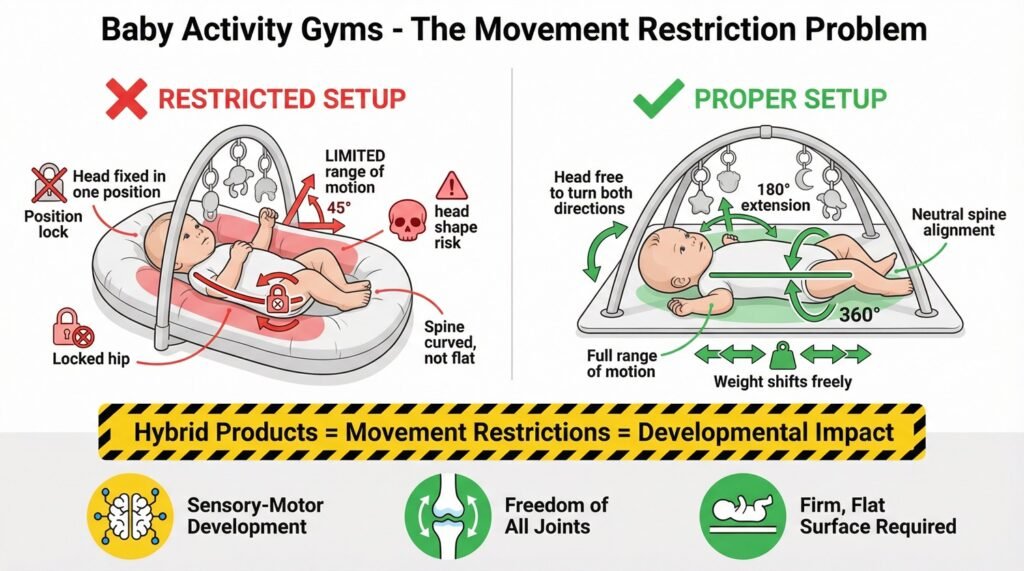
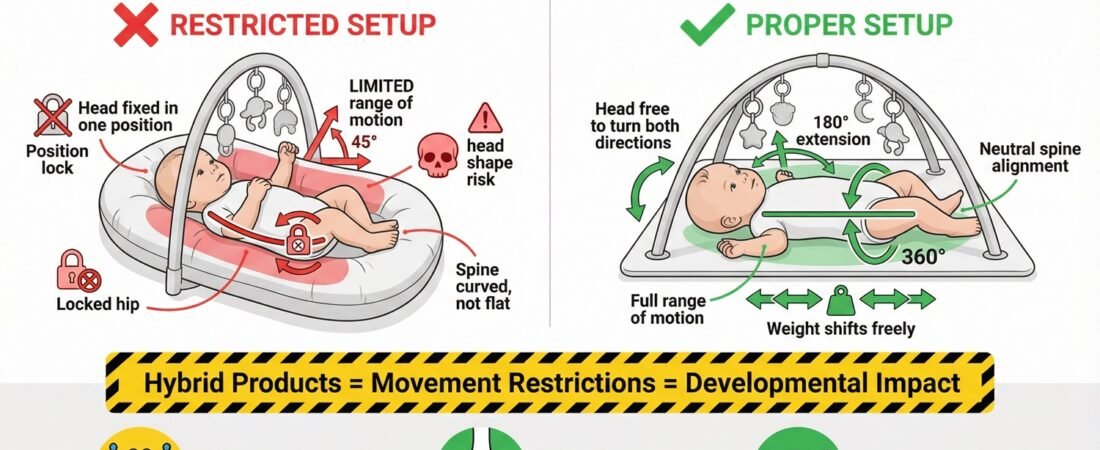
Here’s what really concerns me about current activity gym marketing: the rise of combination products that merge activity gyms with loungers, nests, or positioners. These hybrid products sound convenient, one item that does many things, but they fundamentally compromise the most important safety feature of a proper activity gym.
Your baby needs to be on a completely flat, firm surface with total freedom of movement in all joints. When an activity gym is placed over or integrated with any kind of positioning device, your baby loses the ability to fully extend their shoulders, rotate their hips naturally, or shift their weight distribution.
These restrictions might seem minor, but they directly impact sensory-motor development during the most critical learning period.
I’m particularly troubled by products marketed as “nests” or “loungers” with overhead toys. These create a reclined position that keeps your baby’s head in one spot, exactly what you want to avoid for head shape health.
The American Academy of Pediatrics has been really clear about flat, firm surfaces for infant play, yet these hybrid products continue gaining popularity because they look cozy and contained.
When you’re evaluating an activity gym, your very first check should be whether it rests flat on the floor with either a free-standing arch structure or a firm, completely flat mat underneath. If there’s any cushioning that creates a bowl shape, any elevation at the edges, or any built-in positioning features, that’s an automatic disqualification regardless of how many five-star reviews it has.
The bowl-shaped positioning that seems so comforting actually restricts your baby’s ability to practice the small weight shifts and body adjustments that build foundational motor control. Every time your baby on a flat surface makes even tiny movements, they’re learning how their body interacts with gravity and how to control those interactions.
Put them in a bowl or nest, and those learning opportunities disappear because the structure is doing the work of holding them in place.
Strategic Toy Placement Changes Everything
Most activity gyms come with toys already attached in fixed positions, and most parents never think to change them. This is a massive missed opportunity for supporting your baby’s head shape health and natural movement patterns.
Think about it. When your baby spends extended time on their back looking up at a fixed central mobile, they’re keeping their head in the exact same position repeatedly.
This creates the same kind of pressure on the back of the skull that we worry about during back-sleeping.
The difference is that during sleep, you can’t really control positioning, but during awake play time, you absolutely can.
The solution is choosing an activity gym with substantial flexibility for toy placement around the entire perimeter, positioned close to the floor level. When you place interesting objects to the left side, your baby turns their head left. Place something compelling on the right, they turn right.
This active head rotation is exactly what develops neck strength and prevents positional preference that can lead to head flattening.
I really love gyms that have many attachment points along the arch bars and even on the mat edges. This gives you the ability to completely customize where visual and tactile targets appear.
For babies who are already showing signs of positional preference or head flattening, this flexibility becomes therapeutic.
You can strategically position the most interesting toys in directions that encourage your baby to turn away from their flat spot.
The key insight here is that hanging toys directly above your baby’s face should never be the primary or only option. Yes, having some overhead elements is fine for brief visual focus, but the majority of engaging items should be positioned to encourage head turning and reaching in varied directions.
Start paying attention to which direction your baby naturally prefers to look. If you notice they consistently turn their head to the right, place the most compelling toys on their left side.
This simple adjustment can prevent or even reverse early signs of positional preference.
You’re working with your baby’s natural curiosity to build balanced movement patterns.
Material Safety Beyond the Basics
Everyone knows to check for non-toxic materials, but there’s actually more nuance to material safety than most checklists acknowledge. You need to think through not just the initial safety of materials, but how they hold up over weeks and months of use.
Wooden activity gyms often get praised for being “natural” and eco-friendly, and many are genuinely excellent products made with safe, water-based finishes. But I’ve also seen wooden gyms with finishes that chip or peel after repeated mouthing and grabbing, exposing potentially unsafe layers underneath.
Before you buy a wooden gym, research the specific finish used and whether it’s rated for infant toys that will be mouthed extensively.
Fabric components present their own challenges. That soft, plush mat might feel cozy, but is it treated with flame retardants or stain-resistant chemicals?
Some manufacturers use traditional flame retardants that have been linked to developmental concerns, while others use safer alternatives or simply meet standards through fabric construction as opposed to chemical treatment.
This information isn’t always prominently displayed, so you might need to contact the manufacturer directly.
The hanging toys themselves deserve scrutiny beyond basic choking hazard standards. Look for toys made from single-piece construction when possible, as opposed to items with glued-on components that could detach.
Check attachment mechanisms.
Are toys connected with secure fabric loops, or cheaper plastic clips that could break? I’ve seen several recalled activity gyms where the issue wasn’t the toys themselves but the attachment systems that failed.
One practical tip: before your baby uses the gym for the first time, give every hanging toy a really firm tug from many angles. If anything detaches, breaks, or shows signs of weakness, return the entire product.
Your baby will apply similar force within weeks of active batting and grabbing.
Also examine how toys are constructed internally. Some fabric toys have small beads or pellets inside that create interesting textures, but if the seam fails, those small components become choking hazards.
Squeeze and manipulate each toy while inspecting the seams for any weak points or loose stitching.
The Overstimulation Trap
Here’s where I differ from a lot of popular advice: I’m actually against most electronic activity gyms with lights, sounds, and motorized movement. I know they’re everywhere, and I know babies seem to enjoy them, but the developmental trade-off isn’t worth it.
When an activity gym has a light-up, sound-making, or moving component positioned centrally above your baby’s face, it creates a fixed focal point that discourages natural exploration. Your baby stares at the flashy display as opposed to practicing the essential skill of shifting visual attention between different targets.
The constant central focus keeps their head in one position, exactly what we’re trying to avoid.
There’s also emerging research suggesting that excessive electronic stimulation during early infancy may impact attention development. While the occasional exposure certainly isn’t harmful, when your primary developmental play tool is delivering constant electronic stimulation, you’re potentially setting up patterns that don’t serve your baby’s long-term cognitive development.
The better approach is choosing a visually simple gym with high-contrast elements that you can customize. Black and white images are perfect for newborns who are near-sighted and drawn to strong contrast.
As your baby’s vision develops, you can introduce simple colored objects positioned at varying distances and angles.
This approach gives your baby appropriate stimulation without the passive, fixed-focus problem of electronic displays.
I’ve actually helped parents create incredibly effective DIY modifications to simple wooden gyms by laminating high-contrast images and using fabric ribbons to attach them at strategic positions. These customized setups often engage babies more effectively than expensive electronic versions because they’re positioned exactly where that person baby needs visual motivation.
When you choose non-electronic options, you also avoid the battery and electrical safety concerns that come with powered baby products. There’s no risk of battery compartments opening, no concern about electronic components overheating, and no small parts from battery covers becoming detached.
Age-Based Setup Modifications
The way you set up an activity gym for a one-week-old should look completely different from the setup for a four-month-old, yet most parents never change the configuration.
For brand new babies in the first six to eight weeks, visual elements should be positioned about eight to twelve inches from their face, the distance at which newborns can focus most clearly. At this stage, high-contrast, simple shapes work better than complex, colorful toys.
Position these elements slightly to different sides as opposed to directly centered, encouraging gentle head turning even at this early stage.
I really recommend keeping sessions short initially, maybe just two to three minutes before your newborn needs a break. Watch for signs of engagement like widening eyes, increased arm and leg movement, or sustained visual attention.
These cues tell you your baby is receiving appropriate stimulation.
Watch equally for disengagement cues like looking away, fussing, or decreased movement, which signal overstimulation or fatigue.
As your baby approaches the two to three month mark, you’ll notice increased alertness and sustained focus. This is when you can lower hanging elements closer to reaching distance and introduce varied textures.
Some toys should still be at visual focus distance, but others should be positioned just within potential swatting range.
Your baby won’t have intentional reaching yet, but they’ll start making contact through general arm movement, which provides important sensory feedback.
The three to six month period is when activity gyms shine most. Your baby is now batting intentionally, reaching with purpose, and beginning to grasp objects.
Lower all hanging elements to actual reaching distance, positioning some directly above and others around the perimeter.
Introduce different textures like crinkly fabric, smooth wood, soft plush, and firm silicone, giving your baby varied tactile experiences with each grasp.
This is also when toy rotation becomes important. Your baby’s memory and recognition abilities are developing, so familiar toys become less engaging over time.
Having a collection of approved, safe toys that you swap in and out every few days maintains interest without requiring constant new purchases.
You don’t need dozens of toys, just six to eight options that you rotate through in groups of three or four.
The Critical Transition Point
Here’s what most parents miss: there’s a specific developmental window when you need to completely change how you use the activity gym. That window is when your baby starts rolling over, typically between four and six months.
Once rolling begins, continuing to use the overhead arch component actually restricts your baby’s development as opposed to supporting it. Your baby is signaling readiness for larger exploration spaces and independent mobility.
The overhead structure that was perfect for encouraging reaching now becomes a physical limitation that keeps your baby contained in a small area.
I’ve worked with parents who kept the full activity gym setup in place through seven or eight months because their baby still seemed to enjoy it. While the baby might still engage with the toys, they’re missing out on more important developmental opportunities like practicing transitions between positions, covering distance through rolling or early crawling, and exploring spatial relationships in a larger area.
The transition doesn’t mean the activity gym becomes useless. You just use it differently.
Remove the arch and dangling toys, but keep the padded mat as a comfortable play surface.
Now place interesting toys at varying distances from your baby, some close and some several feet away. This setup encourages your baby to move their whole body to reach desired objects, supporting the next phase of motor development.
Some parents resist this transition because they’re worried about losing the containment aspect. They liked knowing their baby was in a defined space where they could easily supervise.
I understand that concern, but the reality is that once your baby can roll, they’re no longer truly contained anyway.
You need to transition your supervision approach to accommodate increased mobility, and removing the overhead structure is part of that natural progression.
People Also Asked
How long should my baby use an activity gym each day?
Newborns typically benefit from several short sessions of two to three minutes each, spread throughout the day when they’re alert and content. As your baby grows and attention span increases, you can extend sessions to ten or fifteen minutes by three to four months.
By six months, some babies enjoy twenty to thirty minute sessions.
Always watch your baby’s engagement cues as opposed to following a strict schedule. If they’re looking away, fussing, or losing interest, the session should end regardless of how much time has passed.
When can babies start using activity gyms?
Babies can start using properly set up activity gyms from birth, though the very early days might be more focused on simply getting used to floor time. The first few weeks of life, your baby is still adjusting to being outside the womb, so sessions should be extremely brief and gentle.
By two to three weeks, most babies can handle short activity gym sessions as part of their daily routine.
The key is starting with very simple, high-contrast visual elements positioned at the correct distance for newborn vision.
Are wooden or plastic activity gyms safer?
Safety depends more on construction quality and proper use than material type. Well-made wooden gyms using safe finishes and solid construction are excellent choices.
Quality plastic gyms that meet safety standards are equally safe.
The real safety factors to evaluate are stability of the structure, security of attachment points, appropriateness of materials for mouthing, and whether the design allows for flat positioning on the floor. Both materials can be safe or unsafe depending on specific product design and manufacturing quality.
What’s the difference between tummy time and activity gym time?
Tummy time positions your baby on their stomach to build neck, shoulder, and core strength while preventing flat spots on the back of the head. Activity gym time typically happens with your baby on their back, focusing on visual tracking, reaching, and grasping skills.
Both are essential and serve different developmental purposes.
Some activity gyms can be used for both by removing the arch during tummy time and placing toys ahead of your baby to encourage head lifting. You need both types of floor time in your baby’s daily routine.
How do I know if my baby is overstimulated by the activity gym?
Signs of overstimulation include turning their head away from toys, arching their back, increased fussiness or crying, hiccups, color changes in the face, jerky or frantic movements, and clenched fists. Some babies become very still and stare blankly when overwhelmed. If you see these signs, end the session immediately and provide calm comfort.
Overstimulation happens more easily with electronic gyms that have lights and sounds, which is one reason I recommend simpler options that give your baby more control over their sensory input.
Can activity gyms help prevent flat head syndrome?
Activity gyms can help prevent flat head syndrome when used correctly with strategic toy placement that encourages varied head turning. The key is positioning interesting toys around the perimeter as opposed to just overhead, which motivates your baby to turn their head in different directions throughout each session.
This active head rotation during awake time helps balance the pressure on your baby’s skull.
However, activity gyms should be part of a broader approach that includes plenty of supervised tummy time, limited time in car seats and swings, and varied holding positions.
Key Takeaways
The foundation of activity gym safety requires a completely flat, firm surface that allows unrestricted movement in all joints. Any hybrid products that mix positioning devices with overhead toys should be avoided regardless of marketing claims or positive reviews.
Strategic toy placement around the perimeter, as opposed to just overhead, actively prevents head flattening and encourages essential head rotation skills that develop during properly structured play gym time. Choose gyms with multiple attachment points that allow finish customization of where toys appear.
Material safety extends beyond initial non-toxic certification to include durability over months of repeated use, with regular inspections needed to catch degradation before it becomes hazardous. Test every hanging toy with firm tugs from multiple angles before your baby’s first use.
Electronic features with lights, sounds, and movement typically create more developmental problems than benefits by encouraging fixed attention as opposed to natural exploratory behavior. Simple, customizable gyms with high-contrast elements support development more effectively.
The most critical transition point comes when rolling begins. This signals the need to remove overhead components and transition to floor play with toys at varying distances, supporting the next phase of mobility development even if it feels like you haven’t used the gym long enough to justify the purchase.