I remember standing in the baby store during my third trimester, completely overwhelmed by the sheer volume of products marketed as “essential” for infant development. The activity gym display took up an entire corner, with prices ranging from reasonable to absolutely jaw-dropping.
The sales associate assured me that babies who used these gyms reached their milestones faster, developed better coordination, and basically had a head start on life itself.
But here’s what I’ve learned after years of researching child development and talking to actual pediatricians: the baby product industry is really good at making you feel like you’re failing your child if you don’t buy every gadget they’re selling. Activity gyms can absolutely be helpful tools, but they’re not magical devices that will turn your baby into a tiny genius.
The real question you’re probably asking when you’re standing in that store aisle or scrolling through Amazon at 2 AM during a nursing session is whether activity gyms actually work, whether they work better than simpler choices, whether they’re worth your money and floor space, and whether your baby will genuinely benefit from having one.
Let me break down what the research actually says, what pediatricians recommend, and what your realistic options are.
What Activity Gyms Actually Do
An activity gym consists of a padded mat with an overhead frame that holds dangling toys, mirrors, crinkly fabrics, and sometimes musical elements. The concept is straightforward: you place your baby on their back or tummy, and the hanging toys encourage them to reach, grab, kick, and generally move their bodies in ways that support development.
The design targets several developmental areas simultaneously. When your baby reaches for a dangling toy, they’re practicing hand-eye coordination.
When they kick at a musical element, they’re learning cause and effect.
When they grab and manipulate different textures, they’re developing fine motor skills and sensory processing abilities.
Research does support that babies who engage with these types of structured play environments develop motor skills more rapidly than babies without this kind of stimulation. But here’s the really important part that gets glossed over in marketing materials: the research compares babies with activity gyms to babies with basically no enrichment activities at all.
The studies don’t compare activity gyms to parents who actively engage with their babies using simple household items and outdoor environments. That distinction matters tremendously because it shifts the conversation from “do I need this product” to “what’s the best way to provide my baby with developmental stimulation.”
The Developmental Benefits Are Real But Not Exclusive
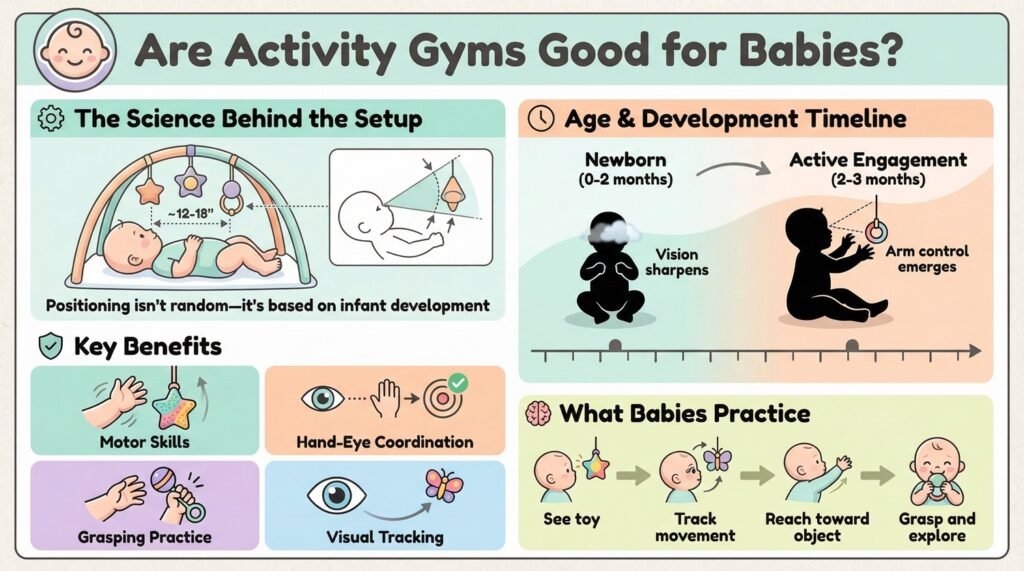
Let’s talk about what activity gyms genuinely offer. The motor skill development benefits are well-documented. When babies lie under an activity gym, those suspended toys are positioned at the perfect distance to encourage reaching and grasping.
This positioning is based on infant visual development and arm length, not random placement.
Babies around 2-3 months old are starting to gain control over their arm movements, and having something visually interesting at just the right distance motivates them to practice these emerging skills. The hand-eye coordination aspect is particularly valuable during this phase.
Newborns have pretty blurry vision initially, but by the time they’re actively engaging with an activity gym, they can focus on objects and track movement.
The process of seeing a toy, reaching for it, missing, adjusting, and trying again builds neural pathways that support coordination. This same skill set eventually translates to self-feeding, writing, and pretty much every task that needs coordinating what you see with what your hands do.
Cognitive development benefits show up too. Babies using activity gyms interact with varied colors, textures, sounds, and often mirrors.
This variety stimulates different sensory processing areas in the developing brain. The mirror component is especially interesting from a developmental psychology perspective because self-recognition is actually a significant cognitive milestone.
When babies start noticing their own reflection and eventually recognizing themselves, it represents an important step in self-awareness.
Physical activity research in early childhood reveals that movement is fundamentally connected to brain development. When infants move regularly, neural networks expand, particularly in areas supporting learning and memory.
The more opportunities babies have to move their bodies in different ways, the more these neural pathways strengthen.
The Overstimulation Problem Nobody Talks About
Here’s what the marketing materials won’t tell you: some babies absolutely hate activity gyms. Not because there’s anything wrong with the baby or the product, but because sensory thresholds vary enormously between infants.
I’ve watched parents stress themselves out trying to figure out why their baby screams the moment they’re placed under their brand-new, top-rated activity gym. The answer is usually pretty straightforward: too many colors, too many sounds, too many textures all demanding attention simultaneously.
For babies with lower sensory thresholds or those who are simply more sensitive to stimulation, an activity gym can be genuinely overwhelming instead of enriching. This is where the one-size-fits-all approach to baby products really falls apart.
Some babies thrive with lots of sensory input.
They’re visually engaged, they reach enthusiastically for toys, and they can happily spend 20-30 minutes under their activity gym.
Other babies do much better with quieter, simpler environments where they can focus on one or two elements at a time. Neither response is wrong or shows anything problematic about your baby’s development.
It just means babies are person humans with different preferences and sensory processing styles, which shouldn’t be surprising but somehow gets lost in the “every baby needs this” marketing approach.
What Pediatricians Actually Recommend
The American Academy of Pediatrics has clear recommendations about infant activity, and notably, they don’t mandate activity gyms. What they do recommend is interactive play opportunities throughout the day, at least 30 minutes of supervised tummy time with an adult, and outdoor play 2-3 times daily when weather allows.
Notice that these recommendations focus on the activity and the interaction, not the equipment. An activity gym can certainly facilitate these recommendations, but so can a blanket on the floor with you lying next to your baby making faces and singing songs.
Dr. Danae Dinkel, who researches infant physical activity at the University of Nebraska at Omaha, has identified three major barriers to infant movement that actually matter: excessive screen time (some infants are exposed to 36-330 minutes daily), overuse of restrictive devices like car seats and swings beyond their intended purpose, and gendered play stereotypes that push girls toward fine motor activities and boys toward gross motor activities.
Her research conclusion is really straightforward: simple parental engagement and outdoor time are more impactful than any product you can buy. That doesn’t mean products are useless, but it does mean they’re supplemental tools instead of requirements.
The critical finding across pediatric recommendations is that parental modeling of physical activity matters enormously. Children whose parents are physically active are significantly more likely to be active themselves.
This pattern starts in infancy, where babies whose parents actively engage with them through movement games, outdoor exploration, and physical play develop stronger movement patterns than babies primarily entertained by products.
The Budget-Friendly Alternatives That Work Just as Well
Let me share what actually worked for families I know who skipped the activity gym purchase entirely. One friend created a DIY play space using a thick quilt on the floor, some ribbon tied between two chair legs at the right height, and household items like wooden spoons, soft fabric pouches filled with rice, and a small unbreakable mirror propped safely nearby.
Her baby met every developmental milestone right on schedule, and she saved well over $150.
Another family borrowed a gently-used activity gym from friends for the 3-4 month window when their baby was most interested in it, then passed it along to another family. This approach made sense because babies typically engage most actively with activity gyms during a relatively narrow developmental window, usually between 2-6 months.
After that, they’re often more interested in rolling, crawling, and exploring their environment in ways that an activity gym actually restricts.
Outdoor play provides sensory stimulation that no manufactured product can copy. The varied textures of grass, dirt, and leaves, the sounds of birds and wind, the changing light and shadows, the temperature variations, all of this creates rich sensory input that supports development.
Research consistently shows that children are significantly more physically active in outdoor environments compared to indoor spaces, and this pattern starts in infancy.
Parent-led activities cost absolutely nothing and provide irreplaceable bonding alongside developmental benefits. Tummy time while you sing, bouncing your baby on your lap, patty-cake, peek-a-boo, and gentle movement games all support the same motor skills, coordination, and cognitive development that activity gyms target.
The added benefit is the emotional connection and language exposure that happens during these interactions.
When Activity Gyms Actually Make Sense
I don’t want to suggest that activity gyms are pointless or that buying one makes you a sucker for marketing. They genuinely work well for many families in specific circumstances.
If you have twins or multiples, an activity gym provides a safe, engaging space where one baby can play independently for short periods while you attend to their sibling. That practical consideration matters tremendously when you’re managing many infants.
If you’re recovering from a difficult birth or dealing with physical limitations that make floor play challenging, an activity gym allows your baby to have enriching play time without requiring you to get down on the floor many times daily.
If you simply have the budget and space and want to provide this option for your baby, that’s perfectly valid. Not every parenting decision needs to be the most minimalist or budget-conscious option.
Sometimes you just want to give your baby something that might be helpful and entertaining.
The key is using activity gyms as part of a broader developmental approach instead of relying on them as your primary method of engaging your baby. The sweet spot seems to be 1-2 hours of activity gym time daily, combined with outdoor play, parent-led activities, and varied environments that expose your baby to different sensory experiences.
What to Look for If You Do Buy One
If you’ve decided an activity gym fits your family’s needs, certain features matter more than others from a developmental perspective.
Adjustability is really valuable because it extends the useful lifespan of the product. Look for gyms where you can remove toys, adjust toy heights, and change the level of stimulation.
This flexibility allows you to start with minimal stimulation for a newborn and gradually add elements as your baby develops.
Machine-washable components are non-negotiable unless you enjoy scrubbing spit-up and drool from fabric by hand. Babies are wonderfully messy, and your activity gym will need frequent cleaning.
Volume control or the ability to turn off sounds completely is essential for managing stimulation levels and maintaining your own sanity. That cheerful jingle might be charming the first fifty times, but by the two-hundredth repetition, you’ll desperately want an off switch.
Stability matters for safety. The frame should be sturdy enough that your baby can’t tip it over by grabbing and pulling on toys, which they will definitely do once they develop that ability.
Storage considerations are practical but often overlooked. Some activity gyms fold relatively flat for storage, while others stay bulky even when disassembled. If you have limited space, this feature might be the deciding factor between models.
Common Mistakes Parents Make
The biggest mistake I see parents make with activity gyms is using them as a substitute for interaction instead of a supplement to it. Placing your baby under an activity gym and walking away to get things done is fine for short periods, but if it becomes your primary childcare strategy, you’re missing the crucial parental engagement component that nothing can copy.
Another common issue is not adjusting the gym to match your baby’s developmental stage and sensory preferences. If your baby seems overwhelmed, remove some toys.
If they seem bored, rotate in different objects or introduce new textures.
The gym should adapt to your baby, not the other way around.
Parents sometimes keep babies in activity gyms too long, past the point where they’re benefiting developmentally. Once your baby is mobile or showing clear signs of wanting to move around instead of lie under toys, transition to floor play that allows more freedom of movement.
Overlooking cleaning needs is another frequent problem. Activity gyms accumulate an impressive amount of drool, spit-up, and general baby residue.
Regular cleaning maintains the visual appeal and tactile experience that makes the gym engaging.
The Sustainability Angle
From an environmental perspective, activity gyms represent a significant investment of materials and manufacturing resources for a product with a relatively short useful lifespan. Most babies actively engage with activity gyms for only 4-6 months before outgrowing them developmentally.
Purchasing second-hand extends the product’s useful life and reduces environmental impact significantly. Baby gear, including activity gyms, is often in excellent condition on the second-hand market because babies outgrow items so quickly.
Facebook Marketplace, local parent groups, and consignment shops regularly have activity gyms available at 50-70% off retail prices.
Borrowing from friends or family is another option that makes sense given the short usage window. Many parents are happy to lend baby gear that’s just taking up storage space in their homes.
If sustainability is a priority for your family, DIY choices using existing household items represent the lowest environmental impact option. Blankets, wooden spoons, fabric scraps, and natural items like pinecones or smooth stones provide sensory variety without requiring new manufacturing.
Frequently Asked Questions
Do babies really need activity gyms?
Babies don’t need activity gyms to develop normally. What babies actually need is regular opportunities for movement, sensory stimulation, and interaction with caregivers.
Activity gyms can provide these things, but so can simple choices like floor play with household objects, outdoor time, and parent-led activities.
At what age should babies start using activity gyms?
Most babies can start using activity gyms around 2-3 months when they begin gaining better control over their arm movements and can focus on objects above them. Before this age, many newborns don’t have the visual acuity or motor control to really engage with the toys.
After about 6 months, many babies lose interest as they become more mobile.
How long should my baby use an activity gym each day?
A good range is 1-2 hours total daily, broken into several shorter sessions. Watch your baby’s cues.
If they seem engaged and happy, they can stay longer.
If they’re fussing or seem overwhelmed, take a break. Activity gym time should be part of a varied day that also includes tummy time, outdoor play, and direct interaction with you.
Can activity gyms cause overstimulation in babies?
Yes, some babies can definitely become overstimulated by activity gyms, especially models with lots of sounds, bright colors, and moving parts all at once. Signs of overstimulation include fussing, crying, looking away from toys, or becoming rigid.
If your baby shows these signs, remove some toys or simplify the setup.
Are expensive activity gyms better than cheaper ones?
Not necessarily. The most expensive activity gyms often include extra features like many music settings, elaborate toys, or brand names, but these don’t necessarily provide better developmental benefits.
A simple, well-made gym with adjustable toys and washable components often works just as well as premium models.
What can I use instead of an activity gym?
You can create effective choices using a blanket on the floor, ribbons or scarves tied between furniture at the right height, and household items with interesting textures like wooden spoons, fabric scraps, or unbreakable mirrors. These DIY setups provide similar developmental benefits without the cost.
Should I buy a new or used activity gym?
Used activity gyms are often a smart choice because babies use them for such a short period. Check that the frame is stable, all parts are intact, and fabric components can be thoroughly washed. Many gently-used activity gyms are available through local parent groups or consignment shops at significant savings.
Do activity gyms help with tummy time?
Some activity gyms can support tummy time by giving babies something interesting to look at while on their stomachs, but they’re not specifically designed for this purpose. A simple setup with toys at eye level or a parent lying face-to-face with the baby often works better for encouraging tummy time.
Key Takeaways
Activity gyms support motor development, sensory stimulation, and cognitive growth, but they’re supplemental tools instead of developmental necessities. Your baby will thrive with or without one, depending on the other enrichment you provide.
Parental engagement matters infinitely more than any product. The time you spend interacting with your baby, talking, singing, playing has irreplaceable benefits that no activity gym can duplicate.
Sensory thresholds vary dramatically between babies. What one infant finds engaging, another might find overwhelming.
Pay attention to your baby’s responses instead of pushing them to enjoy something that clearly doesn’t work for their temperament.
Budget-friendly choices provide comparable developmental benefits when paired with active parental involvement and outdoor play opportunities. You’re not disadvantaging your baby by choosing simpler options.
If you do purchase an activity gym, use it as part of a varied developmental approach that includes floor play, outdoor time, and parent-led activities instead of relying on it as your primary engagement strategy.