For the past decade, subscription boxes have transformed from a novelty concept into a massive industry, and nowhere has this shift been more pronounced than in the children’s market. Every month, millions of parents receive colorful packages filled with activities, toys, books, and learning materials designed specifically for their child’s developmental stage.
These boxes promise convenience, educational value, and the elimination of that endless cycle of researching activities and dragging kids through toy stores.
But here’s the question that actually matters: do these monthly deliveries genuinely deliver value that justifies their cost, or are they just another clever marketing strategy capitalizing on parental guilt and time scarcity?
The answer depends entirely on your family’s specific circumstances. The value proposition of kids subscription boxes exists in this really interesting space where convenience economics, child development theory, and family lifestyle preferences all intersect.
What Makes Subscription Boxes Different From Regular Shopping
The basic promise behind subscription boxes goes well beyond simply receiving products in the mail. When you purchase a subscription, you outsource the entire curation process to someone else.
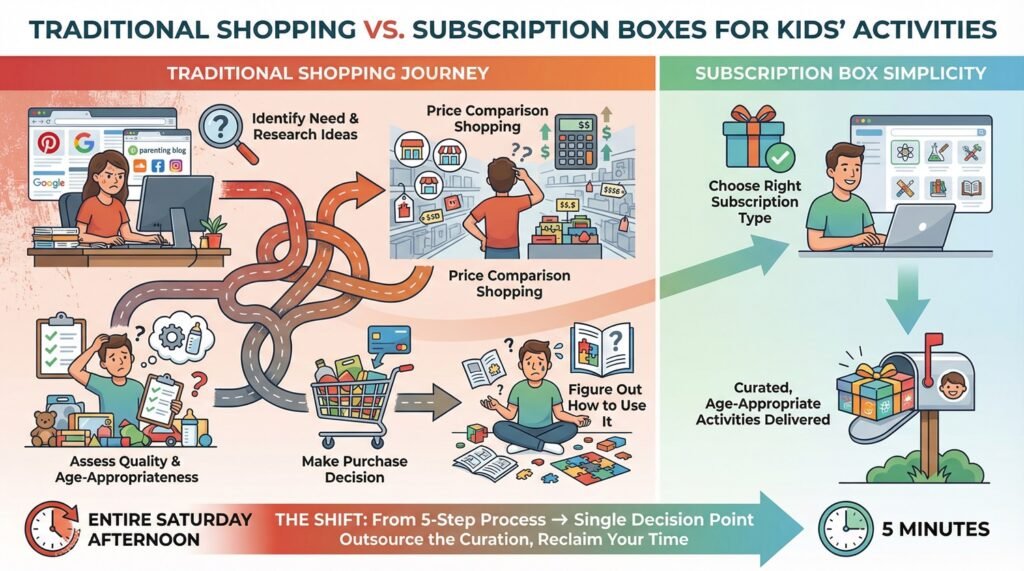
Instead of spending your Saturday afternoon browsing through Pinterest for activity ideas, comparing prices at craft stores, and hoping you’ve selected something age-appropriate and engaging, someone has already done that work for you.
This represents a genuine shift in how families approach children’s activities and learning materials. Traditional shopping requires you to identify a need, research options, assess quality, make purchasing decisions, and then figure out how to actually use what you’ve bought.
Subscription services collapse this entire process into a single decision point: choosing the right subscription type for your family.
The companies behind quality subscription boxes employ child development specialists, educators, and curriculum designers to create cohesive monthly experiences. They’re not randomly throwing toys and crafts into a box.
The better services organize everything around developmental themes, building skills progressively month after month.
One month might focus on spatial reasoning through building activities, while the next explores color theory through art projects.
There’s another dimension that often gets overlooked. Subscription boxes introduce an element of anticipation and surprise that you simply can’t copy with regular shopping. Children get genuinely excited about “their box” arriving, which creates engagement before they’ve even opened it.
That psychological component has real value, even if it’s harder to quantify than the physical materials inside.
The Time Economics Really Do Matter
Let me be really honest: modern parents are overwhelmingly pressed for time. Between dual-income households, single-parent families, and the general acceleration of daily life, many parents genuinely lack the bandwidth to thoughtfully curate activities for their children.
The time investment required for DIY activity planning adds up quickly. You need to identify activities suitable for your child’s current developmental stage, source materials from multiple stores, confirm you have all necessary supplies, and then figure out implementation.
For craft projects alone, this easily consumes several hours per activity when you factor in planning, shopping, and setup.
Subscription boxes compress this entire timeline. The monthly box arrives, you open it, and within minutes you’ve got everything needed for multiple activities.
Some services include video tutorials that walk both parent and child through each activity step by step.
That level of hand-holding might seem excessive if you’ve got unlimited time and energy, but for exhausted parents on a Tuesday evening, it’s genuinely transformative.
However, the time savings calculation gets more complicated when you consider that subscription boxes don’t eliminate parental involvement, they just shift it. You still need to supervise young children, explain instructions, help with challenging steps, and clean up afterwards.
Some boxes actually need more parental engagement than others, particularly those marketing themselves as family bonding experiences.
I’ve noticed that parents who view subscriptions primarily as independent entertainment for their kids often end up disappointed. The boxes work best when parents understand they’re facilitating quality parent-child interaction time, not replacing it. That distinction matters tremendously, and subscription marketing doesn’t always make it clear.
Where Educational Value Gets Murky
The educational claims surrounding subscription boxes range from modest to ambitious, and examining these critically matters. Many services promise STEM learning, literacy development, artistic growth, or social-emotional skills.
Some of these claims hold up better than others.
The strongest educational value comes from boxes that align activities with established developmental frameworks. Montessori-inspired subscriptions, for instance, provide materials designed around specific sensitive periods in child development.
These are carefully sequenced activities that build particular skills systematically.
STEM boxes present a more mixed picture. The concept makes sense: provide engineering challenges, science experiments, and mathematical thinking activities that make abstract concepts tangible.
In practice, execution varies dramatically.
The best STEM subscriptions include comprehensive instruction that explains the underlying principles, not just the activity steps. They help children understand why they’re building what they’re building, not just how to gather it.
I’ve seen many examples where STEM boxes fell short because they lacked enough instructional scaffolding. One parent described their frustration perfectly: their child completed the engineering project but couldn’t articulate what scientific principle it demonstrated. Without that conceptual understanding, the activity became just building for building’s sake, which doesn’t really advance STEM literacy.
Art and creativity boxes tend to deliver more consistent educational value because the learning goals are simpler. Exposure to new materials, techniques, and artistic concepts naturally expands a child’s creative repertoire.
Even basic craft projects build fine motor skills, following instructions, and project completion, all valuable developmental outcomes.
The literacy-focused subscriptions, particularly monthly book boxes, offer straightforward value. Quality children’s literature supports language development, imagination, and early reading skills.
The main consideration here involves whether the curated selection matches your family’s values and your child’s interests better than just visiting the library regularly.
Understanding the Financial Investment
The cost analysis for subscription boxes requires looking beyond the sticker price. A typical mid-range subscription runs between thirty and forty-five dollars monthly.
Multiply that by twelve months, and you’re investing between three hundred sixty and five hundred forty dollars annually per child.
For families with multiple children, this multiplies quickly.
The critical question becomes: could you copy the same value independently for less money? Usually, yes.
If you have the time to plan activities, source materials during sales, and create your own curriculum, you’ll spend less money.
A craft store run might cost fifteen to twenty dollars for supplies that create multiple activities, versus forty dollars for a box providing similar materials.
But this purely financial comparison misses the bigger picture. The value proposition includes curation, convenience, and expertise.
You’re paying for someone else to research developmental appropriateness, design cohesive learning experiences, and gather everything ready to use.
Whether that service justifies the premium depends entirely on how you value your time and what you’re realistically likely to accomplish independently.
I think many parents fall into a trap of comparing the subscription cost against an idealized version of what they could do themselves. They imagine thoughtfully researching activities, carefully shopping for quality materials, and implementing engaging learning experiences.
The reality for most families looks more like exhausted evenings defaulting to screen time because nobody has energy for anything else.
In that context, a subscription that facilitates actual engagement might represent better value than the money saved by doing nothing.
There’s also the hidden cost factor in subscriptions: you’re committing to ongoing expenses that many services want you to prepay. Annual subscriptions often offer discounts but need several hundred dollars upfront.
That’s a significant financial commitment, particularly if you’re uncertain whether the subscription will actually work for your family.
When Subscriptions Actually Fail Families
Despite the marketing promises, subscription boxes don’t work universally, and understanding why they fail helps identify whether they’ll succeed for your specific situation. The most common failure point involves misalignment between the box contents and your child’s actual interests, abilities, or temperament.
Developmental stage recommendations provide general guidance, but children develop unevenly across different domains. A four-year-old might have advanced verbal skills but struggle with fine motor tasks, or vice versa.
Subscription boxes can’t account for these person variations, which sometimes results in activities that frustrate rather than engage.
Sensory considerations create another potential stumbling block. Children with sensory processing sensitivities, whether formally diagnosed or not, may struggle with certain materials or textures.
A subscription that includes play dough, slime, or messy paint activities might be perfect for sensory-seeking children but completely overwhelming for sensory-avoiding ones.
Unless you’re selecting subscriptions designed specifically around sensory needs, you’re risking mismatches.
The personality factor matters more than most parents anticipate. Some children thrive on novelty and adapt easily to new activities.
Others prefer depth over breadth, wanting to master familiar activities rather than constantly trying new things.
Subscription boxes inherently favor the former personality type. If your child falls into the latter category, they might prefer repeatedly using a few high-quality toys rather than constantly receiving new materials.
Storage and accumulation present practical challenges that marketing rarely addresses. Monthly boxes generate a steady stream of materials, craft supplies, and completed projects.
Without adequate storage systems and regular purging, subscriptions can actually increase household clutter rather than providing organized enrichment.
This becomes particularly problematic in smaller living spaces where storage is already limited.
Matching Subscription Types to Family Goals
The subscription box market has segmented dramatically, with services targeting very specific niches. Understanding these distinctions helps identify which type might actually deliver value for your family’s particular goals and circumstances.
Comprehensive activity boxes aim to provide balanced exposure across multiple domains: art, science, literacy, physical activity, and social-emotional learning. These work best for parents seeking convenient enrichment without strong preferences for particular subject areas.
The trade-off means that activities sometimes feel more superficial because they’re covering such broad territory.
Subject-specific subscriptions explore deeper into particular areas like STEM, art, or literacy. These make sense when you’ve identified specific developmental goals or when your child shows strong interest in particular subjects.
A budding artist might get tremendous value from monthly art boxes introducing new techniques and materials, while that same subscription would bore a child more interested in building and engineering.
Montessori and Waldorf-aligned subscriptions appeal to parents committed to particular educational philosophies. These boxes curate materials consistent with specific pedagogical approaches, which matters if you’re trying to extend certain learning principles beyond school or apply them at home.
However, they typically cost more because they’re sourcing specialized materials and adhering to stricter curation standards.
Sensory-focused boxes serve children with sensory processing needs, autism spectrum disorder, or anxiety. These subscriptions specifically choose materials that support regulation, provide calming or alerting sensory input, and build tolerance for various sensory experiences.
For families dealing with these challenges, specialized subscriptions offer significantly more value than generic activity boxes.
Book subscriptions represent perhaps the most straightforward value proposition. Monthly age-appropriate books curated by children’s literature specialists introduce quality stories you might not find out about independently.
The main consideration involves whether the curation genuinely exceeds what you’d choose through library visits or bookstore browsing, and whether you prefer owning books versus borrowing them.
Testing Before Committing
Given the variability in subscription quality and family fit, smart strategy involves testing before making long-term commitments. Unfortunately, subscription business models often discourage this by offering discounts only for longer commitment periods.
You’ll pay more per box buying monthly versus prepaying for six or twelve months, but that premium buys you flexibility and reduced risk.
Several services now offer single-box purchases or short trial periods specifically addressing this concern. Taking advantage of these options let’s you assess whether your child genuinely engages with the activities, whether the quality meets your standards, and whether the subscription actually saves you time versus creates extra work.
During trial periods, pay attention to aspects beyond whether your child enjoys the initial novelty. Notice whether they return to activities multiple times or quickly lose interest.
Observe whether the instructions are clear enough that you can facilitate activities without frustration.
Consider whether the materials feel durable and safe or cheap and concerning. Evaluate whether the educational content aligns with your values and actually teaches what it claims to teach.
Also assess the practical logistics. Does the box arrive reliably on schedule?
Is packaging excessive or reasonable?
Are materials well-organized or jumbled together? Does the company provide good customer service if something is missing or damaged?
These operational factors significantly impact overall satisfaction but only become obvious through actual experience.
Making Subscriptions Work Optimally
For families who decide subscriptions make sense, certain strategies maximize value and satisfaction. These approaches help you get the most from your investment while avoiding common frustrations.
Schedule dedicated box time rather than treating boxes as random entertainment. When the box arrives, put it aside until you have unhurried time to explore it together.
This changes subscription boxes from last-minute time-fillers into intentional family experiences, which significantly increases engagement and educational value.
Extend activities beyond the initial implementation. Most subscription activities can be repeated multiple times with variations.
A science experiment can be tested under different conditions.
An art technique can be applied to new projects. A building challenge can be modified with added constraints.
Getting multiple uses from each box dramatically improves cost-effectiveness.
Combine subscription activities with related extensions. If the box includes a book about ocean animals, visit an aquarium or watch documentaries about marine life.
If an engineering project involves bridges, look for bridges in your community and talk about their design.
These connections deepen learning and show real-world applications.
Create storage systems that keep materials organized and accessible. Dedicate a shelf or drawer to current box contents, and establish routines for rotating out completed activities.
Good organization prevents the overwhelmed feeling that comes from accumulating materials faster than you can use them.
Document activities through photos or journaling. This serves multiple purposes: it creates memories, allows children to see their progress over time, and helps you assess whether the subscription delivers enough value.
Looking back at several months of activities gives you much better data for renewal decisions than trying to remember whether person boxes felt worthwhile.
Evaluating Renewal Decisions
After several months of subscription experience, you’ll face renewal decisions. Automatic renewals make it easy to continue indefinitely without really evaluating ongoing value.
Establishing clear evaluation criteria helps you make intentional decisions rather than defaulting to continuation.
Ask yourself whether your child actively engages with most activities or consistently shows disinterest. One or two misses in a year doesn’t show poor fit, but if your child rarely seems excited about what arrives, the subscription doesn’t deliver entertainment value regardless of educational merit.
Consider whether the subscription helped you actually do more activities together versus just accumulating more materials. Honest assessment might reveal that boxes often sit unopened for weeks because you’re too busy to use them.
If that’s the pattern, the subscription solves nothing.
Evaluate your child’s developmental progress and whether current subscription content still matches their needs. A subscription perfect for a three-year-old might no longer suit a five-year-old. Children’s interests evolve, attention spans lengthen, and skill levels advance.
Subscriptions need to evolve accordingly, either by aging up within the same service or switching to different subscriptions entirely.
Calculate actual per-activity cost based on usage. If a forty-dollar box includes six activities but you only finish three, your per-activity cost is higher than the obvious value.
Some families find out about they prefer purchasing fewer higher-quality materials they’ll definitely use rather than receiving more materials they partially engage with.
Frequently Asked Questions
What age should I start subscription boxes for my child?
Most subscription services start around age two or three, though some offer baby boxes focused on sensory development. The best starting age depends on your child’s ability to focus on structured activities for at least ten to fifteen minutes.
Younger toddlers often do better with sensory-focused boxes rather than craft-heavy ones.
How do I choose between STEM and general activity boxes?
Consider your child’s current interests and attention span. STEM boxes work best for kids who enjoy building, experimenting, and asking “why” questions.
General activity boxes provide more variety and work better for younger children or those still exploring different types of play.
You can always switch types after a few months if the first choice doesn’t fit.
Can subscription boxes work for homeschooling?
Many homeschooling families successfully mix subscription boxes as supplemental curriculum. They work particularly well for hands-on science, art enrichment, and interest-led learning.
However, most subscriptions don’t provide comprehensive coverage of any single subject, so they function best as supplements rather than primary curriculum.
What happens if my child doesn’t like an activity?
Quality subscription services understand that not every activity will resonate. Most recommend setting aside activities your child initially rejects and trying them again later.
Developmental readiness and interest fluctuate, and an activity that bores your child one month might engage them three months later.
Save materials rather than immediately discarding them.
Are subscription boxes good for kids with ADHD?
Subscription boxes can work well for children with ADHD when you choose services offering shorter, varied activities rather than long projects requiring sustained focus. Look for boxes that break activities into clear steps, include visual instructions, and offer hands-on engagement.
Sensory boxes often provide particularly good focus support.
How much parental supervision do subscription boxes need?
This varies dramatically by your child’s age and the subscription type. Toddlers and preschoolers need direct supervision and significant help.
Elementary-age children might need initial guidance but then work independently for portions of activities.
By upper elementary, many kids can finish simpler activities with minimal adult involvement, though parental engagement still enhances learning.
Do subscription boxes create too much waste?
Some subscriptions generate significant packaging waste and single-use materials. Look for companies prioritizing sustainable materials, minimal packaging, and reusable components.
You can also reuse craft supplies for independent projects and recycle completed activities your child no longer wants to keep.
Can I gift a subscription box to someone else’s child?
Subscription boxes make excellent gifts, particularly from grandparents or distant relatives wanting ongoing connection. However, check with parents first to confirm their preferences regarding materials, themes, and whether they have adequate time to use subscription activities.
Some families already have too many subscriptions and would prefer different gifts.
Key Takeaways
The value of kids subscription boxes depends entirely on alignment between what they offer and what your family actually needs. For time-strapped parents prioritizing convenience and expert curation, subscriptions deliver genuine worth despite higher costs. The time savings and reduced decision fatigue justify the premium when you realistically assess what you’d accomplish independently versus what actually happens in daily family life.
However, subscriptions work only when contents match your child’s developmental stage, interests, and learning style. The wrong subscription wastes money regardless of general quality, which makes trial periods and careful evaluation essential.
Start small, test thoroughly, and commit long-term only after confirming actual engagement and value.
The hidden value in subscriptions extends beyond materials to include routine establishment, exposure to new experiences, and scaffolding toward independent learning. When leveraged intentionally through dedicated time, activity extensions, and gradual independence-building, subscriptions can contribute meaningfully to child development in ways that justify costs beyond simple material value.