The traditional advice about baby activity gyms is that they’re nice-to-have items that keep your baby entertained while you grab a shower. That really undersells what happens when your baby lies beneath those dangling toys.
Activity gyms are sophisticated developmental tools that target specific motor skills at precisely the right time in your baby’s neurological development. The difference between a well-designed gym used intentionally and a random play mat with stuff hanging from it is genuinely significant when it comes to how quickly and confidently your baby masters essential physical skills.
Most parents don’t realize that the first six months of life represent the most rapid period of motor development humans ever experience. Your baby’s brain is forming neural pathways at an absolutely staggering rate, and the physical experiences they have during this window quite literally shape how those pathways develop.
An activity gym, when used properly, provides targeted sensory input that strengthens these connections in ways that passive holding or lying flat simply cannot replicate.
Understanding the Motor Development Timeline
Motor development doesn’t happen randomly. It follows a predictable sequence that’s been consistent across cultures and generations, moving from head to toe and from the center of the body outward.
What changes is how quickly person babies progress through these stages, and environmental enrichment really matters here.
In the first six weeks, your baby is primarily working on head control and visual tracking. Their movements are mostly reflexive, and they can’t yet coordinate their arms and legs with intention.
But their nervous system is already processing enormous amounts of sensory information, building the foundation for voluntary movement.
High-contrast patterns and objects positioned about 8-12 inches from their face become incredibly valuable during this period. The visual system develops rapidly, and giving your baby interesting things to look at while lying on their back creates the motivation to strengthen neck muscles and practice holding their head in midline.
These visual targets drive the development of tracking skills that will later support reading, sports, and countless other activities requiring coordinated eye movement.
Between two and three months, you’ll notice a dramatic shift. Babies start batting at objects, though their aim is terrible at first. This represents the beginning of hand-eye coordination.
The brain is learning to judge distance, coordinate bilateral movement, and send intentional signals to muscles.
Every swipe and miss provides feedback that refines these neural pathways.
Activity gyms excel during this phase because they position toys at the optimal distance and height for practicing these skills without requiring a parent to hold objects in place for extended periods. You can go about nearby tasks while your baby gets dozens of practice tries in a single session.
By four to six months, the real transformation happens. Babies develop the ability to reach and grasp with increasing accuracy, they begin rolling, and they start using both hands together in coordinated ways.
Adjustable gym features become crucial during this stage, because what challenged your baby last week might be too easy this week.
The developmental trajectory during this period is steep, and you want equipment that can keep pace as opposed to becoming obsolete after a few weeks of use.
The Specific Motor Skills Activity Gyms Target
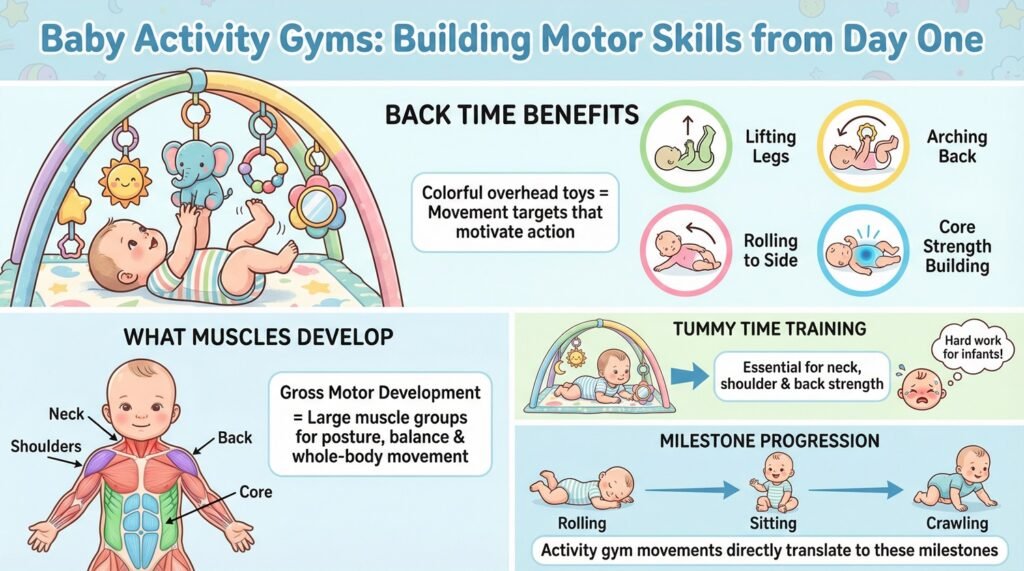
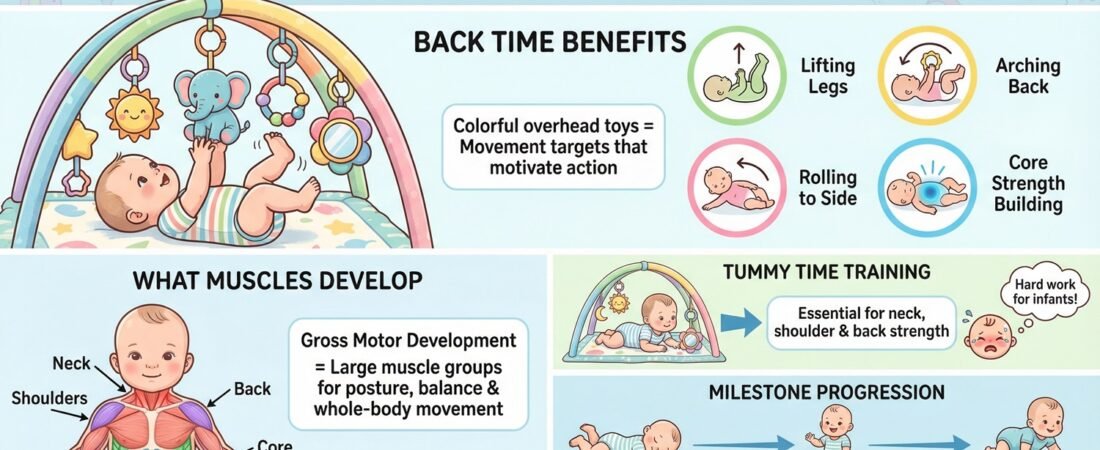
Gross motor development involves the large muscle groups that control posture, balance, and whole-body movement. When your baby lies on their back beneath a gym, they’re constantly making tiny adjustments to maintain stability.
Those colorful toys overhead serve as targets that motivate your baby to lift their legs, arch their back, and eventually roll to the side.
Each of these movements builds core strength and body awareness that directly translates to later milestones like sitting and crawling.
The tummy time function of quality activity gyms is particularly important for gross motor development. Babies need substantial time on their stomachs to develop the neck, shoulder, and back muscles required for rolling, sitting, and eventually crawling.
But tummy time is hard work for young infants, and many babies protest loudly.
Activity gyms solve this problem by providing interesting visual targets at eye level during tummy time, which motivates babies to lift their heads and hold that challenging position longer than they would on a blank mat. A baby who might only tolerate thirty seconds of tummy time on a plain surface might manage three or four minutes when there’s a fascinating mirror or crinkly toy at eye level.
Fine motor skills involve the smaller, more precise movements of hands and fingers. The progression from reflexive grasping to intentional reaching to coordinated manipulation is absolutely fascinating to watch.
At first, your baby’s hands are fisted, and if something touches their palm, they’ll grasp it automatically.
But as the nervous system matures, they begin opening their hands and swiping at objects intentionally.
Activity gyms with toys at varying heights and distances provide graduated challenges that support this progression. A toy positioned close and centered might be easy for your three-month-old to bat, while one positioned slightly higher and to the side needs more coordination and effort.
You can adjust difficulty throughout the day based on your baby’s energy level and frustration tolerance.
The development of the pincer grasp, where babies use their thumb and forefinger together, depends on thousands of earlier reaching and grasping experiences. Toys with different textures, shapes, and sizes attached to an activity gym give babies the varied tactile input their hands need to develop sensitivity and dexterity.
A smooth wooden ring feels different from a soft fabric tag, which feels different from a ridged rubber teether.
Each texture provides unique sensory information that helps the brain map hand function.
Hand-eye coordination deserves special attention because it’s foundational for nearly every skill humans perform. The ability to see an object, judge its distance and position, plan a movement, and execute that movement accurately needs integration across many brain regions.
Activity gyms create thousands of opportunities to practice this integration in a safe, repeatable context.
The baby sees a toy, tries to touch it, receives feedback about whether they succeeded, and adjusts their next try accordingly. This feedback loop is how motor learning happens.
Without interesting targets to reach for, babies get far fewer practice opportunities, which can slow the development of these essential skills.
Bilateral coordination, using both sides of the body together, is another skill that activity gyms naturally encourage. When babies reach for toys with both hands, transfer objects from one hand to another, or push against the mat with their legs while reaching with their arms, they’re building the neural connections that link the brain’s left and right hemispheres.
These connections are essential for complex movements later in life, from crawling to writing to playing sports.
Key Features That Actually Matter
Not all activity gyms are created equal, and the design details really do impact developmental outcomes. The arch height and adjustability matter more than most manufacturers thank.
Fixed arches often position toys at a distance suitable for maybe a six-week window of development.
Adjustable systems let you raise toys as your baby’s reach improves, maintaining an suitable challenge level that keeps them engaged and working on skills just beyond their current mastery.
The quality and variety of attached toys directly influences how much your baby learns from the gym. You want objects with genuinely different properties, not six plastic animals that all feel and sound the same.
Look for combinations of textures like soft fabric, smooth wood, crinkly material, and ridged rubber.
Sounds should vary too, with rattles, squeakers, crinkles, and bells each providing distinct auditory feedback. Visual properties matter as well, from high contrast patterns to mirrors to bright colors.
Each different sensory experience activates different neural pathways and contributes to overall sensory integration. A gym with genuinely diverse toys supports richer learning than one with many similar objects.
Detachability is crucial but often poorly implemented. You should be able to easily remove and reposition toys, swap them out to maintain novelty, and adjust their height. Babies habituate to familiar stimuli quickly, and once something becomes boring, it stops motivating movement and exploration.
The ability to refresh the gym’s appeal without buying entirely new equipment extends its useful life significantly.
Some gyms use complicated clip systems that need two hands and significant effort to adjust, which means parents don’t bother making changes. Look for simple loops, ties, or clips that you can operate one-handed while holding your baby with the other arm.
The mat itself deserves more attention than it typically gets. Thickness matters for comfort, safety, and proprioceptive feedback.
A mat that’s too soft doesn’t provide clear information about body position and movement.
A mat that’s too thin offers not enough cushioning for the inevitable face-plants during tummy time. The ideal thickness is around one to two inches of firm but cushioned material.
Washability is non-negotiable because these mats get truly disgusting. Spit-up, diaper leaks, drool, and mysterious sticky substances will all find their way onto the mat.
Machine washable fabric covers with removable padding make life much easier than gyms requiring spot cleaning or hand washing.
Tummy time functionality varies wildly across products. Some gyms just assume you’ll flip your baby over and hope for the best.
Better designs include positioning pillows, mirrors at floor level, and toys positioned to encourage head lifting without frustrating babies who are still building strength.
The goal is to make tummy time engaging enough that babies tolerate it long enough to build the necessary muscle strength.
How to Use Activity Gyms Across Developmental Stages
During the early weeks, when your baby is still figuring out that they have arms and those arms can move on purpose, positioning is everything. Place your baby on their back with their head centered beneath the arch.
The toys should be about 8-12 inches from their face, close enough to see clearly but not so close they’re startling.
At this stage, you’re primarily supporting visual tracking and building tolerance for floor play. Sessions might only last five to ten minutes before your baby becomes fussy, and that’s completely normal.
Young babies have limited stamina for any activity, and expecting marathon play sessions sets everyone up for frustration.
Position yourself nearby where your baby can see you. Your presence provides security and encouragement.
Talk to your baby, pointing out different toys and gently touching them to create movement.
You’re not entertaining your baby so much as showing them what’s available for exploration.
As your baby starts batting at toys around two to three months, you can begin encouraging more intentional movement. Position toys slightly to each side occasionally, which motivates your baby to reach across their body, building the core rotation that supports rolling later.
Alternate which toys you highlight during play sessions, gently touching a toy to create sound or movement that captures attention.
Draw your baby’s attention to possibilities they might not notice independently. If they’re fixated on one toy, make a different one rattle or crinkle to broaden their awareness.
If they’re reaching with only their right hand, position an appealing toy on the left to encourage bilateral practice.
When your baby develops more reliable reaching and grasping around four months, the gym should evolve into a place for problem-solving. Adjust toys to just beyond their easy reach occasionally, creating a small challenge that motivates effort.
Introduce toys with different grasping requirements, some that are easy to grab, others that need more precision.
Watch for frustration and adjust accordingly. You want to maintain engagement without creating stress.
A baby who’s reaching repeatedly for a toy that’s too far away might give up entirely if you don’t adjust it closer.
But a baby who easily reaches everything might become bored without some challenge.
Tummy time should be incorporated from very early on, ideally from the first week or two. Start with just a few minutes several times per day, positioning your baby so they can see interesting visual targets.
Many gyms include floor-level mirrors, which are genuinely valuable because babies are highly motivated to look at faces, even their own.
As neck strength improves, tummy time sessions can gradually lengthen. By three to four months, many babies can handle 15-20 minute tummy time sessions, which is when you’ll really see the gross motor benefits accelerating.
Babies who get adequate tummy time typically roll, sit, and crawl earlier than those who spend most of their awake time on their backs or in containers like swings and bouncy seats.
The key to maximizing developmental benefits is reading your baby’s engagement cues. Active learning happens when your baby is in a state of calm alertness, interested in their environment but not overstimulated or distressed. If your baby is fussing, arching away, or seeming overwhelmed, take a break.
If they’re staring blankly or seeming bored, adjust something like repositioning toys, introducing novelty, or changing their position from back to tummy or vice versa.
Common Problems and Practical Solutions
Overstimulation is probably the most frequent issue with activity gyms, and poor design largely causes it. Gyms that include lights, music, vibration, and a dozen brightly colored toys all at once create sensory chaos as opposed to learning opportunities.
Babies can’t focus on developing specific skills when they’re overwhelmed by input.
The solution is often counterintuitive: remove most of the toys. Start with just two or three carefully positioned objects and add more only as your baby shows clear engagement and increasing skill.
Less really is more for young babies whose nervous systems are still learning to filter and process sensory information.
The attention span of young babies is naturally short, and expecting them to happily play for thirty minutes under a gym at six weeks old is unrealistic. But I see parents give up on activity gyms entirely when their baby only tolerates a few minutes at a time.
Many short sessions throughout the day are actually more developmentally suitable than longer stretches.
Your baby is working hard during those few minutes, building muscle strength and neural connections. Quality matters more than duration in early infancy.
Storage and space issues plague many families. Activity gyms are bulky, and not everyone has a dedicated playroom.
But developmental benefits need regular access, not having the gym buried in a closet because setting it up is too much hassle.
Look for designs that fold relatively flat or consider keeping the gym set up in whatever room your family spends the most time in, even if that’s not the aesthetic you imagined. The inconvenience of visible baby gear is temporary, but the developmental window is narrow.
Some babies simply seem to hate their activity gym, and parents assume their child isn’t a “gym baby.” Usually, though, the problem is timing or positioning. Trying to use the gym when your baby is hungry, tired, or overstimulated guarantees failure.
The best gym sessions happen during your baby’s naturally alert periods, typically shortly after feeding and diapering when they’re comfortable and interested in the world.
Positioning matters too. Some babies prefer more reclined positions initially, which you can achieve by placing a small pillow or folded blanket under their head and shoulders.
Others do better completely flat.
Experiment with different positions and times of day to find what works for your person baby.
Material durability and safety concerns are legitimate. Cheaper gyms often have toys that detach unexpectedly, creating choking hazards, or fabrics that pill and deteriorate quickly.
Wooden toys can splinter, plastic can crack, and electronic components can malfunction.
Regular inspection is non-negotiable, and investing in quality construction from reputable manufacturers is worth it. Your baby will be grasping, mouthing, and yanking on these toys daily for months.
They need to withstand that use without becoming dangerous.
Adapting the Approach for Different Situations
Babies with developmental delays or physical challenges can benefit tremendously from activity gyms, but often need modifications. Working with early intervention specialists, you can adjust toy positioning to support specific therapeutic goals.
For babies working on head control, positioning toys lower and more forward during tummy time provides motivation to lift against gravity.
For babies developing hand skills, larger, easier-to-grasp toys positioned within reliable reach build confidence before introducing more challenging targets.
Preterm babies or those with sensory sensitivities often need a more gradual introduction to activity gym play. Start with minimal stimulation, perhaps just a simple mirror or one high-contrast toy, and increase complexity very slowly.
These babies benefit from shorter, more frequent sessions in a quiet environment without competing sensory input from television or household noise.
The same developmental goals apply, but the timeline and approach need more patience and individualization.
Multiples present logistical challenges but similar developmental needs. Twins or triplets can sometimes share an activity gym, taking turns or playing side-by-side if you have space for many setups. The key is ensuring each baby gets adequate person attention and that the gym experience doesn’t become just crowd control.
Some parents find that staggering gym time, with one baby having focused play while others are napping or feeding, works better than trying to engage many babies simultaneously.
For families embracing minimalist or Montessori philosophies, traditional plastic activity gyms might feel like clutter and overstimulation. But the concept of providing interesting objects at varying heights for a baby to reach toward is entirely consistent with these approaches.
DIY options using wooden frames, natural fiber toys, and carefully selected objects can provide the same developmental benefits without the plastic and electronics.
The principles of motor skill development don’t change based on parenting philosophy, only the materials and aesthetics.
People Also Asked
What age should I start using a baby activity gym?
You can start using a baby activity gym from birth, though newborns will only be able to look at toys for the first several weeks. The visual stimulation and practice with tummy time benefit even very young babies.
Most babies begin actively batting at toys around 8-12 weeks, which is when the gym becomes really engaging for them.
How long should my baby use an activity gym each day?
Young babies might only tolerate 5-10 minutes at a time, and that’s perfectly fine. Aim for many short sessions throughout the day as opposed to one long session.
By 3-4 months, many babies can engage with the gym for 15-20 minutes at a stretch.
Follow your baby’s cues and stop when they show signs of tiredness or frustration.
Do activity gyms help with tummy time?
Yes, activity gyms with floor-level features specifically designed for tummy time can significantly help. Mirrors, crinkly toys, and other interesting objects at eye level motivate babies to lift their heads and hold that position longer than they would on a plain surface, which builds the neck and shoulder strength needed for later motor milestones.
When do babies outgrow activity gyms?
Most babies naturally outgrow activity gyms between 6-8 months when they become mobile and want to crawl as opposed to lie on their backs. Some babies lose interest earlier if they’re advanced rollers or sitters, while others continue enjoying the gym until 9 or 10 months.
Watch for signs that your baby is frustrated by the gym’s constraints as opposed to engaged with the activities.
Can activity gyms delay motor development?
Activity gyms themselves don’t delay development, but overuse of any container or piece of equipment can. Babies need varied experiences including floor play without equipment, being held, and freedom to move.
Use the gym as one tool among many as opposed to keeping your baby in it for hours at a time.
What’s better, a play mat or activity gym?
Activity gyms with arches and hanging toys provide more developmental benefits than flat play mats alone during the first 6 months. The hanging toys give babies targets to practice reaching, batting, and grasping, while play mats primarily offer visual interest.
Many activity gyms include both features, with a padded mat and arches that can be removed as your baby grows.
Key Takeaways:
Motor development in the first six months follows a predictable sequence from head control to bilateral coordination, and activity gyms provide targeted practice for each stage when used intentionally as opposed to as passive entertainment.
The difference between random entertainment and developmental support comes from matching toy positioning, complexity, and challenge level to your baby’s current skills while encouraging progress toward emerging abilities through careful observation and adjustment.
Quality matters significantly more than quantity when it comes to toys and features, with varied textures, sounds, and visual properties providing richer learning experiences than many similar objects that offer redundant sensory input.
Multiple short play sessions throughout the day, timed during your baby’s naturally alert periods, produce better outcomes than attempting extended sessions when your baby is tired or overstimulated and unable to engage actively.
Regular observation of your baby’s engagement and skill development allows you to adjust the gym’s setup continuously, maintaining an suitable challenge level that supports learning without causing frustration or boredom.