For the past few years, I’ve watched my own living room transform from a minimalist space into what can only be described as a literary obstacle course. There are board books wedged between couch cushions, lift-the-flap books hiding under throw pillows, and at least three copies of the same dinosaur story scattered across different rooms.
This beautiful chaos represents something I’ve come to value deeply: the foundation of a reading life.
Book subscriptions for toddlers have emerged as one of the most practical solutions for parents navigating the overwhelming world of children’s literature. Rather than standing paralyzed in front of massive bookstore displays or falling down Amazon rabbit holes at midnight, you can rely on expert curators to deliver age-appropriate, engaging books directly to your doorstep.
This has really transformed how families build their home libraries and, more importantly, how they introduce the magic of reading to their youngest members.
Understanding Toddler Book Subscription Models
The subscription book market has evolved considerably beyond the simple “book of the month” clubs our parents might remember. Today’s services cater specifically to developmental stages, cultural values, educational philosophies, and even reading preferences that haven’t yet formed. The core principle remains consistent across services: regular delivery of carefully selected books matched to your child’s age and interests eliminates decision fatigue while ensuring a steady stream of fresh content.
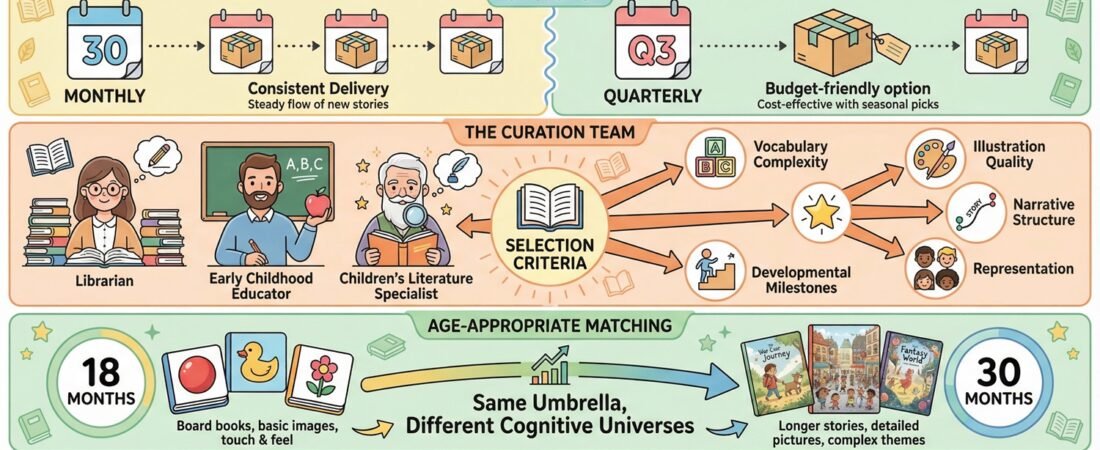
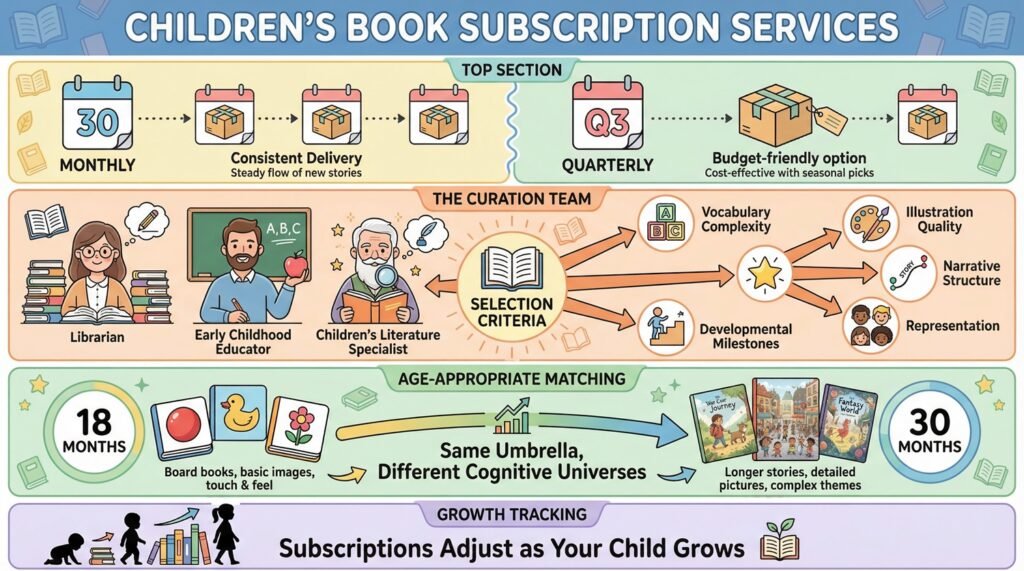
Most subscriptions operate on predictable monthly cycles, though some offer quarterly options for families who prefer less frequent deliveries or are managing tighter budgets. The real magic happens in the curation process.
Professional librarians, early childhood educators, and children’s literature specialists typically handle book selection, applying criteria that go far beyond simple entertainment value. They’re evaluating vocabulary complexity, illustration quality, narrative structure, representation, and how each book supports specific developmental milestones.
What makes these services particularly valuable for the toddler years is their ability to match books to rapidly changing capabilities. An 18-month-old and a 30-month-old exist in completely different cognitive universes, yet both fall under the “toddler” umbrella.
Quality subscriptions account for these nuances, adjusting selections as your child grows and their comprehension deepens.
Developmental Reading Benefits Across Toddler Stages
The toddler years represent an absolutely critical window for literacy development, even though actual reading remains years away. Between 12 and 36 months, children are absorbing language patterns, building vocabulary at astonishing rates, and forming associations between words, images, and concepts.
Regular exposure to books during this period establishes neural pathways that support later reading comprehension and academic success.
Early toddlers, roughly 12 to 18 months, benefit most from simple board books with high-contrast images, repetitive text, and durable construction that withstands enthusiastic page turning and occasional teething incidents. Books become sensory experiences at this stage, with textures, sounds, and interactive elements holding attention more effectively than complex narratives.
Subscriptions targeting this age group typically emphasize concept books covering colors, shapes, animals, and familiar objects.
As toddlers approach the 18 to 24 month range, their attention spans extend and they begin following simple storylines. Books with predictable patterns, rhyming text, and opportunities for participation work exceptionally well.
This is when you’ll notice your child filling in familiar words or mimicking sounds.
The right subscription introduces books that encourage this interactive reading while gradually increasing complexity.
Older toddlers between 24 and 36 months develop preferences, express opinions about stories, and engage with more sophisticated plots involving problem-solving and emotional themes. They’re ready for longer picture books, early character series, and stories that reflect their expanding understanding of relationships and cause-and-effect.
Subscriptions become particularly valuable here because they introduce diversity your toddler might not ask but will absolutely benefit from experiencing.
Bookroo
Bookroo has built a solid reputation around quality curation and presentation. When packages arrive, they’re wrapped individually, creating a genuine gift-opening experience that even very young toddlers find exciting.
This small touch changes routine book delivery into a monthly celebration.
The service offers two distinct subscription tiers for toddlers: a board book option and a picture book option. Board book subscriptions deliver three books monthly for families with children aged 0 to 3 years, while picture book subscriptions provide two books for ages 2 to 6 years.
This overlap allows families to customize based on their child’s developmental stage as opposed to rigid age categories.
Bookroo’s curation leans toward timeless classics mixed with contemporary award-winners, avoiding character licensing and commercial tie-ins. You won’t find books based on television shows or movie franchises, which some parents appreciate for maintaining literary integrity while others might miss if their toddler loves specific characters.
The selection process emphasizes beautiful illustrations, strong narratives, and books with lasting appeal that justify repeated readings.
Pricing sits in the moderate range compared to competitors, and the service offers flexibility with month-to-month subscriptions or prepaid options that reduce per-book costs. The company also guarantees satisfaction, offering replacements for books you already own, which addresses one of the most common subscription frustrations.
Literati
Literati approaches book subscriptions with impressive personalization capabilities. After creating a profile that captures your child’s interests, reading level, and values important to your family, the service uses algorithms combined with human curation to choose five books monthly.
Here’s where it gets really interesting: you preview the selections online before they ship, can swap out titles you don’t want, and only pay for books you decide to keep after a five-day home trial period.
This try-before-you-buy model eliminates the risk of receiving books your toddler ignores or duplicates of stories you already own. For the toddler category, Literati focuses on board books and early picture books that emphasize diversity in characters, family structures, and experiences.
The curation team includes considerations for representation that feel authentic as opposed to tokenistic.
The main drawback is that this flexibility comes at a premium price point. Individual books cost more than you’d pay purchasing them directly, which is the trade-off for the curation service and trial period.
For families who value the personalization and risk-free exploration, the cost makes sense.
For budget-conscious households building libraries on tight margins, the math might not work as favorably.
Imagination Library
Dolly Parton’s Imagination Library operates on an entirely different model that deserves special attention. This program delivers one free book monthly to registered children from birth to age five, funded through local community partnerships and donations.
The finish absence of cost makes it the most accessible option for families regardless of economic circumstances.
Books arrive addressed directly to your child, creating that same excitement of receiving personalized mail. The selection follows a carefully designed progression that matches developmental stages, starting with simple board books and gradually introducing more complex stories and concepts.
While you can’t customize selections or preview titles, the program’s research-based approach confirms age-appropriate, high-quality literature.
The obvious limitation is availability. Imagination Library operates where community sponsors exist to fund local programs, meaning it’s not universally accessible.
Checking whether your area participates takes just minutes through their website, and registration is straightforward when programs exist.
For families who qualify geographically, there’s absolutely no reason not to register. The program has distributed over 180 million books since its founding, with measurable impacts on kindergarten readiness in participating communities.
Tiny Humans Read
Tiny Humans Read carved out a niche by focusing specifically on diverse, inclusive children’s literature. Every box arrives with books featuring characters of different races, cultures, abilities, family structures, and experiences.
For families prioritizing representation in their home libraries, this targeted curation saves countless hours of research and evaluation.
Subscriptions include two books monthly for various age ranges, with their toddler option covering ages 0 to 3 years. Beyond the books themselves, each box includes parent guides discussing the story’s themes, suggested discussion questions adapted for toddler comprehension levels, and activity ideas extending the reading experience.
These resources help parents maximize each book’s educational and emotional value.
The service operates at a higher price point than mass-market options, reflecting the specialized curation and supplementary materials. The books themselves tend toward independent publishers and smaller presses that produce exceptional diverse content but lack the distribution networks of major publishing houses.
This means you’re unlikely to find these specific titles at your local big-box bookstore, which adds genuine discovery value to the subscription.
Amazon Book Box
Amazon’s entry into the children’s book subscription space leverages their massive catalog and logistical infrastructure. Book Box delivers four board books or two hardcover books every one, two, or three months, with selections based on your child’s age category.
The service combines with Prime membership, offering discounted pricing for subscribers.
The curation draws from Amazon’s large inventory, including both mainstream bestsellers and lesser-known titles. Quality varies more noticeably here than with boutique services employing specialist curators.
You might receive genuinely excellent books one month and more forgettable selections the next.
The algorithm-heavy approach lacks the consistent editorial voice that characterizes services with dedicated children’s literature experts making selections.
However, the value proposition is really strong for budget-conscious families, especially Prime members already paying for that subscription. The per-book cost undercuts nearly every competitor, and the flexibility of delivery frequency helps manage expenses.
For families more concerned with volume and variety than carefully curated literary excellence, Book Box provides solid bang for your buck.
Choosing Based on Educational Philosophy
Families following specific educational approaches like Montessori or Waldorf often struggle finding book subscriptions aligned with those values. Most mainstream services don’t specifically cater to these philosophies, but understanding what each approach prioritizes helps you assess options.
Montessori-aligned families typically seek books with realistic illustrations, practical life themes, and respect for the child’s intelligence without condescension. They often avoid fantasy elements for very young toddlers, preferring stories about real children, animals, and experiences.
Bookroo’s classic-leaning selection and Imagination Library’s research-based progression often align naturally with these preferences, though neither markets specifically to Montessori families.
Waldorf approaches emphasize imagination, natural materials, and age-appropriate content that respects developmental stages. These families might prefer subscriptions that avoid commercial characters and focus on nature-based stories, folk tales, and books with artistic illustrations.
The challenge is finding services that understand these nuances without resorting to overly simplistic or preachy content.
Your best strategy involves using subscriptions as one component of a larger library-building approach as opposed to your sole source. Supplement subscription books with intentional purchases that specifically match your educational philosophy, allowing the subscription to provide variety and exposure to different styles and themes.
Building Libraries Within Budget Constraints
The economics of toddler book collections create real tension for many families. Quality board books retail for $8 to $15 each, and toddlers need constant rotation of fresh content to maintain interest.
Subscriptions can either help or hurt your budget depending on how you structure them.
Running the numbers reveals some interesting patterns. If you’re already purchasing two to four new books monthly, most subscriptions deliver comparable or better value once you account for the curation service and shipping.
You’re essentially outsourcing the research and selection process, which has real value even if the per-book cost is slightly higher than finding deals independently.
The key is honestly assessing your actual book purchasing behavior. If you’re disciplined about buying only during sales, utilizing library resources heavily, and finding secondhand options, subscriptions might increase your spending.
If you’re impulse-buying character books at Target or ordering randomly from Amazon, a subscription could actually reduce costs while improving quality.
Consider splitting subscriptions among family members for gift-giving occasions. Grandparents, aunts, uncles, and friends often want to contribute to your child’s development but default to toys that duplicate what your toddler already owns.
A book subscription provides ongoing value, takes no storage space, and creates anticipation throughout the year as opposed to a single birthday moment.
Managing Subscription Accumulation
Here’s something nobody warns you about: successful book subscriptions create their own logistical challenges. Within six months, you’ll have 12 to 18 new books.
After a year, you’re managing 24 to 36 extra titles in your home.
This accumulation is wonderful for literacy development but can overwhelm your space if you’re not intentionally managing the influx.
Implementing a rotation system preserves novelty while controlling clutter. Keep one or two months of subscription books in active circulation, then box the rest for rotation every four to six weeks.
When “new” books reappear after absence, toddlers respond with renewed interest, essentially getting many uses from each title.
Creating a book-out policy maintains balance in your collection. For every new book that arrives, identify one that your toddler has outgrown or never connected with for donation.
Local libraries, preschools, doctors’ offices, and community centers typically welcome gently used children’s books.
This circulation confirms your collection stays current with your child’s development while supporting literacy access in your broader community.
Some families maintain separate spaces for subscription books versus other sources, treating the subscription collection as special volumes reserved for particular reading times. This distinction can increase the perceived value of subscription books and create positive associations, though it needs consistency to maintain the separation.
Frequently Asked Questions
Are book subscriptions worth it for toddlers?
Book subscriptions deliver consistent value when you’re already buying several books monthly. They eliminate the research time spent finding quality age-appropriate titles and introduce books you might not learn independently.
The convenience factor alone justifies the cost for many families, particularly those without easy access to well-stocked libraries or bookstores specializing in children’s literature.
How many books does a toddler need?
There’s no magic number, but having 20 to 30 books in active rotation provides enough variety to prevent boredom while allowing for repeated readings that support comprehension and memory. Quality matters more than quantity.
Five exceptional books your toddler loves provide more developmental value than 50 mediocre titles they barely engage with.
Can I cancel book subscriptions anytime?
Most services offer month-to-month subscriptions you can cancel without penalty, though prepaid multi-month subscriptions typically lock you in for that duration. Always check cancellation policies before subscribing.
Services with trial periods or satisfaction guarantees reduce financial risk if the subscription doesn’t meet your expectations.
What age should you start reading to toddlers?
Reading to children can begin at birth and should definitely be happening throughout the toddler years from 12 to 36 months. Even newborns benefit from hearing language patterns and parental voices.
By the time children reach toddlerhood, daily reading sessions support vocabulary development, attention span, and emotional bonding.
Do bilingual book subscriptions exist?
Spanish-English bilingual subscriptions are widely available through services like Nana’s Box and Bilingual Book Club. Options for other language combinations are more limited. Many multilingual families mix an English subscription with strategic purchases in their heritage languages from international publishers or specialty bookstores.
How do I know if subscription books match my toddler’s level?
Most services allow you to adjust age categories based on developmental stage as opposed to chronological age. If books seem too simple or too complex, contact customer service to change your profile.
Services with preview features like Literati let you see selections before shipping and swap inappropriate titles.
Are board books better than picture books for toddlers?
Board books work better for younger toddlers under 24 months because the thick pages withstand rough handling and turning tries. Older toddlers transitioning toward 3 years can handle regular picture books with paper pages, which typically offer more sophisticated stories and detailed illustrations that support advancing comprehension skills.
Can book subscriptions replace library visits?
Subscriptions and libraries serve different complementary purposes. Libraries provide unlimited variety for exploration without purchase commitment.
Subscriptions deliver curated selections likely to become permanent collection favorites.
Using both maximizes exposure while controlling costs more effectively than purchasing every appealing title you encounter.
Do toddlers really benefit from diverse books?
Exposure to characters of different races, cultures, abilities, and family structures builds empathy and normalizes diversity before prejudice has opportunities to form. Research consistently shows that children who see themselves represented in books develop stronger self-identity, while exposure to different identities promotes social-emotional development and cultural competence.
Key Takeaways
Book subscriptions remove decision paralysis from children’s literature selection while ensuring regular exposure to age-appropriate, quality content during critical developmental windows. Services range from completely free community programs like Imagination Library to premium curated options offering personalization and preview capabilities, with varied price points accommodating different budget realities.
The most effective approach treats subscriptions as one component of a comprehensive literacy strategy that includes library resources, intentional purchases, and book rotation systems preventing overwhelm. Age-appropriate matching matters more than chronological age, requiring proactive communication with services to adjust selections as your toddler’s capabilities evolve.
Developmental benefits extend beyond simple vocabulary building to include attention span development, narrative comprehension, and screen-free engagement patterns that establish foundational habits supporting later academic success. Regular arrivals create anticipated screen-free moments while addressing toddler needs for novelty and stimulation through literature as opposed to digital media.
Quality evaluation focuses on illustration richness, suitable vocabulary challenge, sound narrative structure, and authentic representation across diverse identities and experiences. Managing accumulation through rotation, donation, and selective permanent collection building prevents subscription success from creating storage and clutter challenges that reduce overall value.