Introduction
Visual stimulation toys for babies have exploded in variety over the past few years, ranging from simple black and white cards that cost under ten dollars to comprehensive play kits priced at over one hundred dollars. The core difference between budget and premium options often comes down to curation and convenience as opposed to effectiveness.
A seven-dollar set of high-contrast cards can provide the same developmental benefits as elaborate branded systems if you know what features matter for your baby’s current stage.
The key features that separate effective visual toys from the rest include high-contrast patterns (particularly black and white for newborns), safe materials for mouthing, and designs that grow with your baby’s developing vision. Some toys focus purely on visual engagement through cards or wall decorations, while others mix visual patterns with textures, sounds, or movement.
You’ll find options that work for minimalist households seeking multi-purpose items, DIY enthusiasts wanting affordable solutions, and parents who prefer expert-curated systems that remove the guesswork.
18 Visual Stimulation Toys Worth Your Investment
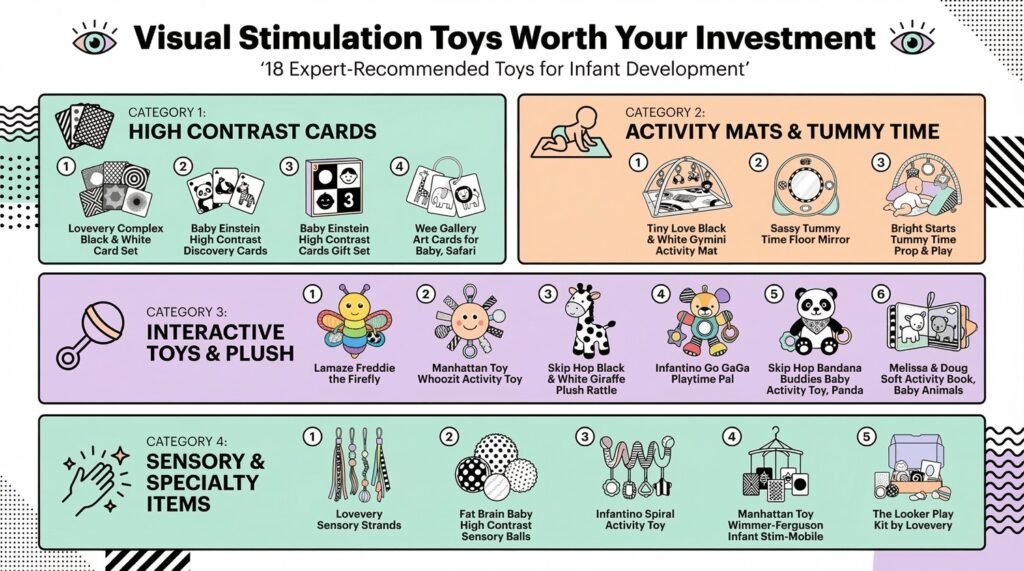
1. Lovevery Complex Black and White Card Set
These research-backed cards progress from simple checkerboards to intricate geometric patterns designed for your baby’s developing vision week by week. At just seven dollars, they deliver exceptional value and fit easily in a diaper bag for visual stimulation anywhere.
The set includes cards for different stages from newborn through six months.
2. The Looker Play Kit by Lovevery
This comprehensive collection includes high-contrast cards, a sensory play mat, age-appropriate toys, and guidance on how to use each item as your newborn’s vision develops. While priced at the premium end, the thoughtful curation based on child development research makes it worth considering if you want a complete system without piecing together individual items.
3. Manhattan Toy Wimmer-Ferguson Infant Stim-Mobile
This crib mobile features bold black and white graphics on both sides of each card, with ten different high-contrast images including faces, patterns, and shapes. The mobile rotates positions so you can adjust it as your baby’s visual tracking improves, and it works from birth through several months.
4. Melissa & Doug Soft Activity Book, Baby Animals
This soft cloth book combines high-contrast illustrations with crinkle sounds and varied fabric textures. Machine washable and safe for mouthing, it transitions from newborn visual engagement through the crawling phase when babies can manipulate it themselves.
The pages feature bold black and white animal designs that capture infant attention.
5. Baby Einstein High Contrast Discovery Cards
Twenty double-sided cards feature animals, shapes, and patterns in black, white, and red (which babies can see around three months). These cards come on a ring so you can flip through them easily or hang them from a play gym.
The variety keeps visual stimulation fresh without purchasing many sets.
6. Fat Brain Baby High Contrast Sensory Balls
These lightweight, easy-to-grasp balls feature bold geometric patterns in black and white. The different textures on each ball add tactile interest while the high-contrast designs support visual tracking as you roll them slowly for your baby to follow.
They’re soft enough for safe indoor play and easy to clean.
7. Lovevery Sensory Strands
Simple ribbons and bands in high-contrast black and white colors invite open-ended exploration. Babies can grasp them, mouth them safely, and watch them flutter during tummy time.
At thirty dollars, these strands grow with your baby from early grasping through crawling stages and align with Montessori-style play principles.
8. Sassy Tummy Time Floor Mirror
This floor mirror features a bold black and white frame with high-contrast patterns surrounding a baby-safe reflective surface. Mirrors fascinate babies while supporting visual development and self-recognition.
The stand positions it at the right angle for tummy time, and the patterns around the edge provide extra visual interest.
9. Skip Hop Black & White Giraffe Plush Rattle
This soft giraffe combines high-contrast patterns with gentle rattle sounds and many textures. The contrasting spots and stripes engage developing vision while the easy-to-grasp design supports early hand-eye coordination.
Machine washable and free from small parts, it works from newborn months through early sitting stages.
10. Infantino Go GaGa Playtime Pal
This accordion-style fold-out toy features high-contrast images on both sides, standing independently for tummy time or lying flat for play on your baby’s back. The compact design makes it travel-friendly, and the crinkle sounds add auditory interest.
Each panel shows different black and white patterns to maintain visual engagement.
11. Lamaze Freddie the Firefly
While not purely black and white, this beloved toy features bold contrasting colors that babies can perceive by three months, including high-contrast patterns on the wings. Multiple textures, a baby-safe mirror, crinkles, and squeaks make it a long-lasting sensory toy.
It clips onto strollers, car seats, or play gyms.
12. Baby Einstein High Contrast Cards Gift Set
This expanded gift set includes many card collections covering patterns, animals, and shapes. The variety let’s you rotate different cards throughout the day and across developmental stages.
The sturdy cardboard construction withstands repeated handling, though you’ll want to supervise since these aren’t meant for mouthing.
13. Tiny Love Black & White Gymini Activity Mat
This complete play gym features a black and white patterned mat, adjustable arches with hanging toys, and detachable high-contrast elements you can rotate. The mat itself provides visual interest during tummy time, while the hanging toys encourage reaching and tracking.
It converts to a flat mat as your baby grows.
14. Manhattan Toy Whoozit Activity Toy
This multi-sensory toy features bold black and white patterns, bright contrasting colors, many textures, and a baby-safe mirror. The large eyes and geometric patterns naturally draw infant attention.
The varied ribbons and loops encourage grasping while the high-contrast design supports visual development from newborn months onward.
15. Wee Gallery Art Cards for Baby, Safari
These oversized cards (6×8 inches) feature black and white illustrations of safari animals with just enough detail to maintain interest without overwhelming developing vision. The non-toxic ink and thick cardboard make them durable.
The larger size works well for displaying around the nursery or during floor play.
16. Bright Starts Tummy Time Prop & Play
This inflatable tummy time pillow features high-contrast patterns and a crinkle butterfly toy. The gentle incline makes tummy time more comfortable while positioning your baby to see the visual elements clearly.
The compact deflated size makes storage and travel simple compared to larger play mats.
17. Infantino Spiral Activity Toy
This spiral toy wraps around car seat handles, stroller bars, or play gym arches, featuring high-contrast patterns, textures, and dangling elements. The spiral design positions visual elements at varying distances, encouraging your baby to focus and track.
Easy to install and reposition, it brings visual stimulation to any location.
18. Skip Hop Bandana Buddies Baby Activity Toy, Panda
This soft panda features bold black and white patterns natural to the animal, plus multi-textured fabric and crinkle sounds. The bandana detail adds visual interest and texture variety.
Small enough for little hands to grasp but substantial enough to stay engaging for months, it bridges the gap between early visual toy and comfort object.
amazon.com/Skip-Hop-Activity-Teething-Multi-Sensory/dp/B00LZKC1S8
Making Your Choice: Finding Your Perfect Visual Stimulation Approach
After reviewing dozens of visual stimulation toys, the Lovevery Complex Black and White Card Set stands out as the single best starting point for any budget. These cards deliver research-backed visual development support at an accessible price, need zero assembly or storage space, and travel anywhere efficiently.
You can start using them from day one and rotate through increasingly complex patterns as your baby’s vision develops.
If you want a more comprehensive approach, pair those cards with a quality play mat like the Tiny Love Black & White Gymini, which creates a dedicated visual engagement space while supporting tummy time. This combination covers your essential visual stimulation needs without overwhelming your space or budget.
The premium option worth considering is The Looker Play Kit if you value expert curation and want guidance on what to introduce when. This kit removes the research and decision-making burden, delivering everything your newborn needs for visual development in their first twelve weeks.
The included guide explains how to use each item effectively, which particularly appeals to first-time parents navigating developmental milestones.
Ready to support your baby’s visual development? Start with a set of high-contrast cards this week. You can introduce them during diaper changes, after feeding, or during floor play.
Watch which patterns capture your baby’s attention most, and you’ll naturally understand what visual complexity suits their current stage.
From there, add one or two multi-sensory toys that align with your parenting philosophy and play style.
The investment you make in visual stimulation toys supports neural connections forming right now in your baby’s developing brain. Each moment spent engaging with high-contrast patterns, tracking moving toys, or exploring visual elements contributes to visual skills your baby will build on for years.
[Shop High-Contrast Visual Toys Here]
Your observations of what fascinates your baby matter more than any expert recommendation. Trust what you notice, provide consistent visual variety, and your baby’s natural curiosity will guide their development beautifully.
Frequently Asked Questions
When should I start using visual stimulation toys with my newborn?
You can start from birth. Newborns can see high-contrast patterns from their first days, though their vision is blurry and limited to about 8-12 inches distance.
Hold black and white cards about 10 inches from your baby’s face during alert periods.
The stark contrast between black and white creates visual edges that trigger eye movement even when babies cannot yet perceive subtle colors or details.
How long should visual play sessions last?
Keep sessions short in the early weeks, around 3-5 minutes during alert periods after feeding or diaper changes. Your baby will look away or close their eyes when overstimulated, which is their natural cue to stop.
As your baby grows and can tolerate more stimulation, gradually extend sessions.
By three months, some babies enjoy 10-15 minutes of engaged visual play, but always follow your baby’s cues as opposed to pushing for longer sessions.
Are expensive visual toys better than simple cards?
Not necessarily. Research shows simple high-contrast cards provide the same visual development benefits as elaborate branded systems.
The advantage of premium kits comes from convenience, curation, and often better materials as opposed to superior developmental outcomes.
A seven-dollar card set used consistently supports visual development just as effectively as a hundred-dollar play kit. Choose based on your budget, space, and whether you value expert guidance over DIY approaches.
When can babies see colors beyond black and white?
Babies begin perceiving color around 2-3 months, starting with red, followed by other primary colors. Their color vision continues maturing through the first year.
You can introduce toys with bold primary colors and high-contrast color combinations around three months, but don’t abandon black and white toys.
High-contrast patterns stay engaging and developmentally useful throughout the first year and beyond.
Can I make DIY visual stimulation toys instead of buying them?
Absolutely. Print black and white geometric patterns from free online sources and laminate them or place them in page protectors.
Attach black and white patterned fabric to cardboard for soft homemade cards.
Use black and white contact paper to create patterns on safe household items. Paint simple designs on wooden toys with non-toxic paint.
DIY approaches work wonderfully and often cost just a few dollars, though purchased options save time and typically use baby-safe materials tested for safety.
How do I know if my baby is getting enough visual stimulation?
Babies getting adequate visual stimulation typically show interest in faces, track objects moving across their visual field, and reach for toys they can see by 4-5 months. They make eye contact, follow you with their eyes as you move around a room, and show preferences for certain toys or patterns.
If you’re offering several short visual play sessions daily with high-contrast toys, responding to your baby’s interest cues, and including them in your daily activities where they can observe, you’re likely providing plenty of stimulation.
Trust your pediatrician’s developmental assessments and your own observations of your baby’s engagement.
Should I be concerned about overstimulation with visual toys?
Yes, overstimulation is possible, particularly with toys featuring flashing lights, many moving parts, or overwhelming amounts of color and pattern. Signs of overstimulation include fussiness, looking away persistently, crying, or falling asleep suddenly.
Babies self-regulate by looking away or closing their eyes when they need a break.
Respect these cues immediately. Static high-contrast patterns rarely overstimulate because babies can control their engagement by looking away.
Moving toys with lights and sounds pose more risk, so use them sparingly and observe your baby’s responses carefully.
References:
[1] Research on infant visual development and high-contrast patterns
[2] Safety standards for infant toys and materials
[3] Play mat effectiveness studies
[7] Lovevery product information and developmental approach
[8] Soft book benefits for infant development
[10] Activity mat research and applications