Introduction
Standing in the baby aisle staring at sleek black and white activity gyms next to rainbow-colored mats can feel overwhelming. I’ve been there myself, and this decision feels way more important than it should because we all want to give our babies the absolute best start.
Both types of activity gyms have devoted followers. The internet overflows with conflicting advice about which one actually supports better development.
Your baby’s visual system develops dramatically during the first year of life. The type of visual stimulation you provide genuinely influences how that development unfolds.
Newborns enter the world with surprisingly limited vision.
They can only see about 8 to 12 inches in front of their faces. Their ability to distinguish colors and complex patterns stays minimal at best.
The debate between high-contrast black and white designs versus vibrant multicolored options goes beyond aesthetics or trendy parenting philosophies. Understanding how infant vision develops gives you a really clear framework for making this choice.
You don’t necessarily have to pick just one approach and stick with it forever.
Your baby’s visual needs change rapidly in those first months. What works brilliantly at two weeks old might be completely wrong by four months.
Before you commit to one style or the other, you need to understand what happens in your baby’s developing brain and eyes. You need to know how different types of visual input support or hinder that process at various stages.
Understanding Infant Visual Development
Your baby’s eyes can physically see from birth, but the neural pathways that process visual information remain incredibly underdeveloped. Think of it like having a high-end camera with terrible software. The hardware can capture images, but the processing power to understand them doesn’t exist yet.
During the first few weeks of life, babies see the world primarily in terms of light and dark contrasts. Their color vision exists but stays limited. The cone cells in the retina responsible for color perception are present but immature.
The visual cortex hasn’t yet learned to interpret the signals it receives.
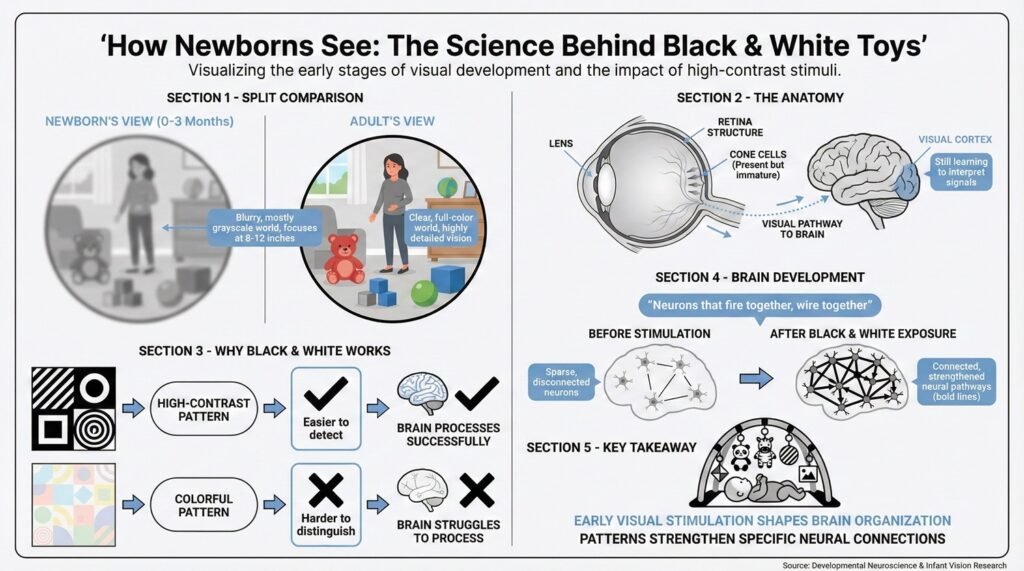
High-contrast patterns, particularly black and white designs, compel newborns because these stark contrasts are simply easier for their developing visual systems to detect and process.
Research in developmental neuroscience has shown that visual stimulation during this early period actually shapes how the visual cortex organizes itself. Neurons that fire together wire together, as neuroscientists say.
The patterns your baby looks at influence which neural connections strengthen and which ones get pruned away.
You don’t need to panic about providing the “perfect” visual environment. The evidence does suggest that the type of stimulation matters more than we might casually assume.
Around six to eight weeks, something fascinating happens. Your baby’s color vision begins to develop more fully, starting with the ability to distinguish reds and greens.
Blues and yellows emerge a bit later.
By three to four months, most babies have color vision approaching adult levels, though their ability to distinguish subtle shades continues improving throughout the first year.
This developmental progression explains why a one-size-fits-all approach to activity gym selection doesn’t make much sense.
The practical application here becomes straightforward. A newborn genuinely benefits from high-contrast patterns because that’s what their visual system can process.
Those black and white geometric shapes, bold stripes, and stark patterns match your baby’s current capabilities.
They represent functional design matched to developmental reality.
Meanwhile, that riot of colors on a traditional activity gym might look stimulating to adult eyes. To a two-week-old baby, though, most of it registers as visual noise that their brain can’t yet organize into meaningful information.
The Case for Black and White Activity Gyms
High-contrast black and white activity gyms have surged in popularity over the past decade. Solid developmental reasoning supports this trend beyond just minimalist aesthetics.
These designs typically feature geometric patterns, bold stripes, checkerboards, and simple shapes in stark black and white.
For the first six to eight weeks of life, these gyms work genuinely well. The high contrast makes it easier for babies to focus their eyes and practice visual tracking.
When you hang a black and white spiral or a bold striped ball from the gym’s arches, your newborn can actually see it clearly enough to engage with it.
This engagement matters more than you might think. Your baby actively works on developing neural pathways for visual processing, eye muscle control, and hand-eye coordination.
Every moment of focused attention strengthens these developing systems.
I’ve noticed that babies on black and white mats tend to spend longer periods engaged in focused looking. Less visual chaos competes for their attention, which allows them to concentrate on individual elements.
This focused attention builds the foundation for later skills like sustained concentration and visual discrimination.
The challenge with black and white gyms shows up in their limited useful lifespan. Once your baby hits that three to four month mark and their color vision has developed, those monochrome patterns become less developmentally optimal.
They won’t harm anything, but they also don’t provide the full spectrum of visual input that your baby’s maturing visual system now needs.
Some parents find this frustrating because they’ve invested in specialized equipment that their baby quickly outgrows. The window of peak usefulness spans maybe twelve to sixteen weeks.
Another practical consideration comes down to aesthetics. Black and white gyms can feel visually stark in your living space.
If you’re trying to create a warm, inviting nursery, an entirely monochrome setup might clash with your vision.
This matters more than it seems at first because you’ll spend considerable time in that space. Your environment affects your mood and stress levels, which directly impacts how you interact with your baby.
The Case for Colorful Activity Gyms
Traditional colorful activity gyms have dominated baby stores for decades. These feature bright primary colors, rainbow patterns, and often include a mix of textures, sounds, and visual elements all competing for attention simultaneously.
For older infants, roughly three months and beyond, colorful gyms provide genuinely valuable stimulation. The variety of colors helps babies practice color discrimination.
The visual complexity encourages them to scan the environment and make choices about where to direct their attention.
This active visual exploration supports cognitive development in ways that simpler, high-contrast environments can’t match.
The big advantage of colorful gyms shows up in their longer useful lifespan. While they don’t work optimally for true newborns, they remain engaging and developmentally suitable from about three months through the entire first year and sometimes beyond.
This extended usability makes them a better investment if you’re thinking purely in economic terms.
Many colorful gyms also incorporate many types of sensory input beyond just visual stimulation. You’ll find crinkly fabrics, rattling toys, squeakers, and mirrors, creating a multisensory experience that supports broader developmental goals.
This variety benefits babies genuinely once they’re ready to handle the complexity, usually around that three to four month mark.
The potential downside surfaces as overstimulation, particularly for young newborns. When you place a two-week-old baby under a gym festooned with bright colors, dangling toys, mirrors, and noise-making elements, their immature nervous system can become overwhelmed.
You might notice your baby becoming fussy, turning away, or showing signs of stress like hiccuping or irregular breathing. This happens because the timing is mismatched to your baby’s current developmental stage, not because colorful gyms are inherently problematic.
Matching the Gym to Your Baby’s Developmental Stage
The smartest approach involves understanding when each type provides the most benefit as opposed to choosing one and defending that choice forever. Your baby’s visual development follows a relatively predictable timeline.
You can align your activity gym choice with that progression.
From birth to about eight weeks, high-contrast black and white patterns deliver superior results. Your baby’s visual system faces the most limitations during this window.
Stark contrasts provide the clearest, most accessible visual input.
If you’re setting up an activity gym for a newborn, black and white makes the most sense. You’ll likely notice your baby can actually focus on and track the toys much more effectively than they would with colorful choices.
Between two and four months, you’re navigating a transition period. Your baby’s color vision is developing but hasn’t reached full maturity yet.
This window creates a great opportunity to start introducing some color, but you need to be thoughtful about implementation.
Consider adding one or two brightly colored elements to an otherwise high-contrast setup. You could rotate between black and white sessions and brief exposures to colorful toys.
You’re essentially helping your baby’s visual system practice processing different types of input without overwhelming their still-developing capabilities.
From four months onward, colorful, complex environments become increasingly suitable and useful. Your baby’s visual system can now handle the complexity.
The variety actively supports continued development.
Those rainbow-colored gyms with many toys and textures really shine during this phase.
Your baby becomes ready to make choices about where to look, reach for specific objects based on their appearance, and handle many types of sensory input simultaneously.
Creating a Flexible Visual Environment
One strategy that delivers really good results involves investing in a basic gym structure that allows you to swap out the hanging toys and mat. Many wooden activity gyms, for instance, come with simple arches and allow you to customize what dangles from them.
You could start with black and white toys for the newborn phase, then gradually introduce colorful elements as your baby develops. Similarly, you might use a black and white mat initially, then swap it for a more colorful option later.
This modular approach gives you the developmental benefits of matching stimulation to your baby’s current stage without requiring many complete gym setups.
Another option involves having two different play spaces. Maybe your baby has a high-contrast area for calm, focused play when they’re fresh and alert, and a more stimulating colorful area for when they’re in a more active, exploratory mood.
This respects the reality that babies have different needs at different times of day and in different states of alertness.
I’ve found that parents who take this flexible approach tend to feel more confident about their choices because they’re not locked into one philosophy or product. You can respond to what you actually observe in your baby’s behavior as opposed to adhering to a rigid plan that might not match your individual child’s preferences and pace of development.
The flexibility also helps when you have many children or when friends come to visit with their babies. Different babies show different preferences even at the same age.
Having options available let’s each child engage with what works best for them.
Beyond Visual Stimulation
Activity gyms serve many developmental purposes beyond just what your baby sees. The best gyms, whether black and white or colorful, support tummy time, reaching and grasping practice, and general motor development.
Look for gyms that position toys at varying heights and distances. This encourages your baby to practice different types of reaching and helps develop spatial awareness.
The mat itself should provide enough cushioning for comfortable tummy time but not be so soft that pushing up and strengthening neck and upper body muscles becomes difficult.
Safety features matter tremendously regardless of color scheme. Make sure any gym you choose has stable arches that won’t tip over if your baby grabs them.
Verify that all hanging toys are securely attached with no small parts that could detach and become choking hazards.
The materials should be non-toxic and easy to clean because your baby will definitely be mouthing everything within reach.
Consider the gym’s footprint and portability too. Some families prefer lightweight options that can easily move from room to room.
Others want a more substantial setup that becomes a dedicated play space.
Neither approach is wrong, but matching the product to your actual living situation and habits will determine how much you actually use it.
The material quality varies significantly across different products. Wooden gyms tend to be more durable and can withstand years of use, potentially serving many children.
Plastic options might be lighter and more portable but may not hold up as well over time.
Fabric mats need to be machine washable because they will get dirty frequently.
Observing Your Baby’s Responses
Your baby will tell you what’s working if you know what to look for. When visual stimulation matches their current developmental stage well, you’ll see sustained attention, active engagement, and generally calm, focused behavior.
Your baby might stare intently at patterns, follow moving objects with their eyes, or reach toward toys with purposeful movements.
Overstimulation looks different. Babies who are visually overwhelmed often turn their heads away, become fussy or cry, have difficulty settling down, or fall asleep as a way to escape excessive input.
If you notice these signs consistently when your baby is under their activity gym, the environment is probably too complex for their current stage.
Understimulation is also possible, though less common with activity gyms. If your baby seems bored, looks away often, or shows little interest in their gym, they might be ready for more complexity.
This could mean introducing new colors, adding different toys, or changing the patterns they’re seeing.
The key involves responsive adjustment. Pay attention to how your baby actually behaves as opposed to rigidly following what a development chart or product marketing suggests.
Individual babies develop at different rates.
Your specific child might be ready for color earlier or later than average. That’s completely normal and fine.
Watch for changes in engagement levels over time. A toy that captivated your baby last week might bore them this week.
This signals developmental progress.
Your baby’s brain has mastered that level of complexity and now needs something more challenging to stay engaged.
Making the Purchase Decision
If you’re buying just one activity gym and need to choose, I’d generally recommend a colorful gym with removable elements that you can simplify for the newborn stage. Take off most of the toys initially, leaving just one or two high-contrast items.
As your baby develops, gradually add back the colorful elements.
This gives you flexibility without requiring many purchases.
Alternatively, if your budget allows, consider a simple black and white setup for the first few months, then transition to a colorful gym around three to four months. You can often find good quality used activity gyms since babies outgrow them relatively quickly.
This makes a two-gym approach more affordable than it might initially seem.
Wooden activity gyms deserve special mention because they tend to be more durable and aesthetically neutral than plastic choices. Many parents find they blend better with home decor and feel more comfortable leaving them out in living spaces as opposed to hiding them away.
The wooden options are typically easy to customize with different hanging toys, making them particularly suitable for a staged approach to visual stimulation.
Budget-conscious families might consider DIY approaches. You can create high-contrast visual stimulation with homemade flashcards, simple black and white mobiles, or even just placing your baby near books with bold patterns propped open.
While these don’t provide the full motor development benefits of an activity gym with toys to reach for, they do support visual development at minimal cost.
Some parents get really creative and make their own gym structures from PVC pipe or wooden dowels. This allows complete customization at a fraction of retail costs.
If you’re handy and have the time, this can be a satisfying project that creates exactly what your baby needs.
Practice and Reinforcement
Start observing your baby’s visual behavior closely this week. Spend a few dedicated minutes each day noticing what they look at, how long they maintain focus, and which types of visual input seem to engage them most effectively.
Keep a simple log if you’re inclined, just noting the date, your baby’s age, and what you observed. This builds your skills in reading your baby’s developmental cues.
Experiment with different visual environments if you have access to various toys or materials. Try showing your baby a black and white pattern, then a brightly colored toy, and note any differences in response.
You’re not conducting rigorous science here, just developing your observational skills and learning what your specific baby responds to at this particular moment.
Set up one area in your home as a dedicated visual play space, even if it’s just a blanket on the floor with a couple of carefully chosen toys nearby. Use this space consistently for alert play time.
Intentionally vary what’s available there based on what you’re learning about your baby’s changing developmental needs.
Practice positioning yourself at your baby’s eye level during play time. This gives you a much better sense of what they’re actually seeing and helps you understand why certain setups work better than others.
What looks stimulating from your standing adult perspective might be completely different from the baby’s view lying on their back.
Take photos or videos of your baby engaging with different visual setups. Looking back at these can help you notice patterns in what captured their attention at different ages.
This documentation also creates a nice record of their developmental progress.
Frequently Asked Questions
Do newborns see better in black and white?
Newborns don’t necessarily see “better” in black and white, but they can process high-contrast patterns much more easily than subtle colors. Their visual system in the first eight weeks can detect stark differences between light and dark more readily than the nuanced differences between colors.
This makes black and white patterns more engaging and accessible for very young babies.
When can babies see bright colors?
Babies begin developing color vision around six to eight weeks, starting with reds and greens. By three to four months, most babies can see the full spectrum of colors at near-adult levels.
However, their preference for and ability to focus on colors continues improving throughout the first year as their visual cortex matures.
Can too many colors overstimulate a baby?
Yes, particularly for newborns and young infants under three months. When babies are exposed to complex, multicolored environments before their visual system can process that information, they can become overwhelmed. Signs include fussiness, turning away, difficulty settling, and general distress.
The timing matters more than the colors themselves.
Are wooden baby gyms better than plastic?
Wooden baby gyms offer several advantages including durability, aesthetic appeal, and easier customization with different hanging toys. They tend to be sturdier and can serve many children.
Plastic gyms are often lighter and more portable, which some families prefer.
The material matters less than whether the gym is safe, appropriately stimulating, and actually gets used.
How long should babies use activity gyms each day?
This varies by age and individual baby. Young newborns might only manage 5-10 minutes of engaged play before becoming tired. By three to four months, babies might enjoy 20-30 minutes at a time.
Watch your baby’s cues as opposed to following a rigid schedule.
Multiple short sessions throughout the day work better than one long session.
What age do babies stop using activity gyms?
Most babies remain engaged with activity gyms until around 6-8 months, when they become more mobile and interested in exploring beyond a fixed play space. Some babies lose interest earlier, while others enjoy their gyms up to a year.
The transition usually happens naturally as babies start crawling and seeking out different types of play.
Do Montessori baby gyms need to be wooden?
Montessori philosophy emphasizes natural materials, which is why many Montessori-inspired gyms are wooden. However, the more important principles involve simplicity, allowing independent exploration, and matching toys to the child’s developmental stage.
You can follow Montessori principles with any gym that meets these criteria, regardless of material.
Should I get a play gym with a mirror?
Mirrors provide valuable visual stimulation and help babies develop self-recognition, which typically emerges around 5-6 months. However, mirrors can also be overstimulating for very young newborns.
A gym with a removable mirror gives you the flexibility to introduce it when developmentally appropriate.
Key Takeaways
Black and white activity gyms provide optimal visual stimulation for newborns up to about eight weeks because high-contrast patterns match their limited visual processing capabilities.
Colorful activity gyms become increasingly suitable from three to four months onward as color vision develops and babies can handle more complex visual environments.
Matching the type of visual stimulation to your baby’s current developmental stage delivers better results than choosing one style exclusively.
Flexible systems that allow you to swap toys and adjust complexity give you the benefits of both approaches without requiring many complete setups.
Your baby’s behavior tells you whether stimulation is well-matched by showing sustained attention and calm engagement versus signs of overstimulation like turning away or fussiness.