Subscription services have fundamentally changed how we consume everything from streaming entertainment to meal kits to carefully curated books for our children. The promise is always enticing: convenience, personalized selection, and the joy of discovering something new delivered right to your doorstep.
But lurking beneath that appealing surface is a question that keeps many of us from clicking that “subscribe” button in the first place.
Can I actually get out of this if it doesn’t work for me?
I’ve watched subscription fatigue become a real phenomenon among parents I know. We sign up enthusiastically for a service that promises to enrich our children’s lives, only to find ourselves three months later trying to remember which credit card is being charged for which box, and whether we actually need another delivery of something we haven’t even opened from last month.
The anxiety around being locked into yet another monthly commitment is completely legitimate.
Literati, the children’s book subscription service that’s gained significant traction among parents looking to build home libraries, positions itself differently. They emphasize flexibility and a try-before-you-buy model that sounds almost too good to be true in an industry where “subscribe and forget” often means “subscribe and regret.” But marketing promises and actual user experiences don’t always align perfectly.
Understanding the real cancellation policies, hidden restrictions, and practical realities of subscription flexibility matters enormously when you’re making decisions about where your family’s budget goes each month. Nobody wants to be that person frantically googling “how to cancel” at midnight, navigating through deliberately confusing customer service portals designed to make leaving as painful as possible.
Understanding Literati’s Subscription Model
Before we can really tackle the cancellation question, we need to understand what you’re actually subscribing to with Literati. The service operates quite differently from traditional book clubs or subscription boxes that simply ship you predetermined selections each month.
Literati sends you five books each month based on your child’s age and reading level. You have five days to preview these books at home before you’re charged anything.
During that preview window, you can keep the books you want at club prices, which are typically discounted from retail, and return the ones you don’t want in a prepaid envelope.
If you decide to keep all five books, you pay the monthly price for your selected club tier. If you keep none, you pay nothing except you’ve essentially gotten a free library experience for nearly a week.
This try-before-you-buy approach represents a fundamentally different value proposition than services like OwlCrate Jr. or Bookroo, which charge you upfront and ship books you’ve committed to purchasing sight unseen. The psychological difference here is really significant.
You’re not technically locked into buying anything until you’ve actually decided those specific books work for your family.
The club operates on different tiers based on age ranges. The Neo Club serves ages 0-3, the Sprout Club covers ages 3-5, the Nova Club targets ages 6-8, the Sage Club serves ages 9-10, and the Phoenix Club caters to ages 10-12.
Each tier has its own monthly pricing structure, with the younger age ranges typically running around twenty-five to thirty dollars if you keep all five books, while older ranges can go higher depending on the books’ retail values.
The Real Cancellation Terms
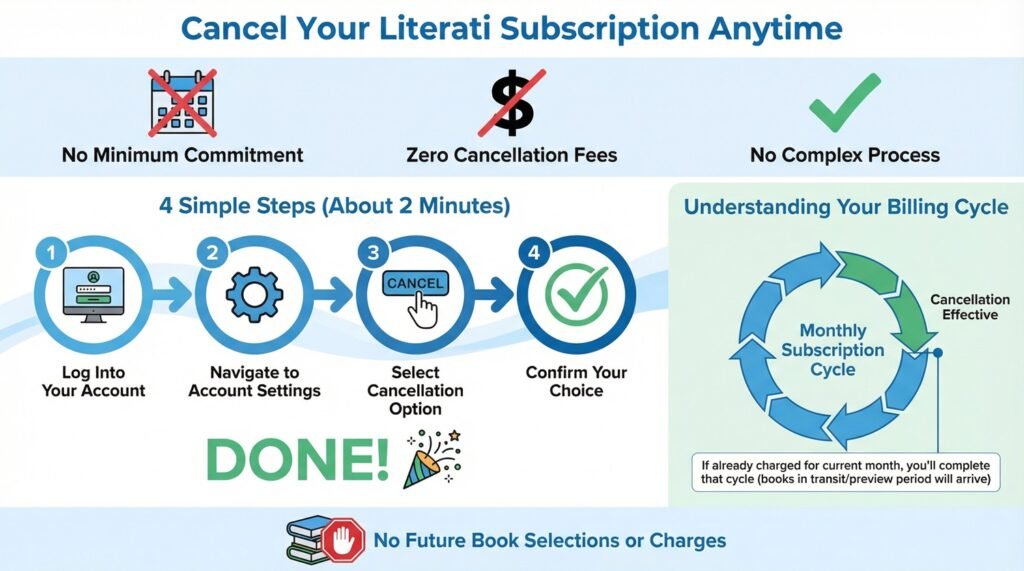
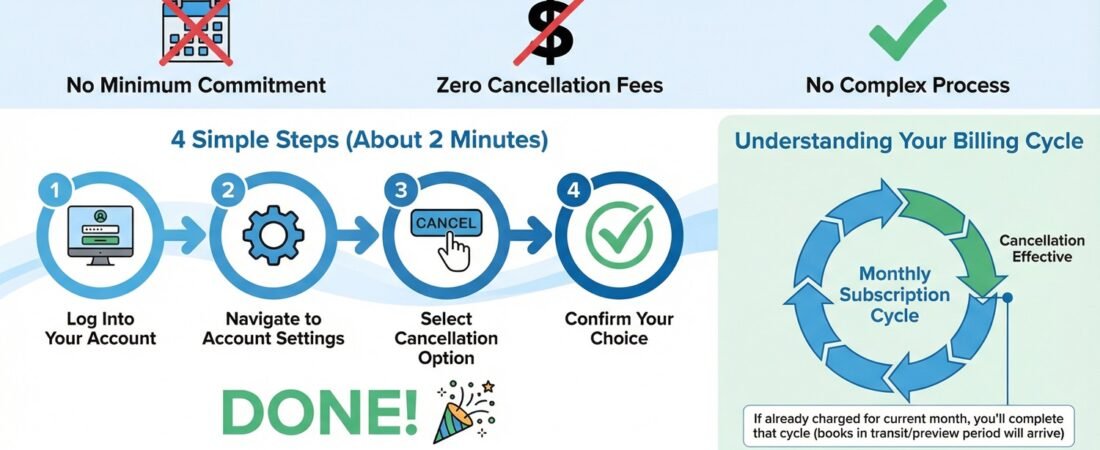
Now let’s get to the actual question at hand. Yes, you can cancel Literati anytime without penalty.
There’s no least commitment period, no cancellation fees, and no complex hoops to jump through.
You can cancel directly through your online account dashboard. The process takes maybe two minutes if you’re moving slowly.
You log in, navigate to your account settings, choose the cancellation option, confirm your choice, and you’re done.
Your subscription stops, and you won’t receive any future book selections or charges.
The timing does matter though. Literati processes subscriptions and selections on a monthly cycle.
Your cancellation becomes effective at the end of your current billing cycle, meaning if you’ve already been charged for a month and books are on their way or in your preview period, you’ll finish that cycle.
But you won’t be charged for the following month.
This is actually pretty standard and fair. Some subscription services operate with more aggressive policies where cancellation doesn’t take effect until the following billing period even if you cancel right after being charged, essentially forcing you to pay for an extra month you don’t want.
Literati’s approach aligns with what most consumer protection advocates consider reasonable.
One thing that occasionally creates confusion: if you’re in the middle of your five-day preview window when you decide to cancel, you still need to return any books you don’t want to purchase. The cancellation stops future shipments, but it doesn’t exempt you from the terms of books already in your possession.
If you keep books beyond the preview period without indicating which ones you want to purchase, you’ll be charged for them according to the standard club pricing.
This makes sense when you think about it. Otherwise people could game the system by canceling mid-preview to get free books.
Pausing Instead of Canceling
Literati demonstrates flexibility that matters for real-life parenting situations. You don’t have to fully cancel if you’re dealing with a temporary situation.
The service allows you to pause your subscription for up to three months at a time.
This pause feature is incredibly useful for several scenarios I’ve seen parents navigate. Maybe you’re going on an extended vacation and don’t want books piling up while you’re away.
Perhaps you’ve accumulated a backlog of unread books and need time for your child to catch up before new selections arrive.
Or maybe you’re in a financially tight month and need to cut discretionary spending temporarily without losing your account setup and preferences.
When you pause, your account stays active but dormant. You won’t receive book selections or charges during the pause period.
Your personalized preferences, previous ratings, and account history all stay intact.
When you’re ready to resume, you reactivate with a single click and your next selection arrives according to the normal monthly schedule.
The three-month maximum pause period is reasonable without being restrictive. It’s long enough to cover most temporary situations but prevents accounts from sitting indefinitely dormant, which creates operational headaches for any subscription business.
If you find yourself wanting to pause for longer than three months, that’s probably a signal that canceling makes more sense anyway.
You can manage pauses through the same account dashboard where cancellations happen. The interface is straightforward, showing you clearly when your pause will end and when billing will resume.
You can also end a pause early if your situation changes and you want books sooner than expected.
The Skip Option for Greater Control
Beyond pausing entirely, Literati offers a skip feature that gives you month-by-month control without disrupting your subscription. This is different from pausing because you’re not setting a specific time period.
You’re making individual decisions about each upcoming selection.
When your monthly selection notification arrives, you have the option to skip that particular month. You won’t receive books, you won’t be charged, and your subscription automatically continues to the following month without any action needed. This works well if you’re selective about which books you want or if some months are more convenient than others.
The skip feature thanks what many subscription services pretend isn’t true: consumption patterns aren’t perfectly consistent month after month. Some months your kid tears through books and you’re desperate for more.
Other months, school assignments or activities dominate and those books from two months ago still sit half-read.
Having the flexibility to align your subscription with actual reading patterns as opposed to arbitrary calendar dates is genuinely valuable.
You need to exercise the skip option before your selection is processed and shipped. Literati sends notification emails before each monthly selection, giving you a window to review what’s coming and decide whether to accept, skip, or make changes. If you miss that window and books ship, you’re back to the standard preview model where you can return what you don’t want.
What Customer Experiences Reveal
The policy language tells us what’s supposed to happen. Customer reviews and experiences tell us what actually happens when real people try to cancel or change their subscriptions.
This distinction matters enormously because plenty of companies have beautiful cancellation policies on paper that become nightmares in practice.
The overwhelming pattern in customer feedback about Literati’s cancellation process is that it works as advertised. Users consistently report being able to cancel quickly through their online accounts without needing to contact customer service. The few complaints that do exist typically involve user error, people who didn’t realize they needed to return preview books, or who thought cancellation was instant even mid-cycle.
I find it noteworthy that there aren’t patterns of complaints about hidden charges after cancellation, unexpected renewal billing, or difficulty actually terminating accounts. These are the red flags that appear repeatedly with problematic subscription services.
When a company makes leaving difficult, customers absolutely voice that frustration online.
The absence of those patterns with Literati is meaningful.
Customer service interactions around cancellation also trend positive. The few times people do need to contact support about cancellation-related issues, usually timing questions or confusion about the current cycle, representatives reportedly handle asks efficiently and honor cancellation wishes without pushback.
There’s no evidence of the retention tactics that make canceling cable or gym memberships so notoriously painful.
One small frustration that appears occasionally: users wish the cancellation confirmation were more prominent. Some people report uncertainty about whether their cancellation actually processed because the confirmation message was subtle.
This seems like a minor UX issue as opposed to a deceptive practice, but saving your cancellation confirmation email is smart practice.
Comparing Flexibility with Competitor Services
Context matters when evaluating any subscription’s flexibility. What seems restrictive might actually be industry-leading, or what seems generous might be standard practice.
Literati’s cancellation and flexibility policies stand up quite well against choices in the children’s book subscription space.
OwlCrate Jr., which serves middle-grade readers, operates on a traditional subscription model where you prepay for your box and receive a curated selection. You can cancel anytime without penalty, which matches Literati’s policy, but you don’t have the try-before-you-buy element.
You’re committing to purchase whatever arrives.
Their pause feature works similarly, though their skip option requires more advance notice.
Bookroo offers monthly subscriptions for various age ranges with anytime cancellation and a pause feature. However, their model ships books you’re immediately charged for without a preview period.
You can return books for credit, but the process is less seamless than Literati’s integrated preview system.
Amazon’s Kindle Unlimited technically offers children’s books, but it’s a read-all-you-want digital subscription as opposed to physical books you own. The cancellation flexibility is similar, anytime cancellation without penalty, but you’re comparing digital rentals to physical ownership, which are fundamentally different value propositions.
Book of the Month, while primarily adult-focused, offers probably the closest comparison in terms of flexibility. They also offer skips, pauses, and anytime cancellation.
Their model let’s you preview selections before committing each month, though the interface works differently than Literati’s home preview approach.
What distinguishes Literati isn’t necessarily that their cancellation policy is dramatically better than everyone else’s. Most reputable book subscriptions have moved toward flexible cancellation as a baseline expectation.
Rather, the combination of flexible cancellation with the preview-at-home model creates a genuinely low-commitment experience.
You can both leave easily and avoid purchasing books you don’t want in the first place.
Hidden Considerations Most Parents Miss
The technical cancellation policy only tells part of the story. There are practical considerations that affect whether Literati’s flexibility actually serves your real needs.
First, consider the book backlog reality. Literati’s entire model encourages keeping many books each month.
If you’re conscientious about only keeping books you’ll actually read, the subscription might naturally create its own breaks through the preview process.
But if you’re keeping most books and your child isn’t keeping pace with reading them, you’ll accumulate unread inventory quickly. The ability to cancel doesn’t help much if you’ve already purchased thirty books sitting unread.
The preview period timing can create unexpected pressure. Five days sounds generous, but it passes quickly in the chaos of everyday parenting.
If the books arrive on a Wednesday and you forget about them until the weekend, you’ve suddenly got only two days to preview five books with your child and make thoughtful decisions about which ones to keep.
Missing the window means either keeping books you might not have chosen or dealing with returns after being charged.
Personalization settings persist through pauses but can drift out of accuracy during longer breaks. If you pause for three months, your child’s reading level might shift, their interests might change, or they might finish series they were in the middle of.
When you resume, the first selection might not align well because the algorithm doesn’t know what happened during the break.
This isn’t really a cancellation issue, but it affects whether pause-and-resume works smoothly or whether canceling and resubscribing later makes more sense.
Gift subscriptions introduce different cancellation dynamics. If someone purchases a prepaid Literati gift subscription for your child, you can’t cancel it early because it’s already paid for in full.
You can still decline individual books during preview periods, but the subscription itself continues for the prepaid duration.
This is standard practice across subscription gifts, but understanding this matters if you’re considering giving or receiving Literati as a gift.
Credit card expiration creates an automatic cancellation of sorts. If your payment method expires and you don’t update it, Literati will send reminders but eventually your subscription lapses.
Some people accidentally learn this “cancellation” when they meant to stay subscribed. Others intentionally let payment methods lapse as a passive cancellation approach.
The former group reports that reactivating is straightforward, you just update payment information and opt back in.
Strategic Approaches to Maximize Flexibility
Understanding the policy is one thing. Using it strategically to improve value and minimize commitment is another.
Here are approaches that make the flexibility work for you as opposed to just being a safety net you hopefully never need.
Start with a mindset of active management as opposed to set-and-forget. Treat your Literati subscription as something you engage with monthly as opposed to a passive automatic delivery.
Review each selection notification email when it arrives.
Make conscious skip decisions based on your current situation. This active approach means you’re genuinely using the flexibility as opposed to just paying by default.
Use the preview period as a teaching opportunity, not just a return window. Sit with your child and go through the books together.
Let them help decide which ones they’re excited about keeping.
This serves the dual purpose of making better purchasing decisions while also building your child’s literacy skills and awareness of their own reading preferences. The preview period becomes valuable family time as opposed to a chore you rush through.
Consider seasonal pause patterns. Many families find that summer break, holiday periods, or busy school activity seasons create natural times when new book subscriptions make less sense.
Rather than canceling and resubscribing repeatedly, you can build a pattern of pausing during predictable periods.
Set a calendar reminder a week before your usual pause time so you remember to activate it before being charged.
Combine Literati with library usage as opposed to treating them as competing options. Use the subscription for books your child wants to own and reread, those series favorites or beloved picture books.
Use the library for one-time reads, experimental titles, or less critical additions.
This approach means you can potentially skip Literati months more freely when the library is meeting needs, while still maintaining the subscription for curated ownership-worthy selections.
Track your actual reading pace honestly. If you’ve kept fifteen books in the past three months but your child has only read eight of them, that’s a clear signal to skip upcoming months or pause.
The math isn’t complicated, but it needs honesty about actual usage versus aspirational usage.
Many subscription services depend on customers paying for more than they use. Fighting that tendency means using flexibility features proactively.
Test the service with a short-term commitment mindset initially. Subscribe for three months with full intention to assess thoroughly and cancel if it doesn’t deliver value.
During those three months, try different approaches: keep all books one month, keep only two another month, skip a month.
This experimentation helps you figure out if Literati fits your actual patterns before settling into longer-term subscription mode.
When Canceling Makes More Sense Than Pausing
The existence of pause and skip options might make canceling seem unnecessary. There are actually several situations where canceling outright serves you better than pausing.
If you’re fundamentally unsatisfied with the book selections or quality, pausing just delays addressing the real issue. Perhaps the curation doesn’t match your child’s interests, or the book conditions arrive less pristine than you expect, or the pricing doesn’t feel worthwhile even with discounts.
These aren’t temporary problems that a pause solves.
Canceling let’s you move on to choices that might work better.
When your child ages out of the available clubs, canceling is the clean endpoint. Literati’s Phoenix Club tops out around age twelve.
If your child has moved beyond that range or has developed independent reading preferences that don’t align with curated subscriptions, maintaining even a paused account serves no purpose.
Canceling fully closes that chapter.
Financial streamlining benefits from cancellation as opposed to indefinite pausing. If you’re auditing subscriptions to reduce monthly commitments and mental overhead, even paused subscriptions clutter your account management landscape.
They represent services you need to remember to keep paused, potential accidental reactivations, and lingering credentials in various systems.
Sometimes the cleanest approach is canceling what you’re not actively using.
Moving to alternative systems warrants cancellation. Maybe you’ve decided that library usage better serves your needs, or you’re building your child’s library through used book stores and thrift shops, or you’re switching to a different book subscription that fits better.
Keeping a paused Literati account while actively using a competitor creates unnecessary complexity.
The psychological weight of maintaining unused subscriptions is real, even if they’re paused and not costing money. Decision fatigue around “should I reactivate this?” each month has a cognitive cost.
If you find yourself repeatedly choosing not to reactivate after a pause ends, that’s a strong signal that canceling would reduce stress.
People Also Asked
How do I cancel my Literati subscription?
You can cancel your Literati subscription by logging into your account dashboard, navigating to account settings, and selecting the cancellation option. The process takes about two minutes and doesn’t need contacting customer service.
Your cancellation becomes effective at the end of your current billing cycle.
Does Literati charge a cancellation fee?
No, Literati doesn’t charge any cancellation fees. You can cancel anytime without penalty or hidden charges.
There’s no least commitment period required.
Can I pause my Literati subscription instead of canceling?
Yes, you can pause your Literati subscription for up to three months at a time. During the pause, you won’t receive book selections or charges, but your account settings and preferences stay intact.
You can reactivate anytime during or after the pause period.
What happens if I cancel during my preview period?
If you cancel during your five-day preview period, you still need to return any books you don’t want to purchase. The cancellation stops future shipments, but you’re responsible for books now in your possession according to standard club terms.
Can I skip a month without canceling Literati?
Yes, Literati offers a skip feature that let’s you pass on individual months without affecting your ongoing subscription. You need to exercise the skip option before your monthly selection is processed and shipped.
How long does it take for Literati cancellation to take effect?
Your Literati cancellation becomes effective at the end of your current billing cycle. If you’ve already been charged for a month and books are on their way or in your preview period, you’ll finish that cycle but won’t be charged for the following month.
Will I lose my preferences if I cancel Literati?
No, your previous account settings, reading level preferences, and rating history stay in the system even after cancellation. If you decide to reactivate later, you won’t be starting from scratch.
Is there a trial period for Literati?
Literati operates on a try-before-you-buy model with a five-day preview period for each monthly selection. You can preview books at home before being charged, and you only pay for books you decide to keep.
Key Takeaways
Literati allows cancellation anytime without fees or penalties through a simple online account management process that takes just a couple minutes to finish.
The pause feature let’s you suspend your subscription for up to three months at a time, keeping your account and preferences intact while stopping shipments and charges temporarily.
Monthly skip options provide even more granular control, allowing you to pass on individual months without affecting your ongoing subscription status.
The five-day preview period fundamentally changes the commitment level since you’re not obligated to purchase books until you’ve actually decided you want them after seeing them at home.
Cancellation becomes effective at the end of your current billing cycle, meaning you finish any in-progress monthly selection but aren’t charged for future months.
Customer experience data consistently shows that Literati’s cancellation process works as advertised without the retention tactics or hidden obstacles common with problematic subscription services.
Strategic use of skip and pause features often serves you better than canceling and resubscribing repeatedly, particularly if you’re dealing with temporary situations or seasonal reading patterns.
Reactivating after cancellation is straightforward and doesn’t come with penalties, though your first post-reactivation selection might need more active curation since the service doesn’t know what happened during your absence.
The combination of flexible cancellation, preview periods, and pause options creates genuinely low-commitment subscription access that removes most of the risk typically associated with recurring services.