The Reality No One Mentions
I’ve watched countless new parents struggle with this exact dilemma. You’re exhausted, you desperately want to reclaim some sense of your pre-baby fitness routine, and you’re staring at your gym membership wondering if it’s actually usable anymore.
The internet gives you two extremes: Instagram influencers doing burpees with babies strapped to their chests, or dire warnings that you’ll destroy your pelvic floor forever if you even think about exercise.
Here’s what I’ve learned from working with hundreds of postpartum clients and studying the actual research. Yes, you can absolutely exercise while caring for your baby, but the approach matters way more than you think.
The question centers on understanding the genuine risks, the realistic timelines for your body’s recovery, and the very real hazards that exercise equipment poses to curious little hands.
Baby wearing fitness can be incredibly useful for both bonding and maintaining your sanity, but it requires a level of awareness that most fitness classes don’t teach. And bringing your baby into a space filled with heavy, moving, electrical equipment demands serious safety protocols that go beyond just keeping an eye on them.
Understanding Your Postpartum Body
Your body went through something really extraordinary during pregnancy and birth. I’m not being patronizing here, but most people genuinely underestimate what happened to their core and pelvic floor during those nine months and beyond.
The pressure on your pelvic floor from simply carrying a baby around is substantial. When you add exercise on top of that weight, especially in those early postpartum months, you’re asking muscles and connective tissue that are still healing to do double duty.
The first year postpartum is when your body is actively recovering from the massive changes of pregnancy, regardless of whether you had a vaginal birth or cesarean section. What happens when you push too hard too soon isn’t just theoretical.
Pelvic organ prolapse affects millions of women, and one of the contributing factors is returning to high impact exercise before the body is ready.
That heaviness you might feel, that sensation of something bulging or dragging in your pelvic area, those are warning signs that your body is telling you to back off. But here’s where it gets complicated. Every body recovers differently.
Some women can return to more intense exercise relatively quickly, while others need significantly more time.
The difference comes down to the structural integrity of tissues that were literally stretched and stressed for months.
Your abdominal wall separated during pregnancy to make room for your growing baby. This separation, called diastasis recti, needs time to close and heal.
When you jump straight into crunches or planks or heavy lifting, you’re pulling on connective tissue that hasn’t regained its strength.
This can make the separation worse and create a dog that won’t go away no matter how many sit-ups you do.
The pelvic floor muscles stretched dramatically during pregnancy and birth. These muscles support your bladder, uterus, and bowel.
They also control continence and contribute to sexual function.
When they’re weakened or damaged, they need careful rehabilitation before they can handle the forces of jumping, running, or heavy lifting.
Your hormones are still fluctuating wildly, especially if you’re breastfeeding. Relaxin, the hormone that loosened your ligaments during pregnancy to allow your pelvis to expand, can stay elevated for months after birth.
This means your joints are less stable than usual, making you more prone to injury if you’re doing movements that need a lot of balance or coordination.
The Baby Wearing Fitness Landscape
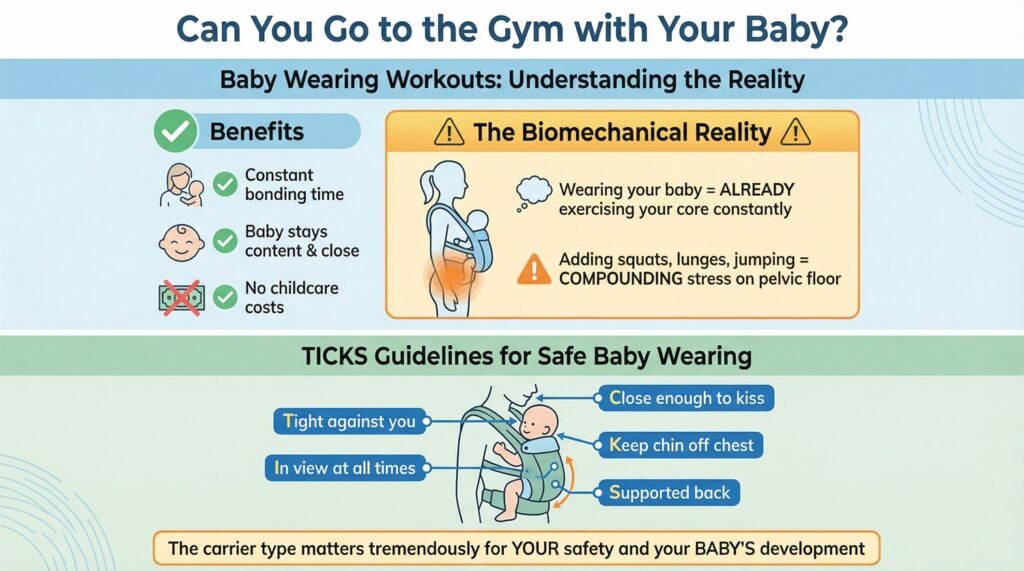
Baby wearing workouts have exploded in popularity, and I understand why. You get to exercise, your baby stays close and content, and you’re not paying for childcare or missing out on bonding time.
The concept makes perfect sense until you really start examining what’s happening biomechanically.
When you wear your baby properly in a good carrier, you’re already engaging your core constantly just to maintain proper posture and support that extra weight. This is actually exercise in itself, especially in those early weeks when you’re rebuilding strength.
Adding squats, lunges, or jumping movements on top of this creates a compounding effect on your pelvic floor that most people don’t consider.
The carrier type matters tremendously for your safety and your baby’s development. A properly fitted carrier that meets TICKS guidelines keeps your baby tight against you, in view at all times, close enough to kiss, with their chin off their chest, and with a supported back.
Forward facing carriers might seem fun because your baby can see the world, but they actually force you into compensatory posture patterns.
You end up leaning backward to counterbalance the weight distribution, which places enormous strain on your lower back and core. This backward lean also shifts your center of gravity in ways that make it harder to maintain proper form during exercise movements.
Your hip flexors get tight, your glutes stop firing properly, and your pelvic floor has to work overtime to stabilize everything.
Your baby’s physical development also plays a crucial role in what’s safe. Infants under six months should always face you because their neck muscles aren’t strong enough to handle the momentum changes that come with movement.
Even once they have better head control, their heads are still disproportionately heavy relative to their neck strength, making them vulnerable to the repetitive forces of exercise movements.
When you’re doing squats or lunges with a baby strapped to your chest, every time you change direction, your baby experiences a force. Their head wants to keep moving in the original direction while their body is changing course.
These repetitive jarring movements can stress their developing neck and spine in ways that aren’t immediately obvious but could contribute to issues down the line.
What Actually Works for Baby Wearing Exercise
If you’re determined to pursue baby wearing fitness, and it can absolutely be done safely, you need to start with realistic expectations. Walking at a normal pace with proper alignment is actually plenty of exercise in the early postpartum months.
I know that sounds boring compared to the high intensity interval training you might have done before pregnancy, but it’s what your body needs.
Proper alignment means your shoulders, pelvis, hips, knees, and ankles are stacked correctly. When you’re wearing a baby, there’s a tendency to lean forward or backward depending on the carrier and your baby’s weight.
Consciously maintaining neutral alignment engages your deep core muscles without adding impact stress.
Think about your ribs stacked over your pelvis, not flared out in front or jutting backward. Your shoulders should be relaxed and down, not hunched up by your ears from the carrier straps.
Your chin should be level, not jutting forward or tucked down.
Every part of your posture affects how your core and pelvic floor function.
As you build strength and endurance, you can gradually add duration to your walks before you add intensity. Increasing your walking speed, adding hills, or extending the time you’re out are all ways to progress without jumping straight to movements that create significant pelvic floor pressure.
A thirty minute walk with good alignment and a moderate pace can be genuinely challenging when you’re carrying fifteen or twenty pounds of baby.
When you do start incorporating strength movements, feed your baby about fifteen to thirty minutes before you begin. A hungry, fussy baby makes it impossible to maintain proper form, and poor form while wearing extra weight is a recipe for injury. You’ll be tensing muscles that shouldn’t be working, compensating with your shoulders and neck, and losing the core engagement that’s supposed to be protecting your back.
The movements you choose matter enormously. Wide squats, deep squats, side lunges, and anything involving jumping, bouncing, spinning, or shaking are off limits when you’re wearing your baby.
These create forces that stress your healing pelvic floor and can jostle your baby in ways that aren’t safe for their developing body.
Basic squats to a comfortable depth, lunges that don’t go too deep, modified planks against a wall, and resistance band exercises for your upper body can all work if you’re maintaining perfect form and listening to your body. The moment you feel any heaviness, pressure, or pain, you stop.
No exceptions.
If you’re going to take a class specifically designed for baby wearing fitness, the instructor’s qualifications are absolutely critical. They need recognized postnatal training that covers specifically pelvic floor anatomy and infant development.
A regular personal trainer, even an excellent one, doesn’t necessarily have this specialized knowledge.
Ask about their certifications, their experience working with postpartum clients, and their approach to modifications and progressions.
Warning Signs You Cannot Ignore
Your body gives you feedback constantly during and after exercise. Learning to interpret these signals is probably the most important skill you can develop for postpartum fitness.
Leaking urine when you cough, laugh, sneeze, or during exercise movements is a sign of pelvic floor dysfunction that needs professional evaluation and treatment. Continuing to exercise without addressing this issue will make it worse over time.
I’ve worked with women who thought occasional leaking was just part of motherhood, only to find themselves dealing with significant prolapse years later because they never addressed the underlying weakness.
That heaviness or bulging sensation I mentioned earlier is another red flag. If you feel pressure or fullness in your vaginal area during or after exercise, especially while wearing your baby, you need to stop and get evaluated. This can show the early stages of pelvic organ prolapse, which is progressive if you don’t address it.
What starts as mild heaviness can progress to organs actually protruding outside your body if you keep putting pressure on weakened tissues.
Lower back pain that develops or worsens during baby wearing exercise often signals compensation patterns. Your body is recruiting the wrong muscles because your core isn’t providing the stability it should.
Pushing through this pain doesn’t build strength, it builds dysfunction.
You’re teaching your body to move incorrectly, which creates chronic problems that are much harder to fix than if you’d addressed them early.
Any pain in your pelvis, hips, or pubic bone during or after exercise means you’re doing too much. The hormone relaxin can make your joints unstable, and forcing movements when you’re experiencing pain can lead to conditions like symphysis pubis dysfunction that can take months to decide.
If you’re noticing any of these warning signs, you need to see a pelvic floor physical therapist. Not your regular OB-GYN, not a general physical therapist.
Someone who specializes in pelvic floor dysfunction can assess what’s happening internally and give you specific exercises to address your particular issues.
The Home Gym Reality Check
Setting up a workout space at home seems like the perfect solution when you have a baby. No childcare costs, no commute, finish flexibility with your schedule.
But the injury statistics for children and home exercise equipment are genuinely terrifying.
Nearly twenty one thousand children were treated in emergency departments for home gym equipment injuries in just one year. These aren’t minor bumps and bruises.
We’re talking about finger amputations from stationary bike mechanisms, friction burns from treadmill belts, broken bones from dropped weights, concussions from collisions with equipment, and even deaths from cord strangulation or entrapment.
The problem is that exercise equipment is inherently dangerous by design. Treadmills have moving belts that create friction.
A toddler who falls on a running treadmill can get severe burns in seconds.
Stationary bikes have exposed gears and mechanisms that can catch tiny fingers. Ellipticals have large swinging pedals that can crush a child who gets underneath.
Weight machines have cables and pulleys that can pinch or entrap.
Free weights are heavy objects that cause serious damage when dropped. A dumbbell that rolls off a bench can break a foot or toe. A barbell that tips off a rack can cause catastrophic head injuries.
Weight plates that aren’t secured properly can slide off and crush fingers or toes.
And almost all modern equipment has electrical cords that pose strangulation risks. Young children are naturally curious and surprisingly strong for their size.
They don’t understand danger, and their impulse control is nonexistent.
A toddler can turn on a treadmill, stick their hand into a bike mechanism, or pull a weight rack over on themselves in the seconds it takes you to grab your water bottle.
Creating a Truly Safe Home Gym Setup
If you’re going to maintain a home gym with a baby or young child in the house, you need many layers of protection because no single safety measure is foolproof.
Physical separation is your first and most important layer. Your workout equipment needs to be in a room with a door that locks from the outside, or behind baby gates that are properly installed and cannot be climbed or pushed over.
Setting up equipment in common areas like living rooms or open basements is asking for trouble, even with supervision.
The door needs to lock in a way that your child cannot open it, which means a lock high up or a keyed lock. Baby gates need to be pressure mounted or hardware mounted depending on the space, and they need to be rated for the height and weight of your child.
Some determined toddlers can scale gates, which means you might need one stacked on top of another or a gate with no horizontal bars they can use as footholds.
Electrical equipment must be unplugged after every single use. Not just turned off, actually unplugged. Safety keys need to be removed from treadmills and stored separately where your child cannot reach them.
This seems excessive until you understand how quickly children can figure out how to turn things on.
Even kids as young as two have managed to start treadmills that were turned off but plugged in.
Weight storage requires serious thought. Free weights should never be stored on racks where a child could pull them down.
They belong on the floor or in locked closets.
Dumbbells, kettlebells, weight plates, all of it needs to be secured after every workout. A weight rack needs to be bolted to the wall if there’s any chance a child could tip it over.
Power cord management is often overlooked but critically important. Cords should be secured and kept as short as possible, never dangling where a child could wrap them around their neck or pull equipment over.
Cable management systems designed for electronics work really well for gym equipment too.
You can use cord covers, cable clips, or even drill holes through walls to keep cords completely out of reach.
Equipment positioning matters more than most people realize. If you’re wearing earphones during your workout, you might not hear a child entering your space.
Positioning equipment so you face the entrance allows you to see anyone approaching.
This seems minor until the day it prevents an injury.
Even with all these precautions, constant supervision is non negotiable when children are awake and mobile in your home. Young children need active watching, not passive monitoring.
This means you realistically need to work out during naps, after bedtime, or when another adult is handling childcare.
The Childcare Gym Option
Many gyms now offer childcare services, which can be fantastic if you find a facility with proper staffing and protocols. This removes the safety concerns of having your baby near equipment and allows you to actually focus on your workout without divided attention.
When evaluating gym childcare, look for adequate staff to child ratios, clean and age suitable spaces, clear sick child policies, and staff trained in infant and child safety. The quality varies dramatically between facilities, so it’s worth touring during busy times to see how they actually operate under normal conditions.
Watch how staff interact with children. Do they engage actively or just monitor from a distance?
Are toys and equipment clean and in good repair?
Is there a separate space for infants away from older kids who might be rough? Are diaper changing areas sanitary?
What’s their policy if your baby won’t stop crying?
The downside is cost and schedule restrictions. Childcare hours are limited, usually during daytime hours that might not match your schedule.
Some babies struggle with separation, especially very young infants.
And you’re paying extra for this service on top of your membership fees. But for many parents, the ability to exercise without worrying about their baby’s safety or having to entertain them is worth every penny.
People Also Asked
Can I do squats while wearing my baby?
You can do shallow squats with proper form while wearing your baby in a well fitted carrier, but deep squats are too risky for both your pelvic floor and your baby’s developing spine. Keep squats to a comfortable depth where you maintain perfect alignment.
When can I start exercising after having a baby?
Most women can start gentle walking within days of an uncomplicated vaginal birth, but you should wait for your six week checkup before starting any structured exercise program. If you had a cesarean section or complications, you’ll need medical clearance before beginning.
Is it safe to run with a baby in a carrier?
Running while wearing a baby creates too much impact force for both your healing pelvic floor and your baby’s developing neck and spine. Even with the best carrier, the repetitive jarring isn’t safe for infants and puts excessive stress on postpartum tissues.
How do I know if I have pelvic floor problems?
Common signs include leaking urine when you cough or exercise, feeling heaviness or pressure in your vaginal area, difficulty controlling gas, pain during sex, or lower back pain that doesn’t decide. Any of these symptoms warrant evaluation by a pelvic floor physical therapist.
Can toddlers be in the room while I use a treadmill?
No. Treadmills pose serious injury risks to young children including friction burns, entrapment, and falls. Children should never be in the same room as operating exercise equipment, even with supervision.
What exercises can I do at home with my baby around?
Bodyweight exercises like modified push-ups, wall sits, glute bridges, and resistance band work are safer options when your baby is awake and nearby. Save equipment-based workouts for when your baby is sleeping or someone else is watching them.
Do I need to see a pelvic floor physical therapist after birth?
Every woman who gives birth should ideally see a pelvic floor physical therapist for evaluation, even without symptoms. Many countries include this as routine postpartum care.
Early assessment can prevent problems from developing or catch issues before they become severe.
Key Takeaways
You can absolutely exercise while caring for your baby, but it requires realistic expectations about intensity and serious attention to safety protocols. Pushing too hard too soon creates problems that take years to fix.
Your pelvic floor is healing for the entire first year postpartum and beyond, making high impact exercise and heavy loaded movements risky during this window regardless of how good you feel. The absence of symptoms doesn’t mean you’re ready for intense training.
Baby wearing fitness is possible with proper form, suitable exercise selection, and qualified instruction, but it’s not suitable for everyone and shouldn’t include jumping, bouncing, or deep squatting movements. Walking with good alignment is genuinely enough exercise in the early months.
Home gym equipment poses legitimate dangers to young children that need many layers of protection including locked spaces, unplugged equipment, secured weights, and constant supervision. One moment of distraction can lead to catastrophic injury.
Warning signs like leaking, heaviness, or pain are your body telling you to back off and get professional help. Ignoring these signals or pushing through discomfort makes problems worse and delays your ability to return to the activities you love.
The investment you make in proper recovery now decides your long term pelvic health and functional capacity for the rest of your life. The choices you make in these early months have consequences that extend decades into your future.