So you’re looking at toddler book subscriptions and trying to figure out if you want books showing up every month or just a few times a year.
Seems like a simple question, right?
Turns out it changes basically everything about how the subscription works in your actual day-to-day life.
I started digging into this because I kept seeing parents in online groups complaining about book pileups. Like, they’d signed up for monthly boxes thinking it sounded great, and six months later they had stacks of unopened books taking over the playroom.
But then other families swore monthly was the only way to go.
The difference comes down to how often books arrive, sure. But it also affects your budget, your storage space, and whether your kid can even keep up with all the reading material coming in.
How Monthly Subscriptions Actually Work
Monthly subscriptions mean you get a box every single month. Twelve times a year, something shows up at your door.
Most services pack 2-5 books per box depending on which plan you pick and what age range you’re shopping for.
Bookroo is probably the most popular monthly option out there. They send either 2-3 board books or 2 hardcover picture books based on your kid’s age.
Pricing starts around $16.95 to $19.95 per month, plus shipping is usually another $4.99.
Do the math on that and you’re looking at roughly $240-$290 annually once you factor in shipping.
For families with kids who actually read through books quickly, that steady stream of new titles keeps things fresh. You don’t hit that wall where your toddler has memorized every book on the shelf and refuses to look at them anymore.
Literati works differently. They charge $10 per month and you basically borrow books for 30 days.
Keep what you love, send back what you don’t.
If you forget to return stuff, they charge you for it, so you gotta stay on top of the returns.
This model works pretty well if you’re not trying to build a massive home library and just want to rotate through books without the commitment.
Highlights I Can Read! Book Club sends five books monthly for $25.
That’s $5 per book, which honestly isn’t bad considering those early reader books usually retail around that price anyway.
They throw in free shipping and often have deals for first-time subscribers.
The main advantage of monthly delivery is consistency. Your kid gets used to new books arriving regularly.
You don’t have to remember to go buy books or hit the library every week.
It becomes automatic, which is helpful when you’re already juggling a million other things.
The downside is storage. Twelve boxes a year adds up fast.
Even if each box only has 2-3 books, you’re bringing 24-60+ books into your house annually depending on the service.
That’s a lot of books.
What You Get With Quarterly Boxes
Quarterly subscriptions ship four times per year instead of twelve. You get books every three months.
There aren’t as many companies doing quarterly delivery. Ourshelves is one of the main ones.
They charge $19.99 for a single-book quarterly box, or around $45 for a three-book premium option.
Over the course of a year, that’s 4-12 books total compared to the 24-60+ books you’d get from monthly subscriptions.
The appeal here is space management. You’re not drowning in books.
Your kid has three full months to read and reread the selections before new stuff arrives.
For families living in apartments or smaller homes, quarterly makes way more sense. You’re not constantly trying to figure out where to shove more books.
Some toddlers also just don’t read that quickly. If your kid has a handful of favorite books they want to hear on repeat for weeks, monthly subscriptions can feel wasteful.
The new boxes pile up while they’re still obsessed with the same three stories.
Quarterly gives them time to actually finish what they have.
The tricky part is that quarterly subscriptions aren’t necessarily cheaper. When you break down the per-book cost, Ourshelves at $19.99 per box comes out to about $80 annually for the single-book option.
That’s actually more expensive per book than a lot of monthly services.
So you’re paying similar or sometimes higher prices for fewer books, but you’re gaining breathing room and less clutter.
Breaking Down The Features Side By Side
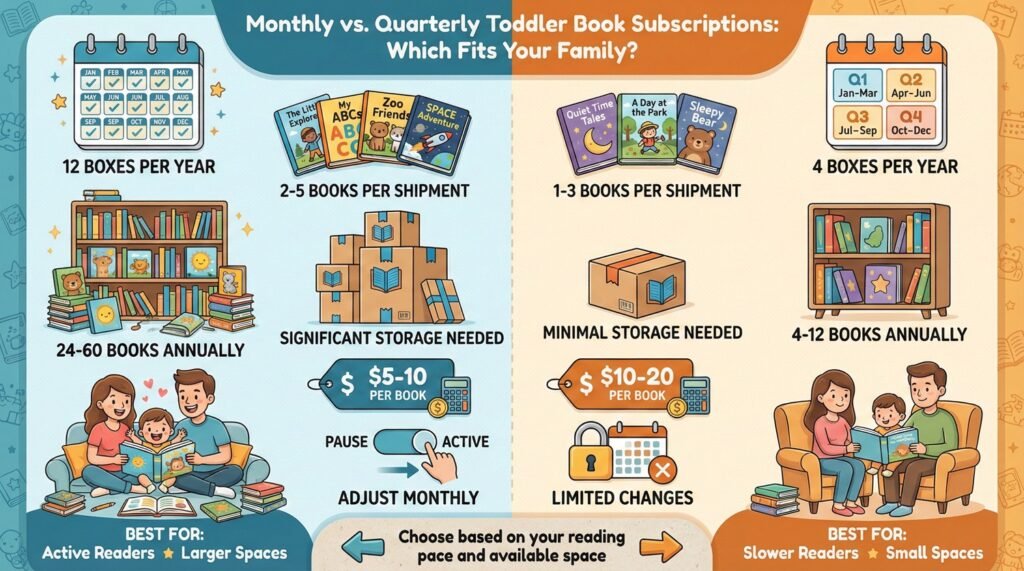
| Feature | Monthly Subscription | Quarterly Subscription |
|---|---|---|
| Delivery frequency | 12 boxes per year | 4 boxes per year |
| Books per shipment | Usually 2-5 books | Usually 1-3 books |
| Total annual books | 24-60 books | 4-12 books |
| Storage needs | Significant | Minimal |
| Typical price per book | $5-10 | $10-20 |
| Flexibility to adjust | Can change monthly | Limited changes |
| Best for | Active readers, larger spaces | Slower readers, small spaces |
Real Pricing Without The Marketing Fluff
Monthly subscriptions range pretty widely on annual cost.
On the lower end, you’ve got Literati at $10 per month (so $120 per year) plus whatever you decide to purchase and keep. A Kids Co. starts around $15.95 monthly, which works out to about $191 annually with shipping included.
Mid-range options like Bookroo at $19.95 per month come to roughly $239 per year, plus that $4.99 shipping fee per box adds another $60 annually. So you’re closer to $300 total.
Premium monthly services like Highlights at $25 per month with free shipping run $300 annually. Specialized subscription boxes focused on diversity or specific educational approaches can run $35-55 monthly.
For quarterly subscriptions, Ourshelves charges $19.99 per box. That’s $80 per year for the single-book tier.
Their premium three-book quarterly boxes are $45 per shipment, coming to $180 annually.
Here’s the thing though. Quarterly subscriptions give you fewer books overall, so even though the annual total looks cheaper, you’re often paying more per person book.
The real question isn’t just what the subscription costs. It’s whether you’d actually buy these books otherwise.
If you’re someone who regularly drops $15-20 on new children’s books at full retail price, subscriptions can save you money and time. You’re getting curated selections delivered without having to shop.
But if you’re the type to hit up sales, thrift stores, or use the library heavily, the value proposition gets weaker. You can find books way cheaper if you’re willing to hunt for deals.
If you want straightforward monthly delivery with solid curation, Bookroo has different age tiers and their board book quality holds up to toddler destruction pretty well.
Which Subscriptions Actually Get Read
This matters more than the pricing tbh.
Some parents report that monthly subscriptions with 5 books per box result in maybe 2-3 getting regular rotation while the others just sit there. The volume can be too much, especially if your kid gets attached to specific stories and wants those on repeat.
Quarterly subscriptions create different reading habits. With fewer books arriving, your kid rereads the same ones more often.
That actually lines up better with how toddlers learn.
They benefit from repetition and familiarity. Hearing the same story many times helps with language development and comprehension.
Constantly introducing brand new books doesn’t always serve that need.
Bookroo gets mentioned a lot for age-appropriate curation in the 0-3 toddler range. Their board books are thick enough to survive the chewing and bending phase.
Story Captain also gets praise for thoughtful selections that match actual toddler interests instead of just random publisher overstock.
Literati’s borrow-and-return model performs well for testing books before you commit to owning them. The main complaint is forgetting return deadlines and getting charged for books you didn’t necessarily want to keep.
A toddler book subscription works best when it matches your actual reading pace. If books pile up unopened, the frequency is wrong for your family.
Matching Subscription Type To Your Situation
If You’re New To This Whole Book Subscription Thing
Monthly subscriptions with strong curation make the most sense when you’re just starting out. Services like Bookroo or Story Captain take the guesswork out of age-appropriate selections.
You get a rhythm going with regular arrivals, and you can adjust the age tier monthly as your kid develops. The flexibility helps when you’re still figuring out what types of books your toddler actually responds to.
If You’re Working Full-Time And Just Need This Handled
Monthly delivery removes one more decision from your plate. You set it up once and books just arrive.
Literati works particularly well here because you’re not stuck with books that don’t land. You can return whatever doesn’t work and only pay for what you keep.
Less guilt about unused purchases.
If Budget Is Tight
Honestly, subscriptions might not be the move.
Places like TJ Maxx, Ollies, and even Target clearance sections often have children’s books for $3-5. Used bookstores and library sales are even cheaper.
If you do want a subscription for the convenience factor, Literati at $10 monthly plus selective purchases keeps costs down. A Kids Co. has budget-friendly tiers too.
But there’s no shame in skipping subscriptions entirely and just buying books on sale when you see good deals.
If You’re Into Intentional, Minimal Collections
Quarterly subscriptions or Literati’s borrow model fit better with this approach.
You’re not constantly bringing new stuff into the house. Your kid has time to really engage with each book before new ones arrive.
The slower pace feels more deliberate and less consumer-driven.
If You’re Shopping For Your Grandkids
Monthly subscriptions create those regular touchpoints. Every month, a new box arrives and reminds your grandkids of you.
That connection has value beyond just the books themselves.
Quarterly works if space is limited at your place or if you’re supplementing an already robust library. You don’t want to overwhelm the parents with too much stuff arriving.
For quarterly delivery that won’t overwhelm your space, Ourshelves keeps it minimal with fewer shipments spread throughout the year.
What Actually Makes Sense For Most Families
Monthly subscriptions work when:
Your kid genuinely reads many books daily and burns through material quickly. You have the shelf space or storage to accommodate regular deliveries.
You value the consistency and don’t want to think about sourcing new books yourself.
You’re building a library you plan to keep long-term, maybe for many kids or to pass down.
Quarterly subscriptions work when:
Your toddler has a slower reading pace or fixates on favorite books for extended periods. You live in a smaller space like an apartment where storage is at a premium.
You already have access to libraries or other book sources and just want occasional supplemental titles.
You’re trying to be more intentional about consumption and don’t want the mental load of managing frequent deliveries.
The honest truth is most children’s books cost less at discount retailers than subscription services price them. If you’re willing to shop strategically and hit sales, you’ll spend less overall.
Subscriptions offer convenience and curation. Someone else does the research, picks age-appropriate titles, and ships them to you.
That service has real value when time is your limiting factor.
The frequency question matters less than whether the subscription matches your actual usage patterns. A quarterly subscription you’re genuinely excited about beats a monthly one that makes you feel guilty every time a box arrives.
Story Captain works well if you’ve got many kids at different ages since they theme their selections and include activity ideas that work across age ranges.
My Take After Looking At All This
For most families just getting started, monthly makes more sense initially.
You can always scale back later if it’s too much, but starting quarterly means you might not get enough variety to really assess whether your kid likes the service.
Go with monthly for 3-6 months and see how your toddler engages with the books. If you notice a pile forming of unread titles, that’s your signal to switch to quarterly or pause altogether.
If your kid tears through everything and asks for more stories constantly, monthly delivery keeps up with their pace.
The storage issue is real though. Before you commit to any toddler book subscription, figure out where these books will actually live.
If you don’t have a plan for the physical space they’ll take up, monthly subscriptions will stress you out.
Quarterly subscriptions get a bad rap for being “not enough books,” but for families who already use libraries or have other book sources, they work perfectly as supplemental additions. Four carefully curated boxes per year can introduce new titles while your library trips handle the bulk of reading material.
Price-wise, neither option is dramatically cheaper than the other when you calculate per-book costs. You’re paying for the curation and convenience either way.
The decision comes down to frequency and volume.
I’d probably start with Bookroo monthly if you want traditional subscription delivery with solid age-appropriate options. Try Literati if you want lower commitment and the ability to return books.
Consider Ourshelves quarterly if you know for sure that monthly would be overwhelming.
The subscription model works best when it reduces decision fatigue and actually gets used. If it becomes another source of guilt or clutter, cancel it. There’s no trophy for maintaining a subscription that doesn’t serve your family.
Books from any source, whether subscription boxes or bargain bins, only matter if someone’s actually reading them with your kid. The delivery frequency is way less important than whether you’re opening the books and enjoying them together.
Literati’s borrow model at $10/month let’s you test books risk-free before deciding what to actually keep and purchase.