I remember the first time I walked into one of those fancy baby boutiques and saw the sensory play section. There were $85 wooden activity boards, $120 light-up sensory tables, and rows upon rows of “developmental toys” that cost more than my monthly grocery budget.
I stood there feeling this weird mix of guilt and frustration, wondering if I was somehow failing my baby by not being able to afford all this specialized equipment.
That feeling stayed with me for maybe two days before I had what I can only describe as a clarity moment. I was watching my six-month-old daughter absolutely lose her mind with joy over a wooden spoon and a metal mixing bowl.
She was banging, listening to the sounds, touching the different textures, and having the time of her life.
And that’s when it hit me: babies don’t know what costs $5 and what costs $85. They just know what’s interesting.
Creating a rich sensory environment for your baby has almost nothing to do with money and everything to do with intention. Your baby’s brain is forming millions of neural connections every single day, and those connections happen through exposure to different textures, sounds, temperatures, and experiences.
Not through branded products that claim to be “developmental.”
If you’re feeling overwhelmed by the pressure to buy expensive sensory toys, or if you’re worried that your budget somehow limits your ability to give your baby enriching experiences, I’m here to tell you that’s completely wrong. In fact, some of the most effective sensory materials are sitting in your kitchen pantry right now, and I’m going to show you exactly how to use them.
What Actually Happens During Sensory Play
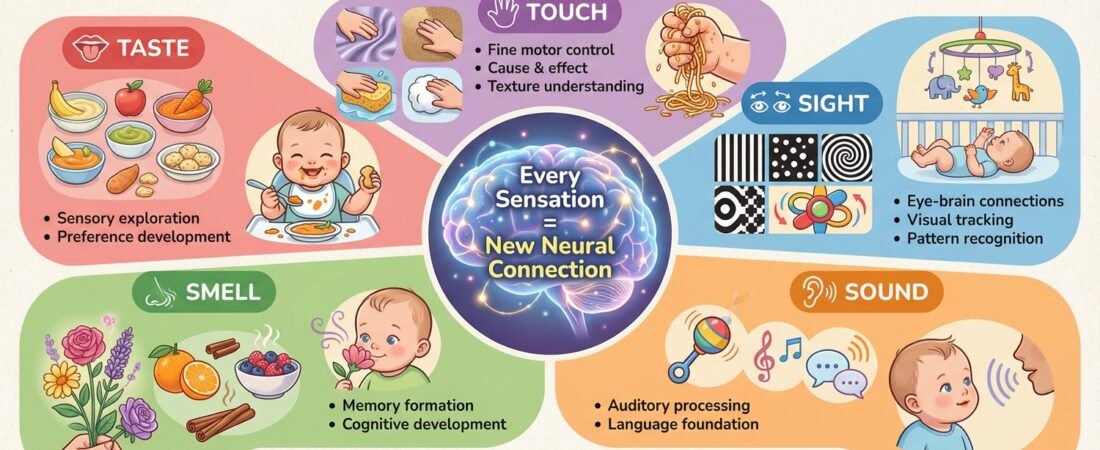
Before we dive into the practical stuff, I think it’s really worth understanding what’s going on in your baby’s brain during sensory play. This gives you exposure to rich developmental experiences while you fold laundry, though that’s definitely a bonus.
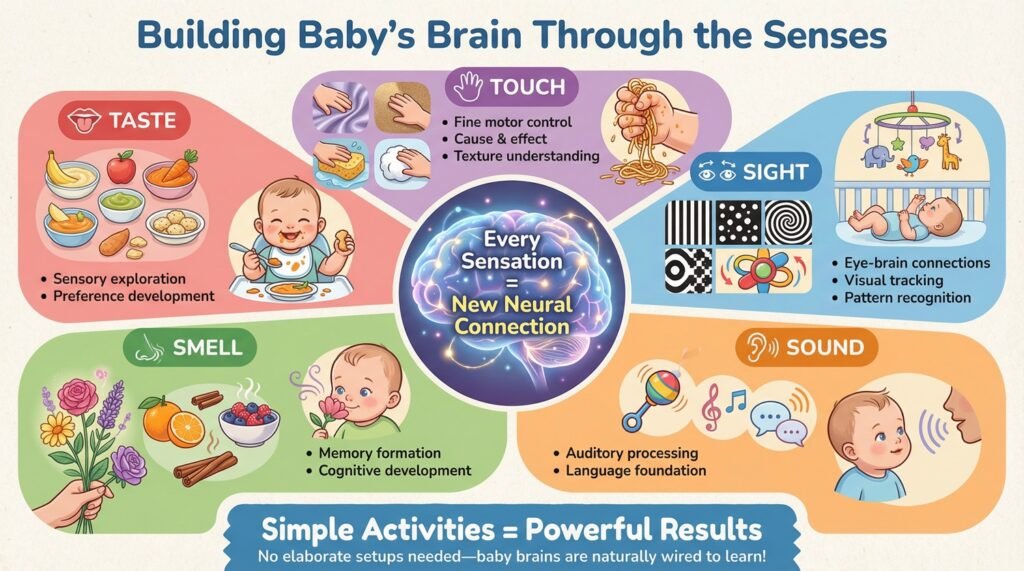
When your baby touches different textures, their brain is literally building maps of tactile information. Smooth versus rough.
Warm versus cold.
Wet versus dry. Every new sensation creates neural pathways that will eventually help them understand their physical world.
When they squeeze cooked pasta between their fingers, they’re learning about cause and effect, developing fine motor control, and exploring properties like consistency and texture. The visual system works similarly.
When babies look at contrasting colors or track moving objects, they’re strengthening the connections between their eyes and brain. Sound exploration helps with auditory processing and eventually language development.
Even smell plays a role in memory formation and cognitive development.
What’s fascinating is that these sensory experiences don’t need to be elaborate. Your baby’s brain is so primed for learning that even simple activities create significant developmental benefits.
The $3 bag of rice in your pantry provides the same tactile stimulation as a $45 sensory bin from a specialty store.
Actually, it probably provides better stimulation because you can give your baby more of it without worrying about the cost.
The key is variety and consistency. Your baby benefits more from daily access to simple, varied sensory experiences than from occasional play with expensive equipment.
That’s actually great news for parents on a budget because it means you can create something sustainable and ongoing as opposed to making one big purchase that your baby might tire of quickly.
Setting Up Your Foundation
The first thing you need is a container, and I really cannot stress enough how much you probably already own something perfect. I’ve used rectangular cake pans, plastic shoe boxes, shallow Tupperware containers, and even cardboard boxes lined with plastic bags.
The ideal sensory play container is shallow enough that your baby can reach everything easily, wide enough to spread materials around, and contained enough that cleanup doesn’t become a nightmare. For water play, your bathtub is honestly the best option.
It’s already waterproof, easy to clean, and creates a space where you can sit right next to your baby and supervise closely.
I spent weeks looking for an affordable water table before I realized I literally had the perfect setup already.
If you’re planning to create many sensory bins that you’ll rotate, investing in a few clear plastic containers with lids makes sense. You can often find three-packs at dollar stores for around $5.
The clear sides let your baby see what’s inside even before opening, which builds anticipation and engagement.
The lids keep materials fresh and contained between play sessions.
Once you have your containers sorted, the next step is choosing your base materials. This is where most parents get tripped up by safety concerns, and honestly, those concerns are completely valid.
But they’re also manageable when you know what to look for.
Safe Sensory Materials That Cost Almost Nothing
The safest approach for babies who are still in the mouthing stage, which is basically every baby under twelve months and many beyond that, is to use materials that are either completely edible or large enough that they can’t be swallowed. I tend to lean heavily toward edible materials because they eliminate the constant stress of watching for choking hazards.
Rice is probably the most versatile sensory material you’ll ever use. It costs maybe $2 for a huge bag, it stores indefinitely, and it creates this wonderful flowing, tactile experience that babies find endlessly fascinating.
You can use it plain or dye it with food coloring for visual interest.
I’ve reused the same batch of rice for months by just storing it in a sealed container between uses.
Oatmeal has this softer, lighter texture that’s different from rice. It’s also naturally toddler-safe if they decide to taste it, though I’d definitely feed them first because eating dry oats isn’t particularly enjoyable.
The light brown color works beautifully for nature-themed setups.
You can hide toy animals in it or add scoops and containers for pouring practice.
Split peas give you that natural green color without any dyes or additives. They’re harder than rice but still small enough to flow through containers and create interesting sounds.
Black-eyed peas work similarly and are one of the few beans that are safe to eat raw, though they might cause some stomach discomfort in large quantities.
Still, for taste-safe play, they’re a solid option.
Here’s something I discovered by accident: decaf coffee grounds. I had a container of them that had gone stale, and instead of throwing them out, I put them in a sensory bin. The dark color is visually striking, the texture is completely unique, and the smell adds another sensory dimension.
Plus, if your baby gets some in their mouth, it’s not harmful, just not particularly tasty.
For wet sensory play, cooked pasta is absolutely wonderful. You know those nights when you make too much spaghetti?
Instead of throwing it away, save it for sensory play.
It’s squishy, slippery, and safe to eat. Just keep it refrigerated between sessions and toss it after a few days when it starts getting questionable.
Gelatin is another favorite in my house. You can make it in different colors, cut it into shapes with cookie cutters, and let your baby squish it, poke it, and explore its unique texture.
It’s completely edible, relatively inexpensive, and creates this really satisfying sensory experience.
The wobbling motion when they touch it is particularly engaging.
Applesauce and pudding fall into the same category of messy, edible sensory materials. They’re genuinely foods, so there’s zero concern about consumption.
Applesauce provides this smooth, cool texture, while pudding is thicker and creates different tactile feedback.
I usually do these in the bathtub because cleanup is much easier that way.
Materials You Already Own
This is where the budget-friendly approach really shines because you probably have dozens of suitable sensory items scattered throughout your house right now. I’m talking about kitchen tools, household objects, and everyday items that provide rich sensory experiences without costing anything extra.
Wooden spoons have different textures and weights than plastic ones. Metal measuring cups feel cool and smooth.
Silicone spatulas are flexible and soft. Just gathering different kitchen tools creates a varied tactile experience.
Add some containers of different sizes for pouring and scooping practice, and you’ve got a finish sensory setup.
Fabric scraps from old clothing offer texture exploration. Silk scarves feel different from cotton towels, which feel different from fleece blankets.
You can play peek-a-boo with them, practice grasping and pulling, and explore how they move through the air.
Socks in different materials and textures work similarly.
Natural materials from outside are completely free and incredibly engaging. Leaves, sticks, pinecones, smooth rocks, grass clippings – all of these provide unique textures and often interesting smells.
Just make sure items are large enough to be safe and wash them before use.
A basket of nature items creates an entire sensory experience without spending a cent.
Ice cubes are probably one of the most underrated sensory materials. They’re cold, they melt, they’re slippery, and they create water.
Babies find the temperature change fascinating, and watching them melt introduces basic cause-and-effect concepts.
Freeze some colored water in ice cube trays for added visual interest.
Paper in different textures offers auditory and tactile exploration. Tissue paper crinkles and tears easily.
Cardboard is stiffer and makes different sounds.
Wrapping paper is shiny and smooth. You can wrap toys in tissue paper for your baby to unwrap, which combines fine motor practice with the element of surprise.
Creating Themed Experiences
Once you have your basic materials and containers, you can start thinking about themed sensory experiences. This isn’t necessary for developmental benefits, but it does make playtime more engaging and helps you think creatively about material combinations.
A nature theme might mix oatmeal as a base with toy animals, artificial plants, small branches, and leaves. Your baby explores the textures while you talk about animals and nature, adding language development to the sensory experience.
You can hide the animals in the oatmeal for them to uncover, which adds an element of surprise.
Temperature exploration themes work wonderfully with water. Set up three containers: one with warm water, one with cool water, and one with ice cubes.
Let your baby touch each one and experience how different temperatures feel.
Add some sponges and cups for pouring, and you’ve got a comprehensive sensory activity that costs nothing.
A texture exploration theme focuses entirely on contrasts. Combine smooth objects like plastic eggs with rough items like natural sponges, soft fabric with hard wooden blocks, and flexible silicone with rigid metal.
The variety creates rich neural stimulation as your baby’s brain processes all these different tactile inputs.
I’ve done simple color themes using naturally colored materials. Split peas for green, rice dyed with yellow food coloring, black-eyed peas for black and white contrast, and coffee grounds for brown.
It’s visually interesting while still using budget-friendly, safe materials.
Age-Specific Approaches
The way you set up sensory play changes pretty significantly as your baby grows, and understanding these shifts helps you make better choices about materials and supervision.
For babies under six months, sensory play is mostly about visual and gentle tactile stimulation. These babies aren’t mobile yet and have limited hand control, so your focus should be on things they can look at and touch while lying on their back or stomach.
High-contrast patterns, mirrors, different fabric textures placed near them, and gentle touches with various materials all work well.
I used to take my daughter’s hand and gently brush it against different fabrics while talking about how they felt.
Sensory bottles are perfect for this age. Fill clear plastic bottles with rice, small toys, colored water, or other safe materials, seal them extremely securely with hot glue, and let your baby look at them and eventually grasp them.
The visual stimulation is valuable, and as they develop hand control, shaking the bottles becomes fascinating.
Between six and twelve months, babies become much more interactive with sensory materials. They can sit up, grasp intentionally, and explore with their hands and mouths.
This is when edible sensory bins become really valuable because mouthing is such a central part of their exploration process.
Rice, oatmeal, cooked pasta, and gelatin all work beautifully during this stage.
Supervision becomes critical now because these babies are quick and absolutely everything goes in their mouths. I used to sit right next to my daughter during sensory play, with my hand always within reaching distance.
This is developmentally appropriate safety for babies who don’t yet understand danger.
Water play becomes more interactive during this stage too. Babies this age love splashing, pouring, and watching water move.
A shallow amount of water in the bathtub with some cups and containers provides extensive entertainment and sensory stimulation.
Just never, ever leave them unattended, even for a second.
After twelve months, you can start introducing slightly more complex materials and activities. These toddlers have better hand control, more impulse control (though still not great), and can understand simple instructions.
They benefit from activities that involve more problem-solving, like stacking, sorting, and pouring between containers of different sizes.
Homemade play dough becomes appropriate around this age. A simple recipe using flour, water, salt, and food coloring costs maybe fifty cents to make and provides hours of sensory exploration.
The squishing, rolling, and manipulating helps develop hand strength and fine motor control.
Practical Management Strategies
Here’s what nobody tells you about sensory play: it’s messy. Like, really messy.
And if you’re not prepared for that reality, you’ll end up frustrated and abandoning the whole concept. So let’s talk about managing the mess in ways that make sensory play sustainable.
First, accept that mess is part of the process. Your baby learns through touching, spreading, dropping, and generally making a disaster.
Fighting against that impulse means fighting against their natural learning process.
Instead of preventing mess, contain it in ways that make cleanup manageable.
I do messy sensory play in specific locations: the bathtub, outside on a blanket, or in the kitchen on a plastic tablecloth spread on the floor. These spaces are easy to clean and don’t stress me out when rice inevitably ends up everywhere.
When you’re not constantly worried about your carpet or couch, you can actually relax and enjoy watching your baby explore.
Dress for mess too. Old clothes, just a diaper, or clothes you don’t care about getting stained make sensory play less stressful.
I learned this after ruining two nice outfits with pudding and gelatin stains.
Now I just strip my daughter down to her diaper for messy play and hose her off in the tub afterward.
Timing matters more than you’d think. I do sensory play right before bath time whenever possible.
That way, the mess becomes part of the transition to bathing as opposed to creating extra work.
It also means I’m naturally prepared for water-based play since we’re heading to the tub anyway.
Storage and rotation keep materials fresh and interesting. I have four or five sensory bins that I rotate through, bringing out a different one every few days.
This approach prevents boredom and makes each bin feel novel and exciting.
Store dry materials in sealed containers to keep them fresh and prevent spills between uses.
Common Problems and Solutions
Even with good planning, sensory play comes with challenges. Here are the issues I’ve encountered most often and how I’ve worked through them.
The biggest concern for most parents is safety, and rightfully so. Babies are unpredictable and fast, and their instinct to mouth everything can feel scary when they’re playing with small materials.
My solution has been to heavily favor edible materials during the mouthing stage and to sit physically next to my baby during play.
Not hovering and interfering, but close enough to intervene immediately if needed.
Some babies seem uninterested in sensory play at first, and that’s actually pretty normal. If your baby isn’t engaging, the materials might not be developmentally appropriate yet, or they might just need more time to warm up to the activity.
Start with very simple setups, model interaction yourself, and keep sessions short.
Sometimes babies need to observe several times before they’re comfortable participating.
The mess can definitely become overwhelming if you’re not careful about boundaries. If you’re finding that sensory play creates more stress than it’s worth, you’re probably being too ambitious with locations and materials.
Scale back to bathroom-only water play and contained dry bins.
It’s better to do simple sensory play consistently than to do elaborate setups that burn you out.
Material waste bothers some parents, especially with edible sensory materials. If this concerns you, focus on reusable dry materials like rice and oatmeal that last indefinitely.
Save edible materials for special occasions as opposed to everyday play.
You can also use very small quantities – your baby doesn’t need a huge amount to get the sensory benefits.
Cleanup resistance from your baby is normal as they get older and more attached to their play. I’ve found that making cleanup part of the activity helps.
Scooping materials back into containers, dumping water, and wiping up becomes part of the sensory experience as opposed to an abrupt ending.
Even young toddlers can join in simple cleanup tasks.
Frequently Asked Questions
What can I use for sensory bins for babies?
Rice, oatmeal, cooked pasta, split peas, and black-eyed peas all work really well for sensory bins. The most important factor is choosing materials that are safe if your baby puts them in their mouth.
Dry foods like rice and oatmeal can be reused for months, while cooked foods should be refrigerated between sessions and replaced after a few days.
You can also use water, ice cubes, fabric scraps, and natural materials like leaves and pinecones.
Is rice safe for baby sensory play?
Rice is safe for baby sensory play as long as you supervise closely. While raw rice won’t hurt your baby if they taste it, you do need to watch that they don’t try to eat large amounts or choke on it.
White rice is safer than brown rice because it’s smoother and less likely to cause irritation if inhaled. Many parents prefer to use rice for babies who are past the stage of putting everything directly in their mouths, usually around 12-15 months.
What age should you start sensory play?
You can start sensory play from birth, but it looks different at different ages. Newborns and young infants benefit from visual sensory experiences like looking at high-contrast images, mirrors, and different colored objects.
Around 3-4 months, you can introduce gentle tactile experiences by brushing their hands against different fabric textures.
Active sensory bins with materials like rice or water typically work best for babies who can sit up independently, usually around 6-8 months.
How do you make edible sensory bins?
The simplest edible sensory bin uses cooked pasta as a base. Cook any type of pasta, let it cool slightly, and place it in a shallow container with some kitchen tools like spoons and cups.
You can also make gelatin in different colors, cut it into cubes, and let your baby squish and explore it.
Applesauce, pudding, and mashed potatoes all work as edible sensory materials. These messy options are best done in the bathtub for easy cleanup.
Can you reuse sensory bin materials?
Dry materials like rice, oatmeal, split peas, and coffee grounds can be reused many times if stored properly in sealed containers between uses. I’ve used the same batch of rice for over six months.
Wet materials like cooked pasta, gelatin, and applesauce should be refrigerated if you plan to reuse them within 1-2 days, but generally these are better as single-use materials.
Natural items like leaves and pinecones can be washed and reused a few times before they break down.
What should you avoid in baby sensory bins?
Never use water beads (also called orbeez) because they’re a serious choking and internal blockage hazard if swallowed. Avoid small items like buttons, beads, or dried beans for babies under 18 months who are still mouthing everything. Skip materials with strong chemicals or dyes that aren’t food-safe.
Avoid anything with small parts that could break off and become choking hazards.
Also skip materials with sharp edges or anything that could splinter like raw wood pieces.
How long should sensory play last?
For babies under 12 months, 10-15 minutes of focused sensory play is plenty. Their attention spans are short, and they tire quickly.
Toddlers between 12-24 months might engage for 20-30 minutes if the materials are really interesting to them.
The key is to end the session while your baby is still engaged as opposed to waiting until they’re frustrated or bored. Shorter, more frequent sessions work better than long ones.
Do sensory bins help with development?
Sensory bins support many areas of development simultaneously. They build fine motor skills through grasping, scooping, and pouring.
They develop tactile processing as babies learn to distinguish different textures and temperatures.
They support cognitive development through cause-and-effect learning and problem-solving. Language development happens when you talk about what your baby is experiencing.
Hand-eye coordination improves as babies manipulate materials and move them between containers.
Key Takeaways
Creating a rich sensory environment for your baby needs intention and consistency, not money or expensive equipment. The developmental benefits come from exposure to varied textures, temperatures, sounds, and visual experiences, all of which happen just as effectively with household materials as with commercial products.
Safety must be your absolute first priority, especially with babies under twelve months who mouth everything they touch. Favor edible materials like rice, oatmeal, cooked pasta, and gelatin during this stage, and always supervise closely during sensory play.
You already own most of what you need. Containers from your kitchen, tools from your drawers, fabrics from your closet, and materials from your pantry create finish sensory experiences without any extra purchases.
Start simple and build complexity as your baby develops. Young infants benefit from visual stimulation and gentle tactile exploration, while older babies engage in active manipulation and eventually problem-solving.
Make sensory play sustainable by managing the mess strategically, rotating materials to maintain novelty, and keeping your expectations realistic. Consistent, simple sensory experiences provide more developmental benefit than occasional elaborate setups that stress you out.