I’ve watched thousands of parents place their babies under activity gyms expecting magic to happen. What really struck me over the years is that the gym itself doesn’t create milestones.
What it does is provide a specifically designed environment that allows certain developmental processes to unfold more efficiently than they might otherwise.
The difference is subtle but critical to understand.
When you lay a three-month-old under those dangling toys, you’re not teaching them to reach. You’re creating conditions where their brain, which is already frantically building neural pathways at a rate it will never match again in life, can practice patterns of movement that strengthen specific connections.
Development isn’t linear, and it certainly isn’t guaranteed just by hitting a certain age. The nervous system needs repetition, variety, and challenge in very particular doses.
These developmental gains don’t happen in isolation. A baby who’s building visual tracking skills under an activity gym is simultaneously developing vestibular awareness, strengthening neck muscles, and forming the neural scaffolding for future problem-solving abilities.
Everything connects to everything else, which is why understanding the actual milestones, not just the approximate ages they occur, gives you insight into whether your baby is getting what they need from this particular piece of equipment.
The Neurodevelopmental Foundation
Let me start with what’s actually happening in your baby’s brain during those seemingly simple moments under the play gym. Between birth and twelve months, an infant’s brain roughly doubles in volume.
But size is just part of the story.
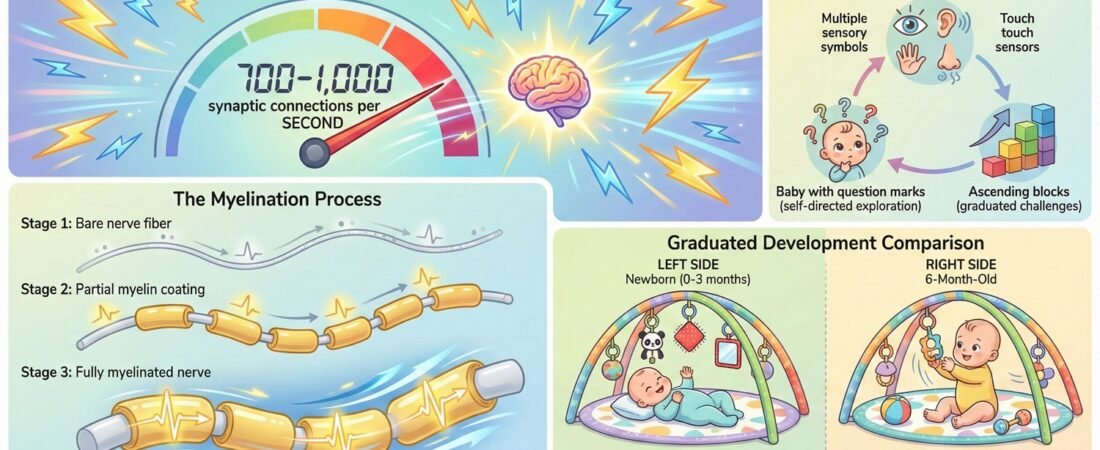
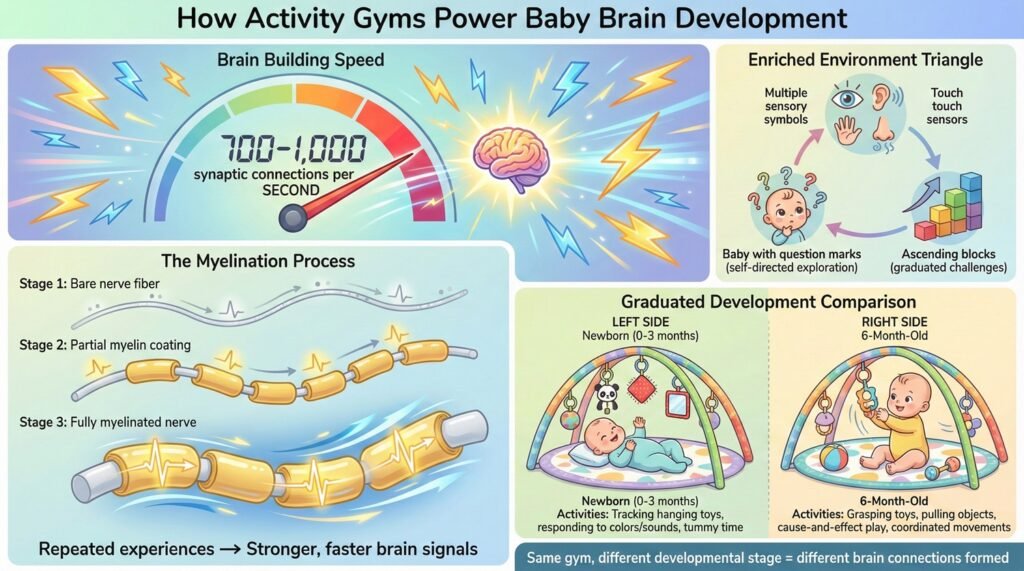
The brain is forming synaptic connections at an estimated rate of 700 to 1,000 per second during peak periods.
These connections don’t form randomly. They form in response to repeated experiences, and they strengthen through a process called myelination, where nerve fibers get coated in a fatty substance that makes signal transmission faster and more effective.
Activity gyms create what developmental specialists call an enriched environment, though that term gets thrown around so loosely that it’s lost meaning. What it actually means is a space that offers many sensory inputs simultaneously, opportunities for self-directed exploration, and graduated challenges that match the baby’s emerging capabilities.
The key word there is graduated. A newborn and a six-month-old will use the same activity gym in completely different ways because their nervous systems are at different stages of organization.
The first major milestone most parents notice is visual tracking, which typically emerges between six and twelve weeks. Babies are born with the physical ability to move their eyes, obviously, but the neural circuitry that allows them to smoothly follow a moving object has to be built through practice.
Under an activity gym, when a toy sways or spins, your baby’s visual system is learning to forecast movement, coordinate both eyes together, and maintain focus while their head position changes. This work is actually laying groundwork for reading skills years down the road, because reading needs precisely these same eye movement patterns.
The maturation happens in stages. First, babies can only track objects moving very slowly in a narrow arc directly in front of them.
By eight weeks, they can follow a full 180-degree path from side to side.
By twelve weeks, they can track in circular patterns and follow objects moving at moderate speeds. Each improvement reflects new neural connections solidifying in the visual cortex and the areas that control eye movements.
The Physical Architecture of Movement
Around two to three months, you’ll start seeing what looks like random batting at toys. Parents often dismiss this as accidental, but there’s nothing accidental about it.
What’s happening is the baby’s proprioceptive system, their internal sense of where their body is in space, is starting to come online in a more organized way.
They’re learning that the arm they see in their peripheral vision is actually attached to them and can be controlled, sort of. The control is shaky at first because the neural pathways are new and the myelin coating is thin. But with each swipe at a toy, successful or not, those pathways get reinforced.
The bilateral nature of activity gyms becomes really important here. Most designs place toys on both sides and in the center, which encourages babies to reach across their body’s midline.
Crossing midline is actually a neurological milestone that shows the two hemispheres of the brain are communicating effectively.
Babies who develop strong cross-lateral patterns early tend to have an easier time with complex motor tasks later, like crawling, writing, and reading. When you see your four-month-old reaching with their right hand for a toy on their left side, you’re witnessing interhemispheric communication in action.
The progression from batting to grasping follows a predictable but really sophisticated pattern. Initial contact is usually with a closed fist and the outer edge of the hand.
Over the next several weeks, babies gradually develop the ability to open their hand on approach, time the grasp to contact, and eventually manipulate objects once they’ve grabbed them.
Each phase needs specific neural circuits to mature, and each phase builds on the previous one. You can’t rush it, but you can absolutely support it by ensuring toys are positioned at the right distance and height.
The distance matters enormously. A toy positioned too far away creates frustration and teaches the baby that effort doesn’t lead to success.
A toy too close doesn’t provide enough challenge to stimulate development.
The sweet spot is just at the edge of their current reaching capability, which means you need to adjust height and position every few weeks as they grow. This concept of just-right challenge comes from sensory integration theory and applies across all areas of development.
By four months, most babies can reach for and grasp a toy with reasonable accuracy when they’re motivated. By five months, they can adjust their grip based on the toy’s size and shape. By six months, they can transfer objects from hand to hand and manipulate toys with increasing precision.
Each milestone represents thousands of practice tries and corresponding neural refinements.
Tummy Time Integration and Neck Strength
Activity gyms aren’t just for back-lying play, though that’s how most people use them. When you flip a baby onto their stomach under the gym, you create entirely different developmental demands.
Now they have to lift their head against gravity to see those interesting toys, which builds neck extensor strength and promotes the development of the cervical curve in their spine.
This curve is actually crucial for later sitting and standing posture.
The milestone progression for tummy time under an activity gym typically starts with brief head lifts at around one month, progresses to holding the head at 45 degrees by two months, and reaches sustained head control at 90 degrees by three to four months. What makes the activity gym valuable for this is the visual motivation.
Babies will work significantly harder and longer to lift their heads when there’s something interesting to look at, compared to just staring at a blank floor or mat. The difference in effort is measurable.
Studies show babies in enriched tummy time environments maintain head lifting two to three times longer than babies on plain surfaces.
This positioning affects the development of what’s called the tonic labyrinthine reflex integration. Newborns have this primitive reflex where certain head positions trigger automatic muscle responses throughout the body.
As the nervous system matures, this reflex needs to be integrated, basically overridden by higher brain centers, and tummy time with visual engagement speeds up this process.
You can actually see it happening. Younger babies in tummy time often have their arms pinned under them or their legs extended stiffly.
As the reflex combines over weeks and months, they gain more control and can prop on their forearms, then eventually on extended arms.
The propping progression is a milestone sequence all its own. Propping on forearms around three months shifts weight-bearing through the shoulder girdle in a way that strengthens scapular stabilizers, muscles that will be essential for literally every arm movement they make for the rest of their life.
The transition to extended arm propping around four to five months needs even more shoulder stability plus the ability to weight-shift side to side, which is preliminary practice for crawling patterns. When babies start pushing up on extended arms, they’re also building wrist stability and strengthening the small muscles in their hands that will later control precise finger movements.
Cognitive Leaps and Object Interaction
Around four to five months, you’ll notice a shift in how babies interact with activity gym toys that reflects a major cognitive milestone: the beginning of intentionality. Earlier reaching and grasping was exploratory and somewhat random.
Now babies start to show clear preferences, reach for specific toys deliberately, and show frustration when they can’t achieve their goal.
This signals that cause-and-effect reasoning is starting to develop.
This is also when you’ll start seeing what developmental psychologists call secondary circular reactions. The baby accidentally makes something interesting happen, maybe they bat a toy and it makes a sound, and then they intentionally repeat the action to make it happen again. They’re conducting little experiments, basically, testing hypotheses about how the world works.
An activity gym with toys that provide varied responses, sounds, movements, textures, gives babies many opportunities per session to build these cognitive frameworks. The more varied the feedback, the more robust their understanding of cause and effect becomes.
The development of object permanence, understanding that things continue to exist even when you can’t see them, starts emerging around this same period. Activity gyms with toys that swing away and return, or toys that can be partially hidden behind other elements, give babies chances to work on this concept.
You’ll see them tracking where a toy went, looking for it, and showing anticipation that it will reappear. This seems simple but represents a massive leap in mental representation ability.
The baby is holding an image of the toy in their mind even when they can’t see it.
Around six to seven months, hand-to-hand transfer emerges as a milestone, and this is where having multiple toys within reach becomes valuable. The baby will grasp one toy, bring it to midline, and transfer it to the other hand.
This needs releasing with one hand while simultaneously grasping with the other, which is actually a complex bilateral coordination task.
The transfer also shows that the corpus callosum, the bundle of nerve fibers connecting the brain’s hemispheres, is maturing and allowing more sophisticated interhemispheric communication. Before this maturation, each hand essentially operates independently.
After, they can work together in coordinated sequences.
Sensory Processing Development
The sensory aspects of activity gyms work on multiple systems simultaneously, and tracking these developments gives you insight into how your baby’s nervous system is organizing sensory information. The tactile system is actually one of the most developed at birth, but babies still need experience with varied textures to build discrimination abilities.
Activity gyms typically offer crinkly fabrics, smooth plastics, soft plush, and sometimes silicone or wooden elements. Each texture provides different tactile input that helps the brain build a library of what different materials feel like.
By five to six months, babies start to show clear preferences for certain textures and will reach more persistently for preferred materials.
Around three to four months, you’ll notice babies starting to bring toys to their mouth more consistently. This happens because the mouth actually has higher tactile sensitivity than the hands at this age, so oral exploration is a sophisticated way babies learn about object properties.
Activity gyms with safe-to-mouth toys support this developmental stage. The milestone here is that they’re using oral exploration systematically to gather information.
They’ll mouth one toy, then another, then return to the first, comparing properties like texture, temperature, and hardness.
The visual system develops through many overlapping stages under activity gyms. Contrast sensitivity improves dramatically in the first three months, which is why black-and-white or high-contrast toys are particularly engaging for younger babies.
Color vision, particularly red-green discrimination, matures around two to three months, followed by blue-yellow perception.
By four months, most babies have vision approaching adult-level color perception, though visual acuity is still developing.
Depth perception is another milestone that activity gyms specifically support. This needs binocular vision, both eyes working together, which doesn’t really come online until around four to five months.
Before then, babies may reach past or short of toys because they can’t accurately judge distance.
Activity gyms, because they present toys at a consistent, relatively close distance, give babies hundreds of opportunities per session to calibrate their depth perception. You can actually watch this calibrate in real time.
The reaching becomes more accurate over days and weeks.
The auditory system benefits from activity gyms that include varied sounds: rattles, crinkles, chimes, music. The milestone here is learning to localize sounds, identify which direction they’re coming from, and eventually understand that actions cause sounds.
Auditory localization develops in stages. Horizontal localization, determining whether a sound comes from the left or right, develops first around three to four months.
Vertical localization, figuring out whether a sound comes from above or below, is actually harder and develops later, around six months.
By six months, most babies can accurately turn toward sounds in any direction.
Motor Planning and Problem-Solving
Around seven to eight months, babies who’ve had consistent activity gym experience typically start showing sophisticated problem-solving behaviors. They’ll intentionally move one toy out of the way to reach another, or they’ll figure out that pulling the arch brings toys closer.
These behaviors show that motor planning, the ability to conceptualize and execute a sequence of movements to achieve a goal, is developing.
Motor planning relies on successful integration of sensory information, body awareness, and cognitive goal-setting. Activity gyms create natural problem-solving scenarios because the toys are suspended in space rather than just lying on a flat surface, which means babies have to work harder to control them.
When a baby bats at a hanging toy and it swings away, they’re learning about action-reaction relationships, momentum, and timing. The next milestone is anticipating where the toy will swing to and reaching for it there rather than where it was.
This predictive reaching shows the brain is modeling physics, essentially.
The transition to sitting, which typically happens between six and eight months, changes everything about how babies use activity gyms. Now they can approach toys from above rather than below, which needs completely different motor strategies.
They’ll start demonstrating tripod sitting, using one hand for support while reaching with the other, then eventually free sitting with both hands available for manipulation.
Activity gyms designed with removable toys support this transition well, as babies can take toys off the arch to examine them more carefully while sitting.
Fine motor milestones speed up during this period too. The raking grasp, using all fingers to drag objects closer, transitions to the radial palmar grasp, using thumb side of hand, then to the inferior pincer, thumb and side of index finger, and finally to the neat pincer grasp, thumb and fingertip, around nine to ten months.
Activity gyms with toys that have loops, tags, or small parts give babies suitable challenges for each stage. The key is that the toy needs to be secure enough not to frustrate them but challenging enough to push skill development forward.
Frequently Asked Questions
When should babies start using activity gyms?
Babies can start using activity gyms from birth, though newborns will primarily just look at the toys overhead. The real interaction begins around six to eight weeks when visual tracking starts to develop.
Position toys closer for younger babies, about eight to ten inches from their face, to match their focal range.
As babies grow and their vision improves, you can gradually move toys farther away to provide suitable challenge.
How long should tummy time sessions last under an activity gym?
Start with very short sessions of just one to two minutes for newborns and gradually increase duration as your baby builds strength and tolerance. By three months, many babies can handle five to ten minutes of tummy time.
By six months, some babies can manage fifteen to twenty minutes.
Watch for signs of fatigue like fussiness, turning the head to the side and staying there, or just giving up on lifting the head. End the session before your baby becomes overly frustrated.
What toys work best for different ages on activity gyms?
For babies under three months, high-contrast black and white toys or bold primary colors work best because their contrast sensitivity is still developing. Between three and six months, add toys with varied textures, rattles, and crinkly sounds to engage their growing sensory awareness.
After six months, include toys with moving parts, mirrors, and elements that respond to manipulation like spinners or toys that slide along bars.
The key is providing variety within their current developmental level.
Can activity gyms help with delayed motor development?
Activity gyms can support motor development when used appropriately, but they work best as part of a comprehensive approach. If you have concerns about delays, work with a pediatric physical or occupational therapist who can show you how to position toys and adjust the setup to target specific skills your baby needs to work on.
The gym provides motivation and opportunity, but sometimes babies need more targeted intervention and guidance than equipment alone can provide.
How do you know if a baby is getting overstimulated by an activity gym?
Signs of overstimulation include turning the head away from toys, arching the back, crying or fussing, hiccupping, sneezing, or becoming very still and glazed-looking. Some babies also show color changes, getting flushed or pale.
If you see these signs, remove your baby from the gym and provide a calm, quiet environment to recover.
For easily overstimulated babies, start with shorter sessions, remove some toys to simplify the setup, and avoid times when they’re already tired or hungry.
Should babies always play alone under activity gyms?
Both independent play and interactive play have value. Independent time under the gym helps babies develop self-entertainment skills, sustained attention, and intrinsic motivation.
But playing together, where you name toys, describe what your baby is doing, and respond to their vocalizations, supports language development, joint attention, and social connection.
A good balance is letting your baby explore independently for part of the time while staying nearby and engaged, then spending some time actively playing together.
What if a baby only uses one hand to reach for toys?
Consistent one-sided reaching warrants attention. First, check that toys are positioned on both sides and at midline to give equal opportunity for both hands.
Some preference is normal, but if your baby never uses one side or seems unable to when toys are positioned there, mention it to your pediatrician.
This could indicate anything from a minor muscle tightness that responds well to simple stretches, to something requiring evaluation. Early identification of asymmetries leads to better outcomes.
Key Takeaways
Visual tracking develops between six and twelve weeks through practice following moving toys, building neural pathways essential for future reading skills and establishing coordinated binocular vision that allows depth perception.
Reaching progresses from reflexive batting around two months to intentional grasping by four months, with each phase requiring specific neural maturation and benefiting from appropriately positioned challenges that match emerging capabilities.
Tummy time under activity gyms builds neck strength and combines primitive reflexes, with milestones progressing from brief head lifts at one month to sustained 90-degree head control by three to four months and propping on extended arms by five months.
Cross-midline reaching that emerges around four months shows effective communication between brain hemispheres and establishes patterns crucial for crawling, writing, and complex motor tasks throughout life.
Cognitive milestones including cause-and-effect reasoning and object permanence develop through repeated toy interactions between four and seven months, with babies progressing from accidental discoveries to intentional experimentation that resembles hypothesis testing.
Hand-to-hand transfer appearing around six to seven months signals maturing corpus callosum and bilateral coordination abilities that support increasingly sophisticated manipulation skills and coordinated use of both hands together.
Motor planning and problem-solving behaviors emerging around seven to eight months show integration of sensory information, body awareness, and goal-setting abilities that form foundations for all future learning and skill acquisition.