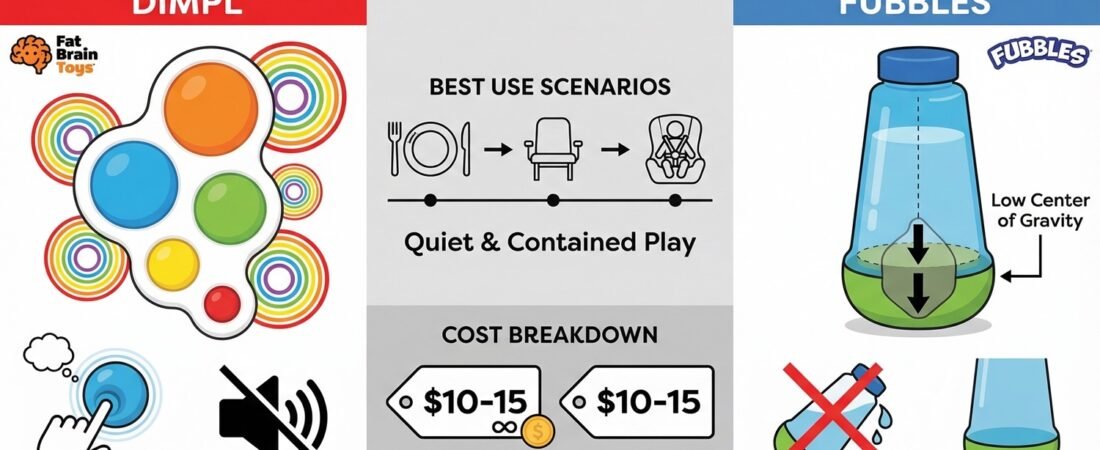
I need to be completely honest with you right from the start. Someone asked me to compare the Dimpl and the Fubbles No-Spill Bubble Tumbler, and I have to tell you that this comparison makes about as much sense as comparing a bicycle to a sandwich.
They’re both things you might give to a child, but that’s where the similarities end.
The Dimpl is a sensory toy. You push colorful silicone bubbles back and forth.
The Fubbles No-Spill Bubble Tumbler is a container of bubble solution designed not to spill when your toddler inevitably knocks it over during outdoor play.
One keeps kids quietly occupied during a doctor’s appointment. The other creates an afternoon of outdoor fun chasing bubbles around the backyard.
So instead of forcing a comparison that doesn’t make sense, I’m going to explain what each toy actually does, when you’d want to use it, and help you figure out which one matches what you’re actually looking for. Because if you’re genuinely torn between these two, you might be confused about what you actually need.
What the Dimpl Actually Is
The Dimpl comes from Fat Brain Toys, and the design is brilliantly simple. You get a rigid plastic frame with five silicone bubbles in different colors and sizes.
You push a bubble, and it pops through to the other side with a satisfying little sensation.
Then you push it back. That’s the entire toy.
But here’s what makes it work. That simple push-and-pop action gives kids exactly the kind of sensory feedback their developing brains crave.
Babies around 10 months old start to develop the finger control needed to push those bubbles intentionally.
When they figure out that pushing creates that satisfying pop, they want to do it again and again. This repetition builds the fine motor skills they’ll eventually need for holding pencils, buttoning shirts, and using utensils.
The silicone is food-grade because the people who designed this toy understand that everything marketed to babies will end up in their mouth. The frame is sturdy enough to survive being thrown across the room, stepped on by older siblings, or chewed during teething phases.
I’ve seen Dimpls that have been through three kids and still work perfectly.
The toy comes in several versions now. The original has five bubbles.
There’s a Dimpl Duo with two large bubbles.
They’ve made themed versions with different color schemes. But the core concept stays the same across all versions.
What really stands out about the Dimpl is how it provides engagement without creating chaos. There’s no music to drive parents crazy.
No batteries to replace at inconvenient moments.
No small pieces to lose under the couch. Just pure, quiet, tactile satisfaction.
Many occupational therapists recommend the Dimpl as part of what they call a sensory diet. Kids who get overwhelmed easily can use the repetitive motion to calm down.
Kids who need more stimulation can use it to get their sensory needs met.
The fact that it’s small, quiet, and socially acceptable means kids can use it in public spaces without drawing attention.
What the Fubbles No-Spill Bubble Tumbler Actually Does
Now let’s talk about bubbles. Every parent knows the standard bubble experience.
You buy a bottle of bubble solution.
Your toddler gets excited. Within seconds, the bottle tips over and dumps sticky soap all over your patio. You spend the next five minutes cleaning up while your child cries because the bubbles are gone.
The Fubbles No-Spill Bubble Tumbler redesigns the entire container to fix this exact problem. The base is wide and weighted, giving it a low center of gravity that makes it really hard to knock over.
The opening where you dip the wand has a special mechanism that limits how much solution escapes even when the container does tip.
I’m not going to tell you it’s completely spill-proof because physics exists and determined toddlers can accomplish anything. But where a regular bottle might dump six ounces of solution in one accident, the No-Spill Tumbler loses maybe a few drops.
The bubble solution itself is the standard Fubbles formula. Nothing fancy, but it works reliably and creates bubbles durable enough for toddlers to actually catch and pop.
The wand is a basic loop design that small hands can grip and dip easily.
Bubbles offer something special for child development. Chasing floating bubbles builds gross motor skills.
The visual tracking supports eye development.
The cause-and-effect of blowing or waving to create bubbles teaches basic physics concepts. Plus, bubble play happens outside, which means fresh air, vitamin D, and all the sensory input that comes from being outdoors.
The No-Spill design means you can set the container on the ground and let many kids take turns without constantly supervising to prevent spills. For playdates or birthday parties, this stability makes a real difference.
When You Actually Want Each Toy
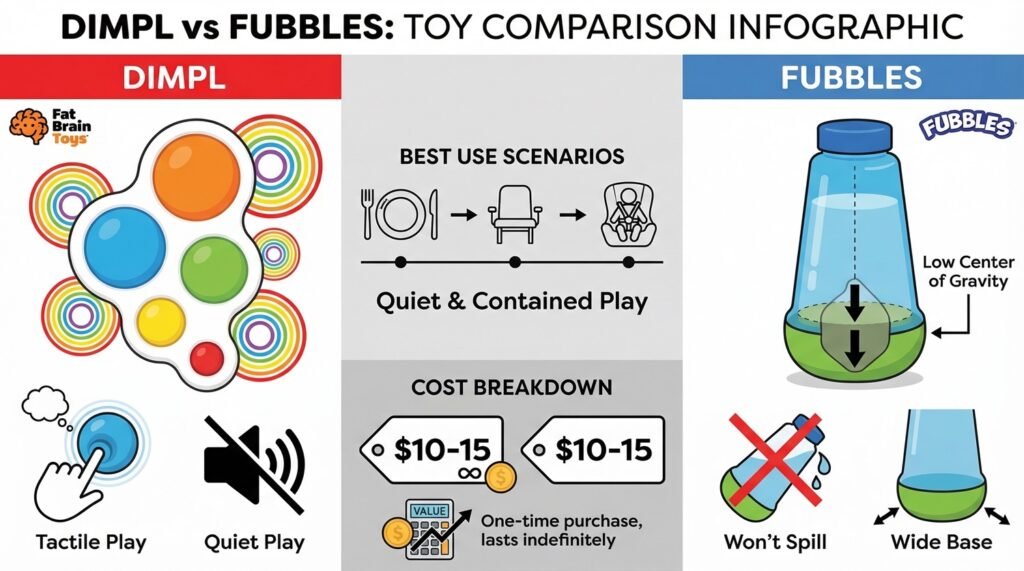
The Dimpl makes sense when you need quiet, contained play in situations where a child needs to stay relatively still. Restaurants where you’re waiting for food.
Doctor’s offices during long waits.
Car rides. Airplane trips.
Basically any scenario where you need fifteen minutes of peaceful engagement.
It’s also valuable for home use during activities that need kids to sit still. Mealtime at the table.
Story time.
Quiet time before bed. Because it provides sensory input without making noise or creating mess, it’s one of those toys that makes parenting easier as opposed to harder.
The age range for the Dimpl extends well beyond toddlerhood. While it’s marketed for 10 months and up, older kids with sensory processing needs, anxiety, or attention difficulties often find it helpful.
I’ve watched elementary school kids use it for fidgeting during homework.
Adults pick it up and mindlessly pop the bubbles during phone calls. The simple satisfaction of the tactile feedback works across ages.
The Fubbles No-Spill Bubble Tumbler makes sense for planned outdoor play. Warm afternoons in the backyard.
Park visits.
Beach trips. Birthday parties.
Any situation where you’re already planning for active outdoor play and want to add bubble fun without the usual mess and frustration.
Bubbles work particularly well for group play. Multiple children can share one container, taking turns with the wand while others chase and pop the bubbles.
The stable base means you’re not constantly watching to make sure someone doesn’t knock it over and create a soapy disaster.
This toy has a shorter age range of appeal. Toddlers who can walk confidently and handle outdoor play, so roughly 18 months to maybe 5 or 6 years old.
Some kids stay interested in bubbles longer, but most move on to other outdoor activities as they get older.
The Real Cost Comparison
Both toys retail somewhere between $10 and $15 depending on where you shop. But the long-term cost calculations work differently.
The Dimpl is a one-time purchase. You buy it once, and barring some catastrophic damage, it lasts indefinitely.
No batteries.
No refills. No replacement parts.
If a child uses it regularly from 10 months old through age 8, you’re looking at pennies per play session in terms of cost per use.
The Fubbles No-Spill Bubble Tumbler comes with an initial batch of solution, but that solution runs out. You can refill it with any bubble solution, which maintains the spill-resistant benefit of the container design.
But if you’re using bubbles regularly through the summer months, you’ll spend probably $20 to $30 per year on refills.
Not expensive, but it’s an ongoing cost to factor in.
What Each Toy Actually Teaches
The developmental benefits of these toys are completely different, which makes sense given that they facilitate totally different types of play.
The Dimpl targets fine motor skills and sensory processing. When a baby works to position their finger precisely enough to push a specific bubble, they’re building motor planning abilities.
The visual element of watching colors change from concave to convex supports visual tracking.
The tactile feedback and the resistance of the silicone provide proprioceptive input that helps with body awareness and sensory integration.
These are foundational skills that support countless other developmental milestones. The hand-eye coordination developed by pushing those bubbles eventually transfers to more complex tasks.
The sustained attention and focus required to engage with the toy builds concentration abilities.
The Fubbles Bubble Tumbler supports gross motor development through active play. Running to chase bubbles builds cardiovascular fitness and leg strength.
Jumping to reach high bubbles develops coordination.
Swinging arms to pop bubbles works on spatial awareness and timing.
The visual tracking of many floating bubbles moving in different directions challenges visual processing in ways that stationary toys can’t. The unpredictability of where bubbles will float and how they’ll move creates constant problem-solving opportunities.
Both toys encourage focus, just in completely different ways. The Dimpl rewards sustained attention to a single object through repetitive, satisfying interaction.
Bubble play needs dynamic attention as kids track many moving targets and react to changing conditions.
Safety Differences
The Dimpl has a straightforward safety profile. Food-grade silicone and rigid plastic, both non-toxic.
No small parts that can detach.
Designed specifically to be mouthed safely. The main safety consideration is checking periodically that the frame hasn’t cracked in a way that creates sharp edges, but the construction quality makes this unlikely.
The Fubbles Bubble Tumbler has typical bubble solution safety concerns. The solution is non-toxic but shouldn’t be ingested in any significant amount.
It can irritate eyes, so supervision makes sense during play.
Spilled solution creates slippery surfaces, though the no-spill design minimizes this risk. The plastic container is sturdy with no particular hazards.
Both meet standard safety certifications for their intended age ranges. Neither poses choking hazards when used properly.
The Dimpl can be handed to a baby with basically zero supervision needed. Bubble play generally needs an adult to be present anyway because of the outdoor nature and the potential for solution to get in eyes.
Portability Matters
The Dimpl wins this category decisively. It’s flat, lightweight, and fits in any diaper bag or purse without taking up meaningful space.
It doesn’t leak.
It doesn’t need accessories. You can literally take it anywhere and pull it out whenever needed.
The Fubbles No-Spill Bubble Tumbler is more portable than regular bubble bottles because the design prevents major spills. But it’s still a container of liquid that needs to be transported carefully.
You probably don’t want to toss it loose in a bag.
It’s portable enough to bring to a park or a friend’s house, but it’s not genuinely grab-and-go.
Storage is simple for both. The Dimpl goes anywhere.
The Bubble Tumbler should be stored upright to prevent potential leaking, but the wide base makes it naturally stable on shelves.
The Gifting Angle
As gifts, these toys communicate different things and suit different occasions.
The Dimpl makes an excellent first birthday gift or baby shower present because it’s immediately useful and has genuine longevity. It’s also a safe choice when you don’t know much about what toys the child already has.
Most kids don’t have many Dimpls, so you’re unlikely to duplicate something they already own.
The Fubbles Bubble Tumbler works well as a seasonal gift, particularly for spring or summer birthdays. It makes sense for Easter baskets or end-of-school-year celebrations.
It’s practical as opposed to personal, but it solves a real problem that parents appreciate.
For party favors at children’s birthday parties, the bubble tumbler works because it’s useful, not too expensive, and actually gets used as opposed to immediately thrown away.
What Parents Really Say
Parent feedback for both products is consistently positive, but for completely different reasons.
For the Dimpl, parents appreciate that it’s engaging without being annoying. The durability gets mentioned constantly.
The portability matters to parents who need entertainment options for situations outside the home.
Most parents comment that their kids return to the Dimpl repeatedly as opposed to playing with it once and forgetting about it.
For the Fubbles No-Spill Bubble Tumbler, every review mentions the spill reduction. Parents who have dealt with years of cleaning up dumped bubble solution express genuine relief at finding this design.
The practical benefit of not constantly managing spills is the primary selling point, and parents confirm it actually works.
How to Actually Decide
Start by thinking about what problem you’re trying to solve. If you need something for quiet time, travel, waiting rooms, or any situation where a child needs contained entertainment, the Dimpl is what you want.
It’s also the right choice if you’re specifically trying to support fine motor development or provide sensory input for regulation.
If you’re looking for outdoor play equipment, summer entertainment, or specifically want to stop dealing with spilled bubble solution, the Fubbles No-Spill Bubble Tumbler is the answer.
There’s no rule that says you have to choose one over the other. They serve completely different purposes.
A well-rounded toy collection includes both quiet, focused toys and active, outdoor toys.
The combined cost of both is still under $30, making them affordable additions that each fill a unique role.
Alternatives in Each Category
If you’re interested in the sensory toy category but want to explore options beyond the Dimpl, look at Pip Squigz, which are suction cup toys that stick to surfaces and provide satisfying tactile feedback when pulled off. Traditional Pop Its work similarly to the Dimpl but are typically marketed to older kids and have become somewhat overused recently.
For bubbles, if spilling isn’t your main concern, consider bubble wands with built-in solution reservoirs for easier carrying. Bubble machines provide automatic bubble production, which is great for parties.
Giant bubble wand kits appeal to older kids who want to create enormous bubbles.
Each serves a different purpose within the broader category of bubble play.
Environmental Factors
The Dimpl has a favorable environmental profile because it’s built to last. It can be passed down to younger siblings, cousins, or other families.
Eventually when it does reach end-of-life, both silicone and the plastic frame can potentially be recycled, though you’d need to check with your local facility.
The Fubbles Bubble Tumbler involves consumable solution, which means ongoing waste through packaging. The container itself is durable and reusable, but the environmental impact of the solution and its packaging is worth considering if that matters to you.
You can reduce impact by buying larger refill bottles or making your own bubble solution from dish soap and water.
Final Thoughts
The Dimpl and Fubbles No-Spill Bubble Tumbler exist in completely different toy categories. Comparing them directly doesn’t make much sense because they’re designed for entirely different purposes.
The Dimpl excels at providing quiet, portable, sensory-focused engagement.
The Fubbles Bubble Tumbler makes outdoor bubble play significantly less frustrating for parents.
Both are well-designed for their intended purposes. Both are reasonably priced. Your choice should be based on what type of play you’re trying to facilitate.
Most families would benefit from having both because they serve complementary as opposed to competing roles.
Frequently Asked Questions
What age is Dimpl good for?
The Dimpl is officially recommended for ages 10 months and up. Most babies develop the fine motor skills needed to intentionally push the bubbles around 9 to 12 months.
But the toy stays engaging well beyond toddlerhood.
Older children with sensory needs, anxiety, or attention challenges often use it through elementary school and beyond. Adults often find themselves playing with it too.
How do you keep bubbles from spilling?
The Fubbles No-Spill Bubble Tumbler uses a wide, weighted base that creates a low center of gravity, making it difficult to knock over. The opening has a special mechanism that limits solution escape even when the container tips.
While no bubble container is truly spill-proof, this design dramatically reduces mess compared to traditional tall, narrow bottles.
What are sensory toys used for?
Sensory toys provide tactile, visual, or auditory input that helps with child development and self-regulation. They support fine motor skill development through repetitive manipulation.
For children with sensory processing needs, anxiety, or attention difficulties, sensory toys can be calming or alerting depending on what the child needs. They’re often used in occupational therapy and as tools for focus during activities that need sustained attention.
Can you refill Fubbles bubble containers?
Yes, you can refill the Fubbles No-Spill Bubble Tumbler with any bubble solution. The spill-resistant benefit comes from the container design, not the solution itself.
Using refill bottles or even homemade bubble solution maintains the stability advantage of the tumbler design while reducing ongoing costs.
Are silicone toys safe for babies?
Food-grade silicone toys like the Dimpl are safe for babies to mouth and chew. The material is non-toxic, doesn’t contain BPA or phthalates, and can withstand repeated exposure to saliva without degrading.
The main safety consideration is ensuring the toy has no small parts that can detach and doesn’t have sharp edges from damage.
What makes good bubble solution?
Good bubble solution creates durable bubbles that don’t pop immediately when touched. The best solutions balance soap concentration with additives like glycerin that strengthen bubble walls. Fubbles uses a reliable formula that works well for toddler play.
You can also make effective bubble solution at home using dish soap, water, and a small amount of corn syrup or glycerin.
Do fidget toys help with focus?
Fidget toys can help some people maintain focus during activities that need sustained attention. The repetitive motion provides sensory input that helps the brain stay alert without being distracting.
This works particularly well for people with ADHD or sensory processing differences.
The Dimpl works as a fidget toy because it’s quiet, portable, and provides satisfying tactile feedback without being visually distracting.